Best Altcoins to Watch as Banks Enter Crypto and DeFi Surges

bitcoinistPubblicato 2025-05-24Pubblicato ultima volta 2025-05-24

Introduzione

The crypto space has never been more exciting, especially with news circulating about traditional financial giants like JPMorgan, Bank of...

Trusted Editorial content, reviewed by leading industry experts and seasoned editors. Ad Disclosure

The crypto space has never been more exciting, especially with news circulating about traditional financial giants like JPMorgan, Bank of America, Citi, and Wells Fargo possibly launching a joint stablecoin.

This could be a game-changer, but it’s not just stablecoins that deserve your attention.

Altcoins continue to be the driving force behind innovation in the blockchain and cryptocurrency world.
In fact, many of the best altcoins of 2025 are looking to capitalize on the growing interest in decentralized finance (DeFi), tokenized assets, and new technologies.

As big banks consider entering the crypto space, it’s important to look beyond the headlines and focus on the smaller, yet powerful projects making waves.

In this article, we’ll highlight three exciting new crypto projects that have the potential to change the game in the world of altcoins.

The Big Picture: Traditional Banks Eye Crypto, But Altcoins Lead the Way

The world of cryptocurrency is undergoing a major shift, with some of the biggest traditional financial institutions – JPMorgan, Bank of America, Citi, and Wells Fargo – reportedly considering a joint stablecoin launch.

This is a significant development, as these major players in banking have largely stayed on the sidelines, hesitant to fully embrace crypto.

Stablecoins, which are pegged to fiat currencies like the US dollar, offer a sense of stability in the otherwise volatile crypto market.
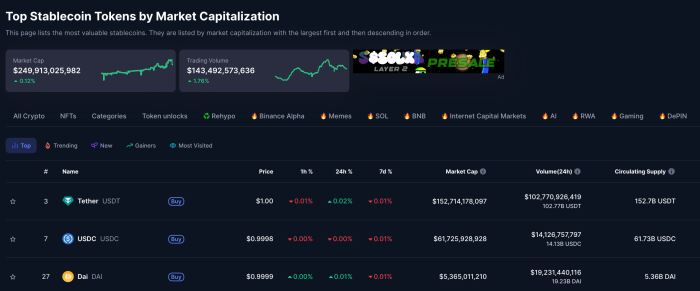
Top 3 stablecoins on CoinMarketCap.
Source: CoinMarketCap.

With these financial giants moving into the space, they may appeal to both retail and institutional investors seeking safer, less volatile options.

However, while stablecoins may offer short-term stability, the true innovation in blockchain lies within altcoins. These projects are pushing the boundaries of what decentralized finance can achieve, from tokenizing real-world assets to enabling decentralized exchanges.

Investors are flocking to protocols that offer speed, transparency, and liquidity, which are solving long-standing issues in traditional finance.

As financial institutions look to enter the crypto space, altcoins are already leading the charge, proving that the future of digital finance is decentralized.

1. Best Wallet Token ($BEST) – Unlocking Future Growth with Innovation and Security

Best Wallet Token ($BEST) is revolutionizing digital wallet management with a user-friendly platform that supports multiple cryptocurrencies, cross-chain transfers, and top-tier security powered by Fireblocks MPC-CMP technology.

Unlike traditional wallets, Best Wallet is designed for both newcomers and experienced investors, making crypto management easy and secure.

Priced at $0.025075, $BEST raised over $12.6M during its presale, signaling strong investor confidence.
As major financial institutions like JPMorgan, Bank of America, and Wells Fargo explore stablecoin initiatives, the decentralized wallet and token space is gaining traction.

how to buy $BEST presale.

With a forecasted price of $0.62 by 2026, $BEST could see a significant 2,372% increase from its current value.

If you staked $1,000 worth of $BEST today, at a 15% annual percentage yield (APY), you could accumulate additional tokens throughout the year.

By 2026, with $BEST priced at $0.62, your total investment could be worth $3,174 – a potential profit of $2,174.

Token buyers also enjoy reduced transaction fees, early access to new projects, and benefits in Best Wallet’s iGaming partnerships.

As Best Wallet continues to disrupt the market with innovative features, $BEST offers significant long-term growth potential — making it one of the most promising altcoins to watch in 2025.

2. SUBBD Token ($SUBBD) – Tokenizing Real-World Assets for Blockchain Innovation

SUBBD Token ($SUBBD) is transforming the creator economy by tokenizing real-world assets such as real estate and commodities, allowing people to buy, sell, and trade them as digital assets.

This approach makes traditionally illiquid markets more accessible and efficient, bridging the gap between blockchain and traditional finance.

Beyond tokenization, $SUBBD leverages AI to empower creators, offering tools to automate chat, editing, and monetization, helping them scale content with ease.

People can also generate AI-driven photos and videos, which are approved by creators, creating new revenue streams. With over 250M combined followers across its ecosystem, $SUBBD is poised to onboard a large user base to its platform.

The project raised nearly $500K during its presale, and you can buy $SUBBD right now for $0.055475.

As financial institutions explore stablecoin initiatives, the decentralized content and asset tokenization space is gaining significant momentum.

SUBBD token benefits

With staking rewards offering 20% APY during the presale, $SUBBD provides an attractive opportunity for early investors.

As the platform grows and blockchain adoption accelerates, $SUBBD is set to become a key player in both the crypto and creator economies.

3. NEAR Protocol ($NEAR) – A Blockchain Built for the Future

NEAR Protocol ($NEAR) is a blockchain platform designed to make decentralized apps (dApps) easier to build and use. Think of it like a super-fast highway for blockchain, where developers can quickly deploy apps without getting stuck in traffic.

One of $NEAR’s coolest features is its sharding technology, called Nightshade. It splits the blockchain into smaller parts (called shards), allowing the network to process a lot more transactions at once.

This makes NEAR Protocol faster and cheaper to use than many other blockchains, which tend to slow down when too many people use them.

But $NEAR isn’t just about speed. It also makes it easy for newcomers.

Instead of dealing with complicated crypto addresses, users get simple, human-readable account names. And developers can easily connect to other blockchains, like Ethereum, thanks to tools like the Aurora EVM.

Currently priced at $2.81, $NEAR has been gaining momentum with over 1K projects already running on its network. It’s quickly becoming one of the most reliable platforms in decentralized space.
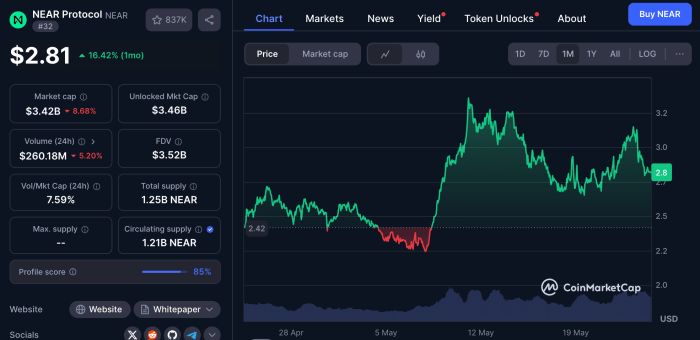
$NEAR pumping over the last month on CoinMarketCap.
Source: CoinMarketCap.

As traditional financial institutions like JPMorgan and Bank of America explore blockchain technology, $NEAR’s scalability and developer-friendly approach make it a key player in the future of decentralized finance.

The Next Generation of Altcoins

As traditional financial institutions start exploring the crypto space, innovative altcoins like Best Wallet Token, SUBBD Token, and NEAR Protocol are leading the charge in decentralized finance.

These projects are pushing the boundaries with secure wallets, tokenizing real-world assets, and bridging crypto with traditional markets. Keep an eye on them for future growth.

Before investing in crypto, always do your own research (DYOR). This article is for informational purposes only and shouldn’t be considered as financial advice.

Editorial Process for bitcoinist is centered on delivering thoroughly researched, accurate, and unbiased content. We uphold strict sourcing standards, and each page undergoes diligent review by our team of top technology experts and seasoned editors. This process ensures the integrity, relevance, and value of our content for our readers.

Letture associate

Crypto 美股观察:CRCL、HOOD、COIN 与 MSTR,最近在交易什么?

Recent weeks have seen significant developments for four key US-listed crypto-related stocks—Circle (CRCL), Robinhood (HOOD), Coinbase (COIN), and MicroStrategy (MSTR)—with their core investment theses diverging. For **Circle (CRCL)**, its stock price is increasingly realigning with the fundamental driver of **USDC circulation**. After IPO exuberance faded, CRCL's performance now correlates closely with changes in USDC supply, which is heavily influenced by DeFi activity and risk appetite. The recent contraction in USDC, linked to events like the KelpDAO incident, has pressured the stock. A sustainable recovery signal for CRCL would require a confluence of recovering DeFi TVL, stablecoin demand, and consecutive weeks of USDC net issuance. **Robinhood (HOOD)** gained market attention with the launch of its **Robinhood Chain**, an Ethereum L2. While not an immediate threat to Coinbase's dominant Base network in terms of scale or developer ecosystem, it represents a strategic encroachment. Robinhood's path—leveraging its traditional retail brokerage user base and assets to build a chain-based financial system—challenges Coinbase's narrative as the sole listed company integrating crypto-native infrastructure with traditional finance. This could dilute COIN's long-term scarcity premium. **MicroStrategy (MSTR)** made a notable shift by **selling Bitcoin** for the first time in a meaningful way (3,588 BTC), breaking its long-standing "buy-only" posture. The sales, used to fund dividends and replenish USD reserves, signal a move towards active capital management. While not indicative of a bearish turn on Bitcoin, it introduces new complexity for MSTR investors. The stock must now be evaluated not just as a leveraged Bitcoin proxy, but also considering fixed cash obligations from preferred dividends and debt, alongside its capital allocation strategy between holding BTC and maintaining liquidity. In summary, the investment narratives for these stocks are evolving beyond simple crypto market beta. Key variables now include stablecoin fundamentals, competition in chain-based financial ecosystems, and the balance between asset accumulation and corporate capital structure management.

marsbit2 min fa

Crypto 美股观察:CRCL、HOOD、COIN 与 MSTR,最近在交易什么?

marsbit2 min fa

Behind Robinhood's Launch of Its Own Chain, the Beautifully Packaged "Tokenized Stocks" Still Have No Equity Rights

Robinhood has launched "Robinhood Chain," an Ethereum-based Layer 2 built with Arbitrum technology, and introduced "Stock Tokens." This article clarifies that these tokens are not actual on-chain equity. They are tokenized debt securities issued by Robinhood Assets Jersey Limited, offering economic exposure to reference stocks or ETFs but lacking direct ownership, voting rights, or other shareholder privileges. The legal structure is conservative, relying on traditional financial intermediaries, custody, KYC/AML controls, and specific jurisdiction rules, even though the tokens are transferable on-chain. The move is part of Robinhood's broader strategy to evolve from a retail brokerage into a global financial ecosystem, integrating services like banking, retirement, crypto, and DeFi. Robinhood Chain aims to provide a programmable settlement layer, making financial products more portable and accessible while masking underlying complexity. However, the "brokerage chain paradox" lies in balancing a simple user interface with the intricate, regulated reality of the wrapped assets. The success of this model depends on users and regulators accepting this structured approach without misunderstanding the tokens as direct stock ownership. Key components supporting this strategy include the Bitstamp acquisition (expanding institutional crypto capabilities), the Robinhood Wallet (bridging brokerage and self-custody), the Robinhood Earn program (integrating DeFi lending), and the Lighter perpetual contracts platform. While ambitious, the initiative is still early, facing challenges in achieving liquidity, developer adoption, and regulatory clarity across jurisdictions.

marsbit1 h fa

Behind Robinhood's Launch of Its Own Chain, the Beautifully Packaged "Tokenized Stocks" Still Have No Equity Rights

marsbit1 h fa

Strategy's Accounting Gimmick: The Cap on BTC Sales Far Exceeds $1.25 Billion

The article, originally from Bankless, discusses how MicroStrategy's (MSTR) recent Bitcoin (BTC) sales reveal a much larger potential selling capacity than the widely reported $1.25 billion "reserve-building" cap. On July 7, MicroStrategy disclosed a sale of 3,588 BTC (~$216M) to pay dividends for its STRAT (STRC) preferred shares and replenish its USD Reserve. Crucially, the company stated this sale did not count against its stated $1.25 billion "reserve-building capacity." The analysis explains that MicroStrategy's "BTC Monetization Plan," part of its broader "Digital Credit Capital Framework," actually outlines three main purposes for selling BTC, only one of which has the $1.25B cap: 1. **Building the USD Reserve** (capped at $1.25B). 2. **Covering preferred share/ debt costs** (replenishing the reserve after payments). 3. **Funding buybacks** (up to $10B for preferred shares and $10B for MSTR common stock). The key nuance is the accounting distinction between "building" the reserve (selling BTC before making payments) and "replenishing" it (selling BTC after using reserve funds for payments). While functionally the same—converting BTC to cash for obligations—only "building" counts against the publicized $1.25B limit. This means sales for "replenishing" and the $20B+ buyback pool allow for total potential sales exceeding $30B. The article frames this as part of MicroStrategy's shift from a simple "buy and hold" Bitcoin narrative to an "active capital management" model, where BTC becomes a balance-sheet tool to manage pressures between its common stock, preferred shares, dollar reserve, and Bitcoin holdings. This creates complex trade-offs and potential conflicts of interest. The conclusion warns investors that the $1.25B figure is not a total sales ceiling. Understanding terms like "build," "replenish," and "repurchase" in MicroStrategy's disclosures is now critical, as the company navigates a new, more complex role as an actively managed entity rather than a passive Bitcoin accumulator.

Odaily星球日报1 h fa

Strategy's Accounting Gimmick: The Cap on BTC Sales Far Exceeds $1.25 Billion

Odaily星球日报1 h fa

Trading

Spot
活动图片