Bitcoin Spread Oscillator Signals Growing Altcoin Momentum – Altseason Entry Signal?

bitcoinistPubblicato 2025-05-14Pubblicato ultima volta 2026-05-14

Introduzione

Bitcoin is trading at critical levels as the entire crypto market enters a high-volatility phase fueled by renewed optimism and...

Trusted Editorial content, reviewed by leading industry experts and seasoned editors. Ad Disclosure

Bitcoin is trading at critical levels as the entire crypto market enters a high-volatility phase fueled by renewed optimism and strong momentum. After weeks of bullish price action, BTC has consolidated above $103K, setting the stage for a definitive move. Market participants are closely watching whether Bitcoin will break above all-time highs or face another rejection—either scenario could trigger significant ripple effects across the altcoin space.

Analysts are increasingly pointing to signs of an incoming altseason, where capital rotates from Bitcoin into alternative cryptocurrencies. According to recent insights from CryptoQuant, the Bitcoin Market Performance & Altcoin Spread value is now at 38%. This proprietary metric gauges relative performance and momentum across major assets like ETH and SOL compared to BTC. A reading above 50% is historically viewed as confirmation that an altseason has begun. With just 12 percentage points remaining, sentiment is heating up across the market.

This key transition phase could define the market’s direction over the coming weeks. If Bitcoin holds its gains and altcoins continue to outperform, it would mark a powerful shift in capital allocation—one that could set the tone for the rest of the cycle. For now, all eyes are on the 50% mark.

Altcoin Oscillator Signals Building Momentum As Bitcoin Approaches ATH

Bitcoin has gained over 12% in the past week and more than 40% since its April 9th low, confirming a sustained five-week uptrend that reflects growing investor confidence. This rally marks a key shift in market sentiment after months of volatility and uncertainty. With BTC now trading just below its all-time high near $109K, bulls are in control—but the real test lies ahead.

The coming weeks are expected to be decisive. Some analysts anticipate a clean breakout above the previous high, which would confirm a continuation of the broader bull cycle. Others argue that current levels may trigger profit-taking and a potential short-term correction. Either way, momentum remains strong, and Bitcoin’s ability to hold above $100K will be crucial.

At the same time, market dynamics are shifting. Top analyst Axel Adler points to the Bitcoin Market Performance & Altcoin Spread indicator—a composite oscillator that tracks how altcoins like Ethereum and Solana perform relative to BTC. According to Adler, this metric recently hit 38%. Historically, once the 30-day moving average of the oscillator crosses 50%, it signals the beginning of an altseason.
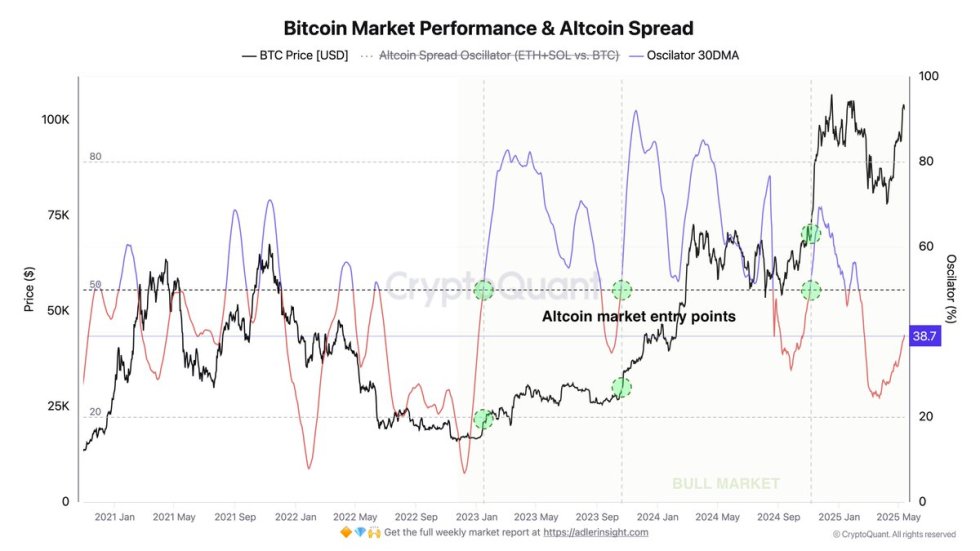
Bitcoin Market Performance & Altcoin Spread | Source: Axel Adler on X

With just 12 percentage points remaining before the signal confirms, capital rotation from Bitcoin to altcoins could be imminent. Green dots on the oscillator indicate these historical inflection points. If this trend continues and altcoins begin to outperform, it would confirm a broader risk-on environment across crypto.

BTC Weekly Chart Analysis: Resistance Holds for Now

The weekly chart for Bitcoin shows that the price is currently consolidating just below the all-time high zone after failing to break cleanly above it. BTC reached a high of $105,706 before pulling back and closing the weekly candle around $103,850. This level marks a critical resistance area, historically significant from January’s peak, and now acting as a short-term ceiling for bullish continuation.
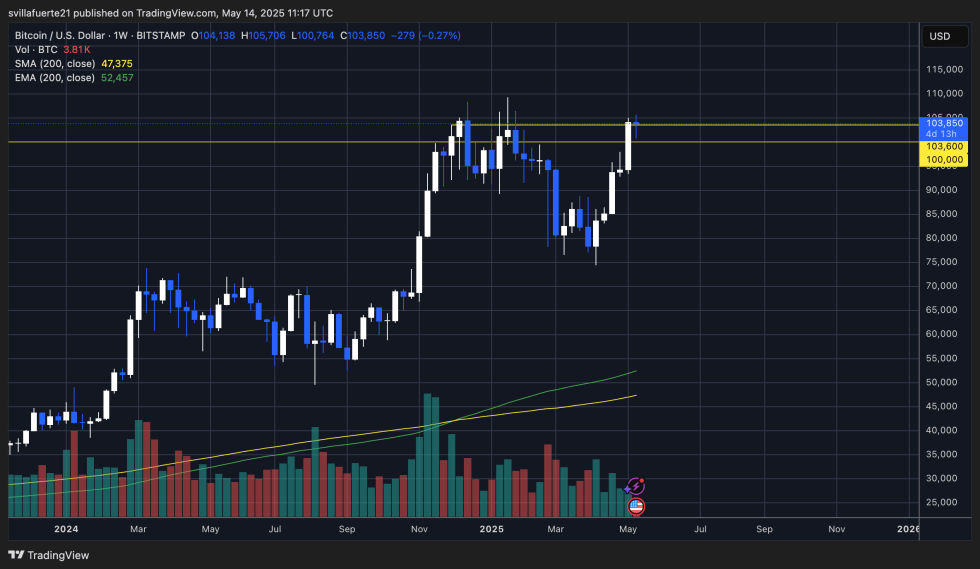
BTC consolidates below ATH | Source: BTCUSDT chart on TradingView

Despite the rejection from highs, the structure remains bullish. BTC is holding well above the psychological $100,000 level and key moving averages. The 200-week SMA sits far below at $47,375, and the 200-week EMA at $52,457, both indicating a strong long-term uptrend is intact.

Volume over recent weeks confirms rising participation, supporting the idea of growing interest as Bitcoin approaches price discovery once again. The key now is whether bulls can reclaim the $105K level on a weekly closing basis, which would open the door for a breakout toward $109K and beyond.

If the price fails to hold above $100K in the coming sessions, a deeper retrace could test lower support zones around $96K–$94K. Still, the momentum is bullish, and the weekly close above $103K keeps the rally alive.

Featured image from Dall-E, chart from TradingView

Editorial Process for bitcoinist is centered on delivering thoroughly researched, accurate, and unbiased content. We uphold strict sourcing standards, and each page undergoes diligent review by our team of top technology experts and seasoned editors. This process ensures the integrity, relevance, and value of our content for our readers.

Sebastian's journey into the world of crypto began four years ago, driven by a fascination with the potential of blockchain technology to revolutionize financial systems. His initial exploration focused on understanding the intricacies of various crypto projects, particularly those focused on building innovative financial solutions. Through countless hours of research and learning, Sebastian developed a deep understanding of the underlying technologies, market dynamics, and potential applications of cryptocurrencies. As his knowledge grew, Sebastian felt compelled to share his insights with others. He began actively contributing to online discussions on platforms like X and LinkedIn, focusing on fintech and crypto-related content. His goal was to expose valuable trends and insights to a wider audience, fostering a deeper understanding of the rapidly evolving crypto landscape. Sebastian's contributions quickly gained recognition, and he became a trusted voice in the online crypto community. To further enhance his expertise, Sebastian pursued a UC Berkeley Fintech: Frameworks, Applications, and Strategies certification. This rigorous program equipped him with valuable skills and knowledge regarding Financial Technology, bridging the gap between traditional finance (TradFi) and decentralized finance (DeFi). The certification deepened his understanding of the broader financial landscape and its intersection with blockchain technology. Sebastian's passion for finance and writing is evident in his work. He enjoys delving into financial research, analyzing market trends, and exploring the latest developments in the crypto space. In his spare time, Sebastian can often be found immersed in charts, studying 10-K forms, or engaging in thought-provoking discussions about the future of finance. Sebastian's journey as a crypto analyst and investor has been marked by a relentless pursuit of knowledge and a dedication to sharing his insights. His ability to navigate the complex world of crypto, combined with his passion for financial research and communication, makes him a valuable asset to the industry. As the crypto landscape continues to evolve, Sebastian remains at the forefront, providing valuable insights and contributing to the growth of this revolutionary technology.

Letture associate

Why the Establishment of SocialFi Originates from a Misunderstanding of Its Own Medium

"Why SocialFi's Establishment Stems from a Misunderstanding of Its Own Medium" This article critiques the failure of SocialFi projects by applying Marshall McLuhan's theory of "hot" and "cool" media. McLuhan posited that a medium's form—not its content—reshapes user behavior. "Hot" media (e.g., print, radio) deliver high-definition, complete information, promoting passive consumption. "Cool" media (e.g., cartoons, telephone calls) provide low-definition, fragmented signals, requiring active user participation to complete the meaning. Traditional social media platforms (like early Twitter) are quintessentially "cool." A tweet or like is an incomplete fragment; its significance emerges only through replies, shares, and community engagement—it's a participation engine disguised as a content system. SocialFi (e.g., Friend.tech) aimed to monetize social capital by attaching real-time, tradable prices to follows and posts. However, this didn't add an economic layer to a cool medium; it fundamentally transformed the medium itself. The explicit, high-resolution signal of price replaced the ambiguous, low-resolution signal of social interaction. The platform became a financial market dressed as a social network. Once the financial dynamics (speculative profits) faded, the underlying social fabric, which had been suffocated from the start, could not sustain it. The medium overheated and collapsed. This "heat death" pattern isn't unique to crypto. Over time, mainstream platforms often drift from cool to hot by adding features like public metrics, verification badges, and algorithmic feeds that optimize for clarity over participation, leading to user disengagement. The article proposes a viable alternative: the "condensation point." Here, capital is introduced locally and infrequently into a cool medium without saturating it. Examples include Substack (subscriptions), Patreon (memberships), and Bandcamp (music purchases). The core social medium remains cool and participatory, while capital condenses at specific, structurally separate points (e.g., a monthly fee). The key lesson: "Liquidity is heat." Adding it to a cool medium doesn't enhance it but alters its fundamental nature. The NFT boom and bust provides a starker example. Collecting is a classic cool medium, where value is built slowly through stories and community. By making floor prices, rarity scores, and real-time charts omnipresent, NFT platforms rapidly overheated the medium, turning collectors into traders and destroying the participatory culture that gave collections meaning in the first place. The conclusion is that for the next wave to succeed, designers must ask not how to price every social action, but how to let capital condense within a social system without disrupting the cool, participatory mechanics that create its enduring value.

marsbit2 min fa

Why the Establishment of SocialFi Originates from a Misunderstanding of Its Own Medium

marsbit2 min fa

After Storage, Are Copper and Fiber Optic Cables Facing an AI "Great Famine"?

Following the storage sector, copper and fiber optics are emerging as potentially the next major markets to experience explosive growth due to AI. Demand for copper, described by Goldman Sachs as "the oil of the AI era," is surging. Prices are near record highs, with LME copper up 41% over the past 12 months. This is driven by AI's immense and unique requirements: copper is the essential material for the massive electrical distribution (e.g., a 1GW AI data center requires ~27,000 tons) and advanced liquid cooling systems needed for high-power AI clusters like NVIDIA's GB200. Meanwhile, new large-scale copper mine discoveries have been scarce for a decade, tightening supply. Concurrently, a "fiber famine" is unfolding. AI's need for ultra-high-speed, long-distance interconnects between thousands of GPUs is pushing data transmission beyond the physical limits of copper cables. Demand for fiber optics is experiencing a step-change, with a single AI data center requiring up to 36 times more fiber than a traditional CPU rack. This has caused prices for standard G.652D fiber in China to nearly double in just three months. Supply is critically constrained due to the long (18-24 month) lead times required to expand production of the core preform material. In summary, AI's infrastructure demands are cascading down from semiconductors to foundational materials. Copper faces a structural supply-demand imbalance, while fiber optics is entering a period of severe shortage, positioning both as critical and potentially strained components of the AI build-out.

marsbit15 min fa

After Storage, Are Copper and Fiber Optic Cables Facing an AI "Great Famine"?

marsbit15 min fa

The Construction of SocialFi Originates from a Misreading of Its Own Medium

This article argues that the fundamental failure of SocialFi projects like Friend.tech stems from a misunderstanding of social media's core nature. It applies Marshall McLuhan's theory of "hot" and "cool" media. "Cool" media (like traditional social networks) rely on low-resolution, incomplete signals (e.g., a tweet) that require user participation to create meaning. "Hot" media (like radio or print) deliver complete, high-resolution information that encourages passive consumption. SocialFi attempted to layer finance onto social media by making actions like follows and posts directly tradable with visible, real-time prices. However, this financial signal is a definitive "hot" signal. By superimposing it onto the inherently "cool" medium of social interaction, it fundamentally transformed the medium. Users stopped participating socially and instead began allocating capital rationally based on prices. The financial layer consumed the social one, leaving no genuine social substrate when speculation faded. The article extends this analysis to broader platform decay (e.g., Twitter's shift from cool participation to hot performance metrics) and NFTs. NFT platforms, by optimizing collections with real-time floor prices and rarity scores, rapidly "heated up" the traditionally "cool," participation-rich medium of collecting, destroying its cultural essence and leaving only speculative trading. The solution proposed is not to abandon capital in social contexts, but to design for "condensation points"—localized, infrequent financial interfaces (like Substack subscriptions or Patreon memberships) that allow capital to gather without saturating and overheating the core cool medium. The key lesson is that "liquidity is heat"; adding it to a cool medium doesn't enhance it but alters it, often destroying what made it valuable. Successful platforms will be those that introduce capital while meticulously preserving the cool, participatory nature of their underlying medium.

链捕手18 min fa

The Construction of SocialFi Originates from a Misreading of Its Own Medium

链捕手18 min fa

Bitwise: Why Are Top-Tier Capitals Frenziedly Betting on New Public Blockchains? The Answer Lies in These Three Points

Recently, a wave of major funding announcements for new public blockchains like Arc, Canton, and Tempo signals a significant industry shift. This article analyzes the driving forces behind this surge. Firstly, regulatory clarity is a key catalyst. These massive investments, including Circle's Arc ($222M), Digital Asset's Canton ($300M), and Stripe's Tempo ($500M), all followed the US passage of the *Genius Act* in July 2025. This suggests that clear legislation is unlocking institutional capital. The anticipated, broader *Clarity Act* could further accelerate growth, particularly in tokenization and compliant infrastructure. Secondly, built-in privacy is emerging as a critical design feature. Unlike Ethereum or Solana, these new chains natively support confidential transactions. This directly addresses real-world business needs, where public transparency can be a liability for corporate dealings or personal salary data, making privacy a potential killer application. Finally, the entry of traditional giants marks a new competitive phase. These projects are backed by major firms: Arc by Circle, Canton by a consortium including Goldman Sachs and Nasdaq, and Tempo by Stripe with partners like Visa. While crypto-native projects remain strong contenders, this institutional involvement brings substantial capital, execution capability, and operational rigor. In conclusion, the convergence of regulatory progress, demand for privacy, and competition from established financial and tech players is rapidly reshaping the blockchain landscape, pushing innovation and expanding the industry's boundaries.

marsbit21 min fa

Bitwise: Why Are Top-Tier Capitals Frenziedly Betting on New Public Blockchains? The Answer Lies in These Three Points

marsbit21 min fa

Trading

Spot
Futures

Articoli Popolari

Cosa è BITCOIN

Comprendere HarryPotterObamaSonic10Inu (ERC-20) e la sua posizione nel mondo delle criptovalute Negli ultimi anni, il mercato delle criptovalute ha assistito a un aumento della popolarità delle meme coin, catturando l'interesse non solo dei trader, ma anche di coloro che cercano coinvolgimento comunitario e valore di intrattenimento. Tra questi token unici c'è HarryPotterObamaSonic10Inu (ERC-20), un progetto intrigante che mescola riferimenti culturali nel tessuto delle criptovalute. Questo articolo esplora gli aspetti chiave di HarryPotterObamaSonic10Inu, analizzando i suoi meccanismi, l'etica guidata dalla comunità e il suo coinvolgimento con il panorama crittografico più ampio. Che cos'è HarryPotterObamaSonic10Inu (ERC-20)? Come suggerisce il suo nome, HarryPotterObamaSonic10Inu è una meme coin costruita sulla blockchain di Ethereum, classificata secondo lo standard ERC-20. A differenza delle criptovalute tradizionali che possono enfatizzare l'utilità pratica o il potenziale investimento, questo token prospera grazie al valore di intrattenimento e alla forza della sua comunità. Il progetto mira a creare un ambiente in cui gli utenti coinvolti possono riunirsi, condividere idee e partecipare ad attività ispirate a diversi fenomeni culturali. Una caratteristica notevole di HarryPotterObamaSonic10Inu è la zero tassa sulle transazioni. Questo elemento allettante tende a incoraggiare il trading e il coinvolgimento della comunità, privo di costi aggiuntivi che possono scoraggiare i trader di piccole dimensioni. L'offerta totale della moneta è fissata a un miliardo di token, un numero che segna la sua intenzione di mantenere una circolazione sostanziale all'interno della comunità. Creatore di HarryPotterObamaSonic10Inu (ERC-20) Le origini di HarryPotterObamaSonic10Inu sono avvolte in un certo mistero; i dettagli sul creatore rimangono sconosciuti. Lo sviluppo di questo token non presenta un team identificabile o un piano esplicito, cosa non rara nel settore delle meme coin. Invece, il progetto è emerso organicamente, con il suo progresso fortemente dipendente dall'entusiasmo e dalla partecipazione della sua comunità. Investitori di HarryPotterObamaSonic10Inu (ERC-20) Per quanto riguarda investimenti esterni e finanziamenti, HarryPotterObamaSonic10Inu rimane ambiguo. Il token non elenca alcuna fondazione di investimento conosciuta o un sostegno organizzativo significativo. Invece, la linfa vitale del progetto è la sua comunità di base, che informa la sua crescita e sostenibilità attraverso azioni collettive e coinvolgimento nello spazio crittografico. Come funziona HarryPotterObamaSonic10Inu (ERC-20)? In quanto meme coin, HarryPotterObamaSonic10Inu opera principalmente al di fuori delle strutture tradizionali che governano spesso il valore degli asset. Ci sono diversi aspetti distintivi che definiscono il funzionamento del progetto: Transazioni senza tasse: Senza costi fiscali sulle transazioni, gli utenti possono comprare e vendere liberamente il token senza preoccuparsi di costi nascosti. Coinvolgimento della comunità: Il progetto prospera sull'interazione della comunità, sfruttando le piattaforme social per creare entusiasmo e facilitare il coinvolgimento. Discussioni, condivisione di contenuti e coinvolgimento sono elementi cruciali che aiutano ad espandere la sua portata e a favorire la lealtà tra i sostenitori. Nessuna utilità pratica: Va notato che HarryPotterObamaSonic10Inu non offre un'utilità concreta all'interno dell'ecosistema finanziario. Piuttosto, è classificato come un token principalmente per attività di intrattenimento e comunitarie. Riferimento culturale: Il token incorpora astutamente elementi della cultura pop per attirare interesse, collegandosi a appassionati di meme e seguaci delle criptovalute. HarryPotterObamaSonic10Inu esemplifica come le meme coin operino in modo diverso rispetto ai progetti di criptovalute più tradizionali, entrando nel mercato come costrutti sociali innovativi piuttosto che come asset utilitari. Cronologia di HarryPotterObamaSonic10Inu (ERC-20) La storia di HarryPotterObamaSonic10Inu è segnata da diversi traguardi notevoli: Creazione: Il token è emerso da un meme virale, catturando l'immaginazione di molti appassionati di criptovalute. Le date di creazione specifiche non sono disponibili, sottolineando la sua crescita organica. Inserimento negli scambi: HarryPotterObamaSonic10Inu ha fatto il suo ingresso in vari scambi, consentendo un accesso e un trading più facili da parte della comunità. Iniziative di coinvolgimento della comunità: Attività in corso volte a migliorare l'interazione della comunità, comprese gare, campagne sui social media e generazione di contenuti da parte di fan e sostenitori. Piani di espansione futura: La tabella di marcia del progetto include il lancio di una collezione NFT, merchandising e un sito di eCommerce relativo ai suoi temi culturali, coinvolgendo ulteriormente la comunità e cercando di aggiungere più dimensioni al suo ecosistema. Punti chiave su HarryPotterObamaSonic10Inu (ERC-20) Natura guidata dalla comunità: Il progetto dà priorità al contributo collettivo e alla creatività, garantendo che il coinvolgimento degli utenti sia al centro del suo sviluppo. Classificazione come meme coin: Rappresenta l'epitome delle criptovalute basate sull'intrattenimento, distinguendosi dai veicoli d'investimento tradizionali. Nessuna affiliazione diretta con Bitcoin: Nonostante la somiglianza nel nome del ticker, HarryPotterObamaSonic10Inu è distintivo e non ha alcuna relazione con Bitcoin o altre criptovalute consolidate. Focus sulla collaborazione: HarryPotterObamaSonic10Inu è progettato per creare uno spazio per la collaborazione e la condivisione di storie tra i suoi detentori, fornendo un canale per la creatività e il legame comunitario. Prospettive future: L'ambizione di espandersi oltre il suo presupposto iniziale verso NFT e merchandising delinea un percorso per il progetto per potenzialmente entrare in strade più mainstream all'interno della cultura digitale. Poiché le meme coin continuano a catturare l'immaginazione della comunità crittografica, HarryPotterObamaSonic10Inu (ERC-20) si distingue per i suoi legami culturali e il suo approccio centrato sulla comunità. Anche se potrebbe non adattarsi al modello tipico di un token orientato all'utilità, la sua essenza risiede nella gioia e nella camaraderia coltivate tra i suoi sostenitori, evidenziando la natura in evoluzione delle criptovalute in un'epoca sempre più digitale. Con la continuazione dello sviluppo del progetto, sarà importante osservare come le dinamiche della comunità influenzano la sua traiettoria nel panorama in continuo cambiamento della tecnologia blockchain.

1.5k Totale visualizzazioniPubblicato il 2024.04.01Aggiornato il 2024.12.03

Cosa è BITCOIN

Come comprare BTC

Benvenuto in HTX.com! Abbiamo reso l'acquisto di Bitcoin (BTC) semplice e conveniente. Segui la nostra guida passo passo per intraprendere il tuo viaggio nel mondo delle criptovalute.Step 1: Crea il tuo Account HTXUsa la tua email o numero di telefono per registrarti il tuo account gratuito su HTX. Vivi un'esperienza facile e sblocca tutte le funzionalità,Crea il mio accountStep 2: Vai in Acquista crypto e seleziona il tuo metodo di pagamentoCarta di credito/debito: utilizza la tua Visa o Mastercard per acquistare immediatamente BitcoinBTC.Bilancio: Usa i fondi dal bilancio del tuo account HTX per fare trading senza problemi.Terze parti: abbiamo aggiunto metodi di pagamento molto utilizzati come Google Pay e Apple Pay per maggiore comodità.P2P: Fai trading direttamente con altri utenti HTX.Over-the-Counter (OTC): Offriamo servizi su misura e tassi di cambio competitivi per i trader.Step 3: Conserva Bitcoin (BTC)Dopo aver acquistato Bitcoin (BTC), conserva nel tuo account HTX. In alternativa, puoi inviare tramite trasferimento blockchain o scambiare per altre criptovalute.Step 4: Scambia Bitcoin (BTC)Scambia facilmente Bitcoin (BTC) nel mercato spot di HTX. Accedi al tuo account, seleziona la tua coppia di trading, esegui le tue operazioni e monitora in tempo reale. Offriamo un'esperienza user-friendly sia per chi ha appena iniziato che per i trader più esperti.

3.8k Totale visualizzazioniPubblicato il 2024.12.12Aggiornato il 2025.03.21

Come comprare BTC

Cosa è $BITCOIN

ORO DIGITALE ($BITCOIN): Un'Analisi Completa Introduzione all'ORO DIGITALE ($BITCOIN) L'ORO DIGITALE ($BITCOIN) è un progetto basato su blockchain che opera sulla rete Solana, con l'obiettivo di combinare le caratteristiche dei metalli preziosi tradizionali con l'innovazione delle tecnologie decentralizzate. Sebbene condivida un nome con Bitcoin, spesso definito “oro digitale” a causa della sua percezione come riserva di valore, l'ORO DIGITALE è un token separato progettato per creare un ecosistema unico all'interno del panorama Web3. Il suo obiettivo è posizionarsi come un asset digitale alternativo valido, anche se i dettagli riguardanti le sue applicazioni e funzionalità sono ancora in fase di sviluppo. Cos'è l'ORO DIGITALE ($BITCOIN)? L'ORO DIGITALE ($BITCOIN) è un token di criptovaluta esplicitamente progettato per l'uso sulla blockchain di Solana. A differenza di Bitcoin, che fornisce un ruolo di stoccaggio di valore ampiamente riconosciuto, questo token sembra concentrarsi su applicazioni e caratteristiche più ampie. Aspetti notevoli includono: Infrastruttura Blockchain: Il token è costruito sulla blockchain di Solana, nota per la sua capacità di gestire transazioni ad alta velocità e a basso costo. Dinamiche di Offerta: L'ORO DIGITALE ha un'offerta massima fissata a 100 quadrilioni di token (100P $BITCOIN), sebbene i dettagli riguardanti la sua offerta circolante siano attualmente non divulgati. Utilità: Sebbene le funzionalità precise non siano esplicitamente delineate, ci sono indicazioni che il token potrebbe essere utilizzato per varie applicazioni, potenzialmente coinvolgendo applicazioni decentralizzate (dApp) o strategie di tokenizzazione degli asset. Chi è il Creatore dell'ORO DIGITALE ($BITCOIN)? Attualmente, l'identità dei creatori e del team di sviluppo dietro l'ORO DIGITALE ($BITCOIN) rimane sconosciuta. Questa situazione è tipica tra molti progetti innovativi nel settore blockchain, in particolare quelli allineati con la finanza decentralizzata e i fenomeni delle meme coin. Sebbene tale anonimato possa favorire una cultura guidata dalla comunità, intensifica le preoccupazioni riguardo alla governance e alla responsabilità. Chi sono gli Investitori dell'ORO DIGITALE ($BITCOIN)? Le informazioni disponibili indicano che l'ORO DIGITALE ($BITCOIN) non ha alcun sostenitore istituzionale noto o investimenti di venture capital prominenti. Il progetto sembra operare su un modello peer-to-peer incentrato sul supporto e sull'adozione della comunità piuttosto che su percorsi di finanziamento tradizionali. La sua attività e liquidità si trovano principalmente su exchange decentralizzati (DEX), come PumpSwap, piuttosto che su piattaforme di trading centralizzate consolidate, evidenziando ulteriormente il suo approccio di base. Come Funziona l'ORO DIGITALE ($BITCOIN) Le meccaniche operative dell'ORO DIGITALE ($BITCOIN) possono essere elaborate in base al suo design blockchain e alle caratteristiche della rete: Meccanismo di Consenso: Sfruttando il proof-of-history (PoH) unico di Solana combinato con un modello di proof-of-stake (PoS), il progetto garantisce una validazione efficiente delle transazioni contribuendo all'alta performance della rete. Tokenomics: Sebbene meccanismi deflazionistici specifici non siano stati dettagliati ampiamente, l'ampia offerta massima di token implica che potrebbe soddisfare microtransazioni o casi d'uso di nicchia che devono ancora essere definiti. Interoperabilità: Esiste il potenziale per l'integrazione con l'ecosistema più ampio di Solana, inclusi vari piattaforme di finanza decentralizzata (DeFi). Tuttavia, i dettagli riguardanti integrazioni specifiche rimangono non specificati. Cronologia degli Eventi Chiave Ecco una cronologia che evidenzia traguardi significativi riguardanti l'ORO DIGITALE ($BITCOIN): 2023: Il dispiegamento iniziale del token avviene sulla blockchain di Solana, contrassegnato dal suo indirizzo di contratto. 2024: L'ORO DIGITALE guadagna visibilità poiché diventa disponibile per il trading su exchange decentralizzati come PumpSwap, consentendo agli utenti di scambiarlo contro SOL. 2025: Il progetto assiste a un'attività di trading sporadica e a un potenziale interesse per impegni guidati dalla comunità, sebbene non siano state documentate partnership significative o avanzamenti tecnici fino ad ora. Analisi Critica Punti di Forza Scalabilità: L'infrastruttura sottostante di Solana supporta alti volumi di transazioni, il che potrebbe migliorare l'utilità di $BITCOIN in vari scenari di transazione. Accessibilità: Il potenziale basso prezzo di trading per token potrebbe attrarre investitori al dettaglio, facilitando una partecipazione più ampia grazie a opportunità di proprietà frazionata. Rischi Mancanza di Trasparenza: L'assenza di sostenitori, sviluppatori o di un processo di audit pubblicamente noti potrebbe generare scetticismo riguardo alla sostenibilità e all'affidabilità del progetto. Volatilità del Mercato: L'attività di trading è fortemente dipendente dal comportamento speculativo, il che può comportare una significativa volatilità dei prezzi e incertezze per gli investitori. Conclusione L'ORO DIGITALE ($BITCOIN) emerge come un progetto intrigante ma ambiguo all'interno dell'evolvente ecosistema di Solana. Sebbene tenti di sfruttare la narrativa dell'“oro digitale”, la sua partenza dal ruolo consolidato di Bitcoin come riserva di valore sottolinea la necessità di una chiara differenziazione della sua utilità e struttura di governance. L'accettazione e l'adozione future dipenderanno probabilmente dall'affrontare l'attuale opacità e dalla definizione più esplicita delle sue strategie operative ed economiche. Nota: Questo rapporto comprende informazioni sintetizzate disponibili a ottobre 2023, e potrebbero essersi verificati sviluppi oltre il periodo di ricerca.

99 Totale visualizzazioniPubblicato il 2025.05.13Aggiornato il 2025.05.13

Cosa è $BITCOIN

Discussioni

Benvenuto nella Community HTX. Qui puoi rimanere informato sugli ultimi sviluppi della piattaforma e accedere ad approfondimenti esperti sul mercato. Le opinioni degli utenti sul prezzo di BTC BTC sono presentate come di seguito.

活动图片