Solana’s Price Plunges. Will Solaxy’s Layer-2 Solution Revive the Ecosystem?

bitcoinistPubblicato 2025-04-14Pubblicato ultima volta 2025-04-14

Introduzione

Solana's price declined sharply to begin April, declining 60% from its all-time high of $294.33 in mid-January. The sudden drop...

Trusted Editorial content, reviewed by leading industry experts and seasoned editors. Ad Disclosure

Solana’s price declined sharply to begin April, declining 60% from its all-time high of $294.33 in mid-January.

The sudden drop has raised concerns about the scalability and resilience of Solana, a leading meme coin ecosystem, and its native token $SOL, one of the top altcoins – but created an opportunity for Solaxy.

Is the latest plunge just another part of $SOL’s particularly volatile nature? Or are there deeper concerns resting beneath the surface?

Time for a closer analysis of $SOL’s performance, and a look at how Solaxy could be just the Layer-2 solution that Solana needs to succeed.

Solana’s Recent Challenges

In mid-January, $SOL reached an all-time high of $295.

By April 7, it briefly traded below $100 before recovering. It currently sits at roughly $133.

What caused the downturn? $SOL has seen wide swings before – the recent all-time-high was just barely higher than the previous one, which came two years earlier.
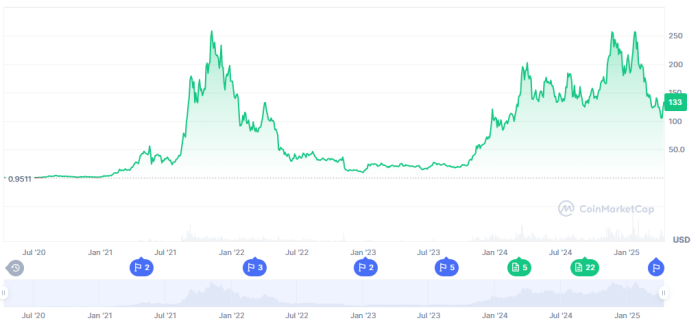
Solana all-time-price performance

On the broader market front, Donald Trump’s escalating trade war continues to send shockwaves through the market. Broader economic uncertainties have impacted investor confidence, leading to sell-offs.

One of the major drivers in Solana’s success as a network was new meme coins. $BONK, back in 2022, helped to kick-start $SOL’s price surge. But increased trading and speculation can lead to congestion of the Solana mainnet, causing transaction delays and failures.

In addition, Solana’s relationship with meme coins has cooled decidedly. Trading volume on the popular meme coin launchpad Pump.fun fell dramatically in Q1 2025, from $3B in January to $170M in early March; it was a paltry $38M in early April.

Top top it all, Ethereum founder Vitalik Buterin criticized Pump.fun for bringing projects with little to no value, hurting blockchain’s ‘social philosophy.’
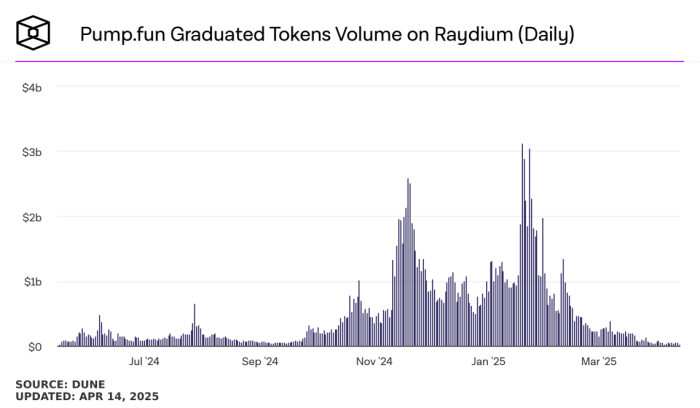
Pump.fun graduated tokens daily volume

To solve its meme coin blues – and perhaps reverse the price plunge – Solana needs some fresh innovation in the ecosystem.

Solaxy: Improved Scalability on Solana’s First-Ever Layer-2

Solaxy ($SOLX) is Solana’s first true Layer-2 (L2) scaling solution, designed to address the network’s congestion and scalability challenges and reinvigorate its meme coin ecosystem.

Solaxy handles transactions off the main chain, alleviating congestion and enhancing throughput with a rollup architecture much like Ethereum’s L2s.

Even better, Solaxy supports a cross-chain infrastructure connecting Solana and Ethereum, blending the latter’s reliability and scalability with Solana’s speed and lower transaction fees.
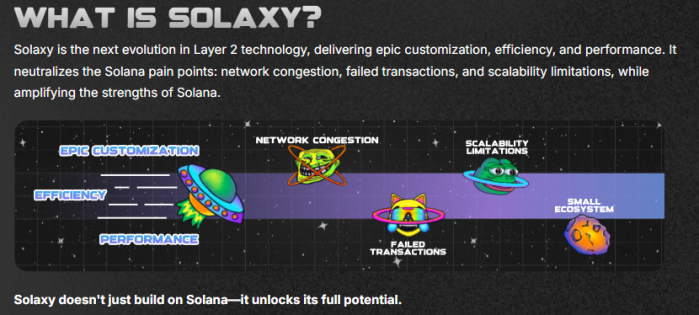
What is Solaxy

The utility token for Solaxy, $SOLX, is currently in the presale stage. You can learn how to buy $SOLX with our guide, but don’t delay – the presale continues to gain steam rapidly. It just passed the $30M mark, with tokens priced at $0.001694.

Solaxy’s ability to deploy a sophisticated Layer-2 solution comes at an ideal time. Our own analysis indicates that, on the back of a successful presale, $SOLX token price could reach $0.032 by the end of 2025.

Visit the Solaxy presale page to learn more.

Continued Interest in Solana Supports Solaxy’s Development

Solaxy deployment could have great timing. Despite the recent losses, at least one company – Renover – plans to build a Solana reserve. They’ve been buying the dip, with a recent purchase of over $11M bringing their total $SOL holdings to over 83K tokens.

The company’s CEO, Joseph Onorati, explained the rationale behind the move. He called Solana the ‘foundation of a high-performance financial system’ and a key strategic asset.

Renover aims to raise a total of $42M to fund a Solana reserve for the company. It’s proof of the positive reputation Solana has as both a cryptocurrency and a blockchain ecosystem.

It’s worth remembering that US President Donald Trump also included $SOL in the planned US Digital Assets Stockpile alongside other best altcoins like $XRP and $ETH.

Short-term losses shouldn’t hinder Solana’s continued ecosystem growth, and Solaxy could be in a perfect position to accelerate that expansion.

The Potential Impact of Solaxy on Solana’s Ecosystem

Solaxy’s development comes at a critical time for Solana. By addressing the network’s scalability issues, Solaxy could play a pivotal role in restoring confidence and attracting new projects to the Solana ecosystem, making it one of the best crypto to buy now.

All the information provided here is just that – information. Do your own research before making any investment decisions; this is not financial advice.

Solaxy could position Solana as a more robust platform, capable of supporting a resurgence of meme coins and high-demand applications, including DeFi and NFT projects.

Editorial Process for bitcoinist is centered on delivering thoroughly researched, accurate, and unbiased content. We uphold strict sourcing standards, and each page undergoes diligent review by our team of top technology experts and seasoned editors. This process ensures the integrity, relevance, and value of our content for our readers.

Bitcoinist is the ultimate news and review site for the crypto currency community!

Letture associate

Six Complaints from an Ethereum Developer

A disgruntled early Ethereum developer and token holder presents six core criticisms of the project's trajectory, contrasting it with Solana's rise. 1. **Premature Complacency**: The Ethereum Foundation shifted from a "building" to an "infrastructure" mindset too soon, adopting a passive, "retired chairman" posture before securing market dominance, reflected in ETH's ~65% decline against BTC post-Merge. 2. **Misguided Messaging**: The Merge was marketed primarily on ESG (99.95% energy reduction) rather than user benefits like speed or yield, appealing to internal ideals instead of market demands. 3. **Delayed Execution**: Proof-of-Stake, on the roadmap since 2015, took seven years to launch, ceding critical narrative and development windows. Competitors like Solana built entire ecosystems in that time. 4. **Poor Native Staking UX**: Years after the Merge, there is still no first-party, user-friendly staking application, forcing reliance on centralized services like Lido and undermining ETH's "sound money" narrative. 5. **Managed Decline**: The rollup-centric roadmap deliberately weakens the base layer's fee capture, outsourcing value and profitability to L2s like Arbitrum and Base, which issue their own tokens and fragment capital. 6. **Ideology Over Product**: Ethereum culture prioritizes philosophical purity ("credible neutrality," "public goods") over competitive product delivery that meets user demands (e.g., financialization), while Solana's ecosystem focuses on coordinated execution. The diagnosis is accumulated execution debt, not a coordination failure. Ethereum possessed a structural advantage in 2021 but spent years in governance debates, while Solana efficiently executed. The current market cap reflects these specific strategic failures, not abstract theory.

marsbit1 h fa

Six Complaints from an Ethereum Developer

marsbit1 h fa

Six Complaints from an Ethereum Developer

Six Grievances from an Ethereum Developer The author, an early investor and developer still building on Ethereum, expresses deep frustration with its trajectory and declining ETH/BTC price since the merge. The core argument is that Ethereum's current market position stems from concrete failures in execution and strategy, not abstract coordination problems. The first grievance targets a shift in the Ethereum Foundation's mentality from builders to "infrastructure," adopting a premature posture of a retired victor. Second, marketing the Merge around ESG (99.95% energy reduction) is seen as talking to its own conscience rather than the market, which prioritizes user experience and yield. Third, the seven-year delay in delivering Proof-of-Stake (PoS) ceded critical narrative and development time to competitors like Solana. Fourth, three years post-merge, there is still no user-friendly first-party staking application, forcing reliance on centralized services like Lido and undermining ETH's monetary narrative. Fifth, the rollup-centric roadmap has strategically surrendered base-layer fee capture to L2s, fragmenting value within the ecosystem while Solana demonstrates an integrated L1's value accrual. Finally, the author criticizes an institutional culture that prioritizes philosophical ideals (credible neutrality, pluralism) over competitive product delivery focused on what users actually want. The diagnosis is "accumulated execution debt." Ethereum possessed a structural advantage in 2021 but spent years in governance debates, while Solana's ecosystem coordinated efficiently to deliver and capture the next wave of value. The conclusion is that Ethereum's market cap reflects its abandonment of the fight for asset appreciation.

链捕手1 h fa

Six Complaints from an Ethereum Developer

链捕手1 h fa

Token Budget Wars: Enterprise AI Enters the 'Accounting Era'

Token Budget Wars: Enterprise AI Enters the "Accounting Era" Enterprise AI is shifting from the question of "whether to adopt" to "how to account for it." As AI inference costs evolve from experimental budgets into ongoing operational expenses, CEOs and CFOs are demanding proof of value: what tangible results does each dollar spent on tokens deliver? The core of "Token Budget Wars" is not simply about reducing AI bills, but about intelligently allocating compute resources. It involves determining which business processes warrant more computational power, which tasks can use cheaper models, which can be outsourced or handled manually, and which are merely inefficient consumption. A key insight is that AI usage (token consumption) does not equal value. While SaaS usage indicated software adoption, AI token usage only indicates the "meter is running." The same workflow can cost vastly different amounts due to factors like prompt quality, context, model choice, and retries. The critical metric for scaling is "marginal token utility"—the business value created per additional dollar of inference cost. However, this is difficult to measure due to challenges like the long tail of retries, context inflation (where costs can scale quadratically with context length), and inefficient model routing (defaulting to the most powerful model for all tasks). The competition for token allocation is intensifying because, in the AI era, influence is tied to how much intelligence one can command, not just team size. AI spending is essentially competing with labor costs, whether for replacing external BPOs, internal staff, or generating new revenue. BPO contracts provide a clearer benchmark as they are priced per completed unit. The missing layer is attribution from tokens to business outcomes. Companies need a system that connects inference spending to completed work and results, capturing the agent's decision trajectory—what it saw, retrieved, tried, and why it succeeded or failed. This recorded rationale becomes a valuable asset. Ultimately, those who master token-to-outcome attribution will control the allocation of AI resources within enterprises, deciding which workflows get more compute, which are capped, or which revert to humans. The first phase of enterprise AI proved models could do the work. The next phase will determine how much of that work is worth paying for.

marsbit1 h fa

Token Budget Wars: Enterprise AI Enters the 'Accounting Era'

marsbit1 h fa

Trading

Spot
Futures

Articoli Popolari

Come comprare LAYER

Benvenuto in HTX.com! Abbiamo reso l'acquisto di Solayer (LAYER) semplice e conveniente. Segui la nostra guida passo passo per intraprendere il tuo viaggio nel mondo delle criptovalute.Step 1: Crea il tuo Account HTXUsa la tua email o numero di telefono per registrarti il tuo account gratuito su HTX. Vivi un'esperienza facile e sblocca tutte le funzionalità,Crea il mio accountStep 2: Vai in Acquista crypto e seleziona il tuo metodo di pagamentoCarta di credito/debito: utilizza la tua Visa o Mastercard per acquistare immediatamente SolayerLAYER.Bilancio: Usa i fondi dal bilancio del tuo account HTX per fare trading senza problemi.Terze parti: abbiamo aggiunto metodi di pagamento molto utilizzati come Google Pay e Apple Pay per maggiore comodità.P2P: Fai trading direttamente con altri utenti HTX.Over-the-Counter (OTC): Offriamo servizi su misura e tassi di cambio competitivi per i trader.Step 3: Conserva Solayer (LAYER)Dopo aver acquistato Solayer (LAYER), conserva nel tuo account HTX. In alternativa, puoi inviare tramite trasferimento blockchain o scambiare per altre criptovalute.Step 4: Scambia Solayer (LAYER)Scambia facilmente Solayer (LAYER) nel mercato spot di HTX. Accedi al tuo account, seleziona la tua coppia di trading, esegui le tue operazioni e monitora in tempo reale. Offriamo un'esperienza user-friendly sia per chi ha appena iniziato che per i trader più esperti.

286 Totale visualizzazioniPubblicato il 2025.02.11Aggiornato il 2025.03.21

Come comprare LAYER

Discussioni

Benvenuto nella Community HTX. Qui puoi rimanere informato sugli ultimi sviluppi della piattaforma e accedere ad approfondimenti esperti sul mercato. Le opinioni degli utenti sul prezzo di LAYER LAYER sono presentate come di seguito.

活动图片