Stablecoin Inflows Surpass All Previous Peaks – Is Bitcoin Set For A Major Move?

bitcoinistPubblicato 2025-03-19Pubblicato ultima volta 2025-03-19

Introduzione

Bitcoin is fighting to reclaim key resistance levels as macroeconomic uncertainty and trade war fears continue to impact both crypto...

Trusted Editorial content, reviewed by leading industry experts and seasoned editors. Ad Disclosure

Bitcoin is fighting to reclaim key resistance levels as macroeconomic uncertainty and trade war fears continue to impact both crypto and equities in the U.S. The leading cryptocurrency has lost over 29% of its value since January, and the downtrend shows no clear signs of reversal yet. As Bitcoin struggles below key levels, investors are questioning whether the bull cycle is over or if the market is setting up for a major comeback.

Despite the negative sentiment, on-chain metrics suggest that demand for BTC and ETH remains strong. CryptoQuant data reveals that the current spread between the Exchange Inflow of all stablecoins on the Ethereum network and the Inflow of BTC + ETH (selling pressure) exceeds all previous peaks in coin demand. Historically, such trends have marked key accumulation zones before price recoveries. Notably, the highest demand for BTC and ETH was recorded near Bitcoin’s all-time high (ATH) at $101K.

While uncertainty persists, this on-chain signal suggests that accumulation may be underway, giving Bitcoin the potential to stabilize and reclaim higher price levels. The next few days will be critical to determining whether bulls can regain control or if further declines are on the horizon.

Bitcoin In Bear Market Territory But Demand Signals A Potential Recovery

Bitcoin has officially entered bear market territory, with many analysts forecasting a deeper correction as fear spreads across global financial markets. Erratic policies by U.S. President Trump, including tariffs and foreign trade decisions, have contributed to economic instability, with rising speculation about a potential recession. These factors have shaken both the crypto and equity markets, leading to a continued decline in Bitcoin’s price.

However, not all analysts agree that the bull cycle is over. Some argue that despite the correction, strong demand remains for BTC and ETH. Top analyst Axel Adler shared insights on X, revealing that the current spread between the Exchange Inflow of all stablecoins on the Ethereum network and the Inflow of BTC + ETH (selling pressure) exceeds all previous peaks in coin demand. Historically, similar trends have marked key accumulation zones before major price recoveries.

Exchange Inflow Speed All Stablecoins Bitcoin/Ethereum | Source: Axel Adler on X

Adler highlighted that the highest demand for BTC + ETH was recorded near Bitcoin’s all-time high (ATH) at $101K. Additionally, the metric peaks, marked by green circles, indicate active accumulation periods in the market. As of now, the spread remains above all previous peaks and sits at one standard deviation from the annual average levels.

Since September 2023, Bitcoin has shown sustained demand growth, reflected in the metric’s range curve, which has a slope of approximately 45 degrees. If this trend holds, Bitcoin may be nearing the end of its correction, setting the stage for a potential recovery in the coming months.

Price Struggles Below Key Levels as Bulls Feel The Pressure

Bitcoin is currently trading at $83,500 after losing the 200-day moving average (MA) around $84,300. The ongoing battle between bulls and bears remains intense, with BTC struggling to reclaim key resistance levels. For a recovery to take shape, Bitcoin must push above the $86,000 level with strength, confirming a shift in momentum. This would open the door for a potential retest of the $90K mark, which remains a critical psychological and technical resistance.
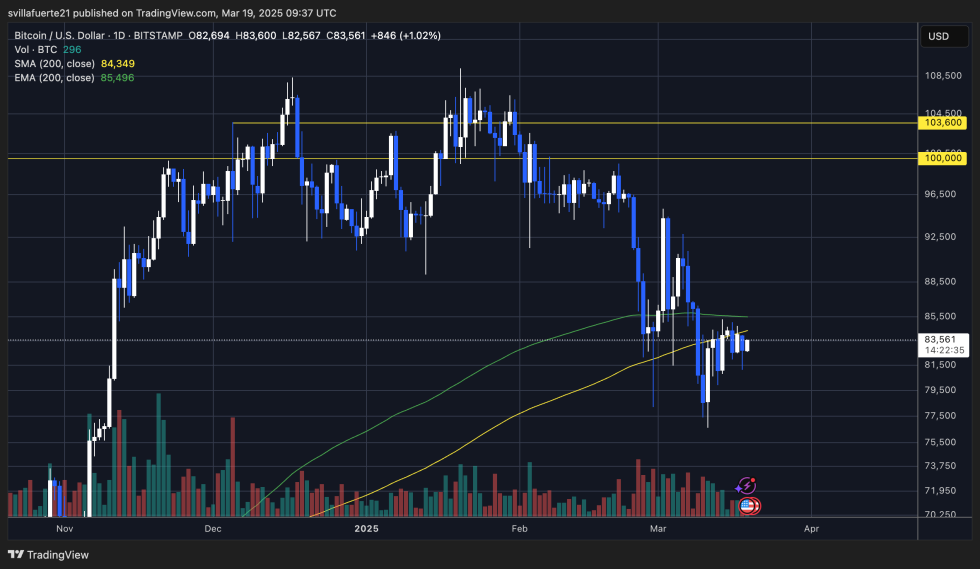
BTC is trading below the 200-day MA | Source: BTCUSDT chart on TradingView

However, failure to reclaim $86K in the coming sessions could spell trouble for bulls. If BTC continues to struggle below this level, a drop below the $80K support zone becomes increasingly likely. A break below this level could trigger a deeper correction, potentially leading BTC into the $75K-$78K demand zone.

For now, Bitcoin remains in a consolidation phase below key moving averages, and the lack of bullish momentum raises concerns about further downside risk. Traders and investors will closely monitor whether BTC can regain lost ground or if continued selling pressure will push prices toward lower levels. The next few days will be crucial in determining Bitcoin’s short-term trajectory.

Featured image from Dall-E, chart from TradingView 

Editorial Process for bitcoinist is centered on delivering thoroughly researched, accurate, and unbiased content. We uphold strict sourcing standards, and each page undergoes diligent review by our team of top technology experts and seasoned editors. This process ensures the integrity, relevance, and value of our content for our readers.

Sebastian's journey into the world of crypto began four years ago, driven by a fascination with the potential of blockchain technology to revolutionize financial systems. His initial exploration focused on understanding the intricacies of various crypto projects, particularly those focused on building innovative financial solutions. Through countless hours of research and learning, Sebastian developed a deep understanding of the underlying technologies, market dynamics, and potential applications of cryptocurrencies. As his knowledge grew, Sebastian felt compelled to share his insights with others. He began actively contributing to online discussions on platforms like X and LinkedIn, focusing on fintech and crypto-related content. His goal was to expose valuable trends and insights to a wider audience, fostering a deeper understanding of the rapidly evolving crypto landscape. Sebastian's contributions quickly gained recognition, and he became a trusted voice in the online crypto community. To further enhance his expertise, Sebastian pursued a UC Berkeley Fintech: Frameworks, Applications, and Strategies certification. This rigorous program equipped him with valuable skills and knowledge regarding Financial Technology, bridging the gap between traditional finance (TradFi) and decentralized finance (DeFi). The certification deepened his understanding of the broader financial landscape and its intersection with blockchain technology. Sebastian's passion for finance and writing is evident in his work. He enjoys delving into financial research, analyzing market trends, and exploring the latest developments in the crypto space. In his spare time, Sebastian can often be found immersed in charts, studying 10-K forms, or engaging in thought-provoking discussions about the future of finance. Sebastian's journey as a crypto analyst and investor has been marked by a relentless pursuit of knowledge and a dedication to sharing his insights. His ability to navigate the complex world of crypto, combined with his passion for financial research and communication, makes him a valuable asset to the industry. As the crypto landscape continues to evolve, Sebastian remains at the forefront, providing valuable insights and contributing to the growth of this revolutionary technology.

Letture associate

Bankless Co-founder: Why I Sold All My ETH

Author David Hoffman, founder of Bankless, explains his decision to sell all his ETH, despite being a prominent figure in the Ethereum ecosystem. He clarifies that his move is not a bearish take on Ethereum itself, which he remains highly optimistic about as a network. His core argument is that the "ETH is money" thesis, which he helped popularize, has largely played out. Hoffman argues that ETH has achieved the market valuation it deserves based on Ethereum's current success and competitive position. He details several reasons for this view. First, the path for ETH to become global money required nearly flawless execution and sustained dominance across Ethereum's entire technical and social stack—a coordination challenge he now believes had a narrower window for success than anticipated. Second, market data shows a strong correlation between L1 chain activity/fees and the price of its native asset; Ethereum's fee dominance has been challenged by competitors like Solana. Third, the "strong version" of crypto (decentralized, native crypto economies) that ETH's monetary thesis relied upon has struggled to maintain a positive mainstream narrative and stable adoption beyond a brief period. Finally, Ethereum's architecture as a "giver"—providing secure block space and tokenization capabilities at cost to L2s and applications—means it doesn't capture premium value directly. Its rollup-centric roadmap further directs most profits to L2s and applications ("fat app theory"). In conclusion, Hoffman believes the opportunity for ETH to be revalued significantly upward as money has diminished. He sold not because ETH will fail, but because its monetary thesis has matured, and he seeks to allocate capital to other opportunities he finds more compelling.

链捕手2 h fa

Bankless Co-founder: Why I Sold All My ETH

链捕手2 h fa

From Issuer to Infrastructure Owner: Circle's Arc Strategy and the Fatal Gap in the GENIUS Act

Circle raised $222 million for its proprietary Layer-1 blockchain, Arc, positioning itself not just as a stablecoin issuer but as the owner of the settlement infrastructure USDC relies on. This move, backed by investors like BlackRock and Apollo, highlights a significant structural conflict unaddressed by the GENIUS Act of 2025. While the act focuses on stablecoin reserves and issuer oversight, it remains silent on the market structure implications of an issuer controlling the underlying network—a scenario akin to a currency issuer also owning the payment rails. Traditionally, financial regulations separate issuers from settlement infrastructure to ensure neutrality. With Arc, Circle gains control over transaction ordering, fees, and network rules, potentially favoring USDC over competitors. The article argues that this creates a permanent structural temptation, even if no abuse occurs. The solution lies in applying established market infrastructure principles: mandating neutral transaction ordering, transparent fee schedules, and governance separated from Circle’s commercial interests. The current pre-mainnet phase offers a critical window for regulators to establish these rules before Arc becomes entrenched. Once operational, enforcing changes would be costly and disruptive. The core question remains: should a regulated stablecoin issuer be allowed to own the settlement network its competitors must use? The GENIUS Act doesn’t answer this, but Circle’s Arc strategy makes it urgent.

marsbit2 h fa

From Issuer to Infrastructure Owner: Circle's Arc Strategy and the Fatal Gap in the GENIUS Act

marsbit2 h fa

Trading

Spot
Futures

Articoli Popolari

Come comprare MOVE

Benvenuto in HTX.com! Abbiamo reso l'acquisto di Movement (MOVE) semplice e conveniente. Segui la nostra guida passo passo per intraprendere il tuo viaggio nel mondo delle criptovalute.Step 1: Crea il tuo Account HTXUsa la tua email o numero di telefono per registrarti il tuo account gratuito su HTX. Vivi un'esperienza facile e sblocca tutte le funzionalità,Crea il mio accountStep 2: Vai in Acquista crypto e seleziona il tuo metodo di pagamentoCarta di credito/debito: utilizza la tua Visa o Mastercard per acquistare immediatamente MovementMOVE.Bilancio: Usa i fondi dal bilancio del tuo account HTX per fare trading senza problemi.Terze parti: abbiamo aggiunto metodi di pagamento molto utilizzati come Google Pay e Apple Pay per maggiore comodità.P2P: Fai trading direttamente con altri utenti HTX.Over-the-Counter (OTC): Offriamo servizi su misura e tassi di cambio competitivi per i trader.Step 3: Conserva Movement (MOVE)Dopo aver acquistato Movement (MOVE), conserva nel tuo account HTX. In alternativa, puoi inviare tramite trasferimento blockchain o scambiare per altre criptovalute.Step 4: Scambia Movement (MOVE)Scambia facilmente Movement (MOVE) nel mercato spot di HTX. Accedi al tuo account, seleziona la tua coppia di trading, esegui le tue operazioni e monitora in tempo reale. Offriamo un'esperienza user-friendly sia per chi ha appena iniziato che per i trader più esperti.

266 Totale visualizzazioniPubblicato il 2024.12.13Aggiornato il 2025.03.21

Come comprare MOVE

Discussioni

Benvenuto nella Community HTX. Qui puoi rimanere informato sugli ultimi sviluppi della piattaforma e accedere ad approfondimenti esperti sul mercato. Le opinioni degli utenti sul prezzo di MOVE MOVE sono presentate come di seguito.

活动图片