Bankless Co-founder: Why I Sold All My ETH

链捕手Pubblicato 2026-05-27Pubblicato ultima volta 2026-05-27

Introduzione

Author David Hoffman, founder of Bankless, explains his decision to sell all his ETH, despite being a prominent figure in the Ethereum ecosystem. He clarifies that his move is not a bearish take on Ethereum itself, which he remains highly optimistic about as a network. His core argument is that the "ETH is money" thesis, which he helped popularize, has largely played out. Hoffman argues that ETH has achieved the market valuation it deserves based on Ethereum's current success and competitive position. He details several reasons for this view. First, the path for ETH to become global money required nearly flawless execution and sustained dominance across Ethereum's entire technical and social stack—a coordination challenge he now believes had a narrower window for success than anticipated. Second, market data shows a strong correlation between L1 chain activity/fees and the price of its native asset; Ethereum's fee dominance has been challenged by competitors like Solana. Third, the "strong version" of crypto (decentralized, native crypto economies) that ETH's monetary thesis relied upon has struggled to maintain a positive mainstream narrative and stable adoption beyond a brief period. Finally, Ethereum's architecture as a "giver"—providing secure block space and tokenization capabilities at cost to L2s and applications—means it doesn't capture premium value directly. Its rollup-centric roadmap further directs most profits to L2s and applications ("fat app theory"). In conc...

Author:David Hoffman

Translation:Jiahuan, ChainCatcher

If you missed the news last week, I sold my ETH.

For someone who has built a career, community, identity, and business around Ethereum, making this decision was not easy.

The reason behind the sale requires a more thorough explanation than fragmented tweets on Twitter.

The 'ETH is Money' thesis did not fail... it has simply been realized. Ethereum has earned the ETH price it deserves, and I believe ETH as an asset will not be revalued, either upwards or downwards.
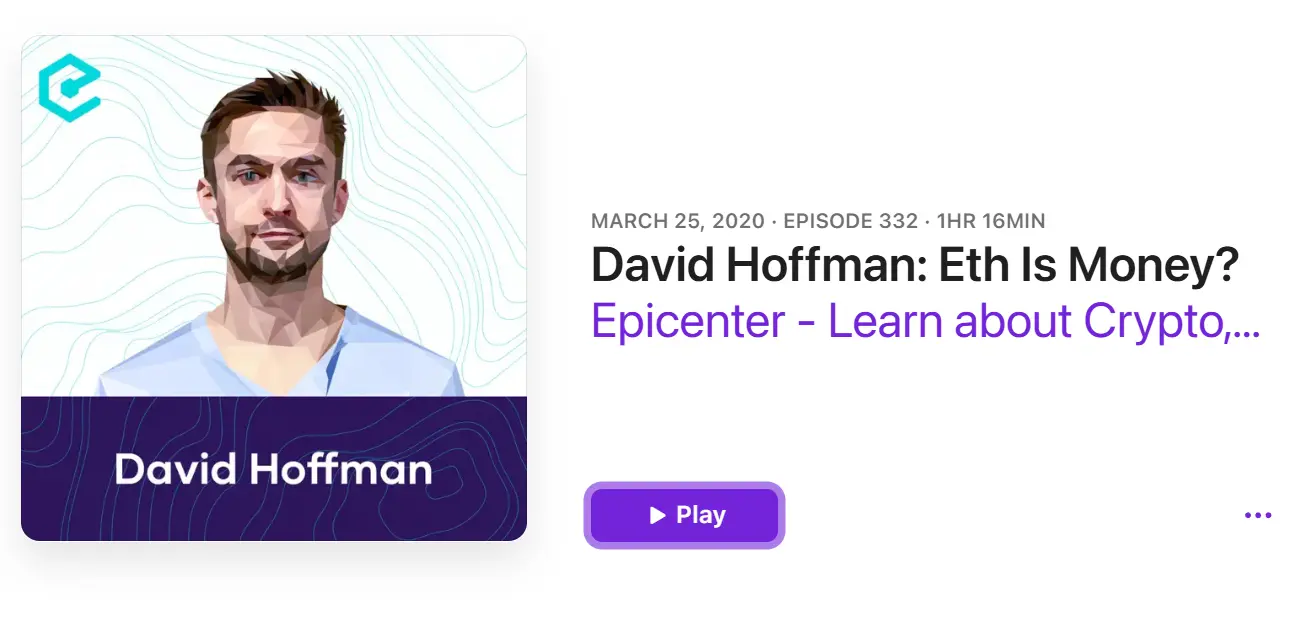
'ETH is Money' is the core narrative proposed by author David Hoffman in 2019 and long promoted through Bankless, advocating that ETH should become a global store of value. It was once one of Ethereum's most mainstream bullish logics.

Note: I am extremely bullish on Ethereum. I expect the Ethereum network to perform exceptionally well from here on out. However, I believe that only a tiny fraction of this success will be reflected in ETH.

The article text is as follows:

'ETH is Money' Has Always Been an Aspiration

Money is a coordination game, and coordination is very difficult.

The Ethereum project itself is a series of coordination challenges stacked upon multiple levels, and the 'ETH is Money' thesis demands that all these levels succeed, and succeed unequivocally.

ETH can only become money if and only if every layer of Ethereum's techno-social stack performs better than its competitors.

Given the ambition of the Ethereum project, achieving its most successful version was always a monumental challenge. Despite shortcomings, the Ethereum project has performed admirably, fully deserving its current market capitalization.

Nevertheless, the window of opportunity for $ETH to be 'revalued' by the market seems to be closing.

In a sense, ETH is money. But it is not the most successful version we collectively aspired to.

Ethereum is a Coordination Game

A Turing-complete blockchain is such a powerful idea that Ethereum's maximum potential is the entire crypto world. Everything.

The only obstacle to Ethereum achieving 100% absolute domination over everything is coordination.

Ethereum's leadership needs to be sufficiently decentralized; governance needs 'rough consensus' to create credible neutrality, maximizing Ethereum's adoption at the highest level.

Ethereum's leadership needs to respond quickly to market dynamics, operating like a startup facing an existential threat of marginalization.

Ethereum L2s need to be able to operate and make their own market choices independently from the base layer, but they also need to be economically bound and constrained by the broader Ethereum economy and brand.

Ethereum's roadmap needs to be executed in a specific order to maximize and maintain Ethereum's momentum and market dominance, thereby fully subduing competition and maximizing confidence in Ethereum and ETH.

Key technology R&D and engineering implementation need to be fast enough so that Ethereum can both prove its utility to the outside world and stay ahead of competitors.

The 'ETH is Money' thesis is about creating an extremely revolutionary and powerful financial asset that, by virtue of its unique properties as the premier global store of value, attracts individuals who would otherwise be indifferent.

Ethereum's brand and ETH's strength need to be so powerful that traditional large capital not only feels safe but actively includes ETH as a significant position in retirement portfolios due to the dominance of the Ethereum project.

For 'ETH is Money' to happen, everything upstream of ETH needs to function in an extremely perfect manner.

Ethereum is not Bitcoin; it chose the hard path. Bitcoin chose to strip everything from its blockchain to elevate BTC.

Ethereum chose to add everything to its blockchain to maximize the utility of its block space. Only by doing this in the best possible way before competitors can ETH attain its status as global money.

We've come a long way, and Ethereum has already achieved the maximum potential market share it deserves.

I fear the window to play this game has closed.

The Macro Environment May Never Allow It to Happen

Looking back over the past few years, I see that Ethereum needed to overcome numerous macro-environmental challenges.

1. L1 Asset Valuation is Inextricably Linked to Revenue

Say what you will about how hard it is to value smart contract chains based on fees and revenue, but fees and revenue are clearly how smart contract L1 assets increase their pricing power.

By 2026, we have ample data showing that all these factors are closely correlated: L1 activity, L1 fees, and the price appreciation of the L1 native asset.

In 2021, when ETH had the highest L1 revenue market share, it dominated.

In 2024, when SOL's L1 revenue market share surged across the industry, it dominated.

In 2026, NEAR is experiencing price revaluation alongside fundamental growth in its L1 revenue and NEAR burn.

You can also look at assets like BNB and TRX, perhaps the highest cumulative revenue projects ever. Their price charts look the way I once expected ETH's should—provided ETH could maintain its L1 fee dominance for longer than just that stretch in 2022.

2. The Strong Version of Crypto Didn't Work

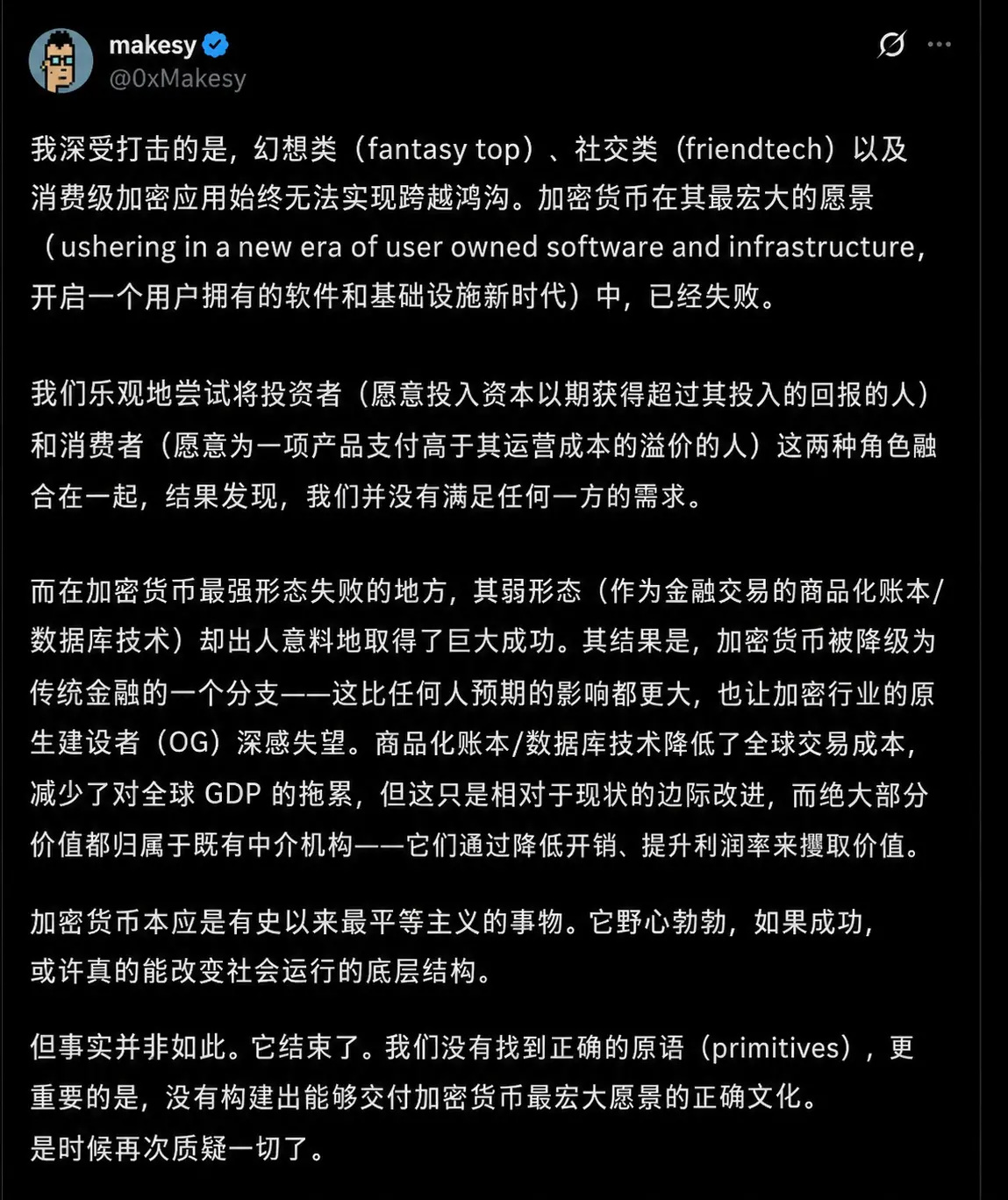
@0xMakesy put it well:

Ethereum represents the strong version of crypto, crypto for crypto's sake, self-sustaining and self-perpetuating. DeFi, NFTs, DAOs—we were rebels, building an alternative financial system of, by, and for the people, plugging imagination into the money system.

Simultaneously, there exists the weak version: efficient ledger infrastructure for financial institutions' backends. The weak version would fuel the strong version, converting demand for internet ledgers into inward-flowing capital streams toward crypto, toward Ethereum, ultimately converging on ETH.

Perhaps if Ethereum executed better, faster, stronger, and if crypto hadn't attracted such a massive cohort of speculative charlatans and value extractors, the industry could have won the influence and respect I always thought it deserved.

But the only period where crypto maintained a positive brand image with the general public was from late 2020 to early 2022. Outside this narrow window, crypto's reputation has been one of fraud, scams, get-rich-quick schemes, and uselessness to the average person.
'ETH is Money' Relies on 'Strong Crypto'

Right at the moment when everyone was forced online, ETH emerged as the internet's money. The world discovered crypto for the first time, and for that brief window, it was very cool.

Money is a coordination game, and a currency's Schelling Point (consensus focal point) is held together by belief. In 2021, the broader public believed in ETH: it was cool, disruptive, and populist. Bitcoin possessed the same properties and has retained them better than ETH post-2021.

This raises a disquieting possibility: the strong version of crypto may never have been a stable equilibrium point. COVID was an extremely distorted time for money, and perhaps 'ETH as Money' was only propped up by that distortion.

If that's the case, ETH becoming money always depended on the strong version of crypto working better than it has in reality.

3. Ethereum's Utility Also Benefits Other Monies

Is Bitcoin money? Is the Dollar money? Is Gold money? It doesn't matter—whatever is money will be tokenized on Ethereum.

In 2020, Nic Carter posited on Bankless that stablecoins would likely be parasitic to ETH as Ethereum's native unit. Back then, Ethereum had $3B in stablecoins. Today, that number is $163B, a 54x increase.

The utility Ethereum provides is helping to expand the monetary network of any asset that truly is money, which is why the US is so bullish on crypto for stablecoin adoption. Ethereum is helping the US maintain dollar hegemony, and leveraging this fact is explicit government policy.

Clearly, the positive spillover effects garnered by $ETH as money are far less potent than those seen by the US government in Ethereum's stablecoin ecosystem.

Ethereum is a Giver, Not a Taker

At its core, Ethereum is a giver, not a taker.

It provides the world's most secure block space to L2s at cost.

It tokenizes the world's assets at cost.

It secures billions in DeFi at cost.

Ethereum takes no markup on anything it does.

This is the nature of open-source software and the power of Ethereum. Ethereum provides its full suite of immensely valuable goods to the world at cost.

Ethereum is noble. Ethereum is good.

Ethereum is the world's most successful non-profit organization.

Naturally, incredible mass adoption will occur on Ethereum. It has been and will continue to be one of the most impactful open-source software projects ever built by humanity, and being a 'non-profit protocol' is one of its core features.

This is why ETH's path to becoming money depended on maintaining sustained and extremely high market dominance.

Ultimately, as block space becomes commoditized, fees will trend towards zero. So long as it's Ethereum that gets commoditized and not its competitors, Ethereum can maintain its margins and dominance.

Ultimately, the fat protocol theory (referring to the idea that the majority of economic value will be captured and monopolized by the foundational protocol (like Ethereum), not by the application layer built on top, as in traditional internet models) will give way to the fat application theory, and applications will swallow the remaining profits.

So long as they are Ethereum's applications and not a competitor's, that's fine for ETH.

It's hard to square 'ETH is Money' with 'Ethereum is a giver, not a taker.' Ethereum's architecture is intentionally designed to give everything back to its ecosystem and only take the minimum required to keep the network running.

Architecturally, ETH is not prioritized within Ethereum; this is a feature, not a bug. ETH could only become money if Ethereum won a battle it was architecturally refusing to fight.

This could have worked if Ethereum could have maintained incredible market dominance.

This Thesis Asks Too Much of Ethereum

'ETH is Money' requires everything about Ethereum to go right. The margin for error is much smaller than I originally thought. Ethereum's momentum in 2021 and 2022 made 'ETH is Money' seem like the default path.

In hindsight, Solana's rise in 2021 alongside rising anti-Ethereum sentiment was the first major sign that Ethereum and ETH's coordination game wasn't going as planned.

The Ethereum Foundation needed to decentralize and allow alternative power structures to emerge. But it also needed to respond to market forces with the urgency and drive of a startup facing an existential elimination threat.

L2 teams needed the freedom for self-determination, but also needed to operate under the larger protective brand of Ethereum and ETH. The technical synchronicity integration between Ethereum and its L2s needed to be executed much faster.

Smart contract chains are valued via fees; to break out of this mold, Ethereum needed to rewrite the rules with overwhelming success.

My Reason for Selling

It just didn't reach its maximum potential either.

Ethereum did a noble thing, choosing for itself the hardest, most ambitious, most ideologically pure path for its future.

It secured some incredible wins and failed to win others.

Ethereum has earned the market cap it deserves.

I am very bullish on the Ethereum network and its ecosystem—Ethereum is architected to maximize the success of its apps, L2s, and ecosystem. The fat application theory means Ethereum's apps take all the fees, and the rollup-centric roadmap means L2s take 97% of the profits.

As for ETH the asset, I have a hard time seeing it being structurally revalued, either up or down.

Therefore, my reason for selling ETH is not bearishness on ETH; it's that I believe the 'ETH is Money' thesis has been realized, and I wish to allocate capital to other opportunities in the market that I'm bullish on.


Domande pertinenti

QAccording to David Hoffman, what is the core reason he sold his ETH, and why doesn't he see significant revaluation potential for it?

AHe believes the 'ETH is money' thesis has played out and has been fully priced into ETH's current market capitalization. He sold not because he is bearish on ETH, but because he sees little potential for the asset to be significantly revalued (either upward or downward) from its current level, as its success as a global store of value depended on a perfect execution by the Ethereum project that he now considers improbable. He wants to reallocate funds to other opportunities.

QWhat key characteristics of Ethereum's architecture make it a 'giver, not a taker,' and why does Hoffman argue this works against ETH becoming money?

AEthereum provides critical value—like secure block space for L2s, tokenization of global assets, and security for DeFi—'at cost,' without charging a premium. Its open-source, non-profit nature is its strength but means it is architected to give back nearly all value to its ecosystem. For ETH to become money, Ethereum would need to maintain extreme market dominance and 'win a battle it is architeturally architected to not participate in'—namely, capturing and monetizing value for the native asset itself.

QHoffman mentions the relationship between L1 assets and their revenue/fees. How does this observed pattern conflict with the 'ETH is money' thesis?

AThe data shows a strong correlation between L1 activity/fees/revenue and the price appreciation of that L1's native asset (e.g., ETH in 2021, SOL in 2024, NEAR in 2026). The 'ETH is money' thesis aimed to transcend this fee-based valuation model, positioning ETH as a global store of value regardless of network fees. However, the market continues to value smart contract L1s based on their revenue capture, and ETH has not maintained the overwhelming fee dominance needed to break this pattern and validate the 'money' narrative.

QWhat does Hoffman mean by 'strong version' versus 'weak version' of cryptocurrency, and why is the former's failure problematic for ETH?

AThe 'strong version' is cryptocurrency for its own sake—a self-sustaining, alternative financial system (DeFi, NFTs, DAOs). The 'weak version' is cryptocurrency as efficient ledger infrastructure for traditional finance. The 'ETH is money' thesis relied on the success and mainstream appeal of the 'strong version' to create a powerful social consensus. However, crypto's public brand has largely been associated with scams and speculation, not positive utility. This failure of the 'strong version' to achieve a stable, respected position undermines the social coordination needed for ETH to become widely accepted as money.

QHow does the concept of 'coordination' present a fundamental challenge for Ethereum and the 'ETH is money' narrative?

AMoney is a coordination game, and for ETH to become the dominant global money, Ethereum needed to win a series of complex, stacked coordination challenges perfectly. This included: decentralized yet decisive leadership, perfectly synchronized L2s, flawless technical execution to stay ahead of competitors, and creating a brand powerful enough to attract major traditional capital. Hoffman argues that the window for Ethereum to achieve this level of flawless coordination and market dominance, which was necessary for ETH to break free from being valued as a fee-generating L1, has likely closed.

Letture associate

From Issuer to Infrastructure Owner: Circle's Arc Strategy and the Fatal Gap in the GENIUS Act

Circle raised $222 million for its proprietary Layer-1 blockchain, Arc, positioning itself not just as a stablecoin issuer but as the owner of the settlement infrastructure USDC relies on. This move, backed by investors like BlackRock and Apollo, highlights a significant structural conflict unaddressed by the GENIUS Act of 2025. While the act focuses on stablecoin reserves and issuer oversight, it remains silent on the market structure implications of an issuer controlling the underlying network—a scenario akin to a currency issuer also owning the payment rails. Traditionally, financial regulations separate issuers from settlement infrastructure to ensure neutrality. With Arc, Circle gains control over transaction ordering, fees, and network rules, potentially favoring USDC over competitors. The article argues that this creates a permanent structural temptation, even if no abuse occurs. The solution lies in applying established market infrastructure principles: mandating neutral transaction ordering, transparent fee schedules, and governance separated from Circle’s commercial interests. The current pre-mainnet phase offers a critical window for regulators to establish these rules before Arc becomes entrenched. Once operational, enforcing changes would be costly and disruptive. The core question remains: should a regulated stablecoin issuer be allowed to own the settlement network its competitors must use? The GENIUS Act doesn’t answer this, but Circle’s Arc strategy makes it urgent.

marsbit1 h fa

From Issuer to Infrastructure Owner: Circle's Arc Strategy and the Fatal Gap in the GENIUS Act

marsbit1 h fa

What Are the Key Variables Determining the AI Bull Market?

Title: What Determines the AI Bull Market? Key Variables Revealed Despite rising oil prices above $100/barrel, persistent inflation, and fragile Fed rate cut expectations—a traditionally hostile environment for high-valuation tech stocks—the AI sector continues to drive the market to new highs. According to analysts, the current AI boom is in a phase of "rational fervor": while bubbles exist, they are not yet out of control. The crucial shift is the emergence of Agentic AI, which is evolving from an assisting tool (Copilot) to an autonomous execution tool (Autopilot), creating a clearer commercial path from investment to revenue. This shift accelerates Token consumption and inference computing demand while boosting revenue forecasts for leading firms. The market is now rewarding capital expenditure as it transforms from a burden into a competitive moat, supporting hardware chains like GPUs, optical modules, and storage. However, valuations have already priced in growth expectations for 2027-2028. The forward P/E ratio for the "Magnificent Seven" tech giants is about 35x, compared to 25x for the rest of the S&P 500. This premium implies AI adoption must occur 5 to 8 times faster than past technological revolutions—a scenario with little room for error. The sustainability of the AI bull market hinges on three key variables: 1. **Short-term liquidity shocks**: Risks include sustained high oil prices, resurgent inflation, rising interest rates, and potential unwinding of the yen carry trade. The critical question is whether the upward revision speed of Annual Recurring Revenue (ARR) can outpace the rise in interest rates. 2. **Mid-term industry realization**: Can the actual pace of AI adoption and commercialization match the current lofty valuations? Historically, general-purpose technology revolutions follow a non-linear path with periods of acceleration and deceleration. 3. **Long-term structural constraints**: These include energy and power grid limitations, employment displacement and consumer purchasing power, social acceptance and potential backlash, and potential hardware technology breakthroughs that could disrupt current supply chains. While the long-term prospects for AI remain optimistic with potential for significant productivity gains, the stock market's pricing depends not just on the vision but on the actual speed of realization amid these growing constraints. The direction is clear, but the pace of execution will determine whether the bubble remains controlled or spirals out of control.

marsbit1 h fa

What Are the Key Variables Determining the AI Bull Market?

marsbit1 h fa

The AI Industrial Revolution: Where Are We Now?

This article explores the current stage of the AI industrial revolution, arguing we are still merely attaching new tools to old workflows rather than fundamentally redesigning production. The author compares this to the early Industrial Revolution, where factories simply replaced waterwheels with steam engines without changing their core structure. Similarly, today we embed AI chat windows into existing software but leave organizational processes unchanged. While massive investment floods into AI infrastructure (data centers, chips), akin to railway manias of the past, the real transformation lies in "dismantling the old workshop"—reorganizing companies around AI. Examples include Notion's use of hundreds of AI Agents and Y Combinator's experiments with self-improving AI systems that operate autonomously. The author notes a critical gap: while China has vast AI user growth, few companies have rebuilt core workflows. AI is beginning to impact entry-level jobs, and early adopters are gaining a compounding advantage. The conclusion is that the pivotal moment will not be the invention of better models, but when organizations decide to tear down old structures and rebuild around AI, shifting the bottleneck from human coordination to computing power. The future workplace and job titles are yet to be defined, but the imperative is to move away from legacy processes and position oneself where the new "railway" is being built.

marsbit1 h fa

The AI Industrial Revolution: Where Are We Now?

marsbit1 h fa

Trading

Spot
Futures

Articoli Popolari

Cosa è ETH 3.0

ETH3.0 e $eth 3.0: Un'Analisi Approfondita del Futuro di Ethereum Introduzione Nel panorama in rapida evoluzione delle criptovalute e della tecnologia blockchain, ETH3.0, spesso indicato come $eth 3.0, è emerso come un argomento di considerevole interesse e speculazione. Il termine comprende due concetti principali che warrantono chiarimenti: Ethereum 3.0: Questo rappresenta un potenziale futuro aggiornamento volto ad aumentare le capacità dell'attuale blockchain di Ethereum, concentrandosi principalmente sul miglioramento della scalabilità e delle prestazioni. ETH3.0 Meme Token: Questo progetto di criptovaluta distinto cerca di sfruttare la blockchain di Ethereum per creare un ecosistema incentrato sui meme, promuovendo il coinvolgimento all'interno della comunità delle criptovalute. Comprendere questi aspetti di ETH3.0 è essenziale non solo per gli appassionati di criptovalute, ma anche per coloro che osservano tendenze tecnologiche più ampie nello spazio digitale. Che cos'è ETH3.0? Ethereum 3.0 Ethereum 3.0 è pubblicizzato come un aggiornamento proposto per la rete Ethereum già stabilita, che è stata la spina dorsale di molte applicazioni decentralizzate (dApps) e contratti smart sin dalla sua nascita. I miglioramenti previsti si concentrano principalmente sulla scalabilità, integrando tecnologie avanzate come lo sharding e le prove a conoscenza zero (zk-proofs). Queste innovazioni tecnologiche mirano a facilitare un numero senza precedenti di transazioni al secondo (TPS), potenzialmente raggiungendo milioni, affrontando così una delle limitazioni più significative della tecnologia blockchain attuale. Il miglioramento non è meramente tecnico, ma anche strategico; è volto a preparare la rete Ethereum per un'adozione e un'utilità diffuse in un futuro contrassegnato da un aumento della domanda di soluzioni decentralizzate. ETH3.0 Meme Token Al contrario di Ethereum 3.0, l'ETH3.0 Meme Token si avventura in un dominio più leggero e giocoso, combinando la cultura dei meme di internet con la dinamica delle criptovalute. Questo progetto consente agli utenti di acquistare, vendere e scambiare meme sulla blockchain di Ethereum, fornendo una piattaforma che promuove il coinvolgimento della comunità attraverso la creatività e interessi condivisi. L'ETH3.0 Meme Token mira a dimostrare come la tecnologia blockchain possa intersecarsi con la cultura digitale, creando casi d'uso che siano sia divertenti che finanziariamente praticabili. Chi è il Creatore di ETH3.0? Ethereum 3.0 L'iniziativa verso Ethereum 3.0 è principalmente propulsa da un consorzio di sviluppatori e ricercatori all'interno della comunità di Ethereum, tra cui Justin Drake. Conosciuto per le sue intuizioni e contributi all'evoluzione di Ethereum, Drake è stato una figura di spicco nelle discussioni riguardanti la transizione di Ethereum verso un nuovo livello di consenso, chiamato “Beam Chain.” Questo approccio collaborativo allo sviluppo significa che Ethereum 3.0 non è il prodotto di un creatore singolo, ma piuttosto una manifestazione di ingegno collettivo focalizzato sul progresso della tecnologia blockchain. ETH3.0 Meme Token I dettagli riguardanti il creatore dell'ETH3.0 Meme Token sono attualmente non rintracciabili. La natura dei token meme conduce spesso a una struttura più decentralizzata e guidata dalla comunità, il che potrebbe spiegare la mancanza di attribuzione specifica. Questo si allinea con l'etica della comunità crypto più ampia, dove l'innovazione spesso nasce da sforzi collaborativi piuttosto che individuali. Chi sono gli Investitori di ETH3.0? Ethereum 3.0 Il supporto per Ethereum 3.0 proviene principalmente dalla Ethereum Foundation insieme a una comunità entusiasta di sviluppatori e investitori. Questa associazione fondamentale fornisce un considerevole grado di legittimità e migliora le prospettive di implementazione di successo poiché sfrutta la fiducia e la credibilità costruite nel corso degli anni di operazioni della rete. Nel clima in rapida evoluzione delle criptovalute, il supporto della comunità gioca un ruolo cruciale nello sviluppo e nell'adozione, posizionando Ethereum 3.0 come un serio contenditore per i futuri progressi della blockchain. ETH3.0 Meme Token Sebbene le fonti attualmente disponibili non forniscano informazioni esplicite riguardo ai fondamenti o alle organizzazioni di investimento che sostengono l'ETH3.0 Meme Token, ciò è indicativo del modello di finanziamento tipico per i token meme, che spesso si basa sul supporto di base e sul coinvolgimento della comunità. Gli investitori in tali progetti sono tipicamente individui motivati dal potenziale per innovazioni guidate dalla comunità e dallo spirito di cooperazione trovato all'interno della comunità crypto. Come Funziona ETH3.0? Ethereum 3.0 Le caratteristiche distintive dell'Ethereum 3.0 risiedono nella sua proposta di implementazione della tecnologia di sharding e zk-proof. Lo sharding è un metodo di partizionamento della blockchain in pezzi più piccoli e gestibili o “shard,” che possono elaborare transazioni in modo concorrente piuttosto che sequenziale. Questa decentralizzazione dell'elaborazione aiuta a prevenire la congestione e garantisce che la rete rimanga reattiva anche sotto un carico pesante. La tecnologia delle prove a conoscenza zero (zk-proof) contribuisce con un ulteriore livello di sofisticazione consentendo la validazione delle transazioni senza rivelare i dati sottostanti coinvolti. Questo aspetto non solo migliora la privacy, ma aumenta anche l'efficienza complessiva della rete. Si parla anche di incorporare una macchina virtuale Ethereum a conoscenza zero (zkEVM) in questo aggiornamento, amplificando ulteriormente le capacità e l'utilità della rete. ETH3.0 Meme Token L'ETH3.0 Meme Token si distingue capitalizzando sulla popolarità della cultura dei meme. Stabilisce un mercato per gli utenti che desiderano partecipare al trading di meme, non solo per divertimento, ma anche per potenziale guadagno economico. Integrando funzioni come lo staking, la fornitura di liquidità e meccanismi di governance, il progetto promuove un ambiente che incentiva l'interazione e la partecipazione della comunità. Offrendo una miscela unica di intrattenimento e opportunità economica, l'ETH3.0 Meme Token mira ad attrarre un pubblico variegato, che va dagli appassionati di crypto ai semplici intenditori di meme. Timeline di ETH3.0 Ethereum 3.0 11 Novembre 2024: Justin Drake accenna al prossimo aggiornamento ETH 3.0, incentrato sui miglioramenti della scalabilità. Questo annuncio segna l'inizio delle discussioni formali riguardo l'architettura futura di Ethereum. 12 Novembre 2024: La proposta attesa per Ethereum 3.0 dovrebbe essere svelata a Devcon a Bangkok, preparando il terreno per un feedback più ampio della comunità e potenziali passi successivi nello sviluppo. ETH3.0 Meme Token 21 Marzo 2024: L'ETH3.0 Meme Token viene ufficialmente elencato su CoinMarketCap, segnando il suo ingresso nel dominio pubblico delle criptovalute e aumentando la visibilità per il suo ecosistema basato sui meme. Punti Chiave In conclusione, Ethereum 3.0 rappresenta una significativa evoluzione all'interno della rete Ethereum, concentrandosi sul superamento delle limitazioni riguardanti scalabilità e prestazioni attraverso tecnologie avanzate. I suoi aggiornamenti proposti riflettono un approccio proattivo alle future esigenze e usabilità. D'altra parte, l'ETH3.0 Meme Token incarna l'essenza della cultura guidata dalla comunità nello spazio delle criptovalute, sfruttando la cultura dei meme per creare piattaforme coinvolgenti che incoraggiano la creatività e la partecipazione degli utenti. Comprendere gli scopi e le funzionalità distinte di ETH3.0 e $eth 3.0 è fondamentale per chiunque sia interessato ai continui sviluppi nello spazio crypto. Con entrambe le iniziative che tracciano percorsi unici, esse sottolineano collettivamente la natura dinamica e multifacetica dell'innovazione blockchain.

173 Totale visualizzazioniPubblicato il 2024.04.04Aggiornato il 2024.12.03

Cosa è ETH 3.0

Cosa è ETHEREUM

HarryPotterTrumpHomerSimpson777Inu: Panoramica di un Progetto Crypto Web3 Introduzione Nel mondo in rapida evoluzione delle criptovalute e della finanza decentralizzata, progetti innovativi emergono frequentemente, catturando l'interesse della comunità degli investitori e degli appassionati di crypto. Uno di questi progetti è HarryPotterTrumpHomerSimpson777Inu, una criptovaluta che si trova all'incrocio tra cultura popolare e tecnologia blockchain. Questo token guidato dalla comunità mescola personaggi e figure politiche ben noti, con l'obiettivo di creare una piattaforma coinvolgente e promuovere un'adozione diffusa. Che cos'è HarryPotterTrumpHomerSimpson777Inu? HarryPotterTrumpHomerSimpson777Inu è un token costruito sulla blockchain di Ethereum, progettato per essere accessibile e divertente per un pubblico diversificato. L'unicità di questo progetto deriva dal suo approccio tematico, che intreccia elementi di fantasia, politica e intrattenimento. Sfruttando il fascino nostalgico di personaggi amati, il progetto cerca di creare un'esperienza di criptovaluta coinvolgente, incoraggiando il coinvolgimento e la partecipazione della comunità. L'obiettivo principale di HarryPotterTrumpHomerSimpson777Inu è stabilire un token che risuoni con gli utenti a livello personale, promuovendo sia il divertimento che il coinvolgimento nell'ambito crypto. Questo branding distintivo mira ad attrarre individui che in precedenza potrebbero non essersi interessati alle criptovalute, facilitando un nuovo punto di ingresso per utenti potenziali. Creatore di HarryPotterTrumpHomerSimpson777Inu L'identità del creatore dietro HarryPotterTrumpHomerSimpson777Inu rimane sconosciuta. Questa non è una pratica rara nel dominio delle criptovalute, dove l'anonimato è spesso preferito dai fondatori come mezzo di protezione della privacy e promozione di un ethos decentralizzato. Questa oscurità non diminuisce il valore del progetto; al contrario, riflette una tendenza più ampia all'interno del settore, dove molti progetti di successo sono emersi da origini anonime. Investitori di HarryPotterTrumpHomerSimpson777Inu Le informazioni pubbliche riguardo agli investitori di HarryPotterTrumpHomerSimpson777Inu sono limitate. La natura del progetto, incentrata sul coinvolgimento della comunità, suggerisce una dipendenza da investimenti di piccole dimensioni da parte di singoli appassionati piuttosto che da sostegni sostanziali da fondazioni di investimento consolidate o corporation. Questo livello di trasparenza nel finanziamento è tipico di molti progetti di criptovaluta guidati dalla comunità, dove il supporto spesso proviene da movimenti di base piuttosto che da investitori istituzionali. Come Funziona HarryPotterTrumpHomerSimpson777Inu? Operando sulla blockchain di Ethereum, HarryPotterTrumpHomerSimpson777Inu sfrutta la sua solida infrastruttura per facilitare transazioni e promuovere interazioni tra gli utenti all'interno della comunità. Ciò che distingue questo progetto è il suo posizionamento tematico: canalizzando il carisma di personaggi iconici provenienti da diversi ambiti culturali, crea un'identità di marca distintiva. Questo approccio non solo attrae gli utenti, ma coltiva anche una comunità fedele attorno al token. Le meccaniche operative del progetto si concentrano sul coinvolgimento della comunità. Adotta un modello decentralizzato che incoraggia la partecipazione, consentendo agli utenti di interagire attraverso vari canali mentre promuovono lo scambio di idee e esperienze. Inoltre, il progetto abbraccia i principi del Web3, privilegiando la sovranità degli utenti e la decentralizzazione, che sono i pilastri del futuro di Internet. Timeline di HarryPotterTrumpHomerSimpson777Inu La storia di HarryPotterTrumpHomerSimpson777Inu è segnata da diversi eventi decisivi: 12 agosto 2023: L'inizio di HarryPotterTrumpHomerSimpson777Inu, segnando il suo ingresso nell'ecosistema delle criptovalute. Fase di Sviluppo: Un periodo focalizzato sulla costruzione di una strategia completa per stimolare la crescita guidata dalla comunità e il coinvolgimento degli utenti. Listing sugli Scambi: Sebbene i dettagli specifici di listing non siano stati divulgati, il progetto è stato reso accessibile su vari scambi di criptovalute, migliorando la sua visibilità nel mercato. Coinvolgimento della Comunità: Sforzi continui per coinvolgere attivamente la comunità, stabilendo canali di dialogo e promuovendo la partecipazione attraverso varie attività, tra cui concorsi, discussioni e votazioni comunitarie. Aspetti Chiave di HarryPotterTrumpHomerSimpson777Inu Focus sulla Comunità Un tratto distintivo di HarryPotterTrumpHomerSimpson777Inu è la sua forte enfasi sul coinvolgimento della comunità. Il progetto incoraggia attivamente gli utenti a partecipare a discussioni, condividere idee e contribuire all'evoluzione del progetto. Questa interazione coltiva un senso di appartenenza e di ownership tra i membri della comunità, essenziale per la sostenibilità a lungo termine del token. Utilizzo della Blockchain di Ethereum La scelta di costruire sulla blockchain di Ethereum consente a HarryPotterTrumpHomerSimpson777Inu di sfruttare le sue caratteristiche di sicurezza ben consolidate e architettura decentralizzata. Questa base garantisce affidabilità per le transazioni e fornisce un framework affidabile su cui sviluppare varie funzionalità. Approccio Tematico Unico Fusione di elementi della cultura pop nella sua identità, HarryPotterTrumpHomerSimpson777Inu crea una narrazione coinvolgente che lo differenzia da altre criptovalute. L'amalgama di personaggi e temi genera riconoscimento e intrigo immediati, rendendo il token relazionabile a un'ampia gamma di utenti potenziali. Anonimato nello Sviluppo Il creatore anonimo del progetto rimane una caratteristica ricorrente in molte iniziative di criptovaluta. Questo aspetto evidenzia un ethos di decentralizzazione, introducendo anche un livello di mistero che potrebbe affascinare un segmento della comunità crypto, attirando l'attenzione sul progetto e invitando l'impegno da parte di utenti che supportano l'idea di un'iniziativa decentralizzata e gestita dalla comunità. Conclusione HarryPotterTrumpHomerSimpson777Inu si presenta come un'aggiunta distintiva al panorama delle criptovalute, combinando il fascino della cultura popolare con le meccaniche innovative della tecnologia blockchain. Sebbene i dettagli riguardanti il creatore e gli investitori specifici rimangano non divulgati, il focus del progetto sulla comunità e il suo approccio tematico lo contraddistinguono come un potenziale attore influente nel contesto del Web3 e delle criptovalute. Man mano che l'ecosistema delle criptovalute continua ad espandersi, iniziative come HarryPotterTrumpHomerSimpson777Inu ci ricordano le molteplici modalità in cui la blockchain può connettere le comunità globali attraverso narrazioni e valori condivisi.

874 Totale visualizzazioniPubblicato il 2024.04.06Aggiornato il 2024.12.03

Cosa è ETHEREUM

Come comprare ETH

Benvenuto in HTX.com! Abbiamo reso l'acquisto di Ethereum (ETH) semplice e conveniente. Segui la nostra guida passo passo per intraprendere il tuo viaggio nel mondo delle criptovalute.Step 1: Crea il tuo Account HTXUsa la tua email o numero di telefono per registrarti il tuo account gratuito su HTX. Vivi un'esperienza facile e sblocca tutte le funzionalità,Crea il mio accountStep 2: Vai in Acquista crypto e seleziona il tuo metodo di pagamentoCarta di credito/debito: utilizza la tua Visa o Mastercard per acquistare immediatamente EthereumETH.Bilancio: Usa i fondi dal bilancio del tuo account HTX per fare trading senza problemi.Terze parti: abbiamo aggiunto metodi di pagamento molto utilizzati come Google Pay e Apple Pay per maggiore comodità.P2P: Fai trading direttamente con altri utenti HTX.Over-the-Counter (OTC): Offriamo servizi su misura e tassi di cambio competitivi per i trader.Step 3: Conserva Ethereum (ETH)Dopo aver acquistato Ethereum (ETH), conserva nel tuo account HTX. In alternativa, puoi inviare tramite trasferimento blockchain o scambiare per altre criptovalute.Step 4: Scambia Ethereum (ETH)Scambia facilmente Ethereum (ETH) nel mercato spot di HTX. Accedi al tuo account, seleziona la tua coppia di trading, esegui le tue operazioni e monitora in tempo reale. Offriamo un'esperienza user-friendly sia per chi ha appena iniziato che per i trader più esperti.

2.9k Totale visualizzazioniPubblicato il 2024.12.10Aggiornato il 2025.03.21

Come comprare ETH

Discussioni

Benvenuto nella Community HTX. Qui puoi rimanere informato sugli ultimi sviluppi della piattaforma e accedere ad approfondimenti esperti sul mercato. Le opinioni degli utenti sul prezzo di ETH ETH sono presentate come di seguito.

活动图片