Трейдеры ждут прорыва биткоина из диапазона $90 000–105 000

cryptonews.ruPubblicato 2024-09-17Pubblicato ultima volta 2025-02-17

За последний месяц цена главной криптовалюты так и не сумела закрепиться выше психологической отметки в $100 000. После январских максимумов биткоин продолжает колебаться между уровнями поддержки и сопротивления, вызывая беспокойство у участников рынка.

Популярный трейдер CrypNuevo предупреждает о возможном падении котировок ниже $91 000 — ближайшего уровня поддержки. По его мнению, цена может упасть до $88 000, поэтому слепо открывать длинные позиции на текущих уровнях рискованно.
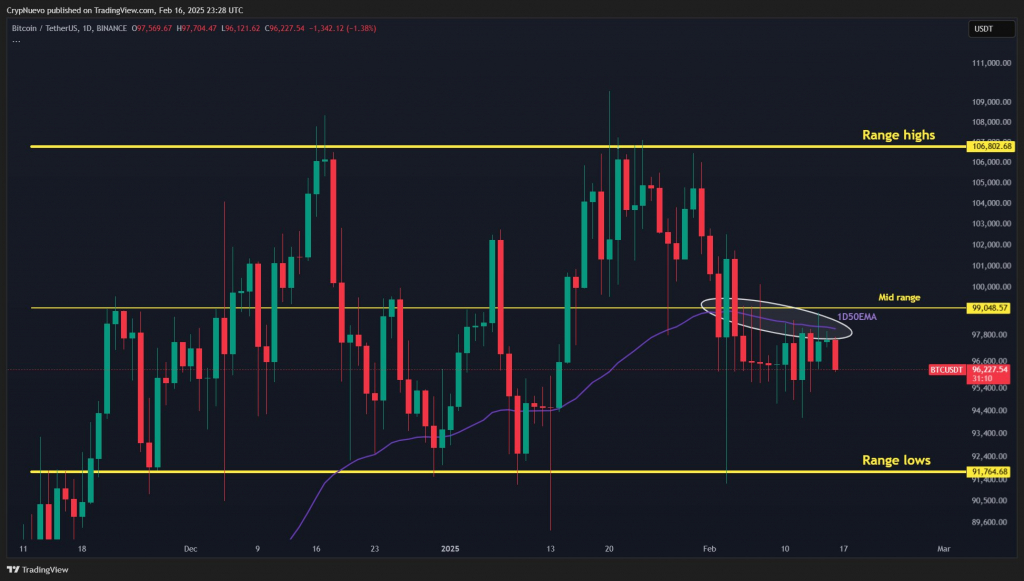
1-дневный график BTC/USD. Источник: CrypNuevo

В поисках точки разворота

На основе данных о ликвидациях с торговой платформы Hyblock Capital, CrypNuevo выделил два ключевых уровня: $93 300 и $99 200. Трейдер считает, что сначала цена протестирует нижний уровень ликвидаций, после чего последует рост к верхнему.

Трейдер CJ обозначил $102 000 как ближайшее сопротивление. «Если мы пробьем этот уровень, я буду смотреть на $125 000. Но сначала возможно снижение до $80 000», — отметил он.

Позиция ФРС может повлиять на рынок

В центре внимания инвесторов — публикация протокола январского заседания Федеральной резервной системы США, где регулятор решил сохранить ставки без изменений. За последний месяц инфляция оказалась выше прогнозов, что заставило рынки пересмотреть ожидания относительно снижения ставок в этом году.

По данным Чикагской товарной биржи, вероятность снижения ставки даже на 0,25% на мартовском заседании ФРС составляет всего 2,5%.
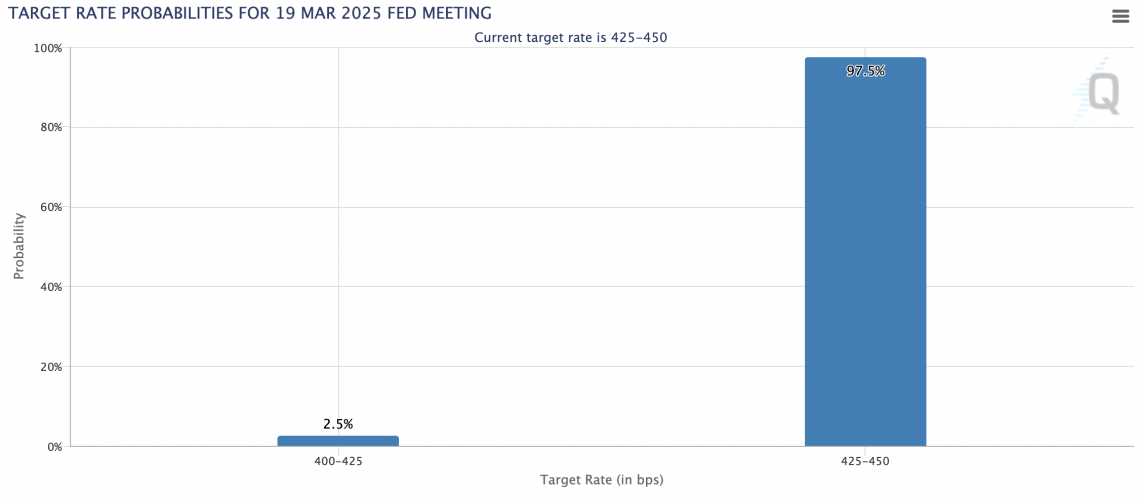
Вероятность изменения ставки ФРС. Источник: Fedwatch

Настроения инвесторов разделились

По данным аналитической платформы CryptoQuant, индикатор Inter-Exchange Flow Pulse (IFP), отслеживающий перемещения биткоина между спотовыми и деривативными биржами, подает медвежий сигнал. Когда крупные инвесторы начинают переводить биткоины с деривативных на спотовые биржи, это может указывать на снижение аппетита к риску.
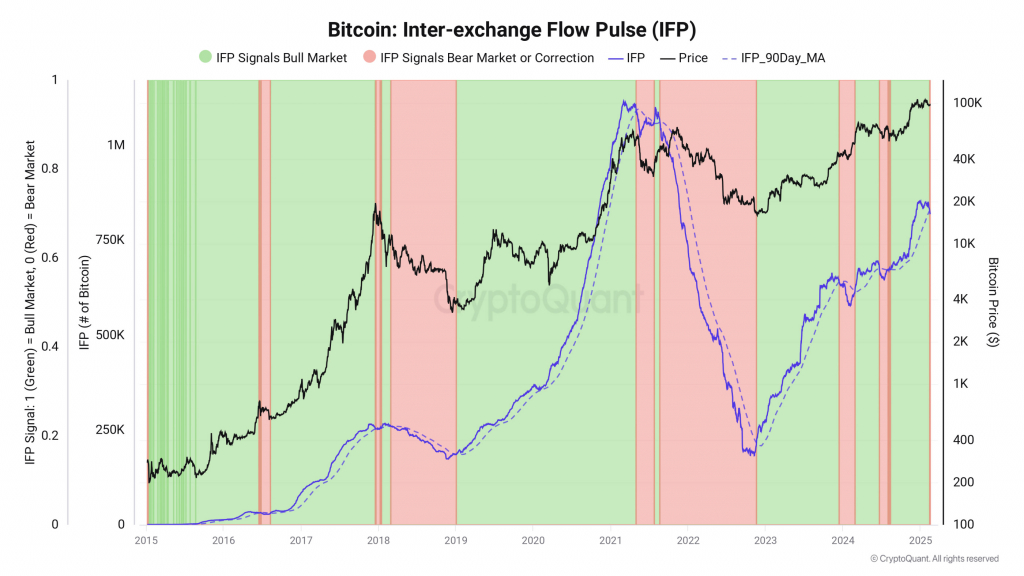
Индикатор IFP биткоина в красной зоне. Источник: CryptoQuant

Несмотря на боковое движение биткоина в диапазоне $90 000–$105 000, данные о движении средств указывают на продолжающееся накопление. Когда 30-дневная скользящая средняя соотношения притоков и оттоков с бирж опускается ниже 1, это говорит о преобладании вывода средств над вводом. Многие профессиональные инвесторы интерпретируют такую динамику как признак роста спроса.
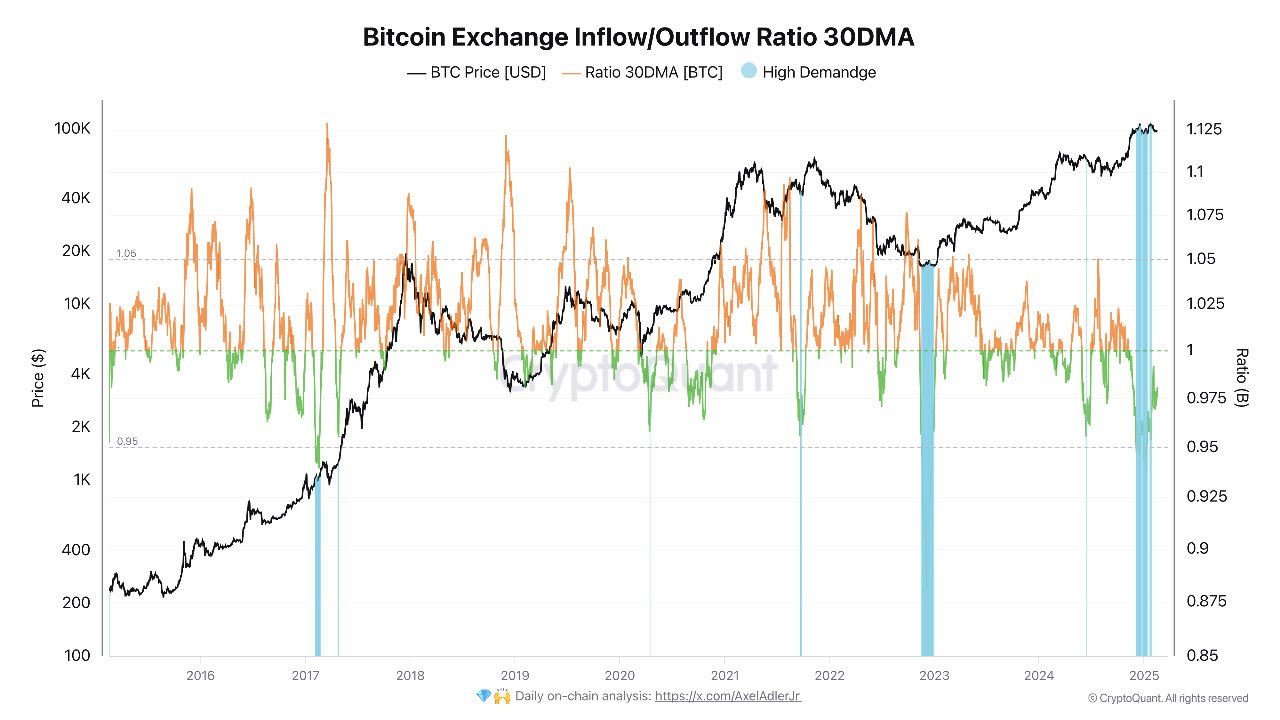
Соотношение притоков и оттоков биткоина с бирж. Источник: CryptoQuant

Впрочем, как отмечают аналитики CryptoQuant, часть этих оттоков может быть связана с рутинными переводами активов централизованными биржами на кастодиальные кошельки ETF, институциональных инвесторов и внебиржевых площадок.

Долгосрочные инвесторы в зоне прибыли

При этом держатели биткоина, хранящие монеты более 6 месяцев, сейчас находятся в существенном плюсе. По данным Glassnode, показатель нереализованной прибыли (NUPL) этой группы инвесторов уже месяц держится выше критической отметки 0,75, что указывает на высокую потенциальную прибыль в их портфелях.
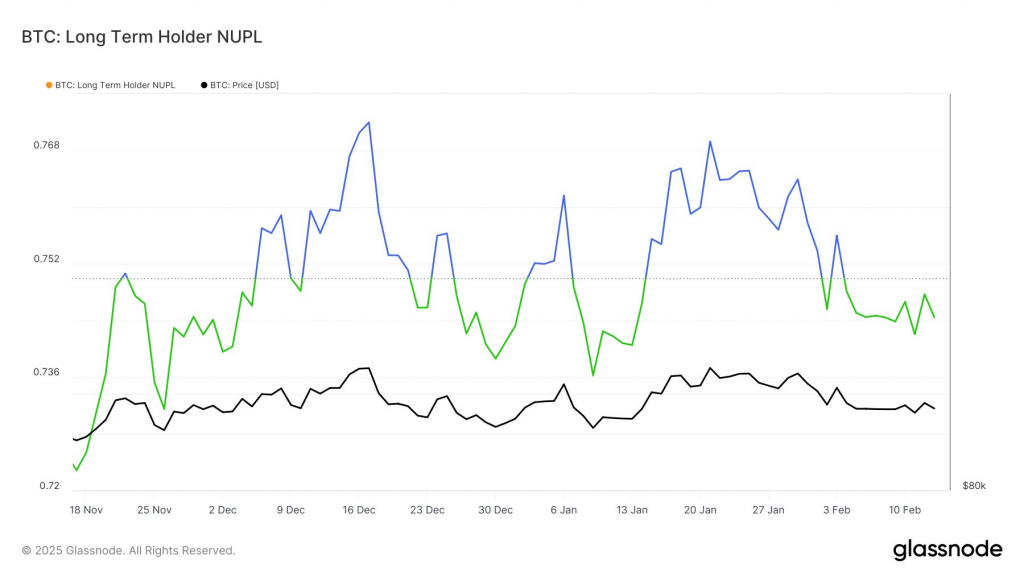
Нереализованная прибыль долгосрочных держателей биткоина. Источник: Glassnode

Исторически такие периоды «эйфории» становились все короче — с 450 до 228 дней, а их интенсивность снижалась. Это указывает на то, что долгосрочные инвесторы стали более осторожными и предпочитают фиксировать прибыль раньше, не дожидаясь максимальных значений.


Letture associate

Tiger Research: Zuckerberg Begins Betting on Prediction Markets, While Asian Nations Still View Them as Gambling

This article examines the rise of prediction markets, contrasting their growing institutional acceptance in the West with their restrictive regulation in Asia. It details how prediction markets, which originated from informal political betting and academic experiments like the Iowa Electronic Market, aggregate crowd wisdom into probabilistic prices through binary contracts. Their growth accelerated around 2020, reaching over $14 billion in monthly volume. A key driver is the "skin in the game" principle, where users risk their own capital, leading to high accuracy in predicting events like Fed rate decisions and elections, as demonstrated by platforms like Polymarket. Meta's entry, with Mark Zuckerberg reportedly leading the development of the Arena app, signals the market's maturation. In the U.S., court rulings have distinguished prediction markets from gambling, facilitating entry by traditional financial institutions. However, most Asian jurisdictions still classify them as gambling, focusing on social control rather than financial innovation. The article argues this stance creates three problems for Asia: 1) regulatory arbitrage pushes users to riskier offshore platforms, 2) loss of sovereign information infrastructure as valuable social sentiment data accumulates abroad, and 3) abandonment of user protection. It concludes that Asia needs a policy shift from prohibition to constructive regulation, integrating these markets into the formal system to harness their data as a national asset, as initiatives like Limitless Research are beginning to do.

marsbit2 h fa

Tiger Research: Zuckerberg Begins Betting on Prediction Markets, While Asian Nations Still View Them as Gambling

marsbit2 h fa

Ethereum's Next Decade in the Eyes of Vitalik

"Lean Ethereum" Long-Term Roadmap Unveiled by Vitalik Buterin On July 5, 2026, Vitalik Buterin published the "Lean Ethereum" roadmap, positioning it as Ethereum's third major evolution following the Merge. This multi-year, multi-phase upgrade aims to fundamentally transform Ethereum's core protocol through staged network upgrades extending to 2029. Key goals include achieving 1 gigagas per second L1 throughput (a massive increase from the current ~32 TPS), near-instant finality, and quantum-resistant cryptography. The plan involves transitioning Ethereum's security model from full transaction re-execution by all nodes to native verification via recursive STARK proofs. A major proposed change is replacing the EVM with a proof-friendly architecture like RISC-V or leanISA, though this remains a point of contention, especially with L2s like Arbitrum favoring alternatives like WASM. Other planned upgrades include a restructured state model with a large, cheap "warehouse" storage layer to drastically reduce fees for migrated applications, multi-dimensional gas pricing, and a new focus on making privacy a first-class, native protocol feature. While the roadmap significantly raises Ethereum's long-term technical ceiling, analysts note it does not directly address ETH's mid-term token economics or value capture. The plan's multi-year timeline means near-term price impact will likely depend on observable progress milestones, such as the successful deployment of the upcoming Glamsterdam gas limit increase, growth in L2 activity and blob usage, and trends in L1 fee revenue and ETH burn.

链捕手3 h fa

Ethereum's Next Decade in the Eyes of Vitalik

链捕手3 h fa

In Just 11 Days, Claude Rewrote Millions of Lines of Code, an Epic AI Engineering Feat Sparks Fury

In just 11 days, Bun's founder Jarred Sumner used Anthropic's Claude AI models to rewrite its million lines of code from Zig to Rust. This move sparked significant controversy, particularly from Zig's creator, Andrew Kelley, who publicly criticized Sumner's engineering practices and the decision to use AI for such a massive rewrite. Bun, a high-performance JavaScript/TypeScript runtime and rival to Node.js, was originally written in Zig. After Anthropic acquired Bun, the team encountered persistent stability and memory safety bugs in the Zig codebase. These issues, combined with Zig's strict policy against LLM-generated code, led to the decision to rewrite in Rust. The rewrite was executed using Claude AI tools at an estimated API cost of $165,000, dramatically reducing the expected time and financial cost. Andrew Kelley's response was scathing. He blamed the original bugs on poor engineering habits, calling Bun's Zig code a collection of "hacks on top of hacks." He expressed relief that Bun was no longer associated with Zig, fearing it would misrepresent the language and attract low-quality, AI-generated contributions. The tech community is divided; some view Kelley's critique as unprofessional, while others see it as a defense of engineering integrity. A major concern about the AI-driven rewrite is the resulting code quality. The translation from Zig left approximately 27,000 lines of unsafe Rust code, raising fears about long-term maintainability and technical debt. The debate centers on whether this project is a milestone in AI-assisted development or a future maintenance nightmare.

marsbit4 h fa

In Just 11 Days, Claude Rewrote Millions of Lines of Code, an Epic AI Engineering Feat Sparks Fury

marsbit4 h fa

Trading

Spot
活动图片