积分制衰落,下一个代币发行热点在哪?

Odaily星球日报Pubblicato 2024-10-14Pubblicato ultima volta 2024-10-14

Introduzione

高FDV代币的推出给新买家留下的空间很小,标志着积分机制的衰落。

原文作者:Ignas | DeFi

原文编译:深潮 TechFlow

积分制衰落,下一个代币发行热点在哪?

每次牛市都会带来新的代币发行方式,理解这些趋势可能是最有利可图的策略。

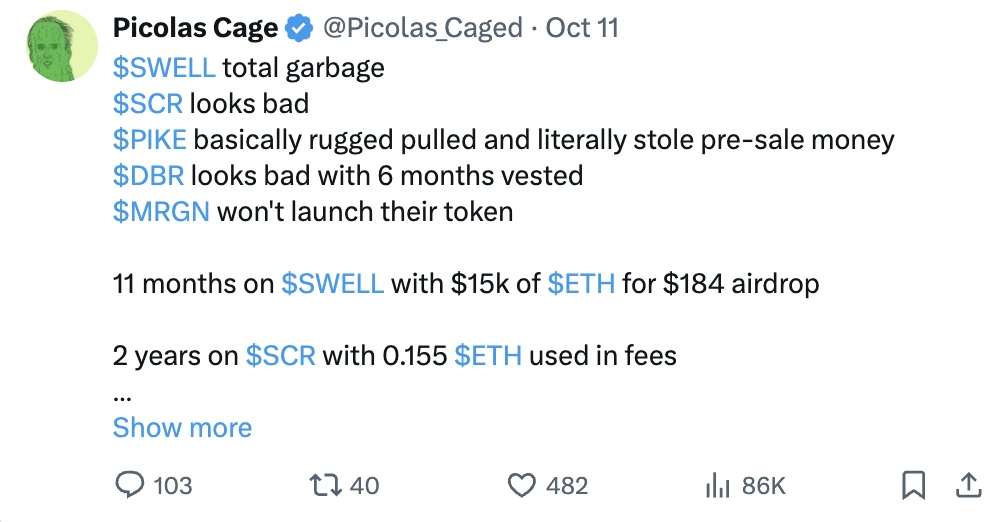
本轮周期由积分空投的趋势兴起,Jito 和 Jupiter 等项目引领潮流。

然而,随着投机者积极获取积分,他们在空投中获得的收益不及投入的成本,导致投资回报率 (ROI) 很快变为负值。
积分制衰落,下一个代币发行热点在哪?

(推文详见此处

然而,积分机制只是我们在市场上寻找最佳代币发行方式的一种演变。

从需要运行 PoW 机器的 Litecoin BTC 分叉,到 ICO,再到 DeFi 的流动性挖矿,这些模式非常明显:每个周期,代币的发行变得越来越容易,而估值也在不断上升。

高 FDV 代币的推出给新买家留下的空间很小,标志着积分机制的衰落。

现在,我相信市场正在自我调整。

由于新买家缺乏兴趣,低流通量代币的估值已经下降,但新代币仍然像 2023 年那样推出——它们为旧机制筹集资金并设计了 TGE。

锁定的条款限制了它们的增长潜力。不适应新机制的 TGE 表现不会太好。

新代币发行的适应速度越慢,Meme 币的狂热就会持续得越久。Meme 币是 VC 代币的对立面,因为它们没有实际用途、没有收入,也没有未来产品。

除了 Meme 币,一个显著的变化是市场正回到积分机制出现之前:像 Eigenlayer 这样的协议正在转向“程序化激励”,表明流动性挖矿的回归。

我们还看到所谓的私有-公开销售的兴起:在 @echodotxyz 和 @legiondotcc 等平台上,您可以参与并投资 VC 参与的交易。

这意味着较低的估值和锁仓期,就像 ICO 时代一样,但要参与这些交易也需要一些社交资源:

  • 在 @echodotxyz 上,您需要被邀请或接受加入专属小组。

  • 在 @legiondotcc 上,您可以根据社交或链上声誉参与交易。您的投机活动可以证明您“值得”加入影响者和 VC 的行列。

然而,由于参与者人数有限,这些方式无法解决所有代币发行的问题。

@CoinList 通过使 ICO 分配的访问随机化“解决”了这个问题。有趣的是,Coinlist 多年前就推出了,所以我们走了一个完整的圈子!

然而,我相信基于优点的访问更为优越,因为这样您会被激励去建立自己的链上或链下声誉。

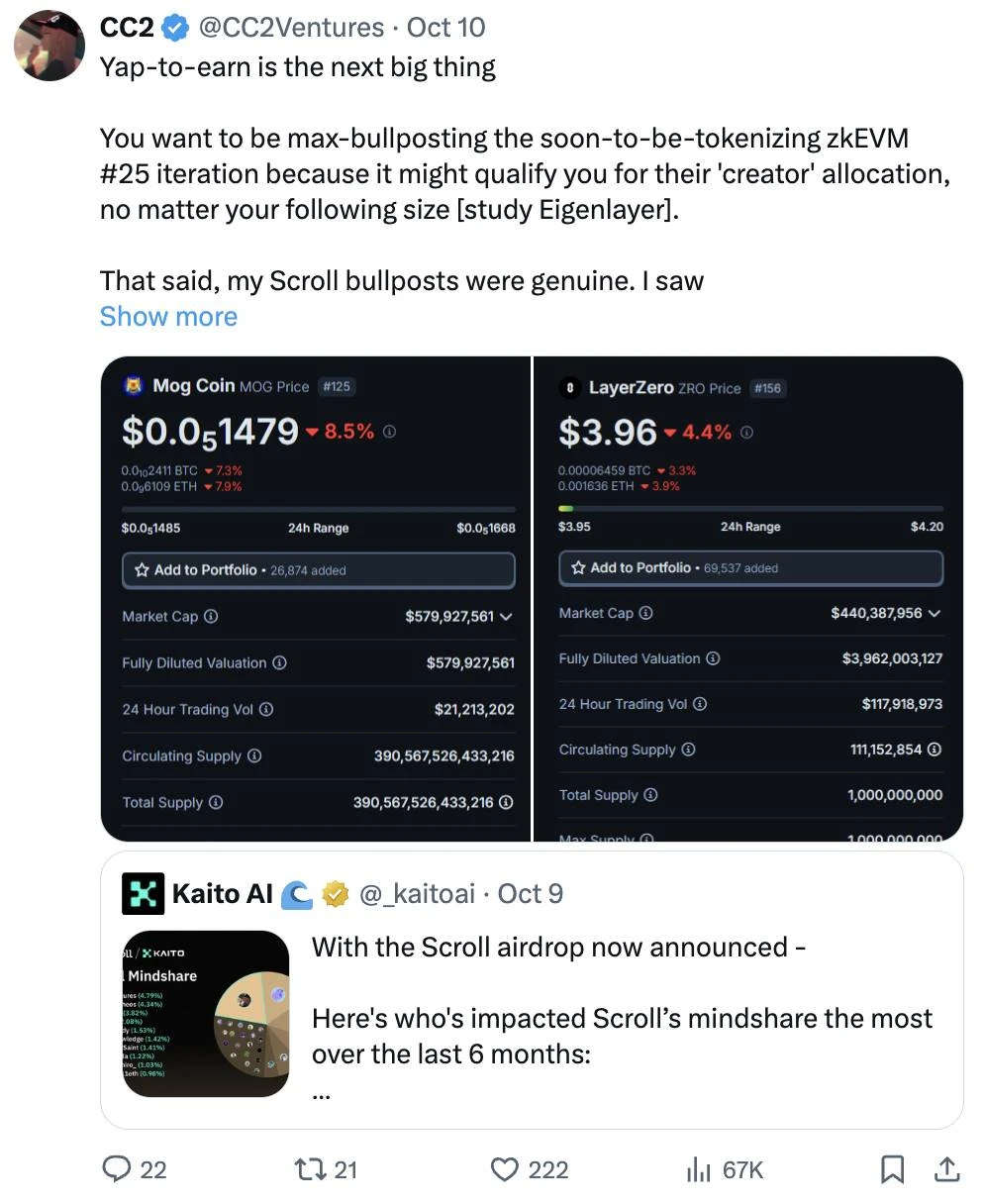
因此,请确保您在社交媒体上积极分享您最喜欢的项目,因为这可能会为您带来代币分配。Eigenlayer 和 Avail 只是 yap-to-earn 模式增长的两个例子。
积分制衰落,下一个代币发行热点在哪?

(推文详见此处

另一种可能兴起的趋势是由 @infinex_app 推出的“Patron Sales”。Infinex 将积分制度与基于优点的 ICO 结合,您需要通过赚取积分来参与 ICO。

值得注意的是,近年来首次,参与代币销售变得越来越困难,这标志着从流动性挖矿、公平发行和积分机制的一种变化。

似乎我们终于意识到,仅仅发放免费代币并不能真正建立一个社区!

然而,其他趋势对所有人更为开放。 比特币上的 Runes 只需支付交易费用即可发行,即使有(可选的)预挖功能,也能保持透明。

它们应对了 VC 轮次、预售、低流通量代币和 Meme 币发行中缺乏透明度的问题。

Runes 可能提供了最公平的代币发行模式。您只需支付比特币交易费,加上比特币较慢的速度,防止了过度发行和钱包集中,这与其他区块链不同。

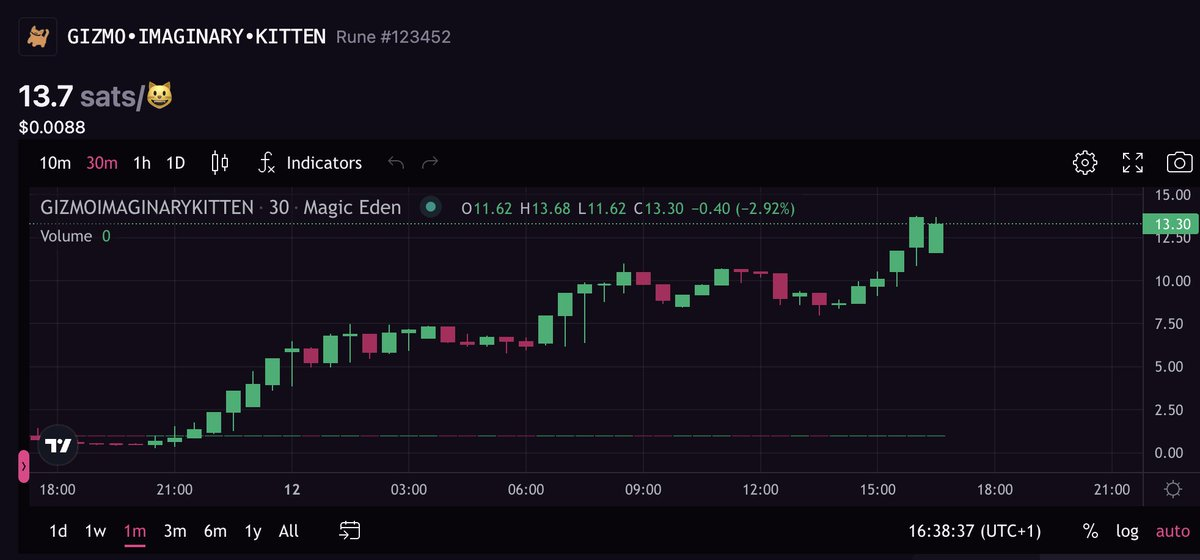
一个例子是 GIZMO•IMAGINARY•KITTEN 代币,它免费铸造,现在的交易价格是首次上市价格的 26 倍。
积分制衰落,下一个代币发行热点在哪?

显然,Runes 缺乏智能合约能力,使其无法成为具有实际用途的代币,但越来越多的 BTC L2 可以添加这些功能。

我们还在尝试其他铸币模型:

  • Tap-to-earn:在许多发展中国家很流行,但其热度似乎正在减退。

  • 社区/社交代币:Friend tech 开创了这一模式,但通过代币在 Farcaster/Lens 上实现社区货币化是一个正在兴起的趋势(例如 $DEGEN)。

  • 主动验证服务:通过再质押协议支持的 AVS 提升了代币的效用(例如 rsENA x Symbiotic 和再质押 MKR),虽然目前大多数 AVS 代币作为 VC 代币发行。希望他们能很快在代币发行上进行创新。

更多的模型正在出现,这是个好兆头!

我们的目标是识别并参与这些新的代币发行活动。尝试所有这些,看看哪个相较于投入的精力能让你赚钱。

这些模型中的一个(也许是我在这里没有提到的,尚未出现的)将成为新的热门趋势,当它出现时,可能是一个投资的好时机。

Letture associate

Six Complaints from an Ethereum Developer

A disgruntled early Ethereum developer and token holder presents six core criticisms of the project's trajectory, contrasting it with Solana's rise. 1. **Premature Complacency**: The Ethereum Foundation shifted from a "building" to an "infrastructure" mindset too soon, adopting a passive, "retired chairman" posture before securing market dominance, reflected in ETH's ~65% decline against BTC post-Merge. 2. **Misguided Messaging**: The Merge was marketed primarily on ESG (99.95% energy reduction) rather than user benefits like speed or yield, appealing to internal ideals instead of market demands. 3. **Delayed Execution**: Proof-of-Stake, on the roadmap since 2015, took seven years to launch, ceding critical narrative and development windows. Competitors like Solana built entire ecosystems in that time. 4. **Poor Native Staking UX**: Years after the Merge, there is still no first-party, user-friendly staking application, forcing reliance on centralized services like Lido and undermining ETH's "sound money" narrative. 5. **Managed Decline**: The rollup-centric roadmap deliberately weakens the base layer's fee capture, outsourcing value and profitability to L2s like Arbitrum and Base, which issue their own tokens and fragment capital. 6. **Ideology Over Product**: Ethereum culture prioritizes philosophical purity ("credible neutrality," "public goods") over competitive product delivery that meets user demands (e.g., financialization), while Solana's ecosystem focuses on coordinated execution. The diagnosis is accumulated execution debt, not a coordination failure. Ethereum possessed a structural advantage in 2021 but spent years in governance debates, while Solana efficiently executed. The current market cap reflects these specific strategic failures, not abstract theory.

marsbit56 min fa

Six Complaints from an Ethereum Developer

marsbit56 min fa

Six Complaints from an Ethereum Developer

Six Grievances from an Ethereum Developer The author, an early investor and developer still building on Ethereum, expresses deep frustration with its trajectory and declining ETH/BTC price since the merge. The core argument is that Ethereum's current market position stems from concrete failures in execution and strategy, not abstract coordination problems. The first grievance targets a shift in the Ethereum Foundation's mentality from builders to "infrastructure," adopting a premature posture of a retired victor. Second, marketing the Merge around ESG (99.95% energy reduction) is seen as talking to its own conscience rather than the market, which prioritizes user experience and yield. Third, the seven-year delay in delivering Proof-of-Stake (PoS) ceded critical narrative and development time to competitors like Solana. Fourth, three years post-merge, there is still no user-friendly first-party staking application, forcing reliance on centralized services like Lido and undermining ETH's monetary narrative. Fifth, the rollup-centric roadmap has strategically surrendered base-layer fee capture to L2s, fragmenting value within the ecosystem while Solana demonstrates an integrated L1's value accrual. Finally, the author criticizes an institutional culture that prioritizes philosophical ideals (credible neutrality, pluralism) over competitive product delivery focused on what users actually want. The diagnosis is "accumulated execution debt." Ethereum possessed a structural advantage in 2021 but spent years in governance debates, while Solana's ecosystem coordinated efficiently to deliver and capture the next wave of value. The conclusion is that Ethereum's market cap reflects its abandonment of the fight for asset appreciation.

链捕手1 h fa

Six Complaints from an Ethereum Developer

链捕手1 h fa

Token Budget Wars: Enterprise AI Enters the 'Accounting Era'

Token Budget Wars: Enterprise AI Enters the "Accounting Era" Enterprise AI is shifting from the question of "whether to adopt" to "how to account for it." As AI inference costs evolve from experimental budgets into ongoing operational expenses, CEOs and CFOs are demanding proof of value: what tangible results does each dollar spent on tokens deliver? The core of "Token Budget Wars" is not simply about reducing AI bills, but about intelligently allocating compute resources. It involves determining which business processes warrant more computational power, which tasks can use cheaper models, which can be outsourced or handled manually, and which are merely inefficient consumption. A key insight is that AI usage (token consumption) does not equal value. While SaaS usage indicated software adoption, AI token usage only indicates the "meter is running." The same workflow can cost vastly different amounts due to factors like prompt quality, context, model choice, and retries. The critical metric for scaling is "marginal token utility"—the business value created per additional dollar of inference cost. However, this is difficult to measure due to challenges like the long tail of retries, context inflation (where costs can scale quadratically with context length), and inefficient model routing (defaulting to the most powerful model for all tasks). The competition for token allocation is intensifying because, in the AI era, influence is tied to how much intelligence one can command, not just team size. AI spending is essentially competing with labor costs, whether for replacing external BPOs, internal staff, or generating new revenue. BPO contracts provide a clearer benchmark as they are priced per completed unit. The missing layer is attribution from tokens to business outcomes. Companies need a system that connects inference spending to completed work and results, capturing the agent's decision trajectory—what it saw, retrieved, tried, and why it succeeded or failed. This recorded rationale becomes a valuable asset. Ultimately, those who master token-to-outcome attribution will control the allocation of AI resources within enterprises, deciding which workflows get more compute, which are capped, or which revert to humans. The first phase of enterprise AI proved models could do the work. The next phase will determine how much of that work is worth paying for.

marsbit1 h fa

Token Budget Wars: Enterprise AI Enters the 'Accounting Era'

marsbit1 h fa

Trading

Spot
Futures
活动图片