降低交易风险的 20 条铁律

深潮Pubblicato 2024-09-12Pubblicato ultima volta 2024-09-12

如果你不主动管理风险,市场就会替你管理。

作者:Edgy - The DeFi Edge

编译:深潮TechFlow

在加密货币领域,风险管理是最重要的技能。

如果你不主动管理风险,市场就会替你管理。

以下是 20 条聪明的规则,可以帮助你降低风险并增加利润:

1. 快速轮换

市场叙事和情绪变化非常快。新的协议可能在短短几周内取代市场领头羊。

时刻关注市场动态。尽早入场,并在大多数人之前退出。

把最后 20% 留给别人

当你获利时,很容易想要精准把握最高点,榨取每一个百分点的利润。

但这是不可能的,错误的时机可能会让你成为长期持币者。

不要贪心。

2. 尽早止损

我们都会犯错,但区别在于,有些人在亏损 15% 时就卖出,而有些人一直持有到亏损 80% 才卖。

在交易前就要制定好退出计划和规则。这样资金可以重新投入到更有潜力的投资中。

例如:如果亏损超过 15%,就卖出。

3. 获利的心理学

你可能会因为害怕错失“100 倍”的机会而不敢获利了结。

但即便你提早卖出,而它涨了 100 倍,你仍然获利。关键在于,你保护了自己免受可能的损失。

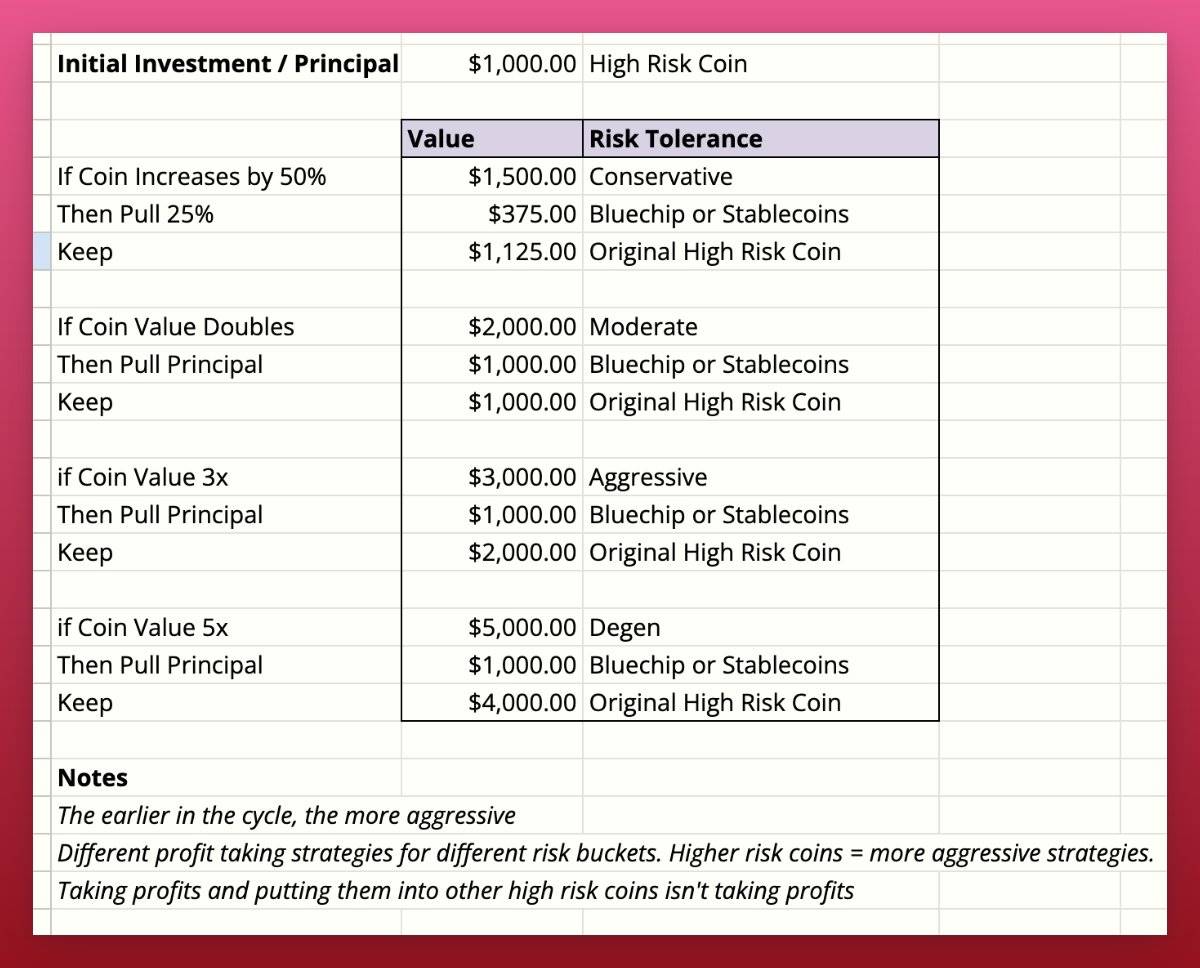
4. 获利了结

在你锁定利润之前,一切都只是屏幕上的数字。

当你收回初始投资时,会有一种心理上的满足感,而剩下的利润则可以继续增长。

用简单的公式来指导你的操作。
5. 等待市场稳定期

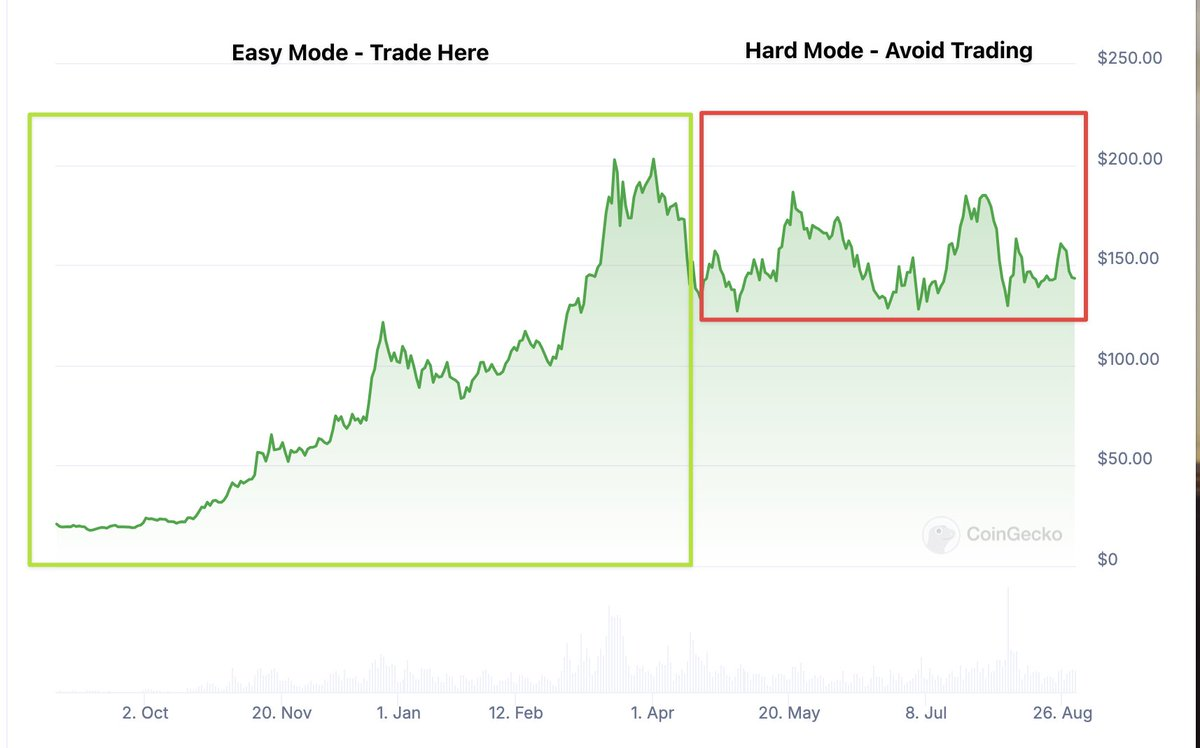
市场稳定期是指当流动性进入市场,整个行业呈现积极趋势。这种情况每年会发生几次。不要因为感到无聊或寻求刺激而参与波动市场。你不需要每天都进行交易。(如图所示的 Solana)
6. 创建一个平衡的投资组合

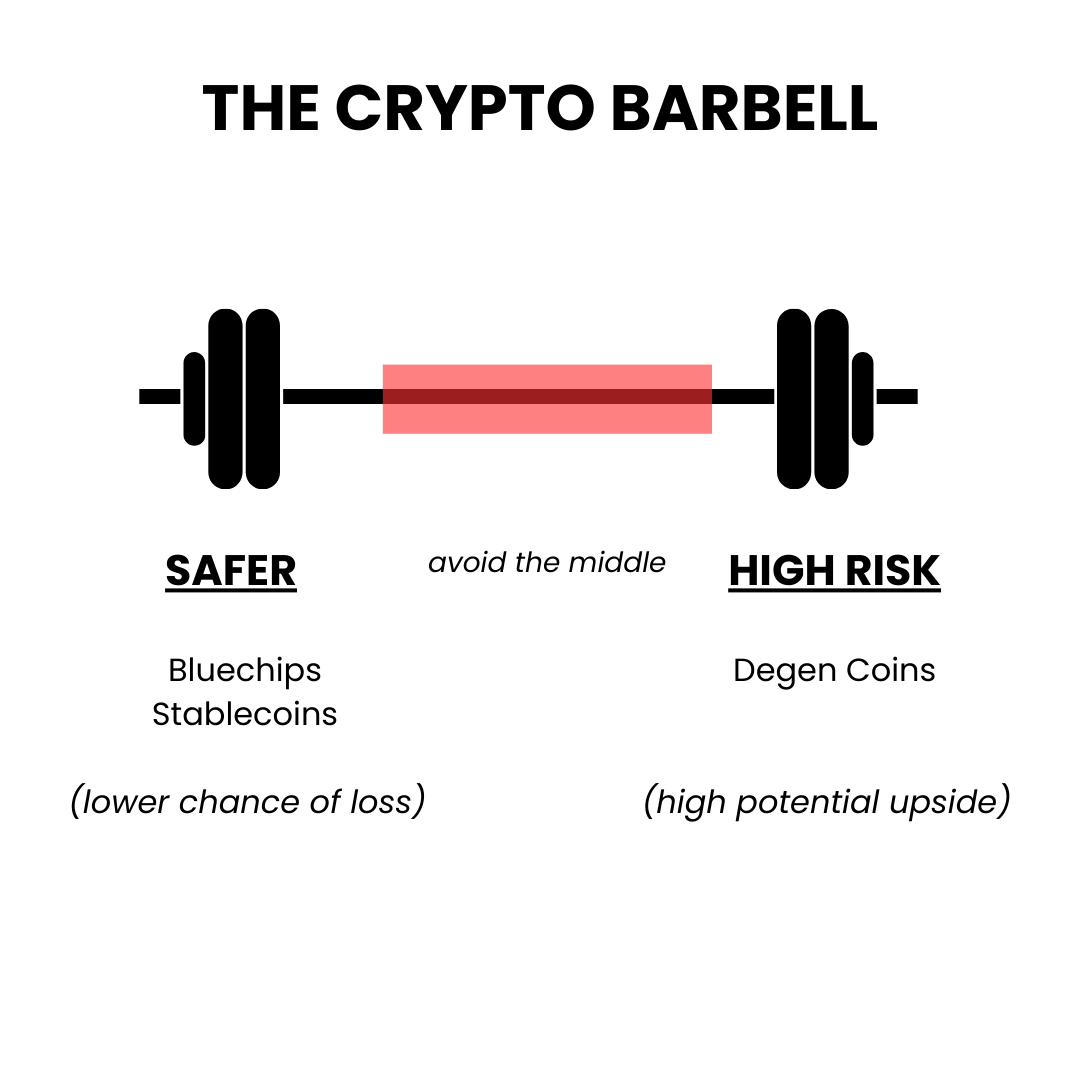
我的长期投资组合主要包括 ETH,并保留了一些稳定币。这些安全资产让我能够更从容地承担较大风险。我喜欢以杠铃策略来构建投资组合——一边是安全资产,另一边是高风险投资。
7. 追求 Alpha 投资

许多人因不断追逐高风险的贝塔投资而亏损。一个替代策略是选择市场领导者:

  • Pendle 用于真实世界资产 (RWA)

  • Bananagun 用于 Telegram 机器人 (TG Bots)

  • 选择 ETH 而不是 ETH 的贝塔投资

潜在的强劲回报和较低风险。

8. 不要随意改变目标

2021年,我的朋友实现了他的目标:将15万美元变成了100万美元。但随后他又设立了新的目标,“再过几个月,我就可以一劳永逸了。”他错误地判断了市场顶点,最终资产回落到15万美元。要知道什么时候是“足够”。

9. 切勿将资产锁定

我见过太多人为了额外收益或积分将 Token 锁定,结果被协议“收割”。重视可选择性——你不希望在市场变化比预期更快时,Token 被锁定而无法使用。

10. 避免单点故障

1)将你的稳定币分散在 USDC、USDT 和 Dai 之间

2)使用多个中心化交易所进行入金,以防其中一个被锁定

3)将你的加密货币分散在多个钱包中

11. 将利润投入 Degen 币并不算是真正的获利

获利意味着你要从市场中撤出资金,将利润转入稳定币、长期持有或兑现。将利润投入 Degen 币更像是在进行复式押注。

12. 不要将超过 15% 的资金投入非蓝筹或非稳定币资产中

在加密货币领域,没有任何保证,也没有什么是大而不倒的。

  • Terra 和 FTX 都曾失败。

  • Euler 和 Curve 也曾遭黑客攻击。 黑天鹅事件比你想象中更常见——要保护好你的下行风险,以免一切归零。

13. 坚持在你的能力圈内行动

选择 2-3 个领域进行深入研究。每周在一个领域专注研究 10 小时将使你位列前 1%。许多风险源于投资你不熟悉的领域,仅仅因为害怕错过机会而盲目投资。

14. 定期调整投资组合

你应该为投资组合设定一个目标分配比例,这会因市场周期阶段的不同而有所变化。市场火热时,高风险 Token 表现优异,容易导致投资组合失衡,因此要养成定期调整的习惯。

15. 在加密货币领域之外进行多元化投资

我常常将获利资金投入加密货币以外的领域,包括最大化退休基金、建立充足的应急基金以及再投资于业务。这让我更能从容应对加密货币的波动性。

16. 尽量避免在现实生活中谈论加密货币

在发展中国家旅行时,佩戴金饰的人比低调的人更容易成为抢劫目标。同样,在现实生活中谈论加密货币越多,就越可能成为目标。

如果有人问我是否从事加密货币,我会说我在 FTX 崩盘时失去了一切,现在从事电子商务供应链工作。富有的人往往高调,而真正的财富则是低调的。不要给自己或家人招来不必要的注意。避免参与地位竞争。

17. 使用合适的安全工具

你应该使用 Rabby Wallet、Brave 浏览器、DeFiLlama 扩展、Wallet Guard 等。通过 DeFiLlama 扩展的绿色 Llama,我能确认自己在正确的协议网站上。

18. 使用临时钱包

我常常尝试新的协议,因此配备了一个临时钱包。这样即便协议是恶意的,我最多也只会损失 100 美元。把临时钱包视作在 Tinder 约会时使用的安全措施。

19. 不要试图在一个周期内实现成功。

• 大量使用杠杆。

• 借钱投资加密货币。

• 过度投资于高风险币种。

这些行为都是因为急于在一个周期内成功而承担过多风险。

20. 最终,整个行业都在鼓励你更加乐观并承担更多风险。为什么?

因为如果你进行风险管理,他们就赚不到钱。他们希望你购买他们手中的资产。

你必须对自己的财富负责。

学会防守才能赢得胜利。

Letture associate

After $HYPE Hits a New High, Is It Worth Considering the Stock of "HYPE Version MicroStrategy" $PURR?

**HYPE Hits New Highs: Is $PURR, the "HYPE Version of MicroStrategy," Worth Considering?** The stock of Hyperliquid Strategies (NASDAQ: $PURR), a publicly-traded company that exclusively buys and holds the cryptocurrency HYPE, has gained over 100% year-to-date, mirroring HYPE's own 150% surge to new all-time highs. This has sparked discussions about PURR being a more "capital-efficient" play than MicroStrategy's bitcoin strategy, given its reported ~$1 billion unrealized gain on a ~$220 million investment. The article clarifies that PURR is essentially a pure-play wrapper for HYPE, with no other business. It resulted from a 2025 SPAC merger led by firms like Paradigm and Atlas Merchant Capital, bringing traditional finance veterans to its board. Its value is entirely derived from the price of HYPE. While PURR offers a crucial compliance bridge for US-based institutional and retirement accounts unable to access HYPE directly, the analysis questions the "capital efficiency" narrative. The outsized gains are attributed to HYPE's exceptional performance, not superior corporate strategy. For investors who can buy HYPE directly, holding PURR introduces unnecessary risks: potential shareholder dilution from future stock offerings, incomplete passthrough of staking rewards, market hour mismatches, and counterparty risk via its single custodian. A key metric is its mNAV (modified net asset value). Current calculations show PURR trades at a discount to its HYPE holdings, but this could flip to a premium depending on the execution of registered share issuances. The article concludes that PURR is primarily a "conduit product." The investment thesis hinges entirely on one's bullishness on HYPE itself, not on the PURR wrapper, which adds friction and risk for those with direct crypto access.

marsbit27 min fa

After $HYPE Hits a New High, Is It Worth Considering the Stock of "HYPE Version MicroStrategy" $PURR?

marsbit27 min fa

The Real Progress and Investment Opportunities of Decentralized AI Computing Power Networks in 2026

In 2026, the AI compute market is marked by centralized GPU consolidation and a significant GPU shortage for smaller players. In this context, Decentralized Physical Infrastructure Networks (DePIN), valued at $9.4B+, have emerged as a viable, revenue-generating alternative. Leading protocols like Aethir ($150M ARR), io.net (130k+ GPUs), Akash, Bittensor, and Render are carving out distinct niches, moving beyond hype to deliver verifiable income primarily from non-crypto-native clients. The key advantage of decentralized GPU networks lies in serving latency-tolerant, cost-sensitive workloads like AI inference, fine-tuning, data preprocessing, and agent operations, offering substantial cost savings (45-80%) compared to major cloud providers. However, reliability variance, lack of robust SLAs, and fragmented tech stacks remain significant adoption hurdles. The sector is maturing with critical 2026 shifts: 1) Evolution of tokenomics towards demand-driven, revenue-linked models (e.g., Render's BME, io.net's IDE), and 2) Clearer enterprise adoption pathways, with traditional firms integrating decentralized compute. For new entrants, opportunities are now concentrated in specialized tooling layers (orchestration, verification, SLA management), vertical applications (e.g., bio-med, content generation), and innovative token designs tied to real usage, rather than generic GPU aggregation. The convergence with the emerging AI Agent economy presents a significant future growth vector.

marsbit28 min fa

The Real Progress and Investment Opportunities of Decentralized AI Computing Power Networks in 2026

marsbit28 min fa

We Captured Thousands of Job Postings and Discovered ByteDance is Reviving Smartphone R&D

This article analyzes ByteDance's recent hiring activities, revealing a potential restart of smartphone hardware development. By scraping and analyzing thousands of ByteDance job postings, the authors identify three key categories: roles for the "Doubao Phone Assistant" (an AI agent), for a "Mobile OS" (system-level development), and for hardware/engineering positions in Shenzhen (a manufacturing hub). The piece traces the context to the 2025 launch of the "Doubao Phone," a concept device that integrated an AI agent directly into a smartphone, allowing it to see the screen, operate apps, and perform tasks like shopping or booking tickets. While innovative as an early AI Agent prototype, it faced operational restrictions from major platforms like WeChat and Alipay. The new hiring signals a deeper commitment. "Doubao Phone Assistant" roles focus on core Agent capabilities (task execution, memory, cross-app operation). "Mobile OS" positions involve deep system work (kernel, chip adaptation, power/thermal management) necessary for a responsive, always-on AI. Shenzhen-based hardware roles (structure design, testing, production) suggest preparation for physical device manufacturing. The article concludes that in the AI era, where phones may become an Agent's "body," controlling the operating system and hardware is critical. For a company like ByteDance, being merely an app within others' ecosystems is no longer sustainable if it aims to own the next-generation user interface. Therefore, while a consumer phone brand isn't confirmed, ByteDance is decisively moving beyond app development into the complex domain of system-level and hardware-integrated AI.

marsbit58 min fa

We Captured Thousands of Job Postings and Discovered ByteDance is Reviving Smartphone R&D

marsbit58 min fa

AI Impact on SaaS Software Stocks: Deconstructing the Bottom-Fishing Logic of Salesforce, ServiceNow, and Snowflake

"AI Nightmare for SaaS Stocks: Unpacking the Bottom-Fishing Logic for Salesforce, ServiceNow, and Snowflake" A deep dive analysis argues that the recent collapse in SaaS software stocks, dubbed the "SaaS Doom," presents a contrarian buying opportunity. The market panic, triggered by fears that AI will disrupt traditional per-user subscription models through "seat compression" and AI agents bypassing software UIs, has led to extreme selling in the software sector. The analysis evaluates three major players under a unified framework: 1. **Salesforce (CRM):** Positioned as a "margin of safety" play. Trading at historically low valuations (13-14x forward P/E), with strong cash flow and a massive buyback, it offers value. Its key challenge is transitioning from a "seat economy" to an AI-driven "task economy" with its Agentforce platform. 2. **ServiceNow (NOW):** The "clearest AI narrative" play. Its "AI Control Tower" strategy aims to become the governance and orchestration layer for enterprise AI agents, benefiting from AI proliferation. Backed by Nvidia's CEO, it trades at a relatively low valuation post-correction. 3. **Snowflake (SNOW):** The "high-risk, high-reward" bet. Its consumption-based model aligns with rising AI workloads, and its RPO growth is strong. However, it faces intense competition (e.g., Databricks), is not yet GAAP profitable, and carries the highest valuation. The conclusion counters the simplified "AI kills software" narrative. AI is eliminating software that sells only functional interfaces but rewarding platforms that provide essential infrastructure, data, and governance. The current sell-off may have created a buying opportunity for resilient software leaders positioned as future AI infrastructure platforms.

marsbit1 h fa

AI Impact on SaaS Software Stocks: Deconstructing the Bottom-Fishing Logic of Salesforce, ServiceNow, and Snowflake

marsbit1 h fa

Trading

Spot
Futures
活动图片