$26 Billion: An 'All-Chinese Team' Backs the World's Highest-Valued AI Programming Company

marsbitPubblicato 2026-05-31Pubblicato ultima volta 2026-05-31

Introduzione

Cognition AI, the company behind the AI programmer "Devin," has raised over $1 billion in new funding at a valuation of $26 billion, just eight months after reaching a $10.2 billion valuation. The round was led by Lux Capital, General Catalyst, and 8VC. Founded by three young Chinese entrepreneurs with strong competitive programming backgrounds, Cognition initially gained fame with Devin, marketed as the world's first AI software engineer capable of handling tasks from start to finish. While its early demos were impressive, real-world usage revealed reliability and cost-effectiveness issues, leading to a significant price cut for Devin in 2025. A pivotal moment came when Cognition acquired the assets of AI IDE company Windsurf after a failed acquisition by OpenAI. This move gave Cognition a crucial developer-facing tool, allowing it to pursue a two-pronged strategy: Devin for autonomous task execution and Windsurf for integrated, collaborative coding within an IDE. This shift helped the company move away from the controversial "AI replacement" narrative towards a model of augmenting human engineers, particularly for repetitive or maintenance tasks. This strategic pivot is backed by strong commercial metrics. The company reports a 10x increase in enterprise usage this year, with an annual revenue run-rate of $492 million and a 50% month-over-month growth in enterprise Devin usage over the past six months. Its client list now includes major corporations like Goldman Sachs an...

By AI Alphabet

$26 billion is the latest price tag the capital market has placed on AI programming company Cognition.

Just last September, Cognition AI had barely crossed the $10 billion valuation threshold, and at that time, it was already enough of a Silicon Valley legend.

Three young Chinese co-founders, collectively winners of 5 International Olympiad in Informatics gold medals, built the prototype of "the world's first AI software engineer" Devin from a short-term rental apartment. In just over two years since its founding, the company's valuation had surged to $10 billion.

Chinese, Olympiad, Harvard, MIT, dropping out to start a business, AI Agent... each label is attention-grabbing enough. Cognition is undoubtedly one of the most story-rich companies in the AI programming track.

Now, this story has been pushed a significant step forward by the capital market.

According to a Bloomberg report, Cognition AI, the company behind Devin, has secured over $1 billion in new funding, with a post-money valuation reaching $26 billion. This round was co-led by Lux Capital, General Catalyst, and 8VC, with participation from Ribbit Capital, Atreides Management, Founders Fund, and others. Cognition has officially confirmed this funding round and its latest valuation.

This means that in just over eight months since its previous valuation of $10.2 billion, Cognition's valuation has grown to 2.5 times its original value.

01 What Capital is Buying is More Than Just an AI Programmer

The leading capital in this round is quite representative.

Lux Capital is a highly recognizable hard-tech fund in Silicon Valley, with long-term investments in frontier science, deep tech, AI, robotics, aerospace, defense, and computing infrastructure—projects that are "relatively hardcore." On its own investment page, Cognition is categorized under "Productivity Enhancement + Infrastructure + Computer Science."

It can be said that Lux Capital's investment in Cognition focuses on Cognition's potential to turn AI Agents into software engineering infrastructure.
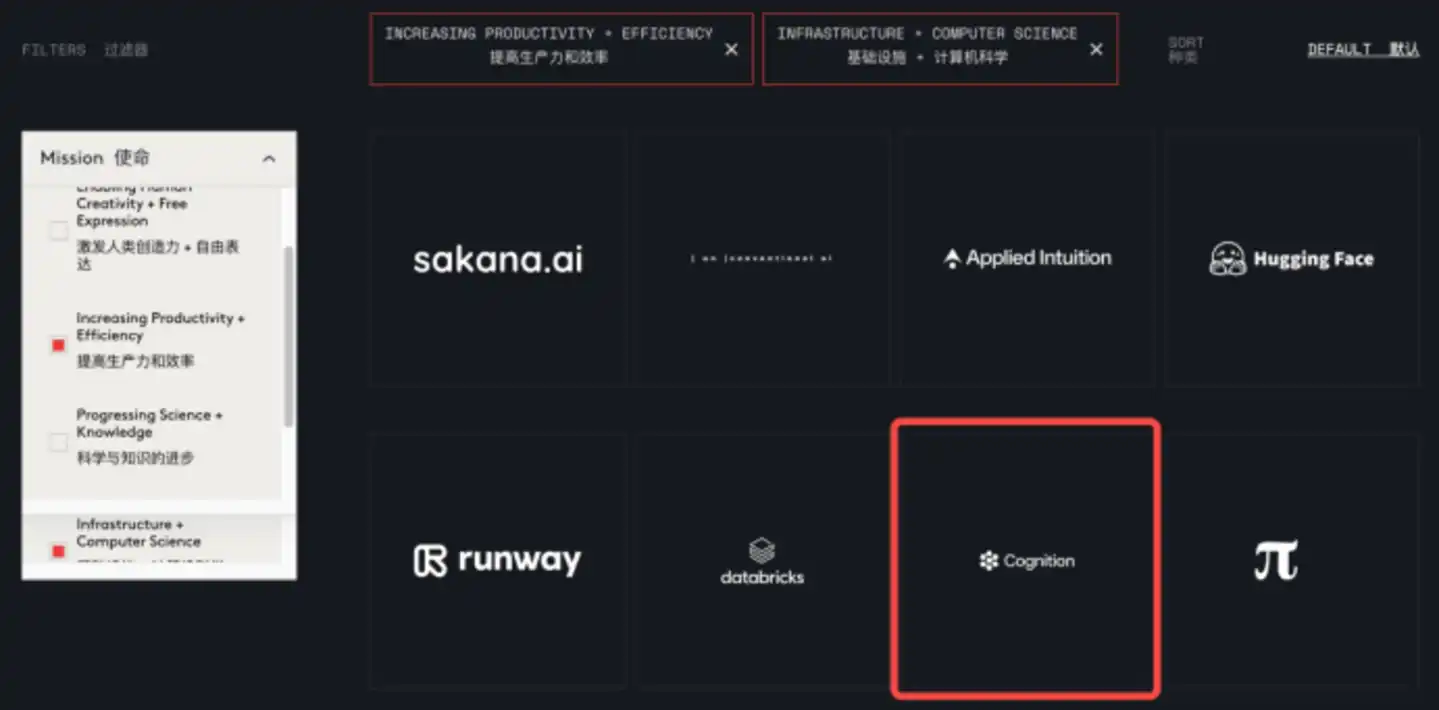
General Catalyst, on the other hand, focuses on the opportunity for enterprise processes to be transformed by AI. This firm is not just a traditional VC; it calls itself a "global investment and transformation company" on its website, emphasizing 'transformation' in recent years—using capital, operations, and corporate relationships to drive the transformation of traditional industries and large institutions.

Besides Cognition, General Catalyst is also doubling down on Anthropic. Over the past year, it has participated in multiple massive funding rounds for Anthropic.

As a co-leading firm, 8VC brings imagination for government and large enterprise deployments. This firm has long bet on "enterprise software infrastructure within complex organizations," and Cognition's client list already includes government or public-sector clients like the US Army, US Navy, and NASA. 8VC's participation as a lead investor affirms Cognition's narrative.

In addition to the three leading firms, existing shareholder Founders Fund continues to increase its stake. The approximately $400 million funding round in 2025, which valued the company at around $10.2 billion post-money, was led by Founders Fund. This firm, co-founded by Peter Thiel, has always had an aggressive investment style, preferring technology companies that can reshape industrial structures, such as SpaceX, Palantir, Anduril, Stripe, OpenAI, etc.

Lux Capital long bets on hard tech and frontier computing, General Catalyst excels at enterprise software and large institution transformation, 8VC carries enterprise software and government market genes, and Founders Fund is one of Cognition's early shareholders. The simultaneous presence of these types of capital in Cognition's funding round is enough to indicate that investors no longer see Cognition merely as a developer tools company, but as a candidate for the next generation of software engineering infrastructure.

The $26 billion post-money valuation fully proves market confidence, and the most direct reason capital is willing to continue driving up the price is growth.

Cognition has presented very solid commercialization data: enterprise usage has grown over 10-fold since the beginning of this year, revenue run-rate has jumped from $37 million in May last year to the current $492 million, and enterprise-side Devin usage has maintained a 50% month-over-month growth for the past six months.

Although $492 million is not confirmed annual revenue but an annualized run-rate calculated based on the current income pace, this growth curve is still astonishing. Investors can already see enterprise clients genuinely paying, genuinely using, and usage is still rapidly climbing—this is nothing short of legendary for a company founded in 2023.

The AI programming track is indeed thriving. Code, issues, tests, PRs, documentation are inherently highly digital work objects; whether a task is completed can be verified through tests, code reviews, and deployment results.

And for enterprises, software teams always have an endless list of tasks, each time-consuming and expensive (at least, senior engineers' hourly rates are expensive). If an AI Agent can reliably take over a portion of clear, repetitive, and verifiable software engineering tasks, it becomes engineering capacity that enterprises are willing to pay for.

Behind the $26 billion, what capital is truly buying is a judgment: software development is becoming the earliest work scenario where AI Agents are being procured on a large scale by enterprises.

02 After Devin's Explosive Popularity, Reality Poured Cold Water

Cognition first gained widespread attention through what, at the time, seemed an extremely bold vision.

Before Devin, AI programming tools mostly remained in "assistant" roles. GitHub Copilot helps programmers complete code, ChatGPT and Claude can explain errors and generate functions, while Cursor integrates AI into the editor, allowing developers to write and edit simultaneously.

But Devin took a significant step forward. It was directly defined by Cognition as an "AI Software Engineer." Users only need to describe requirements in natural language, such as developing a website, building an application feature, or fixing an issue in a codebase, and Devin would independently break down the task, write the code, fix bugs, until the project runs.

When Cognition released the Devin demo in March 2024, the entire developer community was ignited. It was promoted as the world's first AI programmer, and to some extent, became one of the landmark products that truly brought the vibe coding wave into the mainstream.

The founders themselves also came with a story. All three—Scott Wu, Steve Hao, and Walden Yan—are Chinese and hail from the informatics Olympiad circle, collectively holding 5 IOI gold medals. They are not traditional business-oriented founders but resemble a group of young people exceptionally skilled at coding, trying to train another entity that can code.

After Devin's launch, the company quickly secured support from top-tier VCs like Founders Fund, Khosla Ventures, and Bain Capital Ventures, forming a strong capital lineup. Enterprise clients also began to emerge, with names like Goldman Sachs, Citi, and Ramp being linked to Devin.

In July 2025, when Goldman Sachs introduced Devin, a Fast Company headline even directly stated, "Goldman Sachs's New AI Software Engineer Never Sleeps." This highlighted one of the most compelling aspects of Agents for enterprises: they can operate 24/7, no shifts needed, never stopping due to nights, weekends, or time zones.

That was Cognition's earliest moment in the spotlight. A young team, Chinese founders with informatics competition backgrounds, an AI Agent claiming to handle software development end-to-end, plus top-tier VC and major client endorsements. All these elements together formed almost the standard opening of a Silicon Valley AI legend.

However, a tall tree attracts the wind. When the story is told too beautifully, problems inevitably follow.

Initially, Devin's breakout success was largely built on the company's demos. When external developers began scrutinizing frame-by-frame and testing in real environments, doubts emerged. Some believed Devin's demos were carefully edited, omitting processes that made it appear less perfect. For instance, one segment was questioned for potentially showing Devin creating a bug and then fixing it, presenting the illusion of smoothly completing the task.

Devin thus became embroiled in a "fakery" controversy for a period—its promotional tone leaned too heavily towards AI being fully autonomous, but real engineering environments are far more complex than demos.

Software development is never just about writing code; it involves requirement understanding, architectural judgment, contextual memory, team conventions, and a host of implicit constraints not written into issues. An Agent running doesn't mean it always runs in the right direction; it can generate code, but that doesn't mean the code is merge-worthy.

When Devin officially launched, the gap became even more apparent.

Its initial price was very high, starting at $500 per month. But its performance didn't seem to justify such a high price: Answer.AI continuously tested Devin for a month, assigning it 20 real engineering tasks. The result was only 3 successes, 14 failures, and 3 uncertain outcomes.
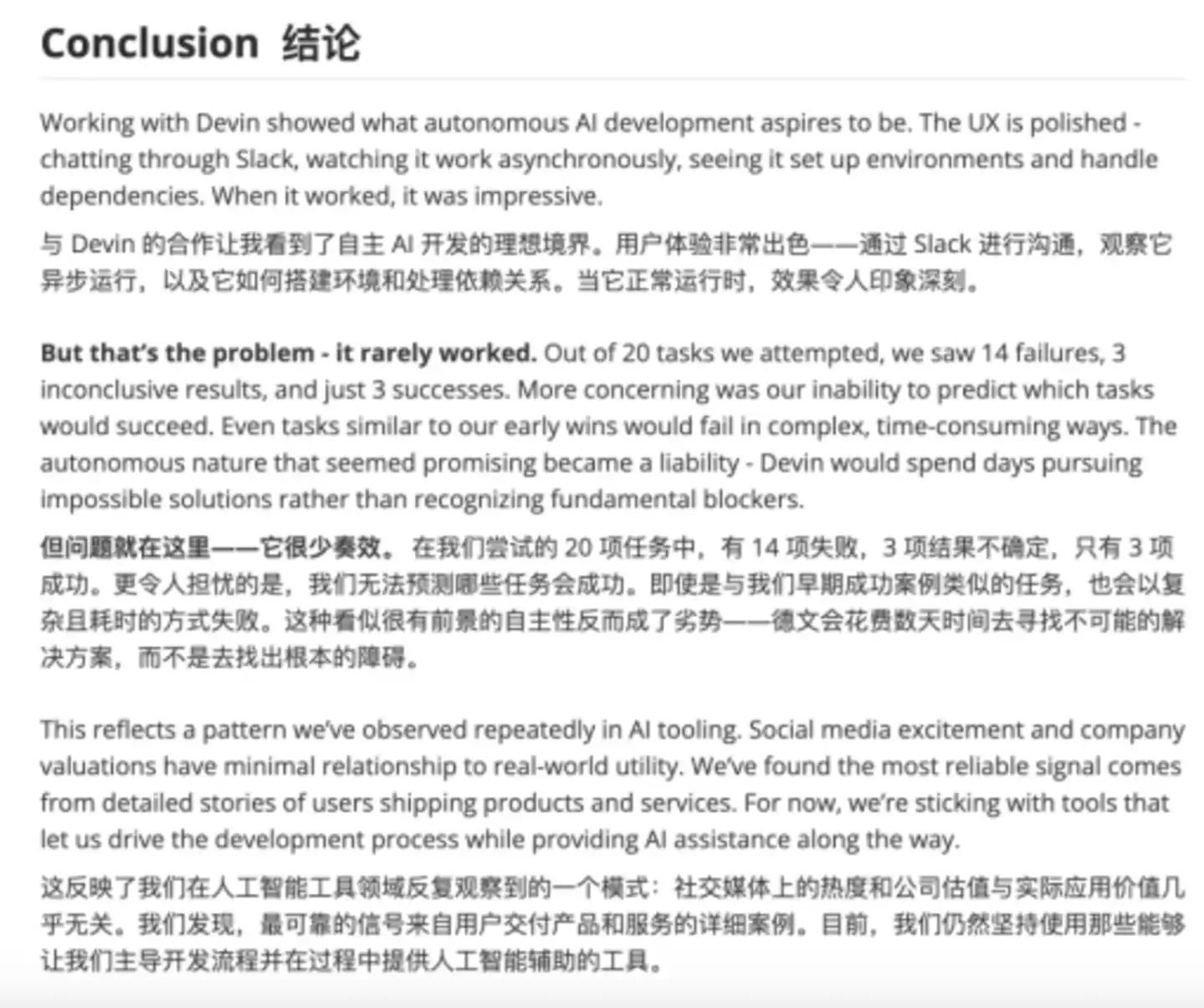
The biggest issue wasn't just the high failure rate, but the unpredictability of failures.

Some tasks that didn't seem complex would lead Devin into dead ends; some tasks themselves were infeasible, yet it would keep trying; sometimes it would generate overly complex, hard-to-maintain code, ultimately forcing engineers to spend more time reviewing and cleaning up.

And all this at such a high price.

Cognition also realized the $500/month threshold was too high. In April 2025, Cognition launched Devin 2.0, reducing the starting price from $500 per month to $20 and introducing a more flexible pay-as-you-go model.

But price reduction isn't a panacea. A tool designed to enhance efficiency ending up wasting more time and energy is hard to justify.

This is the core early-stage contradiction of autonomous Agents: the more AI resembles an independent engineer, the more users need to trust it, but the more it operates like a black box, the more troublesome deviations become.

Devin promised "give me the task," but many real engineering tasks aren't suitable to be handed over completely so early. An Agent running on its own for a long time and finally delivering a PR sounds advanced; but if PR quality is unstable, the engineer's review cost becomes even higher.

Interestingly, amidst this contrast, it was Cursor that captured the first wave of genuine developer dividends.

Because Cursor didn't initially promise to replace programmers. Its logic was gentler and more aligned with real workflows: AI helps modify code, explain errors, refactor files, generate tests on the side, but the developer remains in the editor. It's like a driving school car—you can at least hit the brakes when things seem off.

If Cognition's story ended here, it might have become another "hype" company lifted by the AI boom and then pulled back to earth by real user experience. But as mentioned earlier, reality is often more complex, and the AI programming track itself didn't stand still.

After Devin ignited the imagination of an "AI Software Engineer" and Cursor proved developers still needed a sense of control, foundation model giants like OpenAI, Google, and Anthropic also accelerated integrating coding capabilities into their own products and platforms.

On one side, the more controllable IDE route was rapidly expanding; on the other, model giants were moving down to the application layer. For Cognition to survive, it had to change.

And it was at this time that it "picked up" the treasure left by Windsurf.

03 Grasp Both Sides Firmly

The battle for Windsurf was arguably one of the most dramatic events in the AI coding tools sector in 2025.

At that time, Windsurf was already a highly regarded company in the AI IDE track. It was initially courted by OpenAI, with both sides engaged in lengthy acquisition talks, and the outside world once thought the deal was sealed.

However, the transaction ultimately didn't materialize, with one key reason being the complex partnership between OpenAI and Microsoft. At that time, Microsoft held broad licensing rights to OpenAI's technology and products, and Microsoft-owned GitHub Copilot was a major competitor in the AI programming space. Windsurf was concerned that if acquired by OpenAI, its technology and products might become entangled in the licensing framework between OpenAI and Microsoft, indirectly flowing to a potential competitor.

Just as OpenAI retreated, Google swiftly stepped in.

Google secured a non-exclusive license to Windsurf's technology for $2.4 billion, while bringing Windsurf CEO Varun Mohan, co-founder Douglas Chen, and several key R&D personnel to Google DeepMind.

It happened on a Friday, very quickly. Google took the founders and some core technology licenses. OpenAI failed to complete the acquisition. Windsurf's original corporate entity, product, brand, clients, and 250 employees were left in an awkward position.

It was at this moment that Cognition made its grand entrance.

The incident occurred on a Friday; by Monday, Cognition announced its acquisition of Windsurf's remaining assets, including the Windsurf IDE product itself, intellectual property, trademarks, brand, enterprise customer base, user data, and most of the remaining team's employees.

This move was almost crucial for Cognition's later return to the game, as it addressed exactly what Devin lacked most: a developer entry point.

Following the Windsurf acquisition, Cognition's commercialization pace noticeably accelerated. Windsurf itself already had $82 million in Annual Recurring Revenue (ARR) and over 350 enterprise clients at the time of acquisition. Cognition later disclosed that this acquisition more than doubled the company's ARR, and within seven weeks post-acquisition, the combined enterprise ARR grew over 30%.

Previously, Devin represented a more radical route. It wanted users to hand tasks to a cloud-based Agent, letting it plan, execute, debug, and deliver results autonomously. But Cursor's rise proved developers weren't necessarily willing to hand over tasks completely from the start. They were more accustomed to staying in the editor, watching AI modify code step-by-step, taking over and correcting course at any time.

Windsurf's addition gave Cognition an IDE, finally providing Cognition with more than just the "hand the task to AI" product form.

It began walking on two legs: one is Devin, responsible for asynchronous cloud-based task execution, suitable for handling engineering work that can be broken down, verified, and delivered as PRs; the other is Windsurf, responsible for the IDE entry point, allowing developers to work alongside AI in the coding environment, covering daily development scenarios similar to Cursor's domain.

If users are uncomfortable handing the steering wheel entirely to AI, then bring AI back into the editor as a controllable assistant. If enterprises indeed have a large volume of clear, repetitive, verifiable engineering tasks, let Devin act as a "formal employee" and take over part of the work in the background.

Cognition is no longer solely pursuing an all-powerful, autonomous AI programmer that can independently complete all tasks. It now covers two real needs within software engineering.

This coincidentally forms a contrast with the recently controversial Antigravity 2.0: Google initially focused on an IDE, but after the Antigravity update, it shifted directly towards a more Agent Manager-like interface, jumping from controllable IDE collaboration to black-box Agent scheduling. The direction is ambitious but also more prone to encountering Devin's early problems again.

Individual developers buying tools often consider feel, efficiency, price, and experience. If a tool isn't user-friendly, it's quickly abandoned. But enterprises buy processes and capacity. As long as an Agent can integrate into existing engineering systems and stably produce results for a portion of tasks, it has a chance to become a budget line item.

The most noticeable change in Cognition's narrative later lies here.

Early Devin was like an AI programmer in the spotlight, trying to prove it could code like a human programmer (without needing rest). Later Cognition seemed more like selling a suite of enterprise engineering automation systems: Devin handles asynchronous execution, Windsurf handles the development entry point, and enterprise clients embed them into their own software development workflows.

According to a May 29 TechCrunch interview, CEO Scott Wu clearly pulled Devin back from the "replace programmers" narrative. When asked if Devin could replace a mid-level programmer, his response was "Yes and no."

He emphasized that Cognition never shaped Devin towards "replacing humans." The team members themselves are programmers and don't wish for programmers to lose jobs. He stated Devin's capability varies with tasks, roughly between junior and mid-level engineers; it's more suited for handling the long-tail maintenance tasks many programmers dislike, such as legacy software upgrades, platform migrations, etc., freeing engineers from such grunt work to focus on more creative endeavors.

The two-legged combination precisely avoids the shortcomings of a single product. With only Devin, it appears too radical, and users worry about autonomous Agents being uncontrollable. With only Windsurf, it easily falls into direct competition with products like Cursor, Copilot, Claude Code, Codex. But Devin plus Windsurf gives Cognition a more complete story: serving developers' daily coding scenarios and serving enterprises needing to delegate tasks to Agents.

The data presented in the latest funding round also indicates its story is being validated by the market.

The company states enterprise usage has grown over 10-fold since the beginning of this year, revenue run-rate has reached $492 million, and enterprise-side Devin usage has maintained a 50% month-over-month growth for the past six months.

Clients like Goldman Sachs, Mercedes-Benz, Citi, Dell, Cisco, NASA, US Army, and US Navy also make its enterprise narrative no longer just a demo story.

The $26 billion valuation isn't capital buying a perfect programmer-replacing Devin, but the potential following Cognition's pivot: in the earliest landing sector for AI Agents, it could become the new entry point for enterprise software engineering.

Future software development will likely not completely revert to the era of human engineers coding alone, nor will it immediately transform into AI Agents taking over everything automatically. A more foreseeable scenario is a hybrid system: humans determine direction within the IDE, with AI assisting; some tasks are broken out and handled asynchronously by cloud-based Agents; code is still tested, reviewed, merged, and humans ultimately bear responsibility.

Cognition is betting on this middle ground.

Domande pertinenti

QWhat is the latest valuation of Cognition AI after its recent funding round?

AAfter its recent funding round, Cognition AI's post-money valuation reached $26 billion.

QWhat were some of the initial criticisms and challenges faced by Cognition's flagship AI programmer, Devin?

ADevin faced criticisms for high pricing, unreliable performance with unpredictable failures, and concerns that its early demos were overly polished, leading to skepticism about its readiness for real-world engineering tasks.

QHow did the acquisition of Windsurf benefit Cognition AI's business strategy?

AThe acquisition of Windsurf provided Cognition with a popular IDE product, established enterprise customers, and intellectual property. This allowed Cognition to offer both an autonomous agent (Devin) and a collaborative IDE tool, addressing different software development needs and accelerating its commercialization and revenue growth.

QWhich major venture capital firms led the latest funding round for Cognition AI?

AThe latest funding round for Cognition AI was co-led by Lux Capital, General Catalyst, and 8VC.

QHow has Cognition AI's narrative about its product Devin evolved according to CEO Scott Wu?

ACEO Scott Wu shifted Devin's narrative away from being a direct replacement for human programmers. He emphasized that Devin is designed to handle tedious maintenance tasks, freeing up human engineers for more creative work, and that the company's goal is to augment, not replace, software developers.

Letture associate

Three Years Later: Looking Back on My 2023 Predictions for ChatGPT

Looking Back After Three Years: Revisiting My 2023 Predictions on ChatGPT In March 2023, shortly after ChatGPT's debut and before GPT-4's release, I made over twenty predictions about AI's future based on limited information and intuition. Now, in May 2026, I revisited those forecasts using an AI-driven analysis with 41 Opus 4.8 agents to cross-reference them with the latest data. The assessment used symbols: ✅ Correct, 🟢 Mostly Correct, 🟡 Partially Correct, ❌ Incorrect. Overall, the directional judgments held up well, with only one major factual error regarding GPT-4's rumored parameter size (incorrectly cited as 100T). However, nuances and degrees of accuracy revealed more. **What Was Largely Correct:** Predictions about mechanisms and directions proved accurate. The rise of RAG (Retrieval-Augmented Generation) as the standard architecture for combating AI hallucination was confirmed, as was the transformative potential of LUI (Language User Interface) in creating a new industry layer atop GUIs. The emergence of "robot networks" (agent-to-agent communication protocols) and China's rapid catch-up in developing capable large models (closing the performance gap with top models to ~2.7%) were also on point. The analysis affirmed that LLMs lack consciousness and that the Turing Test merely measures perceived intelligence. **What Was Off Target:** Errors often involved specific numbers, over-optimistic timelines, or misjudged distributions. The prediction that value would primarily accrue to the application layer was half-right but missed NVIDIA's dominance as the profitable infrastructure layer. Forecasts about AI circumventing copyright issues and fostering a "global common ground" by averaging human viewpoints were incorrect; instead, major copyright settlements occurred and AI personalization is increasing. Estimates for model training costs ("$5-10 billion cap") were significantly off, underestimating frontier costs and overestimating replication costs. The notion that LLMs could never do complex math without tools was disproven by later models winning IMO gold. **Key Patterns from the Review:** 1. **Direction over precision:** Judgments about mechanisms and trends were more reliable than specific numbers or definitive statements. 2. **Timing bias:** There was a tendency to overestimate short-term speed but underestimate long-term magnitude and transformation. 3. **The distribution blind spot:** Aggregate-level correctness often masked uneven impacts (e.g., on young professionals' employment). 4. **The value of qualifiers:** Predictions framed with caution (e.g., "reportedly," "for now," "prototype in 2-3 years") aged better. 5. **Some debates continue:** Issues like the nature of "emergent abilities" or machine consciousness remain unresolved. This three-year review highlights that while seeing the big picture is crucial, humility regarding specifics, timelines, and disparate impacts is essential for future forecasting.

链捕手1 h fa

Three Years Later: Looking Back on My 2023 Predictions for ChatGPT

链捕手1 h fa

AI Bubble Warning: AI Investments Are Negative Returns for Most Tech Giants

The article issues a stark warning about a potential AI investment bubble. It notes that while the AI boom shares similarities with the TMT bubble of the late 1990s, its scale is vastly larger, currently driving 93% of U.S. GDP growth. Major hyperscale cloud providers like Microsoft, Alphabet, Amazon, Meta, and Oracle are planning to invest trillions in AI data centers over the coming years. However, calculations based on analyst projections for 2025-2030 reveal a concerning math problem: expected capital expenditure growth far outpaces projected revenue growth. Even under an extremely optimistic scenario of zero costs, the implied return on investment for most of these tech giants (except Amazon) is deeply negative. This suggests that the current trajectory could lead to one of history's largest shareholder value destruction events. The piece outlines two potential escapes: AI generating vastly more revenue than currently anticipated—a near-impossible task—or a significant cutback in the planned investment splurge. The latter scenario could trigger a domino effect, severely impacting the entire tech supply chain (from Nvidia to TSMC), potentially pushing the U.S. economy into recession, and causing a major stock market downturn. The author suggests upcoming high-profile IPOs by companies like OpenAI and Anthropic might represent a transfer of risk from early investors to public market participants. While the peak of the hype cycle might sustain investment through 2026, the fundamental financial dilemma remains unresolved, setting the stage for a potential market correction in 2027 or 2028, similar to the years following Alan Greenspan's "irrational exuberance" warning.

marsbit2 h fa

AI Bubble Warning: AI Investments Are Negative Returns for Most Tech Giants

marsbit2 h fa

From Tokens to Machine Labor: AI is Shifting from Tool to "Worker"

The article "From Token to Machine Labor: AI is Evolving from Tool to 'Worker'" argues that the business model for AI is shifting beyond simply selling computational resources (tokens, GPU hours) or model access. Instead, a new "machine labor market" is emerging, where the core economic transaction is the purchase of economically useful work directly performed by software. The central thesis is that AI pricing will evolve through four stages: 1) raw tokens, 2) standardized LLM capabilities (e.g., text generation), 3) industry-specific labor markets (e.g., legal review, radiology), and finally 4) a programmable results market where tasks like resolving a support ticket are bid on and priced based on outcome. In this future, buyers will care less about *which* model or GPU completes a task and more about whether the work meets specified standards for accuracy, latency, and cost. This transition reframes the impact of AI on human labor. Rather than simple replacement, it suggests a re-coordination where machines handle standardized, verifiable work, freeing humans for roles involving oversight, context management, responsibility, and final judgment. In some cases, this "last 1%" of human input becomes more valuable as it enables the other 99% to be automated. Furthermore, as AI reduces the cost of work, demand may expand, creating larger markets (e.g., 24/7 customer service) rather than just cheaper versions of existing ones. The article concludes that while infrastructure (GPUs, models, tokens) remains crucial upstream, the market is converging on a simpler, tradeable unit: machine labor that can be defined, measured, priced, and procured based on contractible specifications.

marsbit2 h fa

From Tokens to Machine Labor: AI is Shifting from Tool to "Worker"

marsbit2 h fa

Xiaomi MiMo's 99% Price Cut is Not Marketing! Luo Fuli Posts on X to Refute Critics

The price of Xiaomi's MiMo-V2.5 series API has been permanently reduced by up to 99%, specifically for the "Input (Cache Hit)" cost, which covers users re-reading historical context in long conversations. MiMo's head, Luo Fuli, published a detailed technical blog to clarify that this drastic price cut stems from genuine engineering breakthroughs, not a marketing stunt or a simple price war. The core of the achievement lies in six key engineering optimizations. First, the model architecture adopts a Hybrid Sliding Window Attention (SWA), reducing the memory footprint (KVCache) to 1/7th of a traditional model. Second, a dual-pool memory management system actually utilizes these savings, allowing a single GPU to handle over 5 times more concurrent users. Third, an upgraded prefix caching mechanism achieves a cache hit rate of 93-95% for repeated reads, meaning most such requests bypass GPU computation entirely. Fourth, a self-developed distributed cache (GCache) utilizes idle SSD space on existing GPU servers, eliminating additional storage costs. Fifth, an intelligent scheduling system (LLM-Router) efficiently routes requests to maximize cache reuse and performance. Sixth, Multi-Token Prediction (MTP) accelerates the model's text generation ("output") side. Together, these systemic optimizations dramatically lower the real computational cost per request, enabling the 99% price reduction for cached inputs while reportedly maintaining positive gross margins. Luo Fuli's disclosure aims to shift the narrative from "price war" to a demonstration of substantive AI engineering progress.

marsbit4 h fa

Xiaomi MiMo's 99% Price Cut is Not Marketing! Luo Fuli Posts on X to Refute Critics

marsbit4 h fa

The Hottest 00s Generation on Wall Street

"Wall Street's Hottest '00s Phenom: The 25-Year-Old Fund Manager Who Bet on AI's 'Boring' Backbone" At just 25, Leopold Aschenbrenner, once fired by OpenAI, now runs a hedge fund worth $13.7 billion. His strategy? Betting against the consensus. While others chased AI chips, he invested early in the physical infrastructure powering the AI boom: electricity, data centers, and energy. Expelled from OpenAI's safety team in 2024, Aschenbrenner foresaw the coming bottleneck. He argued that AI progress would be limited not by algorithms, but by power, chip capacity, and space. Acting on this, he founded Situational Awareness LP to go long on these "old economy" assets. His bets have paid off spectacularly. His fund's assets soared from $255 million in late 2024 to $13.7 billion by Q1 2026. His portfolio is a direct reflection of his thesis: major long positions in fuel cell company Bloom Energy and data center/bitcoin mining firms like CleanSpark and Riot Platforms, which control critical land and power resources. Conversely, he holds massive put options against overheated semiconductor giants like NVIDIA and AMD. A notable exception was his bullish bet on storage company SanDisk, which surged ~160% in Q2. Aschenbrenner's vision is materializing. Tech giants like Amazon, Alphabet, and Meta are ramping up colossal capital expenditure on data centers. Global data center power consumption is projected to skyrocket, with AI accounting for over half by 2030. The demand for enabling technologies like optical fiber and modules is also exploding. His story underscores a fundamental truth of the AI era: the ethereal intelligence of algorithms rests on a very physical, heavy, and power-hungry foundation. The future is being built not just in code, but in concrete, copper, and kilowatts.

marsbit7 h fa

The Hottest 00s Generation on Wall Street

marsbit7 h fa

Trading

Spot
Futures

Articoli Popolari

Cosa è $S$

Comprendere SPERO: Una Panoramica Completa Introduzione a SPERO Mentre il panorama dell'innovazione continua a evolversi, l'emergere delle tecnologie web3 e dei progetti di criptovaluta gioca un ruolo fondamentale nel plasmare il futuro digitale. Un progetto che ha attirato l'attenzione in questo campo dinamico è SPERO, denotato come SPERO,$$s$. Questo articolo mira a raccogliere e presentare informazioni dettagliate su SPERO, per aiutare gli appassionati e gli investitori a comprendere le sue basi, obiettivi e innovazioni nei domini web3 e crypto. Che cos'è SPERO,$$s$? SPERO,$$s$ è un progetto unico all'interno dello spazio crypto che cerca di sfruttare i principi della decentralizzazione e della tecnologia blockchain per creare un ecosistema che promuove l'impegno, l'utilità e l'inclusione finanziaria. Il progetto è progettato per facilitare interazioni peer-to-peer in modi nuovi, fornendo agli utenti soluzioni e servizi finanziari innovativi. Al suo interno, SPERO,$$s$ mira a responsabilizzare gli individui fornendo strumenti e piattaforme che migliorano l'esperienza dell'utente nello spazio delle criptovalute. Questo include la possibilità di metodi di transazione più flessibili, la promozione di iniziative guidate dalla comunità e la creazione di percorsi per opportunità finanziarie attraverso applicazioni decentralizzate (dApps). La visione sottostante di SPERO,$$s$ ruota attorno all'inclusività, cercando di colmare le lacune all'interno della finanza tradizionale mentre sfrutta i vantaggi della tecnologia blockchain. Chi è il Creatore di SPERO,$$s$? L'identità del creatore di SPERO,$$s$ rimane piuttosto oscura, poiché ci sono risorse pubblicamente disponibili limitate che forniscono informazioni dettagliate sul suo fondatore o fondatori. Questa mancanza di trasparenza può derivare dall'impegno del progetto per la decentralizzazione—un ethos che molti progetti web3 condividono, dando priorità ai contributi collettivi rispetto al riconoscimento individuale. Centrando le discussioni attorno alla comunità e ai suoi obiettivi collettivi, SPERO,$$s$ incarna l'essenza dell'empowerment senza mettere in evidenza individui specifici. Pertanto, comprendere l'etica e la missione di SPERO rimane più importante che identificare un creatore singolo. Chi sono gli Investitori di SPERO,$$s$? SPERO,$$s$ è supportato da una varietà di investitori che vanno dai capitalisti di rischio agli investitori angelici dedicati a promuovere l'innovazione nel settore crypto. Il focus di questi investitori generalmente si allinea con la missione di SPERO—dando priorità a progetti che promettono avanzamenti tecnologici sociali, inclusività finanziaria e governance decentralizzata. Queste fondazioni di investitori sono tipicamente interessate a progetti che non solo offrono prodotti innovativi, ma contribuiscono anche positivamente alla comunità blockchain e ai suoi ecosistemi. Il supporto di questi investitori rafforza SPERO,$$s$ come un concorrente degno di nota nel dominio in rapida evoluzione dei progetti crypto. Come Funziona SPERO,$$s$? SPERO,$$s$ impiega un framework multifunzionale che lo distingue dai progetti di criptovaluta convenzionali. Ecco alcune delle caratteristiche chiave che sottolineano la sua unicità e innovazione: Governance Decentralizzata: SPERO,$$s$ integra modelli di governance decentralizzati, responsabilizzando gli utenti a partecipare attivamente ai processi decisionali riguardanti il futuro del progetto. Questo approccio favorisce un senso di proprietà e responsabilità tra i membri della comunità. Utilità del Token: SPERO,$$s$ utilizza il proprio token di criptovaluta, progettato per servire varie funzioni all'interno dell'ecosistema. Questi token abilitano transazioni, premi e la facilitazione dei servizi offerti sulla piattaforma, migliorando l'impegno e l'utilità complessivi. Architettura Stratificata: L'architettura tecnica di SPERO,$$s$ supporta la modularità e la scalabilità, consentendo un'integrazione fluida di funzionalità e applicazioni aggiuntive man mano che il progetto evolve. Questa adattabilità è fondamentale per mantenere la rilevanza nel panorama crypto in continua evoluzione. Coinvolgimento della Comunità: Il progetto enfatizza iniziative guidate dalla comunità, impiegando meccanismi che incentivano la collaborazione e il feedback. Nutrendo una comunità forte, SPERO,$$s$ può affrontare meglio le esigenze degli utenti e adattarsi alle tendenze di mercato. Focus sull'Inclusione: Offrendo basse commissioni di transazione e interfacce user-friendly, SPERO,$$s$ mira ad attrarre una base utenti diversificata, inclusi individui che potrebbero non aver precedentemente interagito nello spazio crypto. Questo impegno per l'inclusione si allinea con la sua missione generale di empowerment attraverso l'accessibilità. Cronologia di SPERO,$$s$ Comprendere la storia di un progetto fornisce preziose intuizioni sulla sua traiettoria di sviluppo e sui traguardi. Di seguito è riportata una cronologia suggerita che mappa eventi significativi nell'evoluzione di SPERO,$$s$: Fase di Concettualizzazione e Ideazione: Le idee iniziali che formano la base di SPERO,$$s$ sono state concepite, allineandosi strettamente con i principi di decentralizzazione e focus sulla comunità all'interno dell'industria blockchain. Lancio del Whitepaper del Progetto: Dopo la fase concettuale, è stato rilasciato un whitepaper completo che dettaglia la visione, gli obiettivi e l'infrastruttura tecnologica di SPERO,$$s$ per suscitare interesse e feedback dalla comunità. Costruzione della Comunità e Prime Interazioni: Sono stati effettuati sforzi attivi di outreach per costruire una comunità di early adopters e potenziali investitori, facilitando discussioni attorno agli obiettivi del progetto e ottenendo supporto. Evento di Generazione del Token: SPERO,$$s$ ha condotto un evento di generazione del token (TGE) per distribuire i propri token nativi ai primi sostenitori e stabilire una liquidità iniziale all'interno dell'ecosistema. Lancio della Prima dApp: La prima applicazione decentralizzata (dApp) associata a SPERO,$$s$ è stata attivata, consentendo agli utenti di interagire con le funzionalità principali della piattaforma. Sviluppo Continuo e Partnership: Aggiornamenti e miglioramenti continui alle offerte del progetto, inclusi partnership strategiche con altri attori nello spazio blockchain, hanno plasmato SPERO,$$s$ in un concorrente competitivo e in evoluzione nel mercato crypto. Conclusione SPERO,$$s$ rappresenta una testimonianza del potenziale del web3 e delle criptovalute di rivoluzionare i sistemi finanziari e responsabilizzare gli individui. Con un impegno per la governance decentralizzata, il coinvolgimento della comunità e funzionalità progettate in modo innovativo, apre la strada verso un panorama finanziario più inclusivo. Come per qualsiasi investimento nello spazio crypto in rapida evoluzione, si incoraggiano potenziali investitori e utenti a ricercare approfonditamente e a impegnarsi in modo riflessivo con gli sviluppi in corso all'interno di SPERO,$$s$. Il progetto mostra lo spirito innovativo dell'industria crypto, invitando a ulteriori esplorazioni delle sue innumerevoli possibilità. Mentre il percorso di SPERO,$$s$ è ancora in fase di sviluppo, i suoi principi fondamentali potrebbero effettivamente influenzare il futuro di come interagiamo con la tecnologia, la finanza e tra di noi in ecosistemi digitali interconnessi.

75 Totale visualizzazioniPubblicato il 2024.12.17Aggiornato il 2024.12.17

Cosa è $S$

Cosa è AGENT S

Agent S: Il Futuro dell'Interazione Autonoma in Web3 Introduzione Nel panorama in continua evoluzione di Web3 e criptovalute, le innovazioni stanno costantemente ridefinendo il modo in cui gli individui interagiscono con le piattaforme digitali. Uno di questi progetti pionieristici, Agent S, promette di rivoluzionare l'interazione uomo-computer attraverso il suo framework agentico aperto. Aprendo la strada a interazioni autonome, Agent S mira a semplificare compiti complessi, offrendo applicazioni trasformative nell'intelligenza artificiale (AI). Questa esplorazione dettagliata approfondirà le complessità del progetto, le sue caratteristiche uniche e le implicazioni per il dominio delle criptovalute. Cos'è Agent S? Agent S si presenta come un innovativo framework agentico aperto, progettato specificamente per affrontare tre sfide fondamentali nell'automazione dei compiti informatici: Acquisizione di Conoscenze Specifiche del Dominio: Il framework apprende in modo intelligente da varie fonti di conoscenza esterne ed esperienze interne. Questo approccio duale gli consente di costruire un ricco repository di conoscenze specifiche del dominio, migliorando le sue prestazioni nell'esecuzione dei compiti. Pianificazione su Lungo Orizzonte di Compiti: Agent S impiega una pianificazione gerarchica potenziata dall'esperienza, un approccio strategico che facilita la suddivisione e l'esecuzione efficiente di compiti complessi. Questa caratteristica migliora significativamente la sua capacità di gestire più sottocompiti in modo efficiente ed efficace. Gestione di Interfacce Dinamiche e Non Uniformi: Il progetto introduce l'Interfaccia Agente-Computer (ACI), una soluzione innovativa che migliora l'interazione tra agenti e utenti. Utilizzando Modelli Linguistici Multimodali di Grandi Dimensioni (MLLM), Agent S può navigare e manipolare senza sforzo diverse interfacce grafiche utente. Attraverso queste caratteristiche pionieristiche, Agent S fornisce un framework robusto che affronta le complessità coinvolte nell'automazione dell'interazione umana con le macchine, preparando il terreno per innumerevoli applicazioni nell'AI e oltre. Chi è il Creatore di Agent S? Sebbene il concetto di Agent S sia fondamentalmente innovativo, informazioni specifiche sul suo creatore rimangono elusive. Il creatore è attualmente sconosciuto, il che evidenzia sia la fase embrionale del progetto sia la scelta strategica di mantenere i membri fondatori sotto anonimato. Indipendentemente dall'anonimato, l'attenzione rimane sulle capacità e sul potenziale del framework. Chi sono gli Investitori di Agent S? Poiché Agent S è relativamente nuovo nell'ecosistema crittografico, informazioni dettagliate riguardanti i suoi investitori e sostenitori finanziari non sono documentate esplicitamente. La mancanza di approfondimenti pubblicamente disponibili sulle fondazioni di investimento o sulle organizzazioni che supportano il progetto solleva interrogativi sulla sua struttura di finanziamento e sulla roadmap di sviluppo. Comprendere il supporto è cruciale per valutare la sostenibilità del progetto e il suo potenziale impatto sul mercato. Come Funziona Agent S? Al centro di Agent S si trova una tecnologia all'avanguardia che gli consente di funzionare efficacemente in contesti diversi. Il suo modello operativo è costruito attorno a diverse caratteristiche chiave: Interazione Uomo-Computer Simile a Quella Umana: Il framework offre una pianificazione AI avanzata, cercando di rendere le interazioni con i computer più intuitive. Mimando il comportamento umano nell'esecuzione dei compiti, promette di elevare le esperienze degli utenti. Memoria Narrativa: Utilizzata per sfruttare esperienze di alto livello, Agent S utilizza la memoria narrativa per tenere traccia delle storie dei compiti, migliorando così i suoi processi decisionali. Memoria Episodica: Questa caratteristica fornisce agli utenti una guida passo-passo, consentendo al framework di offrire supporto contestuale mentre i compiti si sviluppano. Supporto per OpenACI: Con la capacità di funzionare localmente, Agent S consente agli utenti di mantenere il controllo sulle proprie interazioni e flussi di lavoro, allineandosi con l'etica decentralizzata di Web3. Facile Integrazione con API Esterne: La sua versatilità e compatibilità con varie piattaforme AI garantiscono che Agent S possa adattarsi senza problemi agli ecosistemi tecnologici esistenti, rendendolo una scelta attraente per sviluppatori e organizzazioni. Queste funzionalità contribuiscono collettivamente alla posizione unica di Agent S all'interno dello spazio crittografico, poiché automatizza compiti complessi e multi-fase con un intervento umano minimo. Man mano che il progetto evolve, le sue potenziali applicazioni in Web3 potrebbero ridefinire il modo in cui si svolgono le interazioni digitali. Cronologia di Agent S Lo sviluppo e le tappe di Agent S possono essere riassunti in una cronologia che evidenzia i suoi eventi significativi: 27 Settembre 2024: Il concetto di Agent S è stato lanciato in un documento di ricerca completo intitolato “Un Framework Agentico Aperto che Usa i Computer Come un Umano”, mostrando le basi per il progetto. 10 Ottobre 2024: Il documento di ricerca è stato reso pubblicamente disponibile su arXiv, offrendo un'esplorazione approfondita del framework e della sua valutazione delle prestazioni basata sul benchmark OSWorld. 12 Ottobre 2024: È stata rilasciata una presentazione video, fornendo un'idea visiva delle capacità e delle caratteristiche di Agent S, coinvolgendo ulteriormente potenziali utenti e investitori. Questi indicatori nella cronologia non solo illustrano i progressi di Agent S, ma indicano anche il suo impegno per la trasparenza e il coinvolgimento della comunità. Punti Chiave su Agent S Man mano che il framework Agent S continua a evolversi, diversi attributi chiave si distinguono, sottolineando la sua natura innovativa e il potenziale: Framework Innovativo: Progettato per fornire un uso intuitivo dei computer simile all'interazione umana, Agent S porta un approccio nuovo all'automazione dei compiti. Interazione Autonoma: La capacità di interagire autonomamente con i computer attraverso GUI segna un passo avanti verso soluzioni informatiche più intelligenti ed efficienti. Automazione di Compiti Complessi: Con la sua metodologia robusta, può automatizzare compiti complessi e multi-fase, rendendo i processi più veloci e meno soggetti a errori. Miglioramento Continuo: I meccanismi di apprendimento consentono ad Agent S di migliorare dalle esperienze passate, migliorando continuamente le sue prestazioni e la sua efficacia. Versatilità: La sua adattabilità attraverso diversi ambienti operativi come OSWorld e WindowsAgentArena garantisce che possa servire un'ampia gamma di applicazioni. Man mano che Agent S si posiziona nel panorama di Web3 e delle criptovalute, il suo potenziale per migliorare le capacità di interazione e automatizzare i processi segna un significativo avanzamento nelle tecnologie AI. Attraverso il suo framework innovativo, Agent S esemplifica il futuro delle interazioni digitali, promettendo un'esperienza più fluida ed efficiente per gli utenti in vari settori. Conclusione Agent S rappresenta un audace passo avanti nell'unione tra AI e Web3, con la capacità di ridefinire il modo in cui interagiamo con la tecnologia. Sebbene sia ancora nelle sue fasi iniziali, le possibilità per la sua applicazione sono vaste e coinvolgenti. Attraverso il suo framework completo che affronta sfide critiche, Agent S mira a portare le interazioni autonome al centro dell'esperienza digitale. Man mano che ci addentriamo nei regni delle criptovalute e della decentralizzazione, progetti come Agent S giocheranno senza dubbio un ruolo cruciale nel plasmare il futuro della tecnologia e della collaborazione uomo-computer.

527 Totale visualizzazioniPubblicato il 2025.01.14Aggiornato il 2025.01.14

Cosa è AGENT S

Come comprare S

Benvenuto in HTX.com! Abbiamo reso l'acquisto di Sonic (S) semplice e conveniente. Segui la nostra guida passo passo per intraprendere il tuo viaggio nel mondo delle criptovalute.Step 1: Crea il tuo Account HTXUsa la tua email o numero di telefono per registrarti il tuo account gratuito su HTX. Vivi un'esperienza facile e sblocca tutte le funzionalità,Crea il mio accountStep 2: Vai in Acquista crypto e seleziona il tuo metodo di pagamentoCarta di credito/debito: utilizza la tua Visa o Mastercard per acquistare immediatamente SonicS.Bilancio: Usa i fondi dal bilancio del tuo account HTX per fare trading senza problemi.Terze parti: abbiamo aggiunto metodi di pagamento molto utilizzati come Google Pay e Apple Pay per maggiore comodità.P2P: Fai trading direttamente con altri utenti HTX.Over-the-Counter (OTC): Offriamo servizi su misura e tassi di cambio competitivi per i trader.Step 3: Conserva Sonic (S)Dopo aver acquistato Sonic (S), conserva nel tuo account HTX. In alternativa, puoi inviare tramite trasferimento blockchain o scambiare per altre criptovalute.Step 4: Scambia Sonic (S)Scambia facilmente Sonic (S) nel mercato spot di HTX. Accedi al tuo account, seleziona la tua coppia di trading, esegui le tue operazioni e monitora in tempo reale. Offriamo un'esperienza user-friendly sia per chi ha appena iniziato che per i trader più esperti.

942 Totale visualizzazioniPubblicato il 2025.01.15Aggiornato il 2025.03.21

Come comprare S

Discussioni

Benvenuto nella Community HTX. Qui puoi rimanere informato sugli ultimi sviluppi della piattaforma e accedere ad approfondimenti esperti sul mercato. Le opinioni degli utenti sul prezzo di S S sono presentate come di seguito.

活动图片














