加密早报:Telegram 创始人被捕,机构认为 9 月首次降息大概率为 25 基点

深潮Pubblicato 2024-08-26Pubblicato ultima volta 2024-08-26

OP、SUI、DYDX等本周将迎来大额解锁,SUI将解锁约6509万美元。

作者:深潮 TechFlow

门头沟 Mt.Gox 钱包地址比特币持仓量已减少约 77%

据 Arkham 监测,自 2021 年初以来,Mt. Gox 钱包共持有 141,690 枚比特币,市值在 2024 年 3 月达到 101.2 亿美元的峰值。目前,Mt. Gox 钱包持有 32,900 枚比特币(约合 21.1 亿美元),约占 2021 年初时持有的 23%,持有量已减少约 77%。

1confirmation:预计以太坊市值5年内超过比特币,DeFiNFT将重回巅峰

加密投资机构 1confirmation 公布第 2 季度 LP 信函,创始人 Nick Tomaino 表示,以太坊市值将在未来五年内超过比特币。目前比特币的市值是以太坊的 4 倍,二者都会继续增长,但以太坊最终会超过比特币。 比特币有一个明确的叙事(数字黄金),而机构现在已经接受并买入。以太坊是过去 5 年中该领域最具影响力的区块链,但 ETH 尚未得到很好的理解。以太坊稀缺、产生收益且有实际用例。由于其市值现在明显小于比特币,华尔街能够拥有更多。预计华尔街将持续买入,并在未来几年向世界大力宣传以太坊。

中信证券:鲍威尔演讲后,维持此前9月首次降息25基点的判断

中信证券发布研报指出,美联储主席鲍威尔在2024年Jackson Hole全球央行年会上的演讲“转折点”意味明显,表示“政策调整的时机已经到来”,近乎“官宣”9月降息。鲍威尔对经济情况的描述依旧倾向于“软着陆”,认为当前的就业市场没有2019年紧张,鲍威尔演讲后,美股市场“软着陆”交易逻辑特征明显。当前时点,中信证券维持此前判断,即预计美联储将于9月FOMC会议首次降息25bps,全年有50—75bps的降息空间,需警惕市场过度交易美联储降息幅度后,可能带来的资产价格调整风险。

DOGS:CEX 和 Telegram 钱包申领功能已关闭

Telegram 原生 Meme 项目 DOGS 在社群宣布:“CEX 和 Telegram 钱包的申领功能现已关闭,如果错过申领仍然可以选择在链上申领代币,可在应用程序中连接钱包,以确保流程顺利处理。”

Telegram 联合创始人兼 CEO Pavel Durov 在法国被捕,TON 社区表示将继续全面运营

Telegram 联合创始人兼 CEO Pavel Durov 在法国被捕。Durov 乘坐私人飞机从阿塞拜疆抵达法国后,被法国国家反欺诈办公室逮捕。逮捕原因据称与 Telegram 平台上的非法活动有关,包括协助恐怖主义、毒品和赃物销售、欺诈等。针对 Telegram 创始人 Pavel Durov 被捕的消息,TON 社区发表声明表示将继续全面运营。

Vitalik回应Telegram创始人被捕:欧洲软件和通信自由的未来令人担忧

针对 Telegram 创始人被捕事件,Vitalik 在 X 平台表示:我之前曾批评过 Telegram 对加密不够认真。但是(根据目前掌握的信息:指控似乎只是“不受监管”,并没有泄露人们的数据)逮捕创始人看起来非常糟糕,并且令人担忧欧洲软件和通信自由的未来。

TON将Resistance Dog徽标添加至X账户头像

TON 官方推特将 Telegram 创始人Pavel Durov 于 2018 年手绘的 Resistance Dog (REDO )徽标添加至头像。或受TON更换社媒头像影响,Resistance Dog(REDO)昨日大涨超过60%。

OP、SUI、DYDX等本周将迎来大额解锁,SUI将解锁约6509万美元

据 Token Unlocks 数据显示,OP、SUI 、DYDX 等多个项目下周将迎来代币一次性大额解锁,其中:

Yield Guild Games 将于8月27日解锁1408万枚YGG ,价值约676万美元,占流通供应量的3.7%;

SingularityNET 将于8月28日解锁832万枚 AGIX,价值约428万美元,占流通供应量的1.58%;

Optimism将于8月31日解锁3134万枚OP,价值约5046万美元,占流通供应量的2.64 %;Echelon Prime将于8月31日解锁75万枚PRIME,价值约537 万美元,占流通供应量的1.68 %;Manta Network将于8月31日解锁187万枚MANTA,价值约151万美元,占流通供应量的0.5%;dydx将于9月1日解锁833万枚DYDX ,价值约 975万美元,占流通供应量的3.67%;

Sui将于9月1日解锁6419万枚SUI ,价值约 6509万美元,占流通供应量的2.47%;

Zetachain将于9月1日解锁5389万枚ZETA ,价值约3305万美元,占流通供应量的15.71%;Ethena将于9月1日解锁1489万枚ENA,价值约 536万美元,占流通供应量的0.82%。

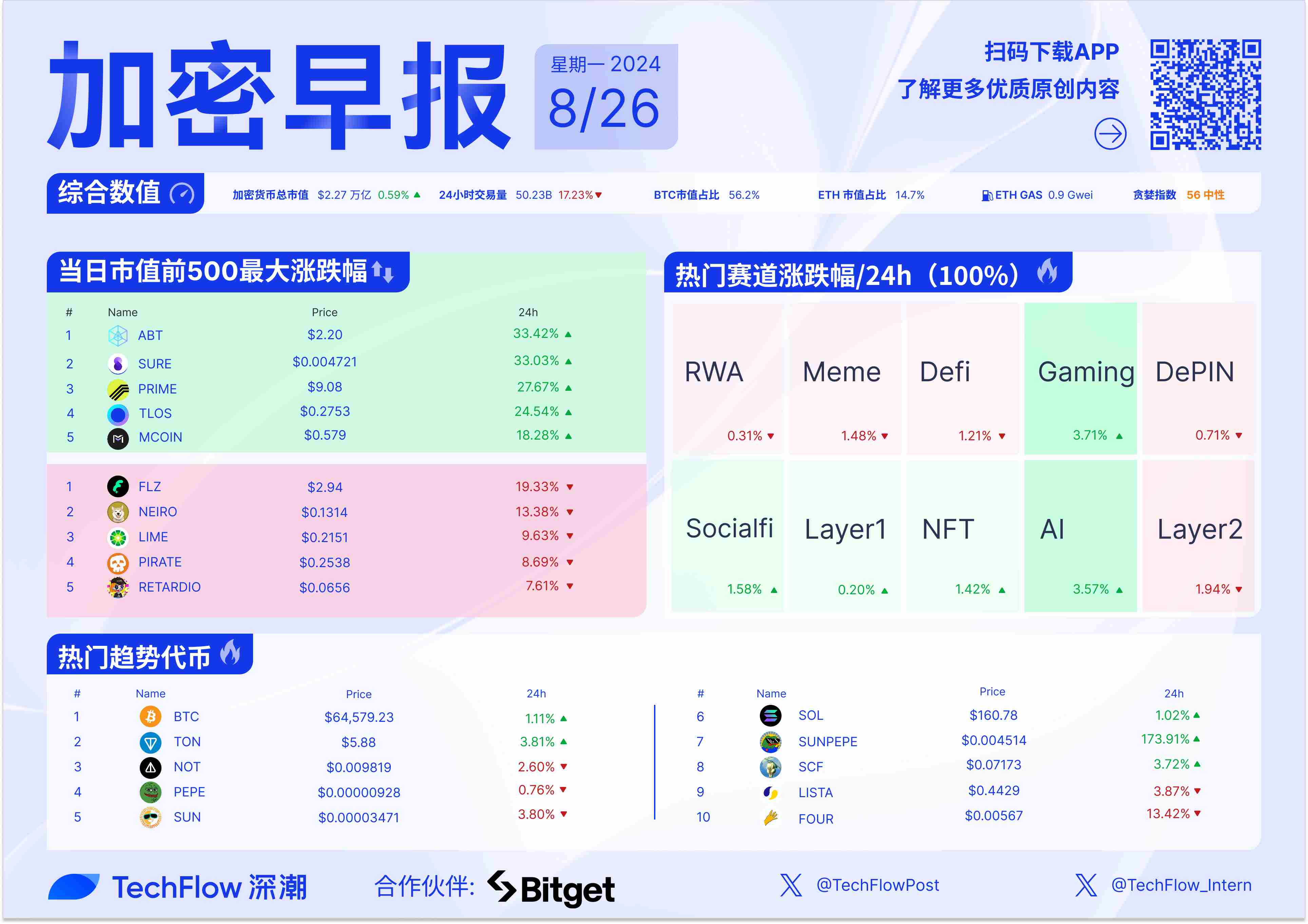
行情动态
今日推荐阅读

万字回顾Telegram发家史:叛逆极客、加密货币和狂热的自由梦

Babylon War 酣战,Bedrock 拔得头筹:uniBTC 引领 BTC LRT 爆发?
鲍威尔:现在是调整政策的时候

空投新手防诈指南:学会识别和避免常见陷阱,守护你的加密资产

Multicoin:评估区块链收藏品市场 (BECM) 时你要考虑的 7 个因素

NEAR 2024上半年数据分析:日新增地址平均 33 万,稳定币市值半年涨 7 倍

Letture associate

Will There Be a Next Wave of Web3 Games? Veteran Player's Review: At the Peak of Hype, You Should at Least Sell Half

**Title: Is There Another Wave for Web3 Gaming? A Veteran Player's Review: When Hype Peaks, You Must Exit at Least Half** **Summary:** In an interview, veteran player "Earn Money Chicken" shares his journey and reflections on Web3 gaming. He transitioned from being a traditional in-game trader to a Web3 gamer, having profited from games like Mobox, StepN, and Seraph, but also experiencing significant losses. He defines himself primarily as a player, not an investor, attracted to Web3 games for the blend of earning potential, engaging gameplay, and the satisfaction of researching game mechanics. While he enjoys strategic "gambling" within games, he emphasizes it's not about zero-sum competition with other players. The interview explores the complex, often adversarial relationship between players, projects, and major investors (whales). The player's experience as a traditional game merchant helped develop his analytical mindset for spotting opportunities, but wasn't directly transferable. He identifies the core sources of profit in early Web3 gaming as **"era红利" (era-specific红利)** and strategic foresight, not just simple calculations. He warns that the biggest mistake ordinary players make is calculating their return-on-investment (ROI) period at peak hype, as asset and yield depreciation can trap them. Reflecting on his wins and losses, he now advocates for managing expectations. His most successful exit was from Seraph, where he sold at a relatively good time. The key problem with current Web3 games, he argues, is that most are not mature games first. A successful Web3 game must primarily be a **good, fun game** with a genuine player base willing to spend money for enjoyment, not just participants seeking profit. The blockchain element should solve problems within that context, not be the primary driver. While he believes the sector might see another speculative boom (possibly another strong "Ponzi" model attracting hype), a truly mature and sustainable Web3 game likely needs to come from a traditional major game studio. It would leverage a proven IP, mature content, a functional NFT trading system, and attract both traditional and crypto-native players, offering more normalized returns rather than extreme暴利. His final advice: Newcomers without prior experience should avoid the space now, as it's like searching for a diamond in the rough. For those remaining, the rule is: be brave when assets are low and overlooked, but **when everyone is talking about it (at peak hype), you must sell at least half your holdings.**

marsbit37 min fa

Will There Be a Next Wave of Web3 Games? Veteran Player's Review: At the Peak of Hype, You Should at Least Sell Half

marsbit37 min fa

The Most Hidden AI Winners

"The Most Under-the-Radar AI Winners" While core AI giants and their direct suppliers have dominated headlines, a group of seemingly unrelated, decades-old manufacturing companies have emerged as major beneficiaries. A key example is Japan's TOTO, famous for bathroom fixtures. Its stock soared 145% in a year, driven not by its mainstay toilet business but by its nearly 40-year-old semiconductor ceramic component unit. Specifically, TOTO manufactures electrostatic chucks—critical, hard-to-replace parts for advanced chip manufacturing processes like etching and EUV lithography. This segment, though only 9% of revenue, contributed over 54% of operating profit in FY2025 with a 43% margin. High barriers to entry, including deep know-how in high-purity ceramic sintering and long supplier certification cycles (5+ years), secure its position. This pattern repeats across industries. Nitto Boseki, a 128-year-old glass fiber maker, saw its stock rise 325% due to near-monopoly supply of T-glass, an essential low-expansion material for AI chip substrates. Similarly, Ajinomoto, the global MSG leader, commands 80-95% of the market for ABF film, a vital insulating layer in chip packaging. These "hidden" segments, often born from deep materials science expertise, are now bottleneck supplies in the AI hardware chain, enjoying pricing power and high margins. In China's A-share market, the theme combines this AI-driven demand with domestic substitution. Companies like Zhongci Electronic (advancing in electrostatic chucks) and Honghe Technology & Feilihua (in high-end electronic glass fabrics) are gaining traction. The investment thesis hinges on whether these domestic players can rapidly scale qualified capacity to capture the supply gap within the critical time window. Ultimately, these cases show that in the AI supply chain, high-profit concentrations exist not only at the cutting-edge tech frontier but also in indispensable, difficult-to-replicate materials and components. Market recognition often lags behind fundamental profit shifts, creating potential for significant re-ratings as traditional industrial firms are re-evaluated as key enablers of advanced semiconductor manufacturing.

marsbit1 h fa

The Most Hidden AI Winners

marsbit1 h fa

The Most Secretive Winners of the AI Boom

"The Most Hidden AI Winners" An unlikely group of companies are emerging as major beneficiaries of the AI boom, not from designing chips, but from supplying critical materials and components essential for advanced semiconductor manufacturing. These 'hidden winners' are traditional manufacturers whose deep expertise in materials science has become indispensable. Japanese companies are leading this trend. Toto, globally known for bathroom fixtures, has seen its stock surge 145% over the past year, driven by its 40-year-old semiconductor ceramics business, which now contributes over half of its operating profit. Its electrostatic chucks are vital for advanced chip production and require years of expertise to manufacture. Similarly, Nittobo, a 128-year-old textile firm, controls 90% of the market for T-glass, a low-expansion glass fiber essential for AI chip substrates. Ajinomoto, the world's largest MSG producer, dominates the market (80-95% share) for ABF insulating film used in chip packaging. The core insight is that chasing "advanced" chips paradoxically increases reliance on traditional, high-precision material science where supply cannot be quickly replicated. These materials are now critical bottlenecks in the AI supply chain. This trend is mirrored in China's A股 market, framed by the theme of 'import substitution'. Companies like Zhongci Dianzi (electrostatic chucks) and Honghe Technology (ultra-thin electronic cloth) are making progress, but face the test of scaling production and matching Japanese rivals' quality. The key tension lies in the slow change of market perception. While profit structures rapidly shift towards high-margin tech components, these firms retain their traditional industry classifications, creating a valuation gap that is gradually closing as their roles in the AI ecosystem become undeniable.

链捕手1 h fa

The Most Secretive Winners of the AI Boom

链捕手1 h fa

Trading

Spot
活动图片