The Rainmakers of the Crypto Market

Token TerminalPubblicato 2024-06-17Pubblicato ultima volta 2024-08-23

Introduction

This week’s newsletter focuses on protocols (blockchains & decentralized applications) that generate the most fees. Understanding which protocols that generate the most fees is interesting for a few different reasons:

  1. Which protocols' services are users willing to pay for?
  2. What services do these protocols provide and how do they charge their users (business model)?
  3. How much are the users actually paying?
  4. Are some market sectors more popular than others?
  5. Is there a dominant protocol within these market sectors?

We’ll learn that analyzing only one chart from the Terminal can tell us a lot about the industry dynamics in the crypto market.

Let’s dive in!


1. Top fee-generating protocols with a highlight on Blockchains
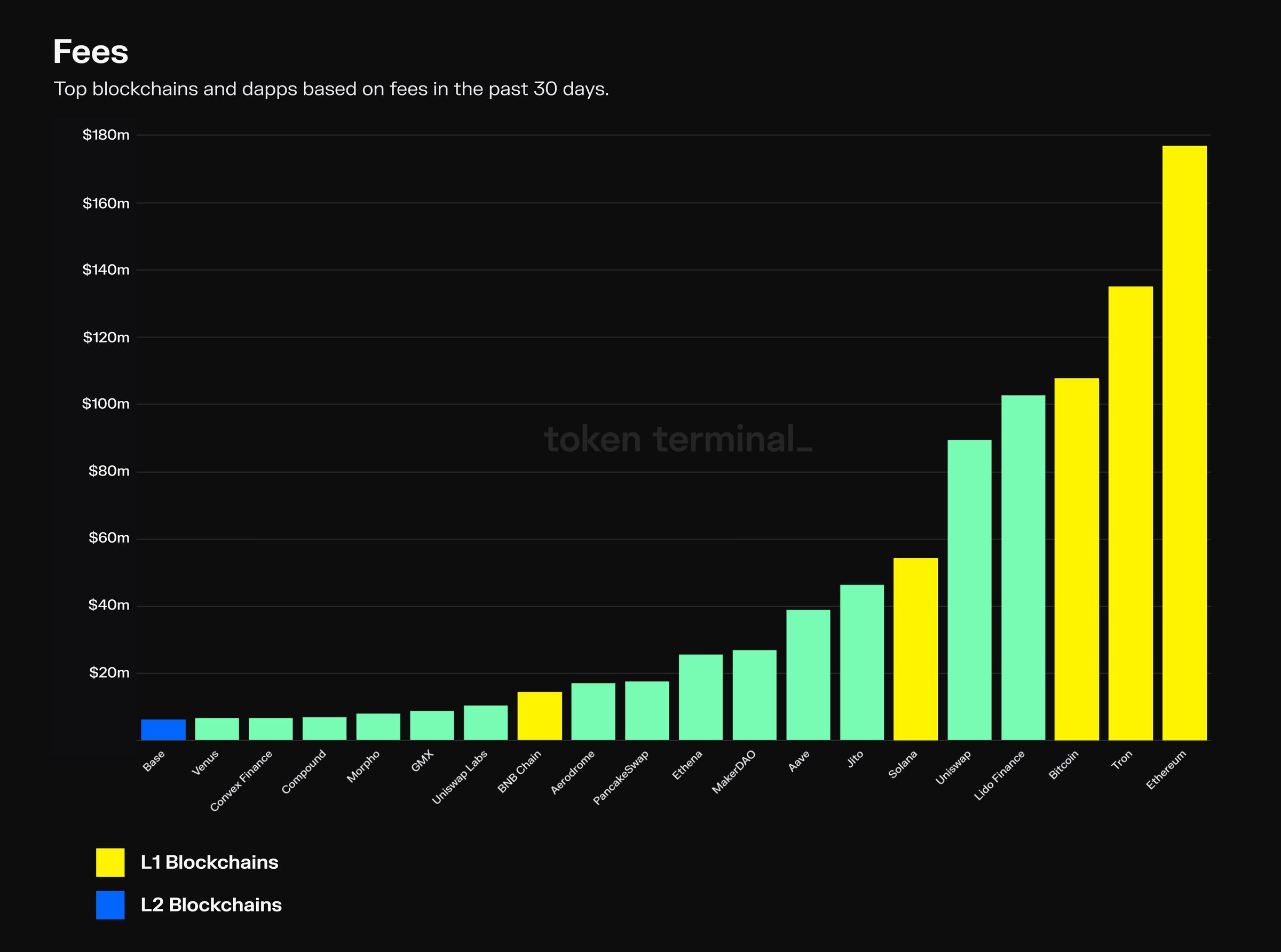
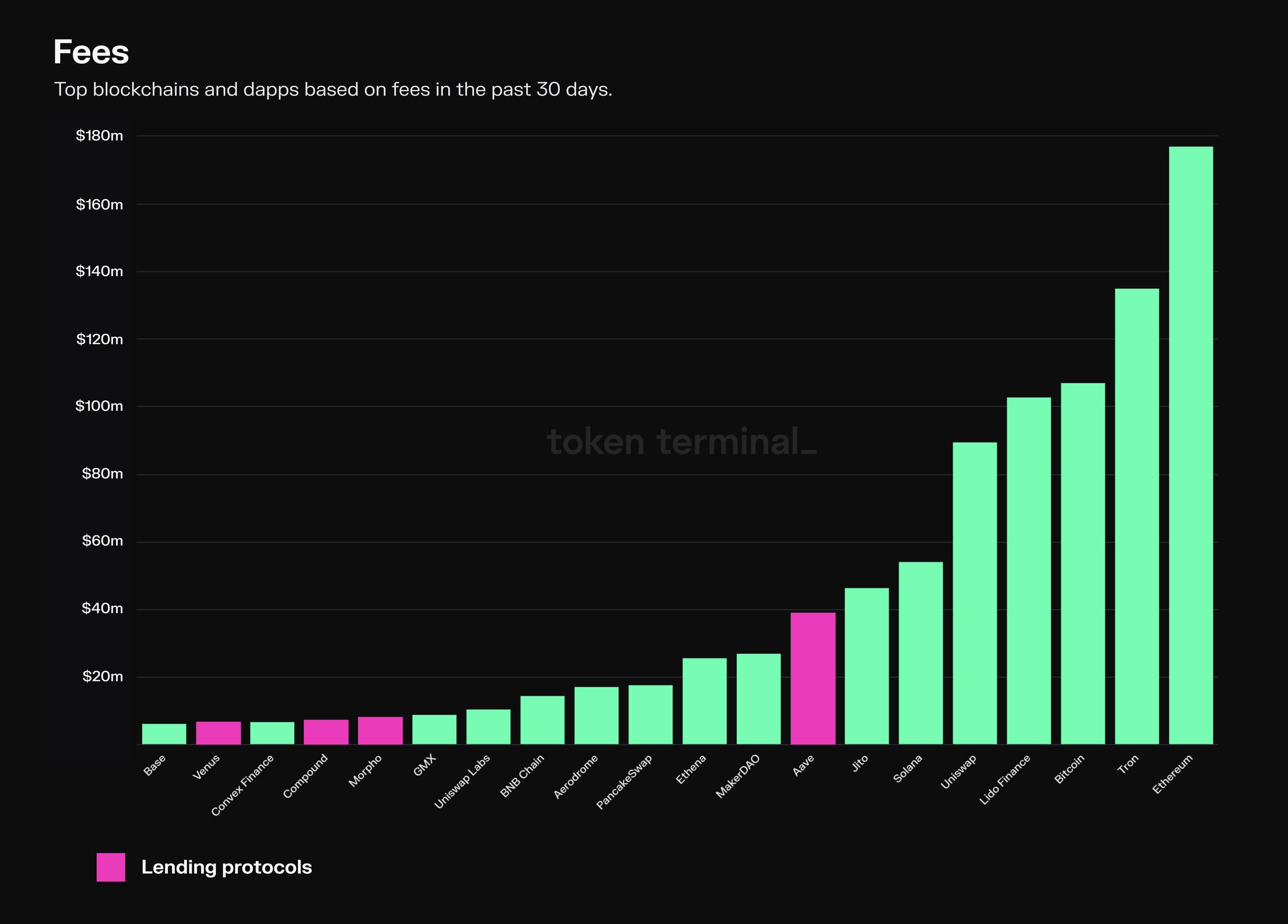
Highlighted protocols: Ethereum, Tron, Bitcoin, Solana, BNB Chain, and Base.

A majority of Fees is generated by general-purpose blockchains

  • Of the top 20, 5 are L1 blockchains, while only 1 is an L2 blockchain.
  • In the past 30 days, Ethereum generated the most Fees (~$180M). It’s worth highlighting that Base, despite the relatively low average transaction fee of ~$0.03 (compared to ~$4.5 on the Ethereum L1), still places among the top 20 because of the surge in user activity on the L2.
  • Outside of L1 & L2 blockchains, all the other protocols in the top 20 belong to the DeFi category.

2. Top fee-generating protocols with a highlight on Lido Finance and Jito
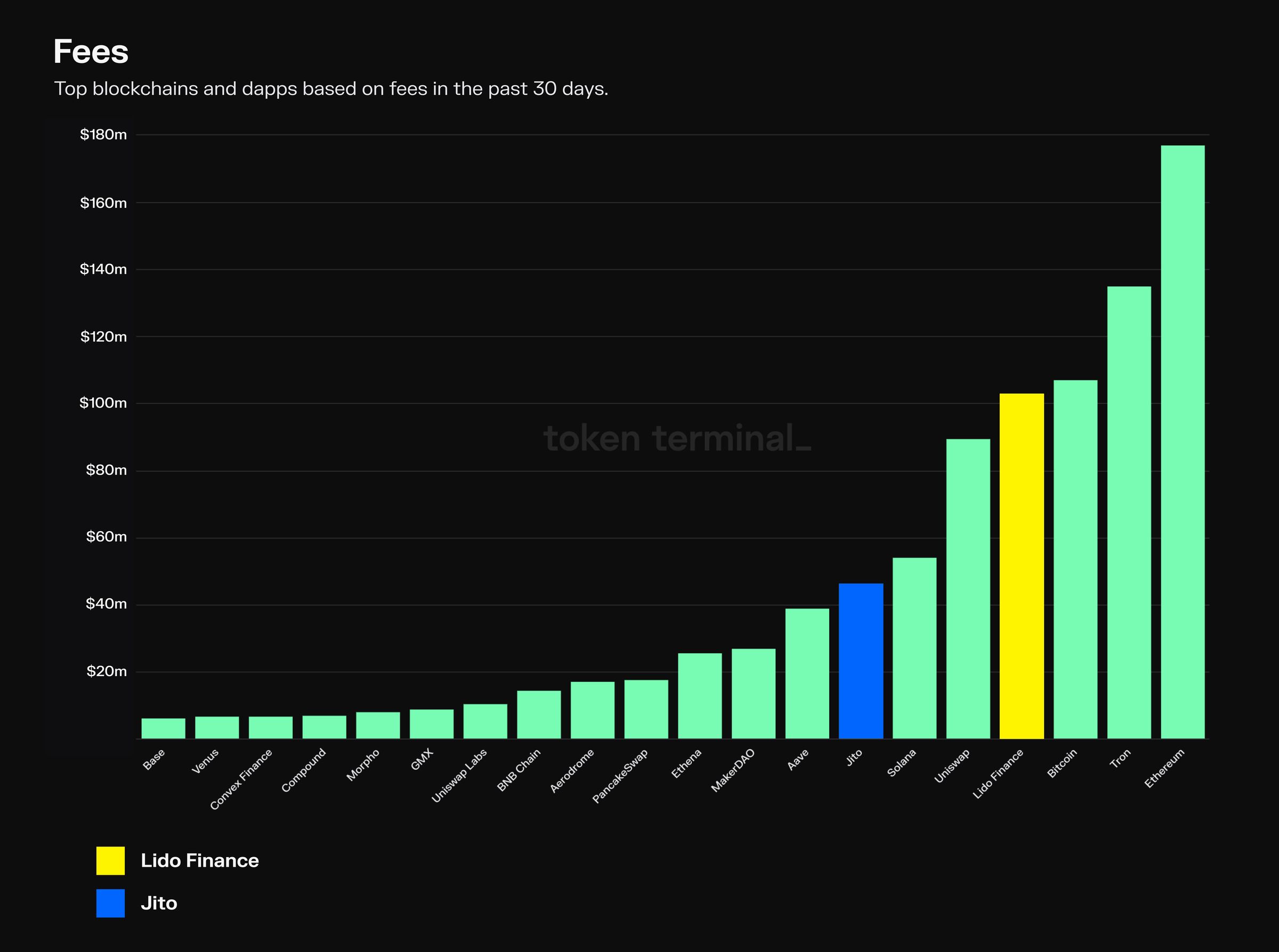
Highlighted protocols: Lido Finance and Jito.

Lido generates the most Fees out of all applications in crypto

  • Jito runs 2 different businesses: liquid staking (JitoSOL) and an MEV marketplace. The former monetizes via an AUM based management fee, and the latter by a take rate on the MEV tips paid to validators (the above chart includes only the MEV tips). Lido runs 1 business: liquid staking. It monetizes by charging a take rate on the staking rewards it earns for its depositors.
  • Lido generates ~2x in Fees compared to Jito, but Jito is growing faster.
  • Lido has $33.5B in Assets staked, whereas Jito has $1.6B. Lido’s fully diluted market cap is $1.9B, whereas Jito’s is $2.5B.

3. Top fee-generating protocols with a highlight on Exchanges (DEX)
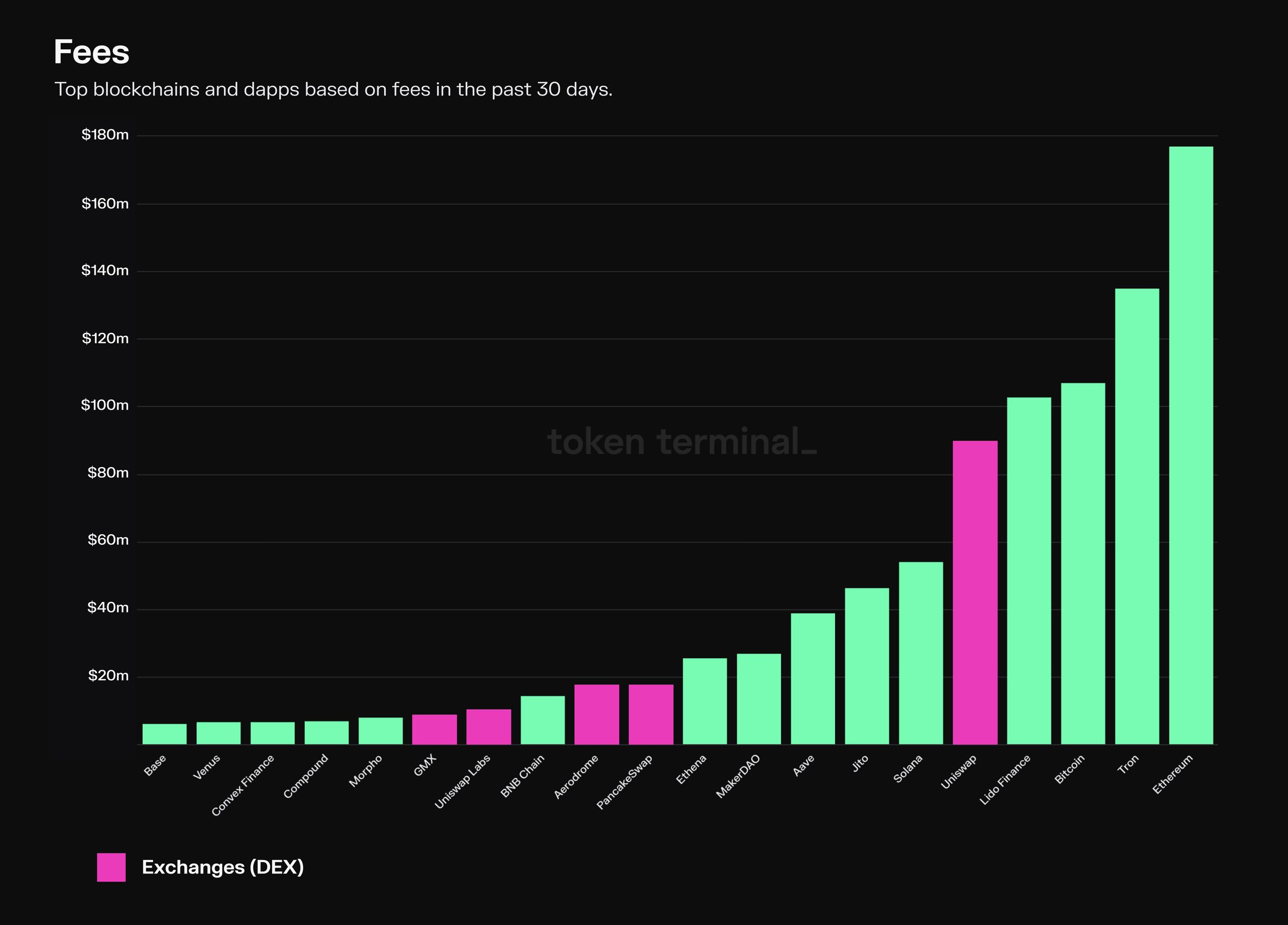
Highlighted protocols: Uniswap, PancakeSwap, Aerodrome, Uniswap Labs, and GMX.

The Uniswap DAO dominates the DEX category with monthly Fees nearing $100M

  • The Uniswap DAO generates the most Fees among DEXs. Note that Uniswap Labs is included as a separate entity, it monetizes by charging users who access the Uniswap Protocol through the official Uniswap Labs frontend application.
  • Uniswap DAO generates over ~2x in Fees compared to all the other DEXs in the top 20.
  • Aerodrome, a Base-native DEX, generates ~2x more fees than its underlying L2 blockchain.

4. Top fee-generating protocols with a highlight on MakerDAO and Ethena
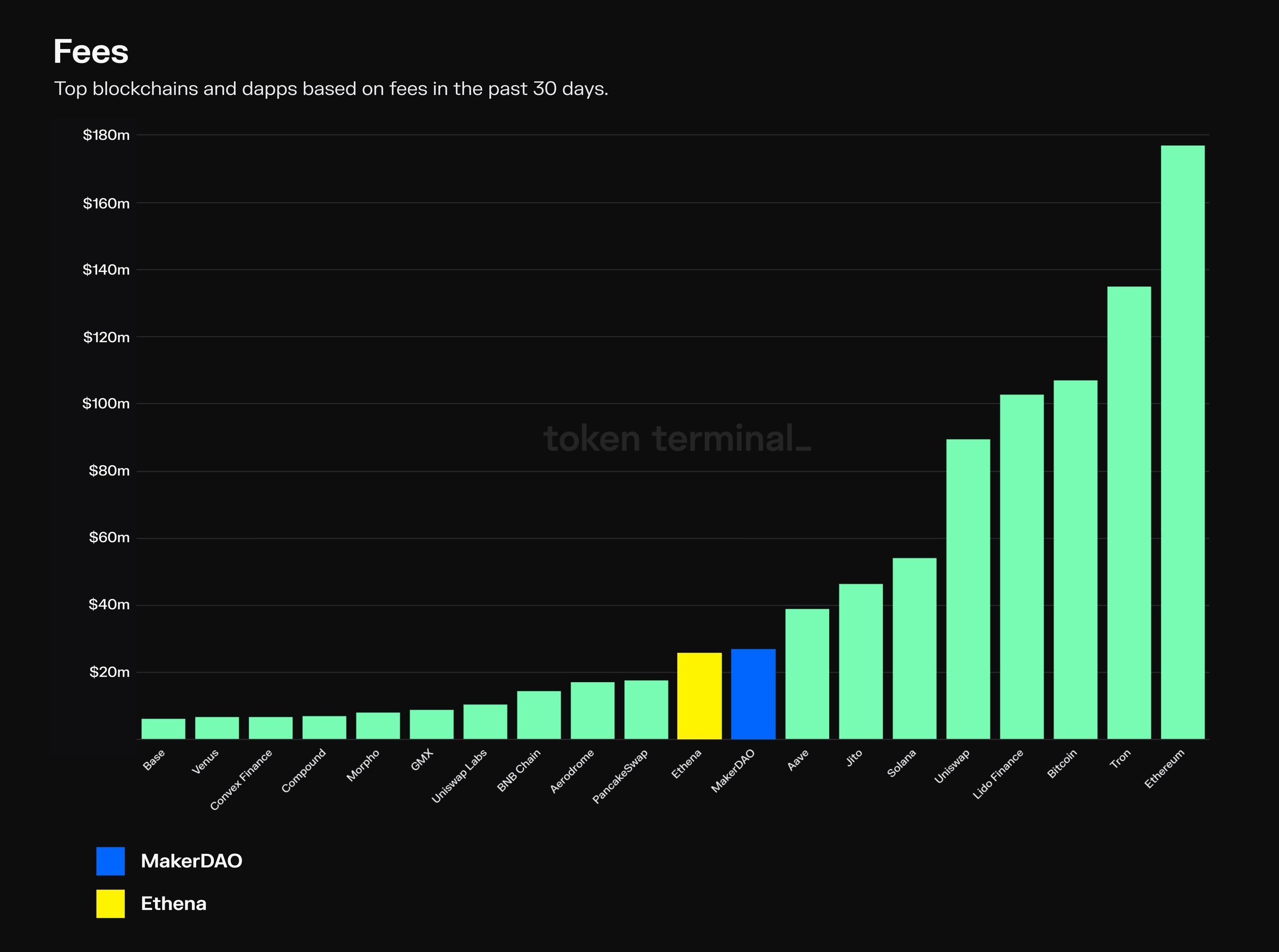
Highlighted protocols: MakerDAO and Ethena.

Ethena is on track to overtake MakerDAO in Fees

  • MakerDAO and Ethena dominate the decentralized Stablecoin issuers category.
  • The biggest stablecoin issuers, Tether (USDT) and Circle (USDC) are not included as they earn their Fees & Revenue offchain.
  • Ethena was launched in November 2024, whereas MakerDAO was launched already in November 2017.

5. Top fee-generating protocols with a highlight on Lending protocols
Highlighted protocols: Aave, Morpho, Compound, and Venus.

Aave is the 4th most fee-generating application in crypto

  • Aave is the clear market leader in the lending category, with a ~$30M Fee gap to Morpho, which comes in 2nd place in the lending market sector.
  • Compound and Aave both launched in 2020, but Aave has since managed to outcompete Compound in terms of Active loans and Fees.
  • Despite Aave’s dominance in the lending category, Venus stands out as the clear market leader for lending on the BNB Chain. Right now, ~90% of Venus’ Fees are generated from its deployment on the BNB Chain.

6. Top fee-generating protocols; breakdown by chain
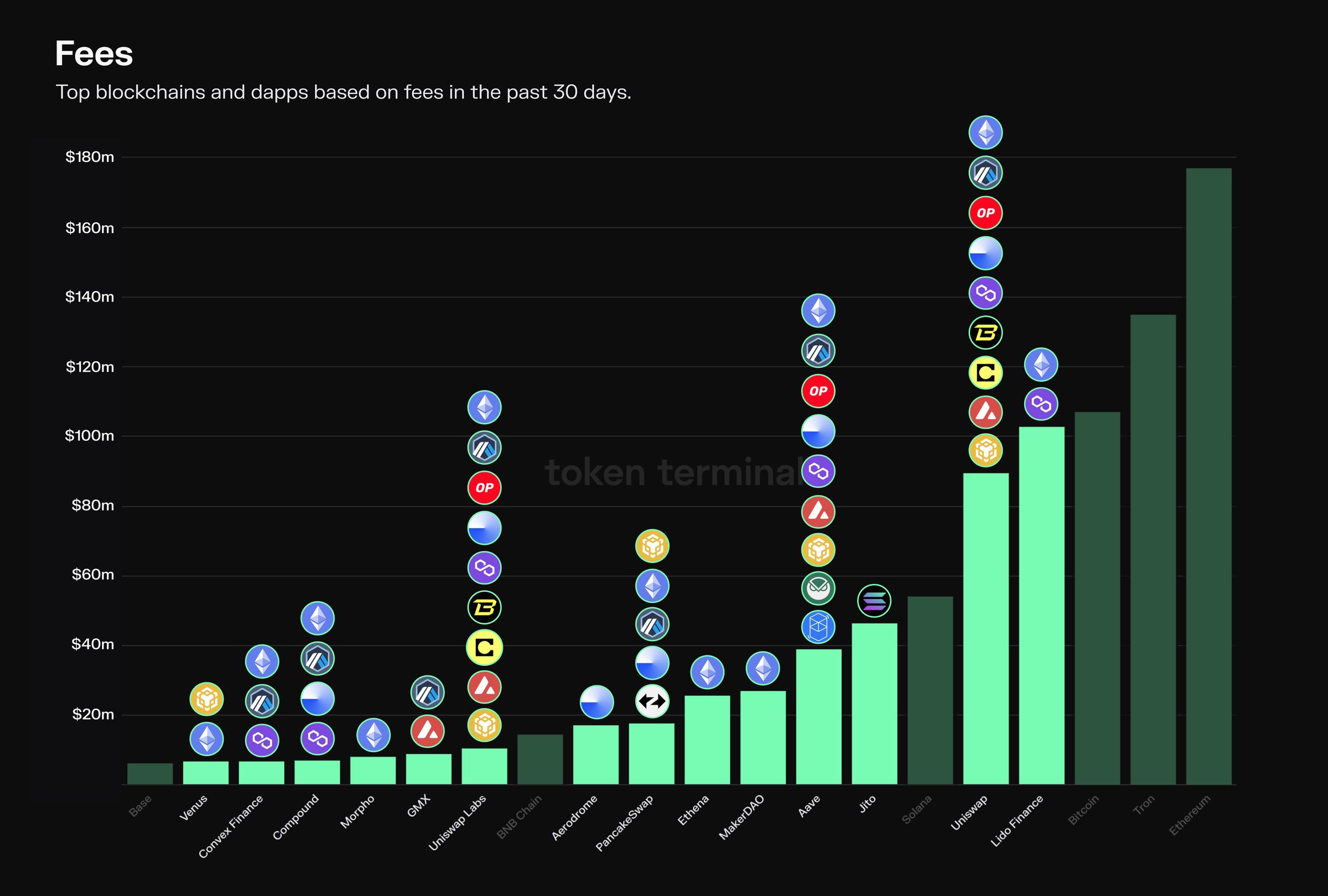
Highlighted which blockchains the applications are deployed to.

Most of the top fee-generating applications are deployed to multiple blockchains

  • A vast majority of the top 20 fee-generating applications in crypto have a deployment on Ethereum (L1 and L2s).
  • It is worth noting that asset issuers (Stablecoin issuers and Liquid staking providers) tend to be governed from a single chain, while their core product (stablecoin or LST) is made available as a bridged asset on multiple other chains.
  • Of the top 20, Aerodrome is the only application that has been launched from an L2 blockchain (Base).

FAQ

What are Fees?

  • The aggregate fees paid by the end users of the protocol’s service.
  • The methodology for Fees varies between Market sectors, because protocol’s in different Market sectors tend to have different business models:
    • Blockchains L1 & L2 = sell blockspace for transaction fees
    • Liquid staking = invest users’ stake to earn staking rewards
    • Exchange (DEX, Derivatives) = enable asset exchange against trading fees
    • Lending = provide loans against interest payments
    • Stablecoin issuers = provide access to USD against interest payments and/or invest user deposits to earn yield
    • Asset management = invest user deposits to earn yield

What’s the difference between Fees and Revenue?

  • Revenue is calculated based on the take rate (%) that the protocol applies to Fees.
  • The take rate can be anything between 0-100%.
  • Currently, the Uniswap DAO and Bitcoin both have a take rate of 0%, whereas Ethereum tends to have a take rate of ~80%.

What’s the difference between Revenue and Earnings?

  • Earnings is calculated by subtracting (i) Token incentives and (ii) Operating expenses from the Revenue.
    • Token incentives = an indication of how much the protocol spends on user acquisition. It’s calculated as the USD value of the protocol’s native tokens that have been distributed to users.
    • Operating expenses = an indication of how much the protocol spends on personnel and infrastructure to develop, maintain, and improve the protocol.
      • Note that a vast majority of protocols do not post their Operating expenses onchain, which is why that metric is yet to be added for most protocols.

When should you look at Fees vs. Revenue or Earnings?

  • As a rule of thumb, investors should pay attention to Fees for early-stage protocols that have not started to monetize yet, and Revenue and/or Earnings for protocols that have started to monetize:
    • Early-stage: Fees, indicates that the protocol has paying customers.
    • Later-stage: Revenue, indicates that the protocol is able to monetize its paying customers.
    • Mature-stage: Earnings, indicates that the protocol is able to return value to its tokenholders.
  • It’s also important to look at the ratios between:
    • Revenue / Fees = ideally, the protocol has so much leverage over its supply-side (LPs) that it can charge a high take rate on the Fees.
    • Earnings / Revenue = ideally, the protocol operates with a (i) low user acquisition spend, and (ii) operational overhead, which leads it to retain a high % of Revenue as Earnings.

The authors of this content, or members, affiliates, or stakeholders of Token Terminal may be participating or are invested in protocols or tokens mentioned herein. The foregoing statement acts as a disclosure of potential conflicts of interest and is not a recommendation to purchase or invest in any token or participate in any protocol. Token Terminal does not recommend any particular course of action in relation to any token or protocol. The content herein is meant purely for educational and informational purposes only, and should not be relied upon as financial, investment, legal, tax or any other professional or other advice. None of the content and information herein is presented to induce or to attempt to induce any reader or other person to buy, sell or hold any token or participate in any protocol or enter into, or offer to enter into, any agreement for or with a view to buying or selling any token or participating in any protocol. Statements made herein (including statements of opinion, if any) are wholly generic and not tailored to take into account the personal needs and unique circumstances of any reader or any other person. Readers are strongly urged to exercise caution and have regard to their own personal needs and circumstances before making any decision to buy or sell any token or participate in any protocol. Observations and views expressed herein may be changed by Token Terminal at any time without notice. Token Terminal accepts no liability whatsoever for any losses or liabilities arising from the use of or reliance on any of this content.

Stay in the loop

Join our mailing list to get the latest insights!

Email
Sign up

Crypto di tendenza

Letture associate

Super Spiral Mega-Boom, Micron's Earnings Report Rekindles the Semiconductor Bull Run

On June 25, 2026, Micron Technology released its blockbuster Q3 FY2026 results, significantly exceeding market expectations and reigniting confidence in the semiconductor bull market. Revenue soared to $41.456 billion (vs. ~$35.4B expected), up 346% year-over-year, while GAAP net profit surged nearly 15 times to $28.243 billion. Guidance for Q4 was even more striking, with projected revenue of approximately $50 billion, far surpassing prior estimates. The report highlighted that the AI boom is now fueling growth across Micron's entire product stack, not just HBM. Cloud memory, core data center, SSD, mobile, and automotive businesses all saw revenue growth exceeding 250-600%, with margins hovering around 80%. While HBM4 is already in volume shipment and 2026 capacity is sold out, AI-driven demand is also tightening supply for traditional DRAM and NAND, sustaining a strong pricing cycle. A pivotal development is Micron's shift toward a "demand-first" model. The company disclosed 16 long-term strategic customer agreements (SCAs), most spanning 5 years to 2030, covering about 20% of DRAM and one-third of NAND shipments. These are take-or-pay contracts, with 14 agreements already securing roughly $100 billion in guaranteed future revenue and $22 billion in customer performance assurances. To fulfill this locked-in demand, Micron plans substantial capacity expansion, with Q4 capital expenditure projected at ~$10 billion. This investment, backed by concrete long-term orders rather than cyclical speculation, marks a historic change for the memory industry. Following the earnings release, Micron's stock surged 16% after-hours, lifting the broader semiconductor sector globally. The report served as a powerful signal that AI infrastructure build-out is accelerating, with memory positioned as a central protagonist in the ongoing narrative.

Odaily星球日报17 min fa

Super Spiral Mega-Boom, Micron's Earnings Report Rekindles the Semiconductor Bull Run

Odaily星球日报17 min fa

Deciphering the Ethereum Foundation's New Structure: Reaffirming Self-Sovereignty Amid Institutionalization Trends

Summary: The Ethereum Foundation (EF) has announced a major restructuring, laying off 20% of its staff and introducing a new five-layer operational framework. This move aims to clarify the EF's mission and reaffirm Ethereum's core principle of self-sovereignty amidst growing institutionalization in the crypto space. The five layers are: 1. **Protocol Layer**: Focuses on maintaining Ethereum's foundational "CROPS" values—Censorship-resistant, Robust, Open, Private, and Secure. This involves core technical work like secure hard forks and mitigating toxic MEV. 2. **Access Layer**: Ensures users can practically exercise self-sovereignty through actions like reading the chain and making transactions. A key principle is the "zero option," meaning a trusted, non-intermediated path must always exist as an alternative to any centralized service. 3. **User Layer**: Bridges the protocol and access layers by grounding EF's work in the real needs of users and organizations. This is seen as crucial for moving beyond a purely research-driven approach and ensuring development effectively serves the ecosystem. 4. **Community Layer**: Responsible for building and maintaining consensus around Ethereum's core values both internally and externally. This involves guarding against centralization, upholding technological neutrality, and preventing short-term commercial interests from undermining CROPS principles. 5. **Institutional Layer**: Manages EF's engagement with institutions, but with the precondition of self-sovereignty. The goal is not to make it easier for institutions to control users, but to demonstrate how Ethereum's technology can enable better integrations. The article argues that while institutional adoption brings legitimacy, it also risks diluting crypto's foundational ethos of decentralization. The new structure represents EF's effort to navigate this tension, upholding its core mission while actively engaging with a broader, more complex ecosystem.

marsbit36 min fa

Deciphering the Ethereum Foundation's New Structure: Reaffirming Self-Sovereignty Amid Institutionalization Trends

marsbit36 min fa

OpenRouter: How Did This 'AI Model Relay Station' Achieve a $10 Billion Valuation?

OpenRouter: The Model Router Building a $10B+ Company This article explores OpenRouter, a platform that aggregates access to over 400 AI models from 70+ providers (like OpenAI, Claude, Gemini) through a single API. It has grown into a unicorn with a $1.3B valuation by 2026, processing massive scale—reaching 100 trillion tokens monthly. Its core value isn't just being a "model supermarket." For developers building real-world AI applications, managing multiple models for different tasks (e.g., cheap models for titles, powerful ones for long articles) is complex. OpenRouter acts as a critical "model scheduling layer," handling routing, failover between providers, cost optimization, and enterprise features like zero-data-retention policies and budget controls. OpenRouter's business model is a "toll fee": it charges a small platform fee (5.5%) on purchased credits while passing model costs directly to users. Its revenue scales with the tokens flowing through its system, which saw explosive growth as AI apps evolved. Key growth drivers include: 1) The explosion of specialized models, increasing choice complexity; 2) AI apps shifting focus from performance to cost optimization; 3) The rise of AI agents that require more reliable, multi-step model calls. However, risks remain. Large enterprises or cloud providers (AWS, Google Cloud) could build similar internal gateways. Its position between model suppliers and developers could also create future tension over pricing and data control. To stay ahead, OpenRouter must deepen its enterprise features and prove it's more than just a request forwarder.

marsbit55 min fa

OpenRouter: How Did This 'AI Model Relay Station' Achieve a $10 Billion Valuation?

marsbit55 min fa

Bitcoin Falls Below $60,000 Again; After 20 Months, We've Reached a New Low

Bitcoin Drops Below $60,000, Hitting a 20-Month Low Bitcoin fell below the key $60,000 psychological level again, reaching a low of $59,023—its lowest point in approximately 20 months, dating back to October 2024. While it later recovered slightly to around $60,600, this marks its third significant breach of $60,000 this year. The downturn is attributed to two primary factors. First, U.S. spot Bitcoin ETFs are experiencing their longest streak of net outflows since launch, with nearly $5.94 billion withdrawn over 30 days. This creates sustained selling pressure as Authorized Participants sell Bitcoin to meet redemptions. Second, shifting macroeconomic expectations are adding pressure. Strong U.S. job data and hawkish remarks from Fed officials have increased market pricing for potential rate hikes, reversing the earlier liquidity-driven bullish sentiment and prompting a shift away from risk assets like Bitcoin. Analyst views are mixed. 21Shares maintains a bullish long-term outlook, expecting prices to recover towards $100,000, citing historical post-halving cycles and substantial ETF holdings as a base. In contrast, Arthur Hayes predicts a potential bottom around $40,000 within six months due to persistent Fed hawkishness. CryptoQuant suggests, based on on-chain data, that the market may not find a bottom until prices fall below the average investor cost basis around $53,000, potentially extending the bearish phase into late 2026 or early 2027. The immediate focus is on upcoming U.S. inflation data and Fed signals. Lower-than-expected CPI could offer relief, but confirmation of sticky inflation or continued ETF outflows may lead to further downside pressure. Bitcoin's ability to hold above $60,000 remains a critical test for the near-term market direction.

Odaily星球日报1 h fa

Bitcoin Falls Below $60,000 Again; After 20 Months, We've Reached a New Low

Odaily星球日报1 h fa

Trading

Spot
Futures

Articoli Popolari

Come comprare TOP

Benvenuto in HTX.com! Abbiamo reso l'acquisto di TOP AI Network (TOP) semplice e conveniente. Segui la nostra guida passo passo per intraprendere il tuo viaggio nel mondo delle criptovalute.Step 1: Crea il tuo Account HTXUsa la tua email o numero di telefono per registrarti il tuo account gratuito su HTX. Vivi un'esperienza facile e sblocca tutte le funzionalità,Crea il mio accountStep 2: Vai in Acquista crypto e seleziona il tuo metodo di pagamentoCarta di credito/debito: utilizza la tua Visa o Mastercard per acquistare immediatamente TOP AI NetworkTOP.Bilancio: Usa i fondi dal bilancio del tuo account HTX per fare trading senza problemi.Terze parti: abbiamo aggiunto metodi di pagamento molto utilizzati come Google Pay e Apple Pay per maggiore comodità.P2P: Fai trading direttamente con altri utenti HTX.Over-the-Counter (OTC): Offriamo servizi su misura e tassi di cambio competitivi per i trader.Step 3: Conserva TOP AI Network (TOP)Dopo aver acquistato TOP AI Network (TOP), conserva nel tuo account HTX. In alternativa, puoi inviare tramite trasferimento blockchain o scambiare per altre criptovalute.Step 4: Scambia TOP AI Network (TOP)Scambia facilmente TOP AI Network (TOP) nel mercato spot di HTX. Accedi al tuo account, seleziona la tua coppia di trading, esegui le tue operazioni e monitora in tempo reale. Offriamo un'esperienza user-friendly sia per chi ha appena iniziato che per i trader più esperti.

157 Totale visualizzazioniPubblicato il 2024.12.10Aggiornato il 2026.06.02

Come comprare TOP

Discussioni

Benvenuto nella Community HTX. Qui puoi rimanere informato sugli ultimi sviluppi della piattaforma e accedere ad approfondimenti esperti sul mercato. Le opinioni degli utenti sul prezzo di TOP TOP sono presentate come di seguito.

活动图片