Cardano Whales Devour Dip, Why They Don’t Care About Price Action

newsbtcPubblicato 2022-02-25Pubblicato ultima volta 2022-02-27

Introduzione

Despite the crypto market's bloodshed, in the past few days, the Cardano (ADA) trading activity has been relentless, and its holders' balance remains strong with a multi-year high. Into The...

Despite the crypto market’s bloodshed, in the past few days, the Cardano (ADA) trading activity has been relentless, and its holders’ balance remains strong with a multi-year high.
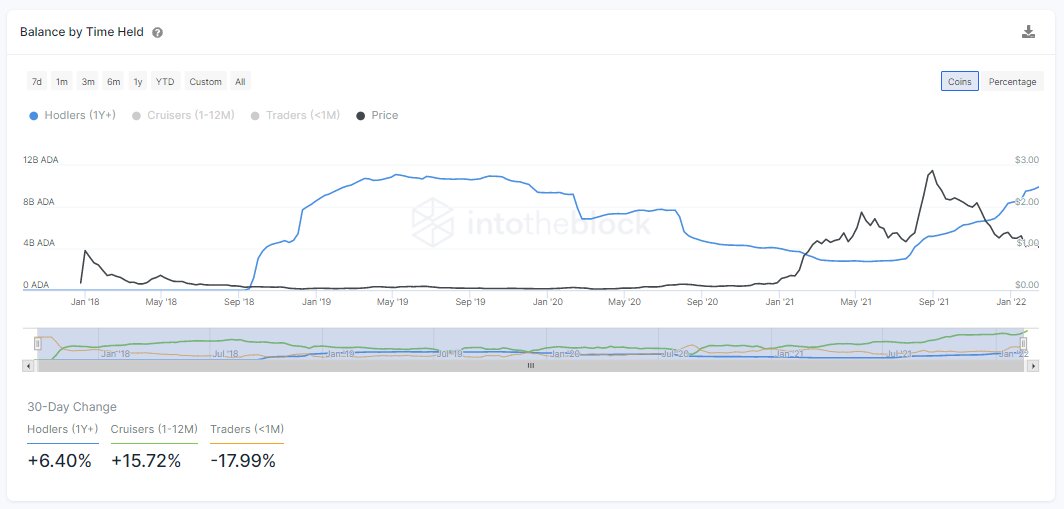
Into The Block data indicates that the wallet balance held by long-term Cardano holders hit a multi-year high on February 23.
“Regardless of the price action, Cardano‘s holders remain strong. The balance held by HODLERS- addresses holding >1 year, is at a multi-year high. These HOLDERS increased their positions to 10.12b $ADA, the largest balance since December 11, 2019.”
Image

Source: Into The Block Despite the geopolitical tension causing the altcoin’s price to drop dramatically, traders have increased their position of Cardano.
5 BTC + 300 Free Spins for new players & 15 BTC + 35.000 Free Spins every month, only at mBitcasino. Play Now!

Holders have accumulated the highest balance of ADA since December 2019. Cardano’s network recent developments might be serving as fuel to its supporters, and as a consequence, many believe its price will climb.
“Every bounce is still getting sold off, waiting for a final leg down before a reversal. Would consider buying this at 0.50,” an analyst noted.
A Finder’s poll indicated several analysts believe the price of ADA will reach $58 by 2030, and a few thought it might close this year at $2.72, a 160% increase. Many traders received the $58 prediction as an exaggeration unless the Cardano ecosystem truly manages to explode during the following years.
BitStarz Player Lands $2,459,124 Record Win! Could you be next big winner? Win up to $1,000,000 in One Spin at CryptoSlots
Get 110 USDT Futures Bonus for FREE!

Expert Vanessa Harris was also bullish on the altcoin. She expects it to close 2022 around the $3 mark, adding that its criticized slow-paced growth could pay off as nations turn their eyes towards it:
“It is one of the few smart contract platforms that have placed security, correctness [and] decentralization at their core, backed by formal methods and peer-reviewed research… While this means Cardano moves more deliberately in the short term, long term this resilience should support adoption by nation-states and non-governmental organizations. We are already seeing this adoption happen in Ethiopia and Tanzania.”
However, other experts remained bearish and cited “lack of execution and poor technology” and alleged that “They have failed on their promise of delivery for the last several years.” But however slow, the expansion of its DeFi ecosystem is starting to happen and might support the loyal holders’ sentiment.
Related Reading | Cardano Daily Transaction Volume Up, But ADA Prices Remain Sluggish

Cardano DeFi Expansion
Cardano volumes and transactions are growing as developers focus on building the first dApps solutions and its DeFi space is set to grow. It has even surpassed the on-chain activity of Ethereum ranking 2nd in 24h transaction volume after registering $17.04 billion on February 22.
In terms of gaining traction, the decentralized exchange SundaeSwap, an Automated Market Maker DEX, was anticipated by many users and launched at the beginning of the year. It tumbled at the beginning due to congestion. But after some adjustments of the block size done by IOHK, the transactions run smoothly now and SundaeSwap reports a Total Value Locked of $21 million.
The boom of NFTs is also contributing to the Cardano blockchain attraction. The non-custodial decentralized exchange ecosystem Arcadex will soon be launched on the network. It has generated enthusiasm for providing a wide variety of DeFi services through both DEX and NFT marketplaces.
Despite the slow-paced growth and 6-month downtrend, Cardano is still gaining traction and holders are not letting go. More growth is expected as the Cardano roadmap aims to increase scalability.
Related Reading | Bitrue Announces Support For Cardano (ADA) As Base Pair On Exchange
Price Of ADA
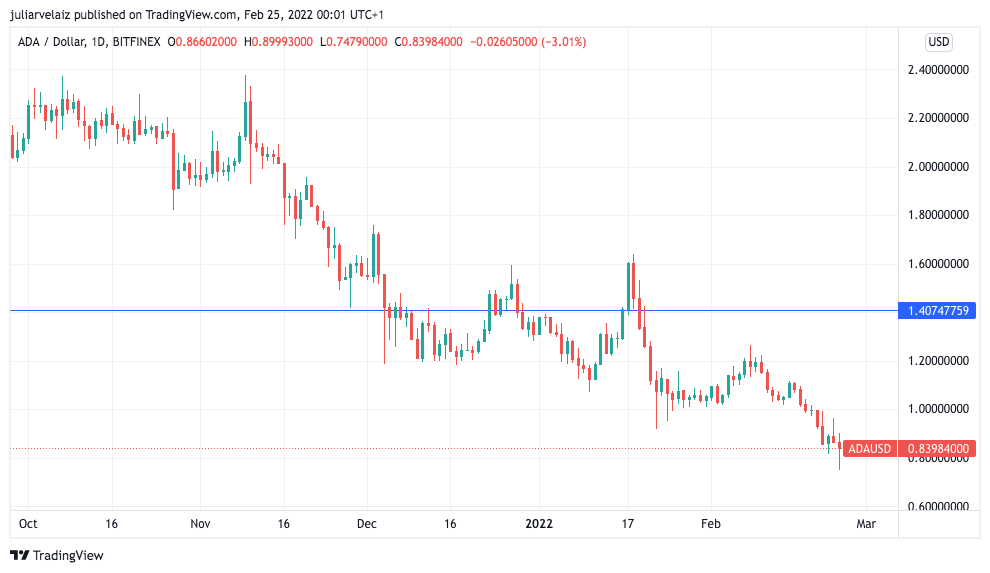
At the time of writing, Ada is down to $0.83, shedding around 0.72% over the past 24 hours.
Cardano

Cardano price down to $0.83 in the daily chart | Source: ADAUSD on TradingView.com

Letture associate

After Marvell's 32% Surge, the Chinese Chip Family Behind It Emerges

The stock price of Marvell Technology surged 32.5% on June 2nd, driven by NVIDIA CEO Jensen Huang highlighting its custom ASICs and optical interconnects as core to AI data center architecture. This event brought attention to the Chinese semiconductor family behind Marvell: the Dai siblings. The story centers on three siblings, all UC Berkeley graduates, whose three-decade entrepreneurial journey aligns with major semiconductor industry shifts. In 1995, youngest sister Dai Wei Li co-founded Marvell with her husband Sehat Sutardja and his brother, focusing on storage controllers. Eldest brother Dai Wei Min founded EDA company Ultima, later sold to Cadence, and later founded VeriSilicon (芯原) in China, becoming a leading semiconductor IP provider. Second brother Dai Wei Jin co-founded EDA firm Silicon Perspective (sold to Cadence) and GPU IP company Vivante, later acquired by VeriSilicon. The combined "Dai-Sutardja" family network extends beyond Marvell. Their ventures and investments form a comprehensive ecosystem for the post-Moore's Law, chiplet era. Key holdings include: Dream Big Semiconductor (AI SuperNICs, acquired by Arm), Alphawave (high-speed SerDes IP, acquired by Qualcomm), and Silicon Box (a chiplet advanced packaging foundry). VeriSilicon itself thrives on the AI ASIC and IP boom in China. Collectively, the family's AI infrastructure-related portfolio is estimated at over $22 billion. Their strategy represents a distinct path: building critical components for open standards and key manufacturing capacity in the chiplet era, rather than pursuing standalone AI chip dominance. While this path may not create the next NVIDIA, it has enabled repeated successful exits and sustained influence within the global semiconductor industry.

marsbit35 min fa

After Marvell's 32% Surge, the Chinese Chip Family Behind It Emerges

marsbit35 min fa

Microsoft is Afraid of Being Marginalized by AI Giants

Microsoft, once the defining force of the PC era, now faces a familiar challenge in the AI age: the risk of being relegated to a profitable but invisible infrastructure provider. This anxiety was laid bare at Build 2026, where CEO Satya Nadella unveiled a major strategic pivot. The catalyst was a quiet April agreement that dissolved Microsoft's exclusive licensing and cloud-hosting deal with OpenAI, its once-vital partner. This erased Microsoft's key AI moat. With OpenAI and Anthropic defining AI applications and gaining enterprise traction—even within Microsoft's own ranks—Nadella had to answer: without exclusivity, what is Microsoft's role? The answer was a suite of seven in-house AI models, a developer-focused AI workstation (Surface RTX Spark Dev Box), and, most crucially, the Agent 365 platform for enterprise AI governance. The models, notably targeting Anthropic's strengths in coding and enterprise, signal a defensive move. However, the broader strategy is to make the models themselves less decisive. Financially, Microsoft's AI revenue is strong, driven largely by Azure running others' models. Yet its user-facing products like Copilot show weak penetration and engagement. Microsoft earns infrastructure money but lacks direct user mindshare. Nadella's core fear is being "hollowed out." As OpenAI and Anthropic prepare for IPOs and gain financial independence, they may build their own infrastructure, threatening Azure's lucrative AI revenue stream. Microsoft's window is to entrench itself deeper: not as the model creator, but as the indispensable platform for securely deploying, managing, and governing all AI models within the enterprise through Agent 365. Build 2026 revealed Microsoft's bet: in the AI era, the ultimate power lies not in any single model, but in the enterprise "operating system" that controls them. Nadella is determined to ensure Microsoft is the driver of this new era, not just a passenger.

marsbit48 min fa

Microsoft is Afraid of Being Marginalized by AI Giants

marsbit48 min fa

CPU, Quietly Returning to the Center of the AI Computing Power Stage

Over the past three years, AI computing power narratives have been dominated by GPUs. However, starting in 2026, this story began to shift. While training large models remains GPU-intensive, the rapid growth of inference and AI agent workloads, which require high levels of task orchestration, concurrency, and data flow management, has highlighted a renewed critical role for CPUs. These are tasks GPUs are not designed to handle. Intel's recent launch of the Xeon 6+ processor, built on its Intel 18A process and featuring up to 288 efficiency cores (E-cores), exemplifies this strategic pivot. It is positioned not as a mere companion to GPUs but as the essential "control plane" for AI infrastructure, optimized for high-density, energy-efficient, and high-throughput workloads characteristic of AI agents and inference. This "CPU resurgence" is not about CPUs outperforming GPUs in raw computation. It reflects a systemic bottleneck: as AI scales from training single models to deploying countless intelligent agents, the demand for coordination and data handling surges. Major cloud providers are also developing their own high-density ARM-based server CPUs for similar workloads. However, Intel's success with this strategy faces significant challenges. Competition includes NVIDIA's integrated CPU-GPU solutions, the expanding adoption of cloud vendors' in-house ARM CPUs, and the crucial market test of Intel's 18A manufacturing process against rivals like TSMC's N2. In conclusion, CPUs are indeed reclaiming a central, though redefined, role in AI compute—managing the complex orchestration that enables massive-scale AI deployment. While the trend is clear, which company will ultimately lead this CPU resurgence remains an open question to be decided in the data centers of 2027 and beyond.

marsbit1 h fa

CPU, Quietly Returning to the Center of the AI Computing Power Stage

marsbit1 h fa

Trading

Spot
Futures

Articoli Popolari

Come comprare ADA

Benvenuto in HTX.com! Abbiamo reso l'acquisto di Cardano (ADA) semplice e conveniente. Segui la nostra guida passo passo per intraprendere il tuo viaggio nel mondo delle criptovalute.Step 1: Crea il tuo Account HTXUsa la tua email o numero di telefono per registrarti il tuo account gratuito su HTX. Vivi un'esperienza facile e sblocca tutte le funzionalità,Crea il mio accountStep 2: Vai in Acquista crypto e seleziona il tuo metodo di pagamentoCarta di credito/debito: utilizza la tua Visa o Mastercard per acquistare immediatamente CardanoADA.Bilancio: Usa i fondi dal bilancio del tuo account HTX per fare trading senza problemi.Terze parti: abbiamo aggiunto metodi di pagamento molto utilizzati come Google Pay e Apple Pay per maggiore comodità.P2P: Fai trading direttamente con altri utenti HTX.Over-the-Counter (OTC): Offriamo servizi su misura e tassi di cambio competitivi per i trader.Step 3: Conserva Cardano (ADA)Dopo aver acquistato Cardano (ADA), conserva nel tuo account HTX. In alternativa, puoi inviare tramite trasferimento blockchain o scambiare per altre criptovalute.Step 4: Scambia Cardano (ADA)Scambia facilmente Cardano (ADA) nel mercato spot di HTX. Accedi al tuo account, seleziona la tua coppia di trading, esegui le tue operazioni e monitora in tempo reale. Offriamo un'esperienza user-friendly sia per chi ha appena iniziato che per i trader più esperti.

1.2k Totale visualizzazioniPubblicato il 2024.12.10Aggiornato il 2026.06.02

Come comprare ADA

Discussioni

Benvenuto nella Community HTX. Qui puoi rimanere informato sugli ultimi sviluppi della piattaforma e accedere ad approfondimenti esperti sul mercato. Le opinioni degli utenti sul prezzo di ADA ADA sono presentate come di seguito.

活动图片