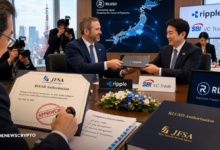
Компания BitGo получила лицензию платежного учреждения в Сингапуре

cryptonews.ruPubblicato 2022-11-08Pubblicato ultima volta 2024-08-08

  • BitGo получила лицензию платежного учреждения в Сингапуре.
  • Теперь кастодиан будет предлагать местным клиентам полный спектр криптовалютных услуг.
  • Ранее аналогичную лицензию получила Hex Trust.

7 августа 2024 года криптовалютный кастодиан BitGo получил лицензию крупного платежного учреждения (MPI) от Денежно-кредитного управления Сингапура (MAS). Теперь компания будет предлагать услуги по хранению и торговле криптовалютами.

BitGo is pleased to announce that we have obtained the Major Payment Institution Licence from the Monetary Authority of Singapore.

We are committed to meeting the rising demands of client needs in Asia through regulated digital payment token services. This includes our… pic.twitter.com/4DAgKvLVVD

— BitGo (@BitGo) August 8, 2024

«Эта веха подчеркивает наше стремление к экспансии в Азии и рассматривает Сингапур как ведущий финансовый центр. Лицензия позволит BitGo удовлетворить растущий спрос на регулируемые услуги по работе с цифровыми активами во всем регионе», — говорится в сообщении.

Известно, что теперь клиенты BitGo смогут покупать и продавать цифровые активы, «находясь в надежном и безопасном хранилище». Также пользователи получат доступ к «агрегированной глубокой ликвидности и платформе для торговли и хранения».

Генеральный директор BitGo Майк Белше заявил:

«Сингапур является ведущим финансовым центром в Азии. Получив эту лицензию, мы сможем удовлетворить растущие потребности клиентов с самыми разнообразными запросами — от полностью регулируемого хранения и торговли до кошельков с самостоятельным хранением. BitGo — единственная компания в регионе, предлагающая полный набор услуг».

Напомним, в январе 2024 года BitGo получил принципиальное одобрение от Валютного управления Сингапура.

Также недавно криптовалютный кастодиан Hex Trust заявил о получении принципиального одобрения в отношении лицензии крупного платежного учреждения в регионе.


Letture associate

Tidal Investment: We Remain Bullish on the AI Industry Chain, But the Reasons Have Changed

Tidal Investment remains optimistic about the AI industry chain, but the rationale has shifted. The market narrative has changed. While recent large-scale IPOs (e.g., SpaceX) and major fundraising plans by tech giants like Alphabet and Meta have caused some nervousness, this isn't a sign of an AI peak. The focus has moved from the initial question of AI's viability to the sustainability of massive investment cycles. The key players—primarily the major cloud providers—are not slowing down; their capital expenditure (Capex) guidance for 2026 has been increased across the board (e.g., Alphabet to $180B, Amazon to $200B). This investment cycle is proving resilient and difficult to stop. Unlike traditional hardware cycles, current AI Capex is distributed across multiple physical layers—computing, memory, networking, and critically, power infrastructure. Bottlenecks are shifting from chips to elements like electricity, transformers, and cooling systems, which have much longer lead times and cannot be easily pre-built like fiber optics during the dot-com bubble. Supply chain data (e.g., Eaton's 240% YoY data center orders) confirms this broad-based, project-driven expansion. Market concerns are acknowledged but viewed differently. First, while Capex growth currently outpaces revenue growth, raising ROI questions, this mirrors the early scaling phase of cloud computing itself. A change in view would require concrete signals like downward Capex revisions or missed AI product targets, which haven't materialized by mid-2026. Second, comparisons to the 2000 dot-com bust are flawed. That crash was driven by a massive, parallel oversupply of cheap capacity (fiber). The current cycle faces *supply constraints* in critical, capital-intensive physical infrastructure that cannot be overbuilt as easily. In conclusion, the wave of fundraising reflects the next, more complex act of the AI story. Physical bottlenecks and sustained high Capex plans suggest this is not the finale but an ongoing, capital-intensive build-out phase. The script has changed, but the play is far from over.

marsbit1 h fa

Tidal Investment: We Remain Bullish on the AI Industry Chain, But the Reasons Have Changed

marsbit1 h fa

Tidal Investment: We Remain Bullish on the AI Industry Chain, But for Different Reasons Now

Tidal Investments remains optimistic about the AI industry chain, but the rationale has shifted. The market is concerned about massive concurrent fundraising by tech giants like SpaceX, OpenAI, Alphabet, and Meta, fearing an AI peak. However, the authors argue this signals the next act of AI development, not its end. Capital expenditure (Capex) from major cloud providers (Alphabet, Amazon, Meta, Microsoft, Oracle) continues to surge aggressively into 2026. This investment cycle is more resilient than past hardware cycles due to its scale and complexity. Bottlenecks have shifted from chips to critical physical infrastructure like power grids, transformers, cooling, and data center construction—areas with long lead times and limited capacity for rapid expansion. Supply chain data (e.g., Eaton's orders) confirms substantial, tangible progress. Key market concerns are addressed: 1. **ROI vs. Capex Growth**: While Capex growth outpaces revenue, the authors note cloud giants have historically overcome similar phases through scale. The cycle will only be in danger if Capex guidance is cut, orders are canceled, or AI product demand falters—none of which are currently observed. 2. **Comparison to the 2000 Dot-com Bubble**: Unlike the telecom bubble, where cheap, oversupplied fiber crashed prices, AI infrastructure (especially power) is constrained, customized, and subject to lengthy approvals, making a similar supply glut and crash unlikely. In conclusion, the wave of fundraising reflects the immense, ongoing capital needs for AI's next phase, constrained by slow-moving physical bottlenecks. The AI cycle is not over; the script has simply changed.

链捕手1 h fa

Tidal Investment: We Remain Bullish on the AI Industry Chain, But for Different Reasons Now

链捕手1 h fa

Grayscale: These 15 Profitable Crypto Protocols Are Severely Undervalued

Grayscale Research identifies 15 top-revenue crypto protocols trading at significant valuation discounts, with many at single-digit or even 1x revenue multiples. Protocols like Pump.fun, PancakeSwap, and Meteora have market capitalizations roughly equal to their annual revenue. The report argues these financially-focused protocols (DEXs, lending, staking) are fundamentally undervalued and could benefit from the potential passage of the CLARITY Act, expected as soon as next month. This legislation aims to clarify digital asset regulation, potentially reducing institutional barriers and driving on-chain activity. The analysis breaks down the protocols into three groups: the "1x Club" (market cap ≈ revenue), mid-tier protocols with 3-9x multiples (e.g., Aave, Lido, Jupiter), and high-multiple protocols like Hyperliquid (15x) and Uniswap (37x), where valuation reflects future potential rather than current cash flows. Grayscale applies a traditional DCF model to Aave, suggesting a one-year price target of ~$175, representing ~130% upside from current levels. The report notes a risk-off macro environment since the Iran conflict has further compressed valuations, creating a potential entry window. The conclusion highlights that while the valuation data presents an intriguing opportunity, the investment thesis is contingent on the CLARITY Act's passage and subsequent institutional capital flows. Investors are cautioned to consider Grayscale's inherent conflict of interest as a crypto asset manager with products tied to these assets.

marsbit1 h fa

Grayscale: These 15 Profitable Crypto Protocols Are Severely Undervalued

marsbit1 h fa

Sam Altman's Personal Alchemy of Wealth: Investing in 400 Companies, Over 10 Deeply Tied to OpenAI

The article investigates Sam Altman's personal wealth strategy, centered around his investments in approximately 400 companies while serving as OpenAI's CEO. Despite not holding direct equity in OpenAI, Altman has built a vast portfolio, with at least 10 of his investments having commercial ties or ongoing negotiations with OpenAI. This creates a complex network of potential conflicts of interest, drawing scrutiny from U.S. congressional committees and state attorneys general. Key investments highlighted include the anti-aging startup Retro Biosciences (valued at $258 million for his stake as of late last year) and the chipmaker Cerebras, whose value soared following an OpenAI procurement deal. His most significant financial gain is linked to the nuclear fusion company Helion, where a recent funding round reportedly increased his stake's value to at least $4.1 billion. The article details a decade-long relationship between Altman, Helion, and OpenAI, including a controversial non-binding power purchase agreement and Altman's efforts to secure investments from OpenAI and its backer SoftBank for Helion. Other points include internal investigations at Tools for Humanity (developer of Worldcoin) and OpenAI's massive contracts with tech giants like Nvidia. According to Forbes, Altman's net worth is around $3.4 billion, ranking him 1251st globally—a rise of over 1400 places since 2024. OpenAI's board states that Altman's external dealings are transparent and potential conflicts are carefully managed.

Odaily星球日报1 h fa

Sam Altman's Personal Alchemy of Wealth: Investing in 400 Companies, Over 10 Deeply Tied to OpenAI

Odaily星球日报1 h fa

Trading

Spot
Futures
活动图片