Sam Altman's Personal Alchemy of Wealth: Investing in 400 Companies, Over 10 Deeply Tied to OpenAI

Odaily星球日报Pubblicato 2026-06-25Pubblicato ultima volta 2026-06-25

Introduzione

The article investigates Sam Altman's personal wealth strategy, centered around his investments in approximately 400 companies while serving as OpenAI's CEO. Despite not holding direct equity in OpenAI, Altman has built a vast portfolio, with at least 10 of his investments having commercial ties or ongoing negotiations with OpenAI. This creates a complex network of potential conflicts of interest, drawing scrutiny from U.S. congressional committees and state attorneys general. Key investments highlighted include the anti-aging startup Retro Biosciences (valued at $258 million for his stake as of late last year) and the chipmaker Cerebras, whose value soared following an OpenAI procurement deal. His most significant financial gain is linked to the nuclear fusion company Helion, where a recent funding round reportedly increased his stake's value to at least $4.1 billion. The article details a decade-long relationship between Altman, Helion, and OpenAI, including a controversial non-binding power purchase agreement and Altman's efforts to secure investments from OpenAI and its backer SoftBank for Helion. Other points include internal investigations at Tools for Humanity (developer of Worldcoin) and OpenAI's massive contracts with tech giants like Nvidia. According to Forbes, Altman's net worth is around $3.4 billion, ranking him 1251st globally—a rise of over 1400 places since 2024. OpenAI's board states that Altman's external dealings are transparent and potential conflicts a...

Original from:WSJ

Compiled by | Odaily Planet Daily (@OdailyChina)

Translator | Wenser(@wenser2010)
Editor's Note: Controversies surrounding OpenAI and Sam Altman have never ceased. Some see him as a leader in AGI, the soul who guides tech elites to challenge and explore the frontiers of AI, even calling him the 'Father of AI'; others consider him an outright villain, often citing evidence such as OpenAI's transition from a non-profit to a commercial company, his faction-building and elimination of dissidents within the OpenAI board. However, in terms of personal wealth, Altman is not as conspicuous as global richest Elon Musk, yet he has meticulously constructed his own 'wealth closed loop' in his own way, leveraging his position as OpenAI CEO, earning him the title of 'Master of Modern AI Wealth Alchemy'.

This issue, Odaily Planet Daily will combine a recent investigation by The Wall Street Journal to unveil the mystery of 'Sam Altman's Personal Alchemy' for our readers. The following is the main text, with some edits for clarity, Enjoy~

Altman's 'Personal Wealth Network': A Private Equity Wealth Group Built Around OpenAI

Most of Sam Altman's personal wealth is dispersed across a vast network of tech companies, including high-tech firms like the nuclear fusion company Helion, and even a startup dedicated to building a new city along the Mediterranean coast.

It is evident that many of these companies have already established various business partnerships with OpenAI, forming an intricate web of investment interests. Amid OpenAI's preparation for an IPO and intense scrutiny from all sides, last month, the U.S. House Oversight Committee launched an investigation into Altman's potential conflicts of interest, and several state attorneys general have called for the U.S. SEC to intervene.

Notably, he does not directly hold equity in OpenAI (latest valuation $852 billion), which signifies a rare phenomenon—his personal interests are not directly tied to the company he helms. Against this backdrop, The Wall Street Journal compiled dozens of his investments and analyzed the impact of some deals on his personal wealth.

Altman's 'Investment List': About 400 Projects, At Least 10 Have Partnerships or Potential Engagement with OpenAI

Three years ago (around 2023), at a public event, Altman personally stated that he had participated in investments in about 400 startup companies that were still active in the market. Based on public records and investigative reports, The Wall Street Journal filtered out over 80 of these investment projects, many of which can be traced back to his tenure as head of the venture capital firm Y Combinator.

These investments are largely concentrated in areas highly relevant to the AI wave, including software, biotech, and energy.

Among the companies he personally invested in, at least 10 have established commercial partnerships with OpenAI or have recently engaged in talks about doing so.

After Altman's personal investments, OpenAI established research collaborations with at least two biotech companies.

According to evidence presented in last month's trial of Musk v. OpenAI, Altman's stake in one of these companies—the anti-aging startup Retro Biosciences—was already worth $258 million as of last December.

Additionally, the chip manufacturer Cerebras, which achieved its IPO under the banner of being 'the next Nvidia,' received investment from Altman nearly a decade ago. A key factor driving its IPO was a recent chip procurement agreement with OpenAI. After Cerebras' IPO, the value of Altman's corresponding shares increased more than sixfold compared to their value in December last year.

Conventionally, CEOs of public companies are typically cautioned by their boards against 'holding substantial stakes in external companies.' The reason is that this creates an entangling of interests, potentially prompting them to facilitate deals favorable to their stake-holding companies or exposing them to accusations of 'self-dealing.'

But OpenAI board chairman Bret Taylor stated that Altman has consistently been highly transparent in disclosing his involvement with other entities, and OpenAI has carefully managed potential conflicts of interest.

Altman's 'Energy Play' Masterpiece: Made $4.1 Billion from Nuclear Fusion Startup Helion

When it comes to the largest investment project Altman has participated in, the nuclear fusion startup Helion is a notable one.

He first began investing in this company during his tenure as president of Y Combinator. The company claims to be close to achieving commercial power generation but does not publicly share its research results, making its claims difficult to independently verify.

On the other hand, the cooperation between OpenAI and Helion, which Altman vigorously promoted, also sparked significant controversy within the company.

The following is the over-a-decade-long 'entanglement of interests' between Altman and Helion—

2015, Altman invested in Helion and became its board chairman. That same year, he co-founded OpenAI.

2021, Altman made additional investments in Helion while leading OpenAI. That year, he invested a staggering $375 million, marking his then-largest-ever personal investment in a single startup.

2024, OpenAI signed a non-binding agreement to potentially purchase power from Helion in the future. During the OpenAI vs. Musk trial, former OpenAI board member Shivon Zilis (Odaily Planet Daily Note: mother of four of Musk's children) testified, saying this deal was 'surprising' because nuclear fusion was still a 'speculative technology' (Odaily Planet Daily: almost writing 'these projects are scams' on their foreheads).

2025, Japanese investment firm SoftBank invested in OpenAI. Altman subsequently lobbied SoftBank to invest in Helion, and SoftBank complied. Months later, according to The Wall Street Journal, Altman urged OpenAI to invest approximately $500 million in Helion, which left some OpenAI employees puzzled and uneasy. Ultimately, OpenAI declined the investment proposal at the company level.

2026, OpenAI still signed a revised agreement with Helion in March of this year; the same month, citing future collaboration with OpenAI, Altman resigned as chairman of Helion's board. OpenAI stated publicly that 'the board determined the agreement is in the company's best interests,' without indicating any impropriety.

2026, June, Helion announced a new round of financing at a $15.5 billion valuation, led by OpenAI strategic investor Thrive Capital. According to people familiar with the matter, Altman's stake in Helion at least doubled in value as a result, now worth at least $4.1 billion.

Finally, the developer behind the well-known Worldcoin, Tools for Humanity, the iris-scanning company co-founded by OpenAI CEO Altman once valued at $2.5 billion, recently returned to the spotlight due to internal investigation scandals.

According to Business Insider, against a backdrop of crashing cryptocurrency prices, global regulatory crackdowns, and business contraction layoffs, the company simultaneously launched two investigations led by external law firms, one focusing on alleged misuse of funds by executives and the other on potential regulatory violations in its Thailand operations.

Previously, OpenAI has faced criticism for its trillion-dollar contracts with major cloud and chip manufacturers, including a $500 billion partnership with chip giant Nvidia, a $300 billion agreement with AMD, a $300 billion deal with cloud service provider Oracle, and a transaction exceeding $22 billion with data center group CoreWeave.
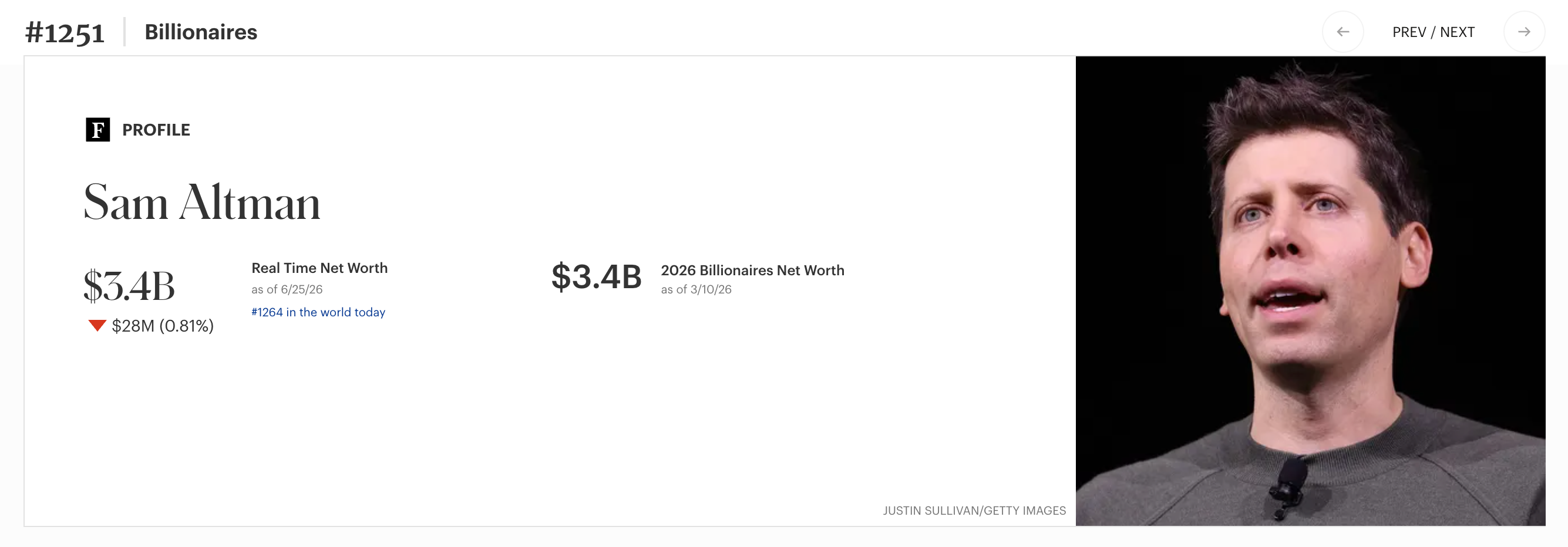
According to Forbes Billionaires List data, Sam Altman currently ranks 1251st on the global rich list, with a personal net worth of around $3.4 billion. Furthermore, he has investments in well-known tech companies like Stripe and Reddit. In April 2024, Altman's rank on this list was only 2692nd; two years later, his personal net worth ranking has risen by over 1400 places. It's worth noting that this list reflects the wealth rankings of over 8 billion people worldwide.

Domande pertinenti

QWhat is the core controversy surrounding Sam Altman and OpenAI as mentioned in the article?

AThe controversy revolves around perceptions of his leadership. Some view him as an AGI pioneer and 'Father of AI,' while others criticize his actions, such as transforming OpenAI from a non-profit to a commercial company, alleged favoritism within the board, and eliminating dissent. The article also details concerns about potential conflicts of interest due to his extensive personal investments in companies that do business with OpenAI.

QAccording to the article, how many companies has Sam Altman invested in, and how many of those have a direct business relationship with OpenAI?

ASam Altman has invested in approximately 400 companies. Of those, at least 10 have established commercial partnerships with OpenAI or have been in recent discussions to do so.

QHow did Sam Altman's investment in Helion Energy significantly increase in value according to the article?

AHis investment in Helion Energy significantly increased in value after a June 2026 funding round led by Thrive Capital, an OpenAI strategic investor, which valued Helion at $15.5 billion. This round at least doubled the value of Altman's stake, bringing it to at least $4.1 billion.

QWhat significant point does the article make about Sam Altman's direct ownership stake in OpenAI?

AThe article highlights that Sam Altman does not directly hold any equity in OpenAI, despite the company's high valuation. This creates a rare situation where his personal wealth is not directly tied to the company he leads.

QWhat internal investigations are reportedly happening at Tools for Humanity, the company behind Worldcoin, as per the article?

ATools for Humanity is reportedly undergoing two separate investigations led by external law firms. One investigation is focused on alleged misuse of funds by executives, and the other is examining potential regulatory violations in the company's Thailand operations.

Letture associate

Tidal Investment: We Remain Bullish on the AI Industry Chain, But the Reasons Have Changed

Tidal Investment remains optimistic about the AI industry chain, but the rationale has shifted. The market narrative has changed. While recent large-scale IPOs (e.g., SpaceX) and major fundraising plans by tech giants like Alphabet and Meta have caused some nervousness, this isn't a sign of an AI peak. The focus has moved from the initial question of AI's viability to the sustainability of massive investment cycles. The key players—primarily the major cloud providers—are not slowing down; their capital expenditure (Capex) guidance for 2026 has been increased across the board (e.g., Alphabet to $180B, Amazon to $200B). This investment cycle is proving resilient and difficult to stop. Unlike traditional hardware cycles, current AI Capex is distributed across multiple physical layers—computing, memory, networking, and critically, power infrastructure. Bottlenecks are shifting from chips to elements like electricity, transformers, and cooling systems, which have much longer lead times and cannot be easily pre-built like fiber optics during the dot-com bubble. Supply chain data (e.g., Eaton's 240% YoY data center orders) confirms this broad-based, project-driven expansion. Market concerns are acknowledged but viewed differently. First, while Capex growth currently outpaces revenue growth, raising ROI questions, this mirrors the early scaling phase of cloud computing itself. A change in view would require concrete signals like downward Capex revisions or missed AI product targets, which haven't materialized by mid-2026. Second, comparisons to the 2000 dot-com bust are flawed. That crash was driven by a massive, parallel oversupply of cheap capacity (fiber). The current cycle faces *supply constraints* in critical, capital-intensive physical infrastructure that cannot be overbuilt as easily. In conclusion, the wave of fundraising reflects the next, more complex act of the AI story. Physical bottlenecks and sustained high Capex plans suggest this is not the finale but an ongoing, capital-intensive build-out phase. The script has changed, but the play is far from over.

marsbit33 min fa

Tidal Investment: We Remain Bullish on the AI Industry Chain, But the Reasons Have Changed

marsbit33 min fa

Tidal Investment: We Remain Bullish on the AI Industry Chain, But for Different Reasons Now

Tidal Investments remains optimistic about the AI industry chain, but the rationale has shifted. The market is concerned about massive concurrent fundraising by tech giants like SpaceX, OpenAI, Alphabet, and Meta, fearing an AI peak. However, the authors argue this signals the next act of AI development, not its end. Capital expenditure (Capex) from major cloud providers (Alphabet, Amazon, Meta, Microsoft, Oracle) continues to surge aggressively into 2026. This investment cycle is more resilient than past hardware cycles due to its scale and complexity. Bottlenecks have shifted from chips to critical physical infrastructure like power grids, transformers, cooling, and data center construction—areas with long lead times and limited capacity for rapid expansion. Supply chain data (e.g., Eaton's orders) confirms substantial, tangible progress. Key market concerns are addressed: 1. **ROI vs. Capex Growth**: While Capex growth outpaces revenue, the authors note cloud giants have historically overcome similar phases through scale. The cycle will only be in danger if Capex guidance is cut, orders are canceled, or AI product demand falters—none of which are currently observed. 2. **Comparison to the 2000 Dot-com Bubble**: Unlike the telecom bubble, where cheap, oversupplied fiber crashed prices, AI infrastructure (especially power) is constrained, customized, and subject to lengthy approvals, making a similar supply glut and crash unlikely. In conclusion, the wave of fundraising reflects the immense, ongoing capital needs for AI's next phase, constrained by slow-moving physical bottlenecks. The AI cycle is not over; the script has simply changed.

链捕手40 min fa

Tidal Investment: We Remain Bullish on the AI Industry Chain, But for Different Reasons Now

链捕手40 min fa

Grayscale: These 15 Profitable Crypto Protocols Are Severely Undervalued

Grayscale Research identifies 15 top-revenue crypto protocols trading at significant valuation discounts, with many at single-digit or even 1x revenue multiples. Protocols like Pump.fun, PancakeSwap, and Meteora have market capitalizations roughly equal to their annual revenue. The report argues these financially-focused protocols (DEXs, lending, staking) are fundamentally undervalued and could benefit from the potential passage of the CLARITY Act, expected as soon as next month. This legislation aims to clarify digital asset regulation, potentially reducing institutional barriers and driving on-chain activity. The analysis breaks down the protocols into three groups: the "1x Club" (market cap ≈ revenue), mid-tier protocols with 3-9x multiples (e.g., Aave, Lido, Jupiter), and high-multiple protocols like Hyperliquid (15x) and Uniswap (37x), where valuation reflects future potential rather than current cash flows. Grayscale applies a traditional DCF model to Aave, suggesting a one-year price target of ~$175, representing ~130% upside from current levels. The report notes a risk-off macro environment since the Iran conflict has further compressed valuations, creating a potential entry window. The conclusion highlights that while the valuation data presents an intriguing opportunity, the investment thesis is contingent on the CLARITY Act's passage and subsequent institutional capital flows. Investors are cautioned to consider Grayscale's inherent conflict of interest as a crypto asset manager with products tied to these assets.

marsbit1 h fa

Grayscale: These 15 Profitable Crypto Protocols Are Severely Undervalued

marsbit1 h fa

Former SpaceX Engineer Reconstructs Financial Execution System Using First Principles

Former SpaceX engineer Lex Li applies "First Principles Thinking" to financial infrastructure with Plan Execution Lab, recently raising angel funding at a $50M post-money valuation. The team argues that the core function of finance is capital allocation, and the critical gap is not in trading but in execution, which remains highly manual and fragmented. While assets, liquidity, and settlement have migrated on-chain, execution workflows (monitoring, risk management, liquidity coordination) are still human-native. In an era of accelerating AI agents, strategy decay is rapid, shifting the competitive edge from having the best strategy to having the most robust execution network. Plan Execution Lab introduces two core components: 1. **PlanX**: A Financial Execution Protocol designed as infrastructure for the migration from CEX to DEX, providing on-chain execution capabilities, liquidity access, risk management, and capital orchestration. 2. **Xgent**: An Autonomous Financial Runtime. Users define investment intents, risk preferences, and constraints; Xgent automatically constructs an execution graph, verifies it, and handles ongoing execution and optimization—streamlining the process from Intent to Autonomous Execution. The long-term vision is to create the "Bloomberg Terminal for Autonomous Finance"—a shared operating environment and execution network built collectively by participants like execution nodes, liquidity providers, and autonomous agents. The future of finance, they contend, belongs not to isolated algorithms but to open, collaborative execution networks.

marsbit2 h fa

Former SpaceX Engineer Reconstructs Financial Execution System Using First Principles

marsbit2 h fa

Trading

Spot
Futures
活动图片