Крах иллюзий: почему биткоин — не цифровое золото

cryptonews.ruPubblicato 2022-01-06Pubblicato ultima volta 2024-08-06

Криптовалютный рынок лихорадит, и это ставит под сомнение одну из самых популярных идей крипто-евангелистов — «биткоин как цифровое золото». Казалось бы, чем не идеальная страховка от биржевых штормов? Но не тут-то было!

В то время как фондовые рынки погружались в пучину паники, а инвесторы разматывали свои кэрри-трейды, биткоин повел себя как типичный рисковый актив. Главная криптовалюта рухнула на 17%, пробив психологическую отметку в $50 000, прежде чем немного отыграть падение. А как насчет корреляции с золотом? Она ушла в минус еще в июле.
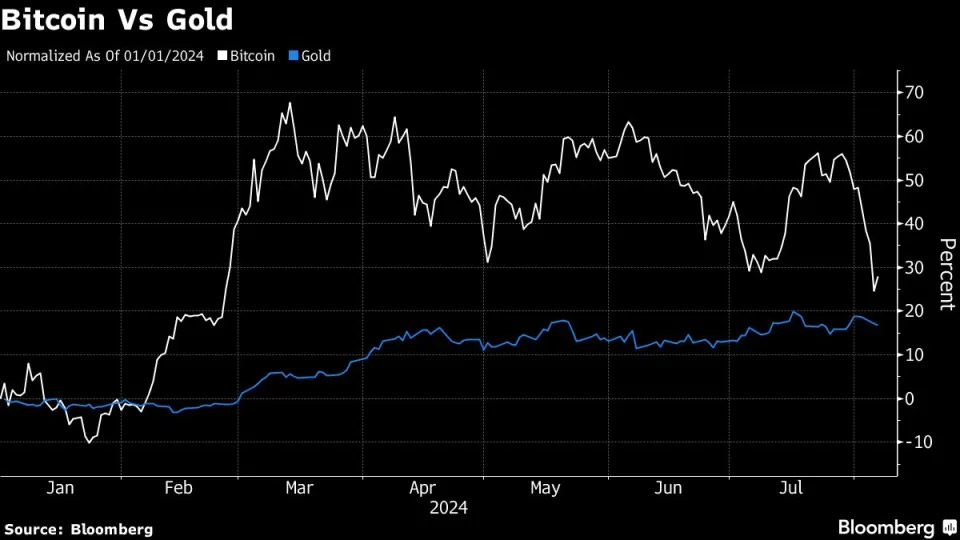
Сравнение графиков биткоина и золота

Джош Гилберт (Josh Gilbert), аналитик eToro, не стесняется в выражениях: «Наивно полагать, что институциональные инвесторы вкладываются в биткоин по тем же причинам, что и в золото. Эти активы играют совершенно разные роли в инвестиционных портфелях».

А что же тогда? Ряд экспертов выдвигает альтернативную теорию. Они утверждают, что резкое падение биткоина подтверждает мысль о том, что криптовалюты — это класс активов, особенно чувствительный к потенциальным опасностям. Например, к риску того, что Федеральная резервная система США слишком долго будет тянуть с снижением ставок и столкнет экономику в рецессию. «Если инвесторы паникуют или хотят снизить долговую нагрузку, криптовалюты часто первыми попадают под раздачу», — отмечает Гилберт.

Сравнения биткоина с золотом отчасти уходят корнями в их общую характеристику — ограниченное предложение. Подобно тому, как запасы золота в недрах Земли конечны, блокчейн биткоина запрограммирован на автоматическое замедление создания новых токенов через процесс, известный как халвинг, который происходит каждые четыре года. В конечном итоге в обращении будет 21 миллион биткоинов.

Некоторые аналитики не спешат отказываться от тезиса «биткоин как золото» — или, по крайней мере, от идеи, что когда-нибудь это может стать реальностью.

«Многие инвесторы рассматривают биткоин как венчурную ставку на его будущее в качестве цифрового золота», — написал в понедельник в заметке для инвесторов Алекс Торн (Alex Thorn), глава исследовательского отдела Galaxy Research. «В отличие от золота, биткоин пока не получил широкого распространения среди суверенных фондов, центральных банков или институциональных инвесторов».

Несмотря на выраженное падение с начала июля, биткоин остается одним из самых успешных крупных активов, который подорожал на 26% с начала года и легко обогнал по доходности золото. Однако этот рост был вызван запуском спотовых биткоин-ETF в США в начале января, а не чем-либо другим. В качестве хеджа от инфляции биткоин показал себя неважно, демонстрируя рост вместе с другими рынками и падая как раз тогда, когда появились первые признаки того, что высокие процентные ставки начали приносить свои неумолимые плоды.

Letture associate

A Company Once on the Brink of Bankruptcy Just Surpassed Bitcoin in Market Cap

On June 22nd, driven by rising stock prices, SK Hynix’s market capitalization reached $1.35 trillion, surpassing Bitcoin's total market cap of approximately $1.29 trillion. This temporarily made it South Korea's highest-valued company. The core driver of this surge is HBM (High Bandwidth Memory), for which SK Hynix is the primary supplier to NVIDIA, holding over 60% market share. AI's demand for high memory bandwidth has translated into immense profitability, with SK Hynix reporting a 72% operating profit margin in Q1. The company's success follows a 13-year bet on HBM technology, beginning in 2009. It nearly failed after the 2001 dot-com bubble, was acquired by SK Group in 2012, and was subsequently recapitalized to continue its long-term HBM development. The article contrasts this with the Crypto AI narrative. Capital currently favors AI infrastructure players like SK Hynix due to "real orders, physical barriers, and quantifiable profit margins." In comparison, Crypto AI projects, promising decentralized compute and data markets, remain largely conceptual with limited tangible progress. Examples include Bittensor, whose core mechanisms are still under development, and Bitcoin miners transitioning to AI, who face significant funding gaps and execution challenges. The piece cites analysis suggesting the AI sector has absorbed nearly all new market liquidity since 2022, leaving little for crypto. It concludes that the current AI infrastructure红利 is captured by entities with proven technical barriers and supply capabilities, while crypto networks still need to define their concrete role in the value chain.

链捕手1 min fa

A Company Once on the Brink of Bankruptcy Just Surpassed Bitcoin in Market Cap

链捕手1 min fa

Bittensor Moves Towards Ultimate Decentralization: The Critical 18 Months for the TAO Ecosystem is Here?

Bittensor, a decentralized AI protocol, is accelerating its transition to full decentralization over the next 18 months, as outlined in a recent post by co-founder Const. The project currently operates in a "semi-decentralized" state: ownership and network participation are open and permissionless, with TAO distribution based on competitive contribution. However, protocol upgrades and governance have remained under core team control to enable rapid iteration in the fast-evolving AI sector. This strategic shift comes as the ecosystem matures, boasting 128 subnets and a large community. Const argues that continued centralization now poses risks, including single points of failure and regulatory scrutiny. The upcoming decentralization roadmap includes optimizing validator competition, opening liquidity pools, introducing governance rights for Alpha holders, and refining economic models. The move could fundamentally reshape TAO's value proposition, adding governance premiums to its existing valuation based on AI narrative and scarcity. It also signals a potential maturation of the AI crypto sector, where competition may shift from hype to sustainable protocol design and real economic activity. Bittensor positions itself not just as another AI token, but as foundational infrastructure aiming to decentralize intelligence production—analogous to Bitcoin's role in decentralizing money—with the goal of creating a resilient "Millennium Intelligence Federation."

marsbit14 min fa

Bittensor Moves Towards Ultimate Decentralization: The Critical 18 Months for the TAO Ecosystem is Here?

marsbit14 min fa

Japan's AI Dark Horse Emerges: How a 7B Small Model Challenges Fable and Mythos?

In June 2026, Sakana AI's new model Fugu caused a stir in the AI community. Its Fugu Ultra variant achieved scores of 73.7 on SWE-Bench Pro and 82.1 on TerminalBench 2.1, surpassing GPT-5.5 and Claude Opus 4.8, and was claimed to be comparable to export-restricted models like Fable 5 and Mythos Preview. Remarkably, the core of this high-performance system is not a massive model, but a small 7B-parameter RL Conductor model. Fugu operates as a multi-agent orchestrator: the 7B model acts as a "foreman," dynamically analyzing user tasks and delegating subtasks to a pool of top-tier global models (e.g., GPT-5, Gemini 3.1 Pro). It then synthesizes and verifies their outputs. This architecture represents a paradigm shift from monolithic models to an expert-team approach. It enhances performance in complex, multi-step engineering tasks like code review and security testing by enabling cross-validation from specialized models, improving long-session stability and token efficiency. However, Fugu's strengths come with trade-offs: it faces inherent latency due to multiple API calls, relies heavily on underlying US model APIs (creating dependency risks), and its benchmark comparisons with Fable/Mythos are based on reported scores, not head-to-head testing. For Japan's AI ecosystem, which lacks the massive compute and data resources of the US or China, Fugu exemplifies an "asymmetric breakthrough" strategy. Instead of competing directly in parameter scale, it focuses on intelligent orchestration of existing global models, offering a degree of AI sovereignty and resilience. While a significant system-level innovation, its ultimate capability is still bounded by the underlying models it coordinates.

marsbit14 min fa

Japan's AI Dark Horse Emerges: How a 7B Small Model Challenges Fable and Mythos?

marsbit14 min fa

Trading

Spot
Futures
活动图片