Japan's AI Dark Horse Emerges: How a 7B Small Model Challenges Fable and Mythos?

marsbitPubblicato 2026-06-22Pubblicato ultima volta 2026-06-22

Introduzione

In June 2026, Sakana AI's new model Fugu caused a stir in the AI community. Its Fugu Ultra variant achieved scores of 73.7 on SWE-Bench Pro and 82.1 on TerminalBench 2.1, surpassing GPT-5.5 and Claude Opus 4.8, and was claimed to be comparable to export-restricted models like Fable 5 and Mythos Preview. Remarkably, the core of this high-performance system is not a massive model, but a small 7B-parameter RL Conductor model. Fugu operates as a multi-agent orchestrator: the 7B model acts as a "foreman," dynamically analyzing user tasks and delegating subtasks to a pool of top-tier global models (e.g., GPT-5, Gemini 3.1 Pro). It then synthesizes and verifies their outputs. This architecture represents a paradigm shift from monolithic models to an expert-team approach. It enhances performance in complex, multi-step engineering tasks like code review and security testing by enabling cross-validation from specialized models, improving long-session stability and token efficiency. However, Fugu's strengths come with trade-offs: it faces inherent latency due to multiple API calls, relies heavily on underlying US model APIs (creating dependency risks), and its benchmark comparisons with Fable/Mythos are based on reported scores, not head-to-head testing. For Japan's AI ecosystem, which lacks the massive compute and data resources of the US or China, Fugu exemplifies an "asymmetric breakthrough" strategy. Instead of competing directly in parameter scale, it focuses on intelligent orche...

June 22, 2026 — The new model "Fugu" released by Sakana AI sent shockwaves through the AI community. In the rigorous SWE-Bench Pro and TerminalBench benchmark tests, Fugu Ultra scored 73.7 and 82.1 points respectively, surpassing GPT-5.5 and Claude Opus 4.8, and even claimed to be on par with the export-controlled Fable 5 and Mythos Preview. Surprisingly, the core of this system, which topped the charts in engineering and reasoning capabilities, is not a massive model with hundreds of billions of parameters, but a model with only 7B parameters. It doesn't do the work itself; instead, it acts as a "project manager," dynamically orchestrating top global large models. This counter-intuitive architecture not only shatters the myth of "parameters equal justice" but also reflects Japan's path to AI breakthroughs amidst constrained computing resources.

The 7B "Project Manager": The Counter-Intuitive Architecture of Fugu

To understand the peculiarities of Fugu, one must first look at its origins. Sakana AI was founded in Tokyo in 2023 by Llion Jones, a co-author of the Transformer paper, and former Google researcher David Ha. From its inception, the company carried the "nature-inspired" gene, dedicated to solving AI problems with evolutionary algorithms and natural swarm intelligence. In 2025, Sakana AI secured investments from giants like NVIDIA and Google, valuing the company at over $25 billion. However, despite backing from these giants, Japan still lacks the massive computing infrastructure and data pools found in China and the US. Under these resource constraints, Sakana AI did not choose to compete head-on with trillion-parameter models but instead took an "orchestration" route.

Fugu is officially positioned as "a multi-agent orchestration system acting as a single foundational model." In traditional AI architecture, a large model is a "monolithic beast." A user inputs a prompt, and the model calculates from the first neural network layer to the last, outputting the result. This mode is extremely efficient for simple problems but often leads to hallucinations or logical breakdowns when facing complex, multi-step engineering tasks.
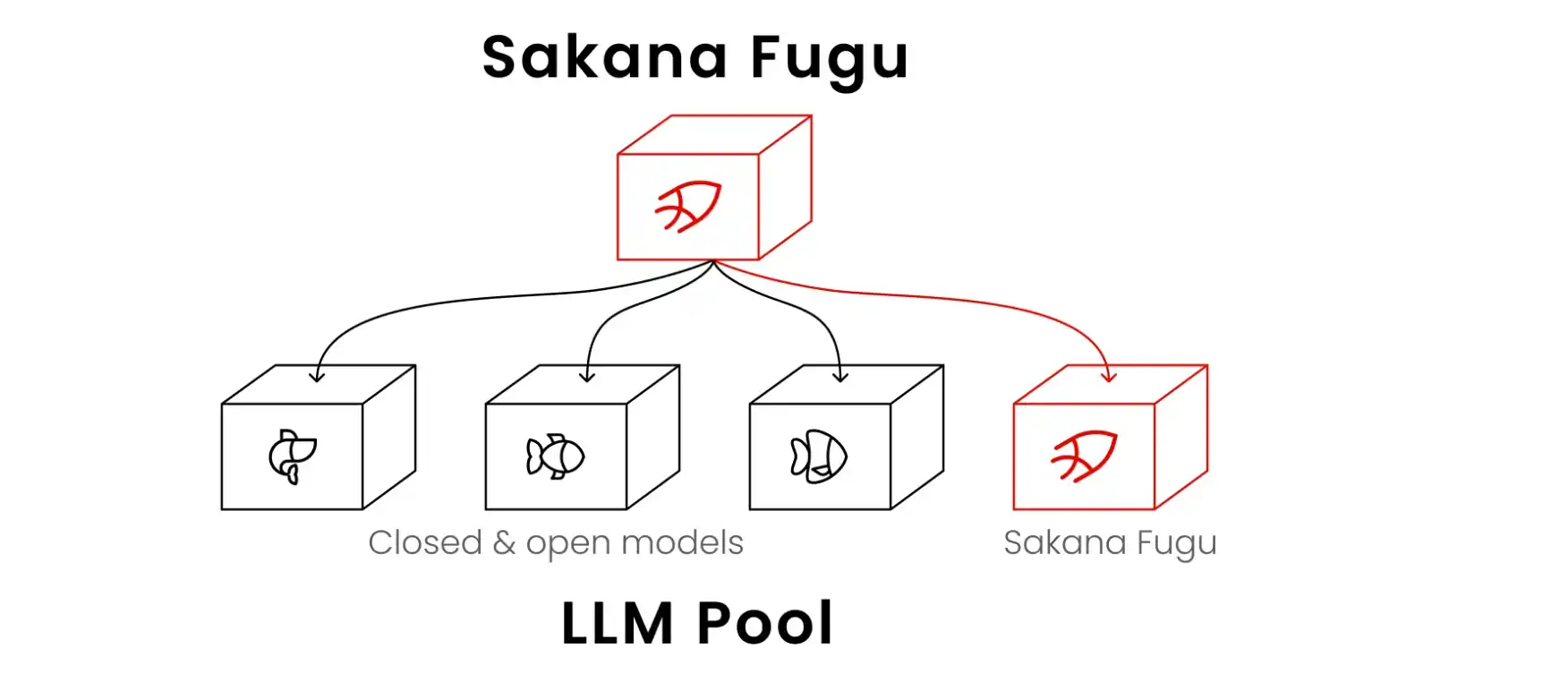
Fugu fundamentally changed this paradigm. Its core is a 7B-parameter model trained with reinforcement learning, called the RL Conductor. This 7B model does not directly generate the final answer; instead, it plays the role of a "project manager." When a user submits a task through a single OpenAI-compatible API, the RL Conductor dynamically analyzes the task type and then assigns subtasks to top global models in its agent pool, such as GPT-5, Gemini 3.1 Pro, or Claude Opus 4.8. It is responsible for scheduling, verifying, and synthesizing the outputs of these models, ultimately providing a result that has undergone multiple rounds of verification.

The theoretical underpinning for this architecture comes from two papers at ICLR 2026: "TRINITY: An Evolved LLM Coordinator" and "Learning to Orchestrate Agents in Natural Language with the Conductor." The papers detail how a small-parameter model can "conduct" large models through reinforcement learning. This changes the paradigm of "Test-time scaling." In the past, computing power was primarily used for deep inference within the model, making the model "struggle" for an answer. Now, computing power is used for external scheduling, verification, and synthesis. Traditional large models are monolithic all-rounders, while Fugu is a team of experts. The 7B RL Conductor proves that model parameter size is no longer the sole determinant of capability; knowing how to call tools and external agents can also lead to performance leaps.

The Truth Behind the Scores: Matching Fable and Surpassing GPT-5.5

The immediate reason for Fugu's sensation is its benchmark scores in rigorous tests. In the AI industry, benchmark scores are the hard currency for measuring model capabilities, but different benchmarks focus on entirely different aspects. The SWE-Bench Pro and TerminalBench 2.1 chosen by Sakana AI are both "tough nuts" biased towards real-world engineering environments.

SWE-Bench Pro focuses on software engineering capabilities, requiring models to locate and fix bugs in real codebases. According to data published in the Sakana AI console, Fugu Ultra scored 73.7 on SWE-Bench Pro. For comparison, Claude Opus 4.8 scored 69.2, GPT-5.5 scored 58.6, and Gemini 3.1 Pro scored 54.2. On TerminalBench 2.1, another test for system operation capabilities, Fugu Ultra scored 82.1, surpassing GPT-5.5's 78.2 and Opus 4.8's 74.6. These two tests not only examine a model's code generation ability but also its logical stability and tool-calling capability in multi-step, long-chain tasks. Fugu Ultra's lead means it experiences fewer mid-process crashes or deviations from goals when handling complex engineering problems compared to monolithic models.
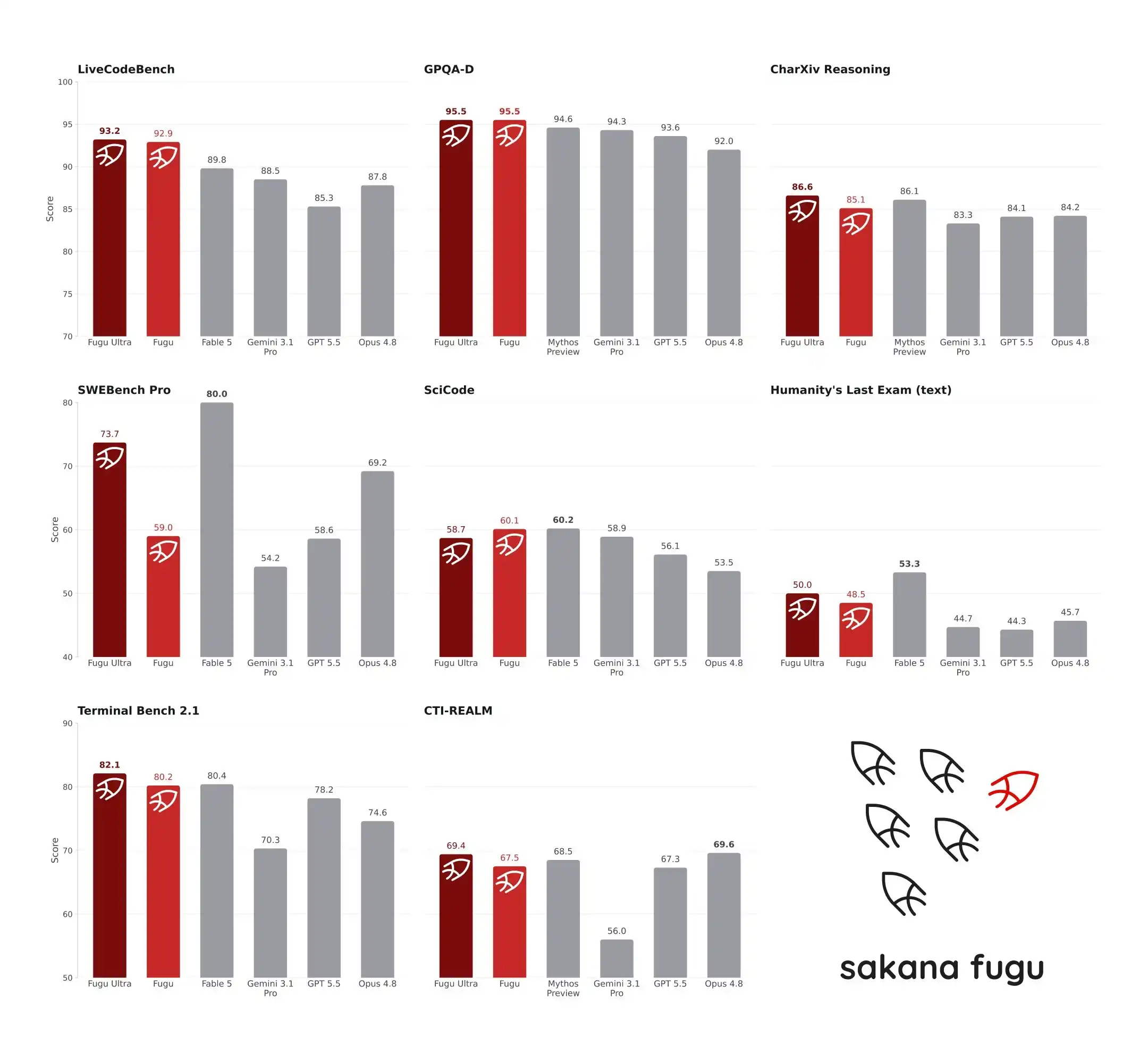
More attention was paid to the comparison between Fugu and Fable 5/Mythos Preview. Anthropic's Fable series and another frontier lab's Mythos series represent the pinnacle of current AI reasoning capabilities. However, due to export controls or incomplete public release, these two models are not part of Fugu's agent pool. Sakana AI officially claims that Fugu Ultra is "on par" with Fable 5 and Mythos Preview on engineering and science benchmarks. It must be clarified, however, that this comparison is not based on head-to-head testing in the same pool. Fugu's scores are based on actual runs of its own system, while Fable and Mythos data are based on report scores publicly released by their respective vendors.

This comparison methodology has sparked some controversy in the developer community. Some argue that test conditions across different systems and environments are difficult to align perfectly, making direct score comparisons unfair. However, other developers point out that referencing vendor-reported data is industry practice in the absence of a unified testing environment. Setting aside the controversy with Fable and Mythos, Fugu Ultra's surpassing of GPT-5.5 and Opus 4.8 on SWE-Bench Pro and TerminalBench 2.1 is a real, like-for-like comparison. This surpassing is not because Fugu's underlying model is smarter than GPT-5.5, but because the RL Conductor performs task decomposition and expert scheduling more precisely. In experiments requiring multiple rounds of reasoning and verification, such as AutoResearch, Rubik's Cube solving, and mechanical design, Fugu consistently showed advantages. This indicates that in handling "long, messy, multi-step" real-world workflows, the multi-agent orchestration architecture indeed offers more resilience than monolithic models.

Real Development Scenario Tests: Code Review and Long Session Stability

For developers and AI tool users, benchmark scores are only references. What truly determines a model's usefulness is its performance in real work scenarios. Fugu underwent beta testing with nearly 500 early users before release. Their feedback revealed Fugu's unique value in practical applications.

Code review is one of the most common AI scenarios for developers. Traditional monolithic models often only find superficial syntax errors or common logic bugs when reviewing code. In beta testing, some developers reported that Fugu demonstrated unusually detailed performance in code reviews, capable of uncovering deep architectural bugs, while other tools often found only a few surface-level issues. This difference stems from Fugu's architecture. Upon receiving a code review task, the RL Conductor can call models specializing in static analysis, logical reasoning, and security auditing respectively to conduct cross-validation on the same piece of code from multiple angles. This "expert consultation" model naturally uncovers more hidden problems than the "solo effort" of a single model.

Another frequently mentioned advantage is long-session stability. When building AI Agent products, one of developers' biggest headaches is the model's "persona drift" in long conversations. As the number of dialogue rounds increases, monolithic models often forget the initial setup or deviate in instruction following. After testing, some enterprise executives reported that Fugu's Persona in long conversations is exceptionally stable, with almost no drift. This is because the RL Conductor itself is not responsible for maintaining long-text memory; it only selects the most appropriate underlying model to generate a response in each dialogue round based on the current context. This architecture of "separation of control and generation" greatly improves Agent stability during long-running sessions.

In the field of cybersecurity, Fugu also demonstrated end-to-end practical capability. In tests, Fugu could independently complete the entire workflow from reconnaissance, XSS/SQLi vulnerability detection to authentication review, and generate a complete penetration test report, strictly adhering to instructions not to cross boundaries and damage systems. This level of completion for complex tasks relies on the RL Conductor's precise orchestration of security toolchains and the capabilities of different large models.

In addition, token efficiency is a major highlight of Fugu. Traditional large models often generate lengthy chains of thought, consuming a large number of tokens when dealing with complex problems. Fugu's RL Conductor avoids wasteful long CoT consumption through precise routing. Official data and early testing show it can significantly reduce waste of ineffective tokens. For developers billed by tokens, this means not only cost reduction but also improved response speed.

The Achilles' Heel of Underlying Dependency: The Cost of Multi-Agent Orchestration

Although Fugu shines in architecture and benchmark scores, as a tool for practical work, it is not without weaknesses. The multi-agent orchestration architecture, while bringing performance breakthroughs, also introduces significant risks and limitations.

The core issue is underlying dependency risk. Fugu's agent pool heavily relies on underlying APIs from US giants like GPT, Claude, and Gemini. Although the RL Conductor has dynamic routing capabilities and can switch to other models if one fails or is rate-limited, this only mitigates single-supplier risk. It does not and cannot detach from the entire US AI infrastructure ecosystem. If these underlying models collectively raise prices, impose large-scale rate limits, or change API terms, Fugu's cost structure and stability will be directly impacted. This "parasitic" mode, living atop others' infrastructure, has inherent fragility in commercialization and long-term stability.

Next is the trade-off between latency and cost structure. While the RL Conductor saves on ineffective token consumption through precise routing, multi-agent orchestration inevitably involves multiple API calls and inter-model communication. For real-time interaction scenarios requiring extremely low latency, such as real-time voice conversations or high-frequency trading assistance, Fugu Ultra's "deep thinking and scheduling" time may be longer than directly calling a monolithic model. In scenarios where response speed is paramount, Fugu's architectural advantage could become a drag on user experience.

Furthermore, controversies over fairness of comparison persist. As mentioned, Fugu claims parity with Fable and Mythos, but the latter two are not in its agent pool. In the developer community, some voices question whether comparisons based on vendor-reported data have practical reference value. After all, model performance can vary greatly across different task distributions, and simple aggregate score comparisons might mask specific strengths and weaknesses. For developers needing precise model capability assessments, the lack of head-to-head test data means they must remain cautious during selection.

Not Competing on Compute, but on Orchestration: Japan's Asymmetric Breakthrough in Large Models

Looking beyond the specific product review, Fugu's birth carries deeper implications for Japan's large model ecosystem. In the global AI arms race, Japan is in an awkward position. It lacks both the continuous influx of top-tier computing power and frontier algorithm accumulation of the US, and the massive data pools and fiercely competitive market environment of China. More critically, Japan also faces export control risks from US frontier models (like Fable/Mythos). Against this backdrop, Sakana AI's "evolutionary algorithm" and "multi-agent orchestration" route showcase the logic of "asymmetric breakthrough" for a resource-constrained nation.

Japan does have domestic large model players. NTT released tsuzumi, and institutions like ELYZA, Rinna, and LLM-jp are also working hard to train local language models. However, most follow the traditional "train from scratch" route, struggling to compete with top US and Chinese models in parameter scale and general capabilities. Sakana AI is the only Japanese lab with global frontier influence that champions an "asymmetric architecture."

Fugu's dynamic routing capability essentially helps Japanese companies and institutions establish "AI Sovereignty." Under limited computing resources, instead of spending huge sums to train a hundred-billion-parameter model that is inferior to GPT-5.5 in all aspects, it's better to train a clever 7B "project manager." This manager can flexibly connect to the world's best models based on task needs. If one day a US model faces export controls or supply cuts, the RL Conductor can quickly route tasks to other available models, even connecting to Japan's domestic specialized models. This architecture gives Japan a degree of autonomy and risk resilience in utilizing AI capabilities.

Observing the global AI tool ecosystem, OmniTools notes that large model capabilities are gradually leveling, and the main battleground of competition is shifting from mere parameter stacking to toolchains and landing scenarios. The emergence of Fugu precisely confirms this trend. It no longer pursues perfection in a single model but pursues optimality at the system level. This thinking holds significant reference value for nations and regions lacking advantages in compute and data.

Of course, this "asymmetric breakthrough" has its ceiling. As long as the core technology of underlying models remains in the hands of a few giants, the capability ceiling of orchestration systems will be limited by those underlying models. Fugu proves a 7B model can be an excellent conductor, but it cannot magically create capabilities that the underlying models lack. For Japan's large models to truly achieve a breakthrough, beyond architectural innovation in orchestration, continued investment in underlying computing power, core algorithms, and high-quality data is still necessary. Fugu is an ingenious system-level innovation, but it's not a panacea. For developers and enterprise users, Fugu provides a highly competitive new option in complex engineering scenarios. However, when using it, one must also be clear-eyed about its underlying dependency vulnerabilities and the latency-cost trade-offs.


Crypto di tendenza

Domande pertinenti

QWhat is the core innovation and role of the 7B-parameter model in Sakana AI's Fugu system?

AThe core innovation is a 7B-parameter model called the RL Conductor, which acts as a 'foreman' or intelligent orchestrator. It does not directly generate final answers but dynamically analyzes user tasks and dispatches subtasks to a pool of top-tier global foundation models like GPT-5 or Claude Opus. It is responsible for scheduling, verifying, and synthesizing these models' outputs.

QOn which two benchmark tests did Fugu Ultra outperform models like GPT-5.5 and Claude Opus 4.8, and what do these tests evaluate?

AFugu Ultra outperformed competitors on SWE-Bench Pro and TerminalBench 2.1. SWE-Bench Pro evaluates software engineering capabilities, specifically locating and fixing bugs in real codebases. TerminalBench 2.1 tests system operation capabilities, focusing on multi-step tasks in real-world engineering environments.

QAccording to the article, what are two key practical advantages of Fugu's architecture reported by early beta testers?

ATwo key practical advantages are: 1) Superior code review capabilities, where Fugu's multi-agent 'expert consultation' approach finds deeper architectural bugs compared to single models. 2) Exceptional long-session stability, where the RL Conductor's 'control-generation separation' architecture prevents persona drift over long conversations by selecting the best model for each turn based on context.

QWhat are the main weaknesses or risks associated with Fugu's multi-agent orchestration architecture?

AThe main weaknesses are: 1) Underlying dependency risk, as Fugu's agent pool relies on APIs from major US AI providers, making it vulnerable to collective price changes, rate limits, or policy shifts. 2) Latency trade-offs, where the orchestration process involving multiple API calls can introduce higher latency unsuitable for real-time interaction scenarios.

QHow does the Fugu system represent a 'non-symmetric breakthrough' strategy for Japan's AI industry, according to the article?

AIt represents a 'non-symmetric breakthrough' by circumventing Japan's limitations in compute power and data. Instead of expensively training a massive general-purpose model that can't compete with US/China leaders, Japan focused on training a smart, small 'foreman' model (the RL Conductor) that orchestrates the world's best models. This grants a degree of AI sovereignty and risk resilience, allowing flexible routing if certain US models become unavailable, though ultimate capability is still bounded by the underlying models.

Letture associate

27-Year Reign Ends: SK Hynix Market Cap Surpasses Samsung for First Time, an AI-Driven Reshuffle of Korean Chip Power

On June 22, 2026, SK Hynix made history by surpassing Samsung Electronics in market capitalization, ending Samsung's 27-year reign as South Korea's most valuable company. This dramatic reversal is powered by the AI boom and SK Hynix's dominant position in High Bandwidth Memory (HBM), a critical component for AI model training. Once a heavily indebted firm on the brink of bankruptcy, SK Hynix bet early on HBM, which has evolved from a niche product to essential AI infrastructure. It now commands a 59% share of the global HBM market. Its financial performance is staggering, with Q1 2026 net profit soaring nearly fourfold year-over-year to KRW 40.35 trillion, translating to over 2 billion RMB in daily net profit. HBM now drives roughly 40% of its revenue with exceptionally high margins. In contrast, Samsung, with its broad portfolio spanning memory chips, smartphones, and foundry services, has lagged in the HBM race while facing headwinds in other divisions. This shift signifies a deeper restructuring of South Korea's economy, moving from consumer electronics to AI-driven growth. However, the future remains competitive. With major capacity expansions planned industry-wide by 2028 and Samsung aiming to catch up in HBM technology, the new market leader cannot afford complacency. This event marks a pivotal moment in the global semiconductor industry's ongoing power realignment.

marsbit5 min fa

27-Year Reign Ends: SK Hynix Market Cap Surpasses Samsung for First Time, an AI-Driven Reshuffle of Korean Chip Power

marsbit5 min fa

Why Does 'AGI Godfather' Ben Goertzel Believe the Future of AI Relies on Blockchain?

Ben Goertzel, known as the "AGI Godfather," argues that the future of Artificial General Intelligence (AGI) must be built on blockchain to prevent its control by a few corporations or venture capital firms. He believes the core AGI code should be free and open-source, but that this alone is insufficient without a decentralized infrastructure to run it affordably. His blockchain project, SingularityNET, and the broader Artificial Superintelligence Alliance aim to create a user-owned, decentralized network for hosting and deploying AGI, contrasting with the closed models of companies like OpenAI and Anthropic. Goertzel criticizes the shift of other labs from open to closed development. He argues that while a closed path is simpler, an open, decentralized model—akin to Linux and the internet—is both possible and ultimately better for humanity. He envisions an "Agent economy" where individuals orchestrate teams of AI agents to perform tasks, including transactions, on an open network rather than corporate clouds. While his current model relies on cryptocurrency, plans include offering paid AI services to businesses with the decentralized blockchain as the backend. Goertzel predicts human-level AGI could arrive by 2029 and warns that a gap in understanding and access to AGI could drastically worsen inequality. The first test of his decentralized approach will be the upcoming release of the Agent Omega Claw.

Foresight News36 min fa

Why Does 'AGI Godfather' Ben Goertzel Believe the Future of AI Relies on Blockchain?

Foresight News36 min fa

Trading

Spot
Futures

Articoli Popolari

Cosa è $S$

Comprendere SPERO: Una Panoramica Completa Introduzione a SPERO Mentre il panorama dell'innovazione continua a evolversi, l'emergere delle tecnologie web3 e dei progetti di criptovaluta gioca un ruolo fondamentale nel plasmare il futuro digitale. Un progetto che ha attirato l'attenzione in questo campo dinamico è SPERO, denotato come SPERO,$$s$. Questo articolo mira a raccogliere e presentare informazioni dettagliate su SPERO, per aiutare gli appassionati e gli investitori a comprendere le sue basi, obiettivi e innovazioni nei domini web3 e crypto. Che cos'è SPERO,$$s$? SPERO,$$s$ è un progetto unico all'interno dello spazio crypto che cerca di sfruttare i principi della decentralizzazione e della tecnologia blockchain per creare un ecosistema che promuove l'impegno, l'utilità e l'inclusione finanziaria. Il progetto è progettato per facilitare interazioni peer-to-peer in modi nuovi, fornendo agli utenti soluzioni e servizi finanziari innovativi. Al suo interno, SPERO,$$s$ mira a responsabilizzare gli individui fornendo strumenti e piattaforme che migliorano l'esperienza dell'utente nello spazio delle criptovalute. Questo include la possibilità di metodi di transazione più flessibili, la promozione di iniziative guidate dalla comunità e la creazione di percorsi per opportunità finanziarie attraverso applicazioni decentralizzate (dApps). La visione sottostante di SPERO,$$s$ ruota attorno all'inclusività, cercando di colmare le lacune all'interno della finanza tradizionale mentre sfrutta i vantaggi della tecnologia blockchain. Chi è il Creatore di SPERO,$$s$? L'identità del creatore di SPERO,$$s$ rimane piuttosto oscura, poiché ci sono risorse pubblicamente disponibili limitate che forniscono informazioni dettagliate sul suo fondatore o fondatori. Questa mancanza di trasparenza può derivare dall'impegno del progetto per la decentralizzazione—un ethos che molti progetti web3 condividono, dando priorità ai contributi collettivi rispetto al riconoscimento individuale. Centrando le discussioni attorno alla comunità e ai suoi obiettivi collettivi, SPERO,$$s$ incarna l'essenza dell'empowerment senza mettere in evidenza individui specifici. Pertanto, comprendere l'etica e la missione di SPERO rimane più importante che identificare un creatore singolo. Chi sono gli Investitori di SPERO,$$s$? SPERO,$$s$ è supportato da una varietà di investitori che vanno dai capitalisti di rischio agli investitori angelici dedicati a promuovere l'innovazione nel settore crypto. Il focus di questi investitori generalmente si allinea con la missione di SPERO—dando priorità a progetti che promettono avanzamenti tecnologici sociali, inclusività finanziaria e governance decentralizzata. Queste fondazioni di investitori sono tipicamente interessate a progetti che non solo offrono prodotti innovativi, ma contribuiscono anche positivamente alla comunità blockchain e ai suoi ecosistemi. Il supporto di questi investitori rafforza SPERO,$$s$ come un concorrente degno di nota nel dominio in rapida evoluzione dei progetti crypto. Come Funziona SPERO,$$s$? SPERO,$$s$ impiega un framework multifunzionale che lo distingue dai progetti di criptovaluta convenzionali. Ecco alcune delle caratteristiche chiave che sottolineano la sua unicità e innovazione: Governance Decentralizzata: SPERO,$$s$ integra modelli di governance decentralizzati, responsabilizzando gli utenti a partecipare attivamente ai processi decisionali riguardanti il futuro del progetto. Questo approccio favorisce un senso di proprietà e responsabilità tra i membri della comunità. Utilità del Token: SPERO,$$s$ utilizza il proprio token di criptovaluta, progettato per servire varie funzioni all'interno dell'ecosistema. Questi token abilitano transazioni, premi e la facilitazione dei servizi offerti sulla piattaforma, migliorando l'impegno e l'utilità complessivi. Architettura Stratificata: L'architettura tecnica di SPERO,$$s$ supporta la modularità e la scalabilità, consentendo un'integrazione fluida di funzionalità e applicazioni aggiuntive man mano che il progetto evolve. Questa adattabilità è fondamentale per mantenere la rilevanza nel panorama crypto in continua evoluzione. Coinvolgimento della Comunità: Il progetto enfatizza iniziative guidate dalla comunità, impiegando meccanismi che incentivano la collaborazione e il feedback. Nutrendo una comunità forte, SPERO,$$s$ può affrontare meglio le esigenze degli utenti e adattarsi alle tendenze di mercato. Focus sull'Inclusione: Offrendo basse commissioni di transazione e interfacce user-friendly, SPERO,$$s$ mira ad attrarre una base utenti diversificata, inclusi individui che potrebbero non aver precedentemente interagito nello spazio crypto. Questo impegno per l'inclusione si allinea con la sua missione generale di empowerment attraverso l'accessibilità. Cronologia di SPERO,$$s$ Comprendere la storia di un progetto fornisce preziose intuizioni sulla sua traiettoria di sviluppo e sui traguardi. Di seguito è riportata una cronologia suggerita che mappa eventi significativi nell'evoluzione di SPERO,$$s$: Fase di Concettualizzazione e Ideazione: Le idee iniziali che formano la base di SPERO,$$s$ sono state concepite, allineandosi strettamente con i principi di decentralizzazione e focus sulla comunità all'interno dell'industria blockchain. Lancio del Whitepaper del Progetto: Dopo la fase concettuale, è stato rilasciato un whitepaper completo che dettaglia la visione, gli obiettivi e l'infrastruttura tecnologica di SPERO,$$s$ per suscitare interesse e feedback dalla comunità. Costruzione della Comunità e Prime Interazioni: Sono stati effettuati sforzi attivi di outreach per costruire una comunità di early adopters e potenziali investitori, facilitando discussioni attorno agli obiettivi del progetto e ottenendo supporto. Evento di Generazione del Token: SPERO,$$s$ ha condotto un evento di generazione del token (TGE) per distribuire i propri token nativi ai primi sostenitori e stabilire una liquidità iniziale all'interno dell'ecosistema. Lancio della Prima dApp: La prima applicazione decentralizzata (dApp) associata a SPERO,$$s$ è stata attivata, consentendo agli utenti di interagire con le funzionalità principali della piattaforma. Sviluppo Continuo e Partnership: Aggiornamenti e miglioramenti continui alle offerte del progetto, inclusi partnership strategiche con altri attori nello spazio blockchain, hanno plasmato SPERO,$$s$ in un concorrente competitivo e in evoluzione nel mercato crypto. Conclusione SPERO,$$s$ rappresenta una testimonianza del potenziale del web3 e delle criptovalute di rivoluzionare i sistemi finanziari e responsabilizzare gli individui. Con un impegno per la governance decentralizzata, il coinvolgimento della comunità e funzionalità progettate in modo innovativo, apre la strada verso un panorama finanziario più inclusivo. Come per qualsiasi investimento nello spazio crypto in rapida evoluzione, si incoraggiano potenziali investitori e utenti a ricercare approfonditamente e a impegnarsi in modo riflessivo con gli sviluppi in corso all'interno di SPERO,$$s$. Il progetto mostra lo spirito innovativo dell'industria crypto, invitando a ulteriori esplorazioni delle sue innumerevoli possibilità. Mentre il percorso di SPERO,$$s$ è ancora in fase di sviluppo, i suoi principi fondamentali potrebbero effettivamente influenzare il futuro di come interagiamo con la tecnologia, la finanza e tra di noi in ecosistemi digitali interconnessi.

86 Totale visualizzazioniPubblicato il 2024.12.17Aggiornato il 2024.12.17

Cosa è $S$

Cosa è AGENT S

Agent S: Il Futuro dell'Interazione Autonoma in Web3 Introduzione Nel panorama in continua evoluzione di Web3 e criptovalute, le innovazioni stanno costantemente ridefinendo il modo in cui gli individui interagiscono con le piattaforme digitali. Uno di questi progetti pionieristici, Agent S, promette di rivoluzionare l'interazione uomo-computer attraverso il suo framework agentico aperto. Aprendo la strada a interazioni autonome, Agent S mira a semplificare compiti complessi, offrendo applicazioni trasformative nell'intelligenza artificiale (AI). Questa esplorazione dettagliata approfondirà le complessità del progetto, le sue caratteristiche uniche e le implicazioni per il dominio delle criptovalute. Cos'è Agent S? Agent S si presenta come un innovativo framework agentico aperto, progettato specificamente per affrontare tre sfide fondamentali nell'automazione dei compiti informatici: Acquisizione di Conoscenze Specifiche del Dominio: Il framework apprende in modo intelligente da varie fonti di conoscenza esterne ed esperienze interne. Questo approccio duale gli consente di costruire un ricco repository di conoscenze specifiche del dominio, migliorando le sue prestazioni nell'esecuzione dei compiti. Pianificazione su Lungo Orizzonte di Compiti: Agent S impiega una pianificazione gerarchica potenziata dall'esperienza, un approccio strategico che facilita la suddivisione e l'esecuzione efficiente di compiti complessi. Questa caratteristica migliora significativamente la sua capacità di gestire più sottocompiti in modo efficiente ed efficace. Gestione di Interfacce Dinamiche e Non Uniformi: Il progetto introduce l'Interfaccia Agente-Computer (ACI), una soluzione innovativa che migliora l'interazione tra agenti e utenti. Utilizzando Modelli Linguistici Multimodali di Grandi Dimensioni (MLLM), Agent S può navigare e manipolare senza sforzo diverse interfacce grafiche utente. Attraverso queste caratteristiche pionieristiche, Agent S fornisce un framework robusto che affronta le complessità coinvolte nell'automazione dell'interazione umana con le macchine, preparando il terreno per innumerevoli applicazioni nell'AI e oltre. Chi è il Creatore di Agent S? Sebbene il concetto di Agent S sia fondamentalmente innovativo, informazioni specifiche sul suo creatore rimangono elusive. Il creatore è attualmente sconosciuto, il che evidenzia sia la fase embrionale del progetto sia la scelta strategica di mantenere i membri fondatori sotto anonimato. Indipendentemente dall'anonimato, l'attenzione rimane sulle capacità e sul potenziale del framework. Chi sono gli Investitori di Agent S? Poiché Agent S è relativamente nuovo nell'ecosistema crittografico, informazioni dettagliate riguardanti i suoi investitori e sostenitori finanziari non sono documentate esplicitamente. La mancanza di approfondimenti pubblicamente disponibili sulle fondazioni di investimento o sulle organizzazioni che supportano il progetto solleva interrogativi sulla sua struttura di finanziamento e sulla roadmap di sviluppo. Comprendere il supporto è cruciale per valutare la sostenibilità del progetto e il suo potenziale impatto sul mercato. Come Funziona Agent S? Al centro di Agent S si trova una tecnologia all'avanguardia che gli consente di funzionare efficacemente in contesti diversi. Il suo modello operativo è costruito attorno a diverse caratteristiche chiave: Interazione Uomo-Computer Simile a Quella Umana: Il framework offre una pianificazione AI avanzata, cercando di rendere le interazioni con i computer più intuitive. Mimando il comportamento umano nell'esecuzione dei compiti, promette di elevare le esperienze degli utenti. Memoria Narrativa: Utilizzata per sfruttare esperienze di alto livello, Agent S utilizza la memoria narrativa per tenere traccia delle storie dei compiti, migliorando così i suoi processi decisionali. Memoria Episodica: Questa caratteristica fornisce agli utenti una guida passo-passo, consentendo al framework di offrire supporto contestuale mentre i compiti si sviluppano. Supporto per OpenACI: Con la capacità di funzionare localmente, Agent S consente agli utenti di mantenere il controllo sulle proprie interazioni e flussi di lavoro, allineandosi con l'etica decentralizzata di Web3. Facile Integrazione con API Esterne: La sua versatilità e compatibilità con varie piattaforme AI garantiscono che Agent S possa adattarsi senza problemi agli ecosistemi tecnologici esistenti, rendendolo una scelta attraente per sviluppatori e organizzazioni. Queste funzionalità contribuiscono collettivamente alla posizione unica di Agent S all'interno dello spazio crittografico, poiché automatizza compiti complessi e multi-fase con un intervento umano minimo. Man mano che il progetto evolve, le sue potenziali applicazioni in Web3 potrebbero ridefinire il modo in cui si svolgono le interazioni digitali. Cronologia di Agent S Lo sviluppo e le tappe di Agent S possono essere riassunti in una cronologia che evidenzia i suoi eventi significativi: 27 Settembre 2024: Il concetto di Agent S è stato lanciato in un documento di ricerca completo intitolato “Un Framework Agentico Aperto che Usa i Computer Come un Umano”, mostrando le basi per il progetto. 10 Ottobre 2024: Il documento di ricerca è stato reso pubblicamente disponibile su arXiv, offrendo un'esplorazione approfondita del framework e della sua valutazione delle prestazioni basata sul benchmark OSWorld. 12 Ottobre 2024: È stata rilasciata una presentazione video, fornendo un'idea visiva delle capacità e delle caratteristiche di Agent S, coinvolgendo ulteriormente potenziali utenti e investitori. Questi indicatori nella cronologia non solo illustrano i progressi di Agent S, ma indicano anche il suo impegno per la trasparenza e il coinvolgimento della comunità. Punti Chiave su Agent S Man mano che il framework Agent S continua a evolversi, diversi attributi chiave si distinguono, sottolineando la sua natura innovativa e il potenziale: Framework Innovativo: Progettato per fornire un uso intuitivo dei computer simile all'interazione umana, Agent S porta un approccio nuovo all'automazione dei compiti. Interazione Autonoma: La capacità di interagire autonomamente con i computer attraverso GUI segna un passo avanti verso soluzioni informatiche più intelligenti ed efficienti. Automazione di Compiti Complessi: Con la sua metodologia robusta, può automatizzare compiti complessi e multi-fase, rendendo i processi più veloci e meno soggetti a errori. Miglioramento Continuo: I meccanismi di apprendimento consentono ad Agent S di migliorare dalle esperienze passate, migliorando continuamente le sue prestazioni e la sua efficacia. Versatilità: La sua adattabilità attraverso diversi ambienti operativi come OSWorld e WindowsAgentArena garantisce che possa servire un'ampia gamma di applicazioni. Man mano che Agent S si posiziona nel panorama di Web3 e delle criptovalute, il suo potenziale per migliorare le capacità di interazione e automatizzare i processi segna un significativo avanzamento nelle tecnologie AI. Attraverso il suo framework innovativo, Agent S esemplifica il futuro delle interazioni digitali, promettendo un'esperienza più fluida ed efficiente per gli utenti in vari settori. Conclusione Agent S rappresenta un audace passo avanti nell'unione tra AI e Web3, con la capacità di ridefinire il modo in cui interagiamo con la tecnologia. Sebbene sia ancora nelle sue fasi iniziali, le possibilità per la sua applicazione sono vaste e coinvolgenti. Attraverso il suo framework completo che affronta sfide critiche, Agent S mira a portare le interazioni autonome al centro dell'esperienza digitale. Man mano che ci addentriamo nei regni delle criptovalute e della decentralizzazione, progetti come Agent S giocheranno senza dubbio un ruolo cruciale nel plasmare il futuro della tecnologia e della collaborazione uomo-computer.

554 Totale visualizzazioniPubblicato il 2025.01.14Aggiornato il 2025.01.14

Cosa è AGENT S

Come comprare S

Benvenuto in HTX.com! Abbiamo reso l'acquisto di Sonic (S) semplice e conveniente. Segui la nostra guida passo passo per intraprendere il tuo viaggio nel mondo delle criptovalute.Step 1: Crea il tuo Account HTXUsa la tua email o numero di telefono per registrarti il tuo account gratuito su HTX. Vivi un'esperienza facile e sblocca tutte le funzionalità,Crea il mio accountStep 2: Vai in Acquista crypto e seleziona il tuo metodo di pagamentoCarta di credito/debito: utilizza la tua Visa o Mastercard per acquistare immediatamente SonicS.Bilancio: Usa i fondi dal bilancio del tuo account HTX per fare trading senza problemi.Terze parti: abbiamo aggiunto metodi di pagamento molto utilizzati come Google Pay e Apple Pay per maggiore comodità.P2P: Fai trading direttamente con altri utenti HTX.Over-the-Counter (OTC): Offriamo servizi su misura e tassi di cambio competitivi per i trader.Step 3: Conserva Sonic (S)Dopo aver acquistato Sonic (S), conserva nel tuo account HTX. In alternativa, puoi inviare tramite trasferimento blockchain o scambiare per altre criptovalute.Step 4: Scambia Sonic (S)Scambia facilmente Sonic (S) nel mercato spot di HTX. Accedi al tuo account, seleziona la tua coppia di trading, esegui le tue operazioni e monitora in tempo reale. Offriamo un'esperienza user-friendly sia per chi ha appena iniziato che per i trader più esperti.

1.1k Totale visualizzazioniPubblicato il 2025.01.15Aggiornato il 2026.06.02

Come comprare S

Discussioni

Benvenuto nella Community HTX. Qui puoi rimanere informato sugli ultimi sviluppi della piattaforma e accedere ad approfondimenti esperti sul mercato. Le opinioni degli utenti sul prezzo di S S sono presentate come di seguito.

活动图片