2026 TradFi x Crypto Outlook: 8 Macro Forces and 7 Investment Trends Driving 2026

marsbitPubblicato 2026-01-22Pubblicato ultima volta 2026-01-22

Introduzione

CoinFound's "TradFi x Crypto 2026 Outlook" report identifies 2025 as an inflection point of convergence and predicts an acceleration of "programmable finance" in 2026. It outlines eight key macro forces, including a fiat currency trust crisis driving demand for hard assets like Bitcoin, geopolitical shifts fostering parallel blockchain-based settlement systems, and AI automation necessitating machine-to-machine payments. The report also highlights seven major investment trends, forecasting a structural explosion in the RWA market, with stablecoins reaching a $320B base. Key developments include the evolution of stablecoins 2.0 competing for global payment infrastructure, rapid growth in tokenized stock liquidity, and a shift in private credit RWA towards asset-driven models due to default risks. A major prediction for 2026 is the shift of RWA from yield-bearing assets to high-frequency trading instruments, accompanied by credit expansion into riskier assets like corporate bonds. The overarching theme is the unification of TradFi and Crypto under "On-chain Finance," though the complexity of off-chain defaults triggering on-chain liquidations remains a significant systemic risk.

Author: CoinFound,A TradFi × Crypto Data Technology Company

On January 21, CoinFound officially released the "CoinFound Annual Report: TradFi x Crypto 2026 Outlook." This report focuses on the deep integration trends between TradFi and Crypto. Below is a summary of the report's content:

2025 is the "tipping point for integration," and 2026 will enter an acceleration period for "programmable finance."

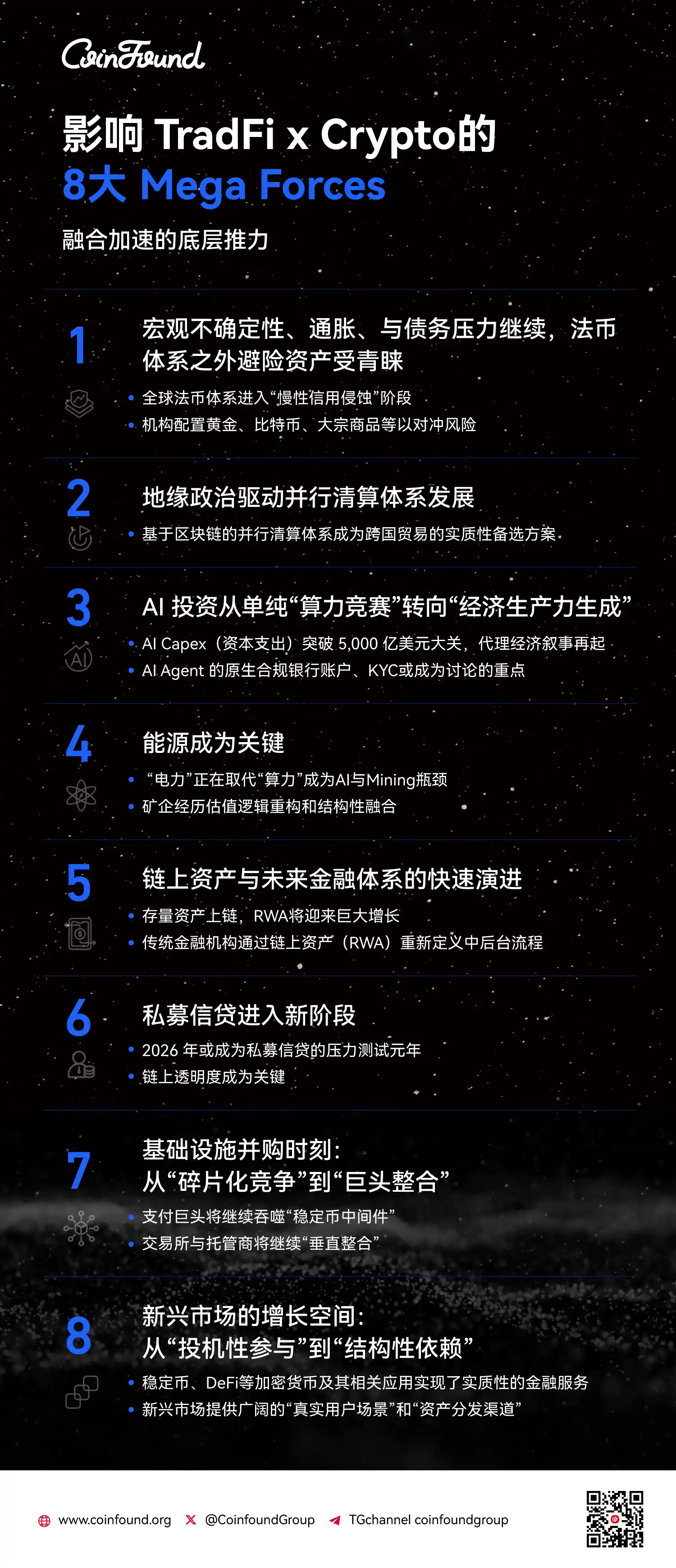
The report distills 8 Mega Forces and 7 trend outlooks: from Stablecoin 2.0 competing for global payment infrastructure, to RWA moving from "issuance" to "utility," and key variables such as stock tokenization, and the divergence and concentration of DATs.

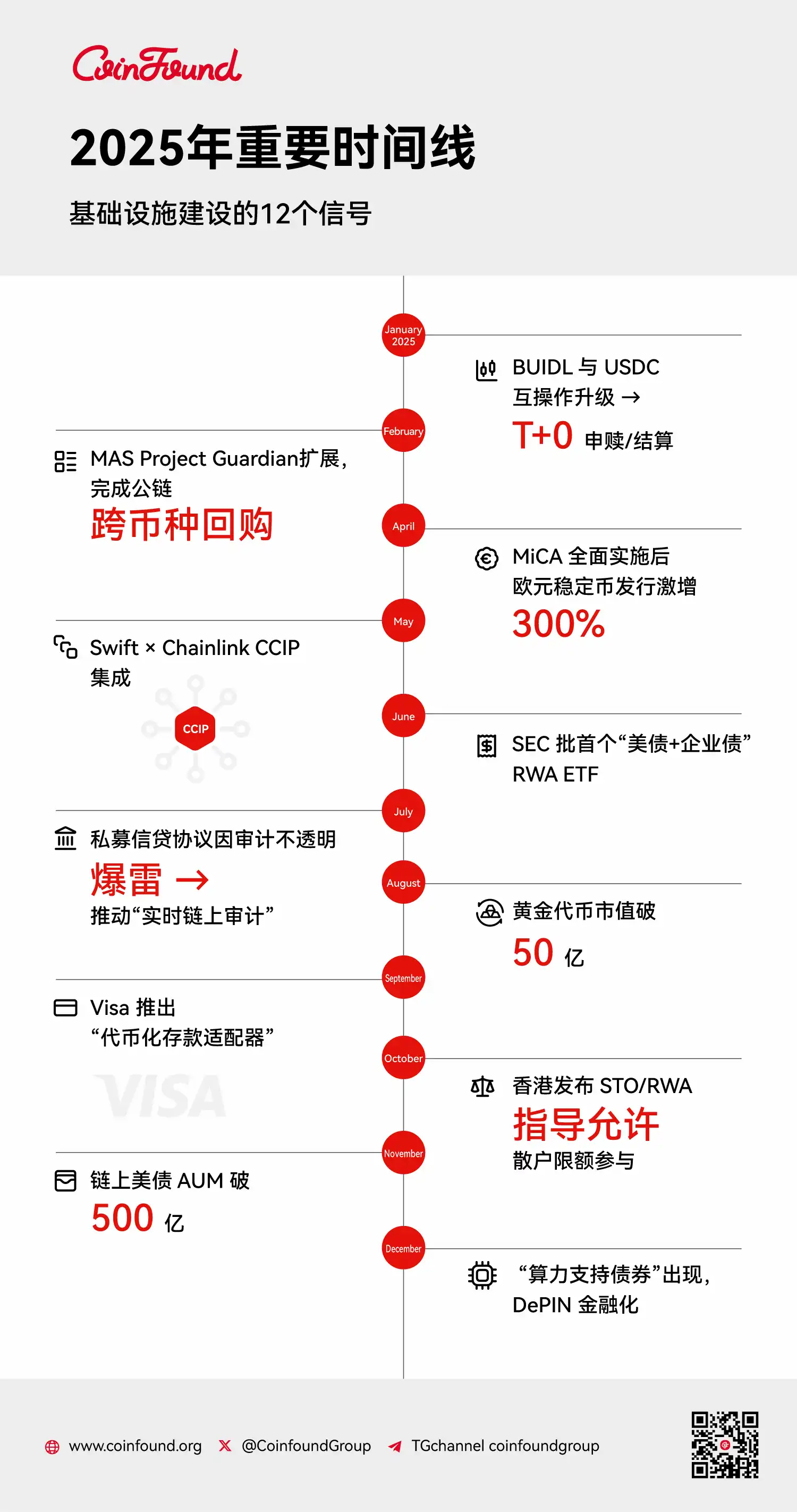
2025 Timeline of Key Events for Traditional Finance x Crypto
In 2026, the following macro trends will impact the TradeFi x Crypto field:

  • Fiat System Trust Crisis and Return to Hard Assets: Facing a global debt spiral and "fiscal dominance" risks, institutions are accelerating allocations to "hard assets" like gold, Bitcoin, and commodities to hedge against fiat currency credit erosion.
  • Geopolitics Driving the Implementation of Parallel Clearing Systems: The need for "de-weaponization" of financial infrastructure is pushing blockchain as an alternative settlement solution independent of SWIFT, with atomic settlement mechanisms effectively reducing trust and counterparty risks in cross-border transactions.
  • AI Productivity Monetization and the Rise of Machine Payments: The focus of AI investment is shifting from computing hardware to generating economic productivity, spurring a rigid demand from AI Agents for compliant stablecoins and on-chain automatic settlement to achieve value attribution between machines.
  • Energy as a Core Asset and the Infrastructure-ization of Mining Companies: Power shortages are driving mining companies to transform into "hybrid computing centers." Their scarce power access rights (Time-to-Power) are triggering acquisitions by tech giants, driving the revaluation of mining companies towards data center infrastructure.
  • On-Chain Assets (RWA) Moving from Issuance to Utility: Asset tokenization is entering the "programmable finance" stage. RWA is no longer just a digital certificate but serves as 24/7 core collateral, significantly enhancing the capital efficiency of repo markets and全域 liquidity.
  • Private Credit Faces Stress Tests and Transparent Transformation: The 2026 debt maturity wave may trigger default risks, forcing the industry to shift from "black boxes" to real-time on-chain transparent audits based on zero-knowledge proofs (ZK) to avoid DeFi chain liquidation crises.
  • Infrastructure Moves from Fragmented Competition to Giant Consolidation: The market is entering a consolidation period similar to the telecommunications industry. Payment and financial giants are acquiring stablecoin middleware and custodians to secure their positions, eliminating redundancy and building compliance moats. Emerging markets shift from speculation to structural dependence: Crypto assets have deepened into underlying tools for payments and remittances in emerging markets. Vast real-user scenarios make them a core hub connecting traditional financial assets with global retail liquidity.

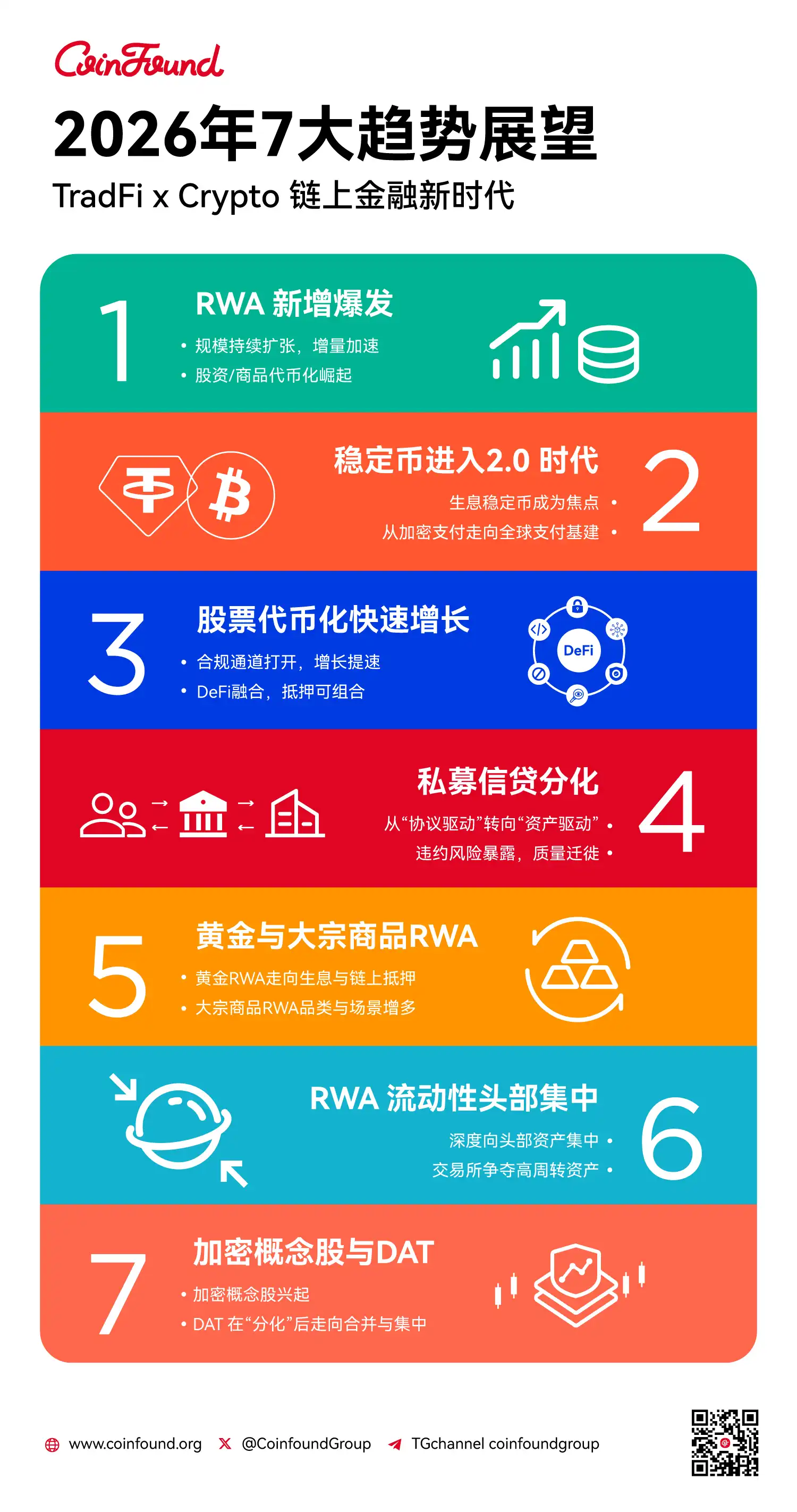
The trend outlook for 2026 is as follows:

1. Structural explosion in the RWA market, stablecoins forming a base of a 3200 billion market, equities and commodities becoming new growth points

2. Stablecoins enter the 2.0 era, moving from crypto payments to competing for global payment infrastructure

3. Stock tokenization liquidity may grow rapidly, DeFi integration will be key

4. Private credit RWA shifts to "asset-driven," may accelerate differentiation under "default" risk pressure

5. Gold and commodity RWA usher in a new era of "full asset collateral"

6. RWA liquidity will further concentrate, three types of RWA assets are gaining favor with exchanges

7. The "rise" of crypto concept stocks, the "divergence" and "concentration" of DATs
Summary

2025 Summary: 2025 was a year of "demystification and integration" for TradeFi and Crypto. Blockchain technology is being还原 (restored) from the光环 (halo) of "revolution" to an efficient bookkeeping and settlement technology. The success of treasury RWA proved the feasibility of putting traditional assets on-chain, and the full entry of giants like BlackRock provided irreversible credit endorsement for the industry.

2026 Prediction: 2026 will be a year of "secondary market explosion and credit expansion." We judge:

  • Liquidity Explosion: With the improvement of infrastructure, RWA will shift from "hold-to-earn" to "high-frequency trading."
  • Credit Downward Drift: Asset classes will drift down from high-credit government bonds to corporate bonds, stocks, and emerging market credit. Risk Premium will become a new source of yield.
  • Risk Warning: As the scale of RWA expands, the complexity of off-chain default transmission to on-chain liquidation will be the biggest systemic risk.

In 2026, both TradeFi and Crypto will be unified under the banner of "On-chain Finance."

Full report link for "CoinFound Annual Report: TradFi x Crypto 2026 Outlook": https://app.coinfound.org/zh/research/4


Domande pertinenti

QWhat are the 8 Mega Forces that will influence the TradFi x Crypto field in 2026 according to the CoinFound report?

AThe 8 Mega Forces are: 1. Fiat system trust crisis and the return to hard assets. 2. Geopolitics driving the implementation of parallel clearing systems. 3. AI productivity realization and the rise of machine payments. 4. Energy as a core asset and the infrastructuralization of mining companies. 5. On-chain assets (RWA) moving from issuance to utility. 6. Stress testing and transparency transformation in private credit. 7. Infrastructure moving from fragmented competition to giant integration. 8. Emerging markets shifting from speculation to structural dependence.

QWhat are the 7 key investment trends outlined for 2026 in the report?

AThe 7 key investment trends for 2026 are: 1. Structural explosion of the RWA market with stablecoins forming a $320B base. 2. Stablecoins entering the 2.0 era, competing for global payment infrastructure. 3. Rapid growth in stock tokenization liquidity, with DeFi integration being key. 4. Private credit RWA shifting to 'asset-driven' models, potentially accelerating differentiation under default risk. 5. Gold and commodity RWA ushering in a new era of 'full-asset collateralization'. 6. Further concentration of RWA liquidity, with three types of RWA assets favored by exchanges. 7. The rise of 'crypto concept stocks' and the 'differentiation' and 'concentration' of DATs.

QHow does the report summarize the key difference between 2025 and the predicted landscape for 2026?

AThe report summarizes 2025 as a year of 'disillusionment and integration' where blockchain technology was reduced from a 'revolutionary'光环 to an efficient bookkeeping and settlement technology. In contrast, it predicts 2026 will be a year of 'secondary market explosion and credit expansion', characterized by liquidity爆发 (shifting from 'holding for yield' to 'high-frequency trading'), credit下沉 (expanding from high-credit sovereign bonds to corporate bonds, stocks, and emerging market credit for risk premium), and new systemic risks from off-chain defaults triggering on-chain liquidations.

QWhat is identified as the major systemic risk associated with the growing RWA market in 2026?

AThe major systemic risk identified is the complexity of off-chain asset defaults (Off-chain Default) triggering chain上清算 (On-chain Liquidation) as the scale of Real-World Assets (RWA) expands.

QWhat overarching concept does the report predict will unify both TradFi and Crypto by 2026?

AThe report predicts that by 2026, both TradFi and Crypto will be unified under the banner of 'On-chain Finance'.

Letture associate

OpenAI Post-Training Engineer Weng Jiayi Proposes a New Paradigm Hypothesis for Agentic AI

OpenAI engineer Weng Jiayi's "Heuristic Learning" experiments propose a new paradigm for Agentic AI, suggesting that intelligent agents can improve not just by training neural networks, but also by autonomously writing and refining code based on environmental feedback. In the experiment, a coding agent (powered by Codex) was tasked with developing and maintaining a programmatic strategy for the Atari game Breakout. Starting from a basic prompt, the agent iteratively wrote code, ran the game, analyzed logs and video replays to identify failures, and then modified the code. Through this engineering loop of "code-run-debug-update," it evolved a pure Python heuristic strategy that achieved a perfect score of 864 in Breakout and performed competitively with deep reinforcement learning (RL) algorithms in MuJoCo control tasks like Ant and HalfCheetah. This approach, termed Heuristic Learning (HL), contrasts with Deep RL. In HL, experience is captured in readable, modifiable code, tests, logs, and configurations—a software system—rather than being encoded solely into opaque neural network weights. This offers potential advantages in explainability, auditability for safety-critical applications, easier integration of regression tests to combat catastrophic forgetting, and more efficient sample use in early learning stages, as demonstrated in broader tests on 57 Atari games. However, the blog acknowledges clear limitations. Programmatic strategies struggle with tasks requiring long-horizon planning or complex perception (e.g., Montezuma's Revenge), areas where neural networks excel. The future vision is a hybrid architecture: specialized neural networks for fast perception (System 1), HL systems for rules, safety, and local recovery (also System 1), and LLM agents providing high-level feedback and learning from the HL system's data (System 2). The core proposition is that in the era of capable coding agents, a significant portion of an AI's learned experience could be maintained as an auditable, evolving software system.

marsbit1 h fa

OpenAI Post-Training Engineer Weng Jiayi Proposes a New Paradigm Hypothesis for Agentic AI

marsbit1 h fa

Your Claude Will Dream Tonight, Don't Disturb It

This article explores the recent phenomenon of AI companies increasingly using anthropomorphic language—like "thinking," "memory," "hallucination," and now "dreaming"—to describe machine learning processes. Focusing on Anthropic's newly announced "Dreaming" feature for its Claude Agent platform, the piece explains that this function is essentially an automated, offline batch processing of an agent's operational logs. It analyzes past task sessions to identify patterns, optimize future actions, and consolidate learnings into a persistent memory system, akin to a form of reinforcement learning and self-correction. The article draws parallels to similar features in other AI agent systems like Hermes Agent and OpenClaw, which also implement mechanisms for reviewing historical data, extracting reusable "skills," and strengthening long-term memory. It notes a key difference from human dreaming: these AI "dreams" still consume computational resources and user tokens. Further context is provided by discussing the technical challenges of managing AI "memory" or context, highlighting the computational expense of large context windows and innovations like Subquadratic's new model claiming drastically longer contexts. The core critique argues that this strategic use of human-centric vocabulary does more than market products; it subtly reshapes user perception. By framing algorithms with terms associated with consciousness, companies blur the line between tool and autonomous entity. This linguistic shift can influence user expectations, tolerance for errors, and even perceptions of responsibility when systems fail, potentially diverting scrutiny from the companies and engineers behind the technology. The article concludes by speculating that terms like "daydreaming" for predictive task simulation might be next, continuing this trend of embedding the idea of an "inner life" into computational processes.

marsbit1 h fa

Your Claude Will Dream Tonight, Don't Disturb It

marsbit1 h fa

Trading

Spot
Futures
活动图片