2025 Korean CEX Listing Review: Investing in New Tokens = 70% Loss?

marsbitPubblicato 2026-03-12Pubblicato ultima volta 2026-03-12

Introduzione

The analysis examines the performance of new tokens listed on major Korean cryptocurrency exchanges (Upbit and Bithumb) in 2025, comparing them with Binance. The study finds that investing $100 in each new KRW trading pair on Upbit (59 tokens) and Bithumb (144 tokens) would have resulted in a portfolio value of only 31% of the original investment by March 11, 2026, equivalent to a 70% loss. Binance (92 tokens) performed similarly with a 29% return. Only two tokens on Upbit (KITE +232.8%, BARD +9.3%) and eight on Bithumb ended in profit. Median returns were -80.9% for Upbit and -82.1% for Bithumb, indicating worse typical performance than the average suggests. Tokens listed in the second half of the year performed better, likely due to shorter exposure to the bear market. Notably, tokens listed on both exchanges (50 tokens) showed nearly identical losses (-69.4%) to those listed only on Bithumb (-68.9%), indicating that multiple listings do not guarantee better performance. The study concludes that the loss is structural: initial buying pressure inflates prices on listing day, followed by a predictable decline. This pattern is global, not specific to Korea or any exchange.

Original Author: @c4lvin, Four Pillars

Original Compilation: AididiaoJP, Foresight News

Core Conclusion

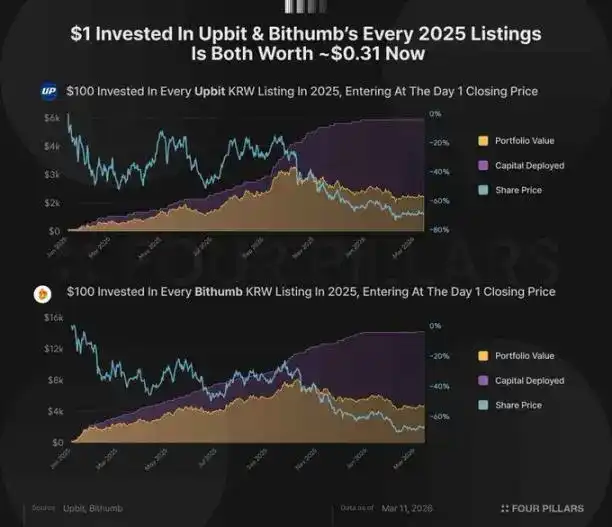
If you invested $100 in each of the 59 new tokens listed for Korean Won (KRW) trading pairs on Upbit in 2025, as of March 11, 2026, the value of this portfolio would be only 31% of the original investment (i.e., each dollar dropped to $0.31). Bithumb (144 tokens) performed identically, also at 31%; Binance (92 tokens) was slightly lower at 29%. All three major exchanges resulted in approximately a 70% loss of capital.

Of the 59 tokens listed on Upbit, only two ultimately turned a profit: KITE (up 232.8%) and BARD (up 9.3%). Bithumb performed slightly better, with 8 out of 144 tokens maintaining positive returns. The median return on Upbit was -80.9%, while on Bithumb it was -82.1%.

For the 50 tokens listed on both major Korean exchanges, their average return (-69.4%) was almost identical to that of the 94 tokens listed only on Bithumb (-68.9%). This data indicates that listing on multiple major exchanges does not guarantee subsequent price performance.

Research Background

The inspiration for this analysis came from a data chart published today by Messari research analyst @Degenerate_DeFi.
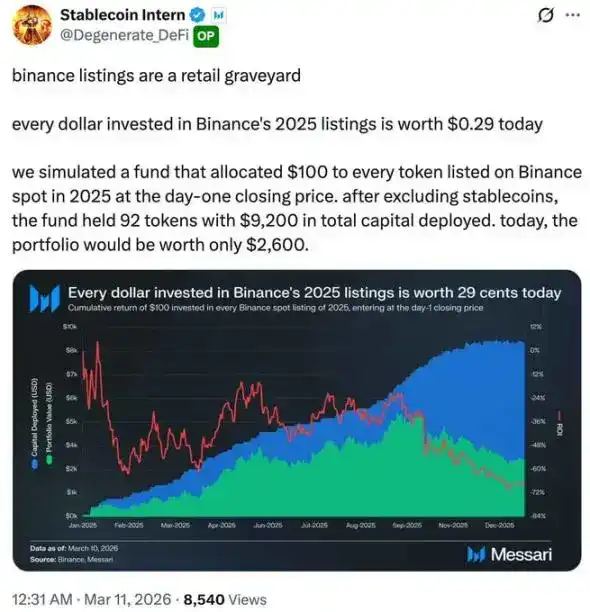
Data Source: @Degenerate_DeFi

The chart shows that if you invested $100 in each of the 92 new tokens listed on Binance in 2025, as of today, each dollar invested is worth only $0.29. This means that out of a total investment of $9,200, the cumulative loss reached 71.7%, leaving a remaining value of approximately $2,600.

As the world's largest cryptocurrency exchange by trading volume, Binance's listing standards are generally considered stricter than those of smaller platforms, and its liquidity advantage is unparalleled. If the data from Binance looks like this, what about the situation on Korean exchanges? The Korean market is retail-investor dominated, with trading patterns significantly different from the global market. Do these differences affect the performance of newly listed tokens? Or will the data ultimately reveal similar patterns?

This article will adopt the same methodology as the Binance analysis to systematically analyze all tokens that gained Korean Won trading pairs on Upbit and Bithumb throughout 2025.

Research Methodology

Scope Definition and Screening Criteria

This study covers all tokens that had new KRW market trading pairs added on Upbit and Bithumb between January 1, 2025, and December 31, 2025. This includes 59 tokens on Upbit and 144 tokens on Bithumb. For tokens listed in 2025 but subsequently delisted, such as Elixir (ELX), Strike (STRIKE), and AI16Z, this study treats them as complete losses.

The investment simulation rules follow the unified framework used in Messari's analysis of Binance listings. We assume an investment of $100 at the closing price on the first day of listing for each token and hold until the present without any selling. By tracking the cumulative value and return rate of this portfolio daily, a time-series dataset is constructed.

Choosing the first day's closing price as the entry point was a deliberate decision. On Korean exchanges, the opening price on the first day is often significantly inflated due to extreme volatility and speculative buying. Using the closing price effectively filters out this short-term noise.

Data Collection

Price data was obtained directly through the public REST APIs of each exchange. For Upbit, we used the daily candlestick (K-line) interface to collect complete daily OHLCV data for each token from its listing date until March 11, 2026, and cross-verified the current price using the ticker interface (/v1/ticker). For Bithumb, the 24-hour K-line interface was used to gather data for the same period. To simplify the model, this study did not consider exchange rate fluctuations between the US Dollar and the Korean Won.

Overall Performance

The chart below visually presents the simulation results. Subsequent sections will provide a detailed interpretation and analysis of this data.

Comparison of the Three Major Exchanges
The performance comparison of new tokens listed in 2025 on the three major exchanges is as follows:
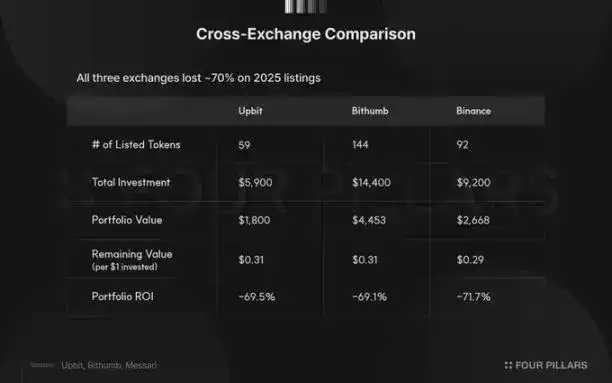
All three exchanges recorded losses of approximately 70%. Upbit (-69.5%) and Bithumb (-69.1%) performed almost equally, with Binance (-71.7%) also being very similar. Regardless of which exchange was chosen, investors buying new tokens at the first day's closing price lost about seventy percent of their initial capital on average.

Return Distribution Characteristics

The overall average is not enough to reveal the differences in individual token performance. The following breaks down the returns of each token in detail by interval:
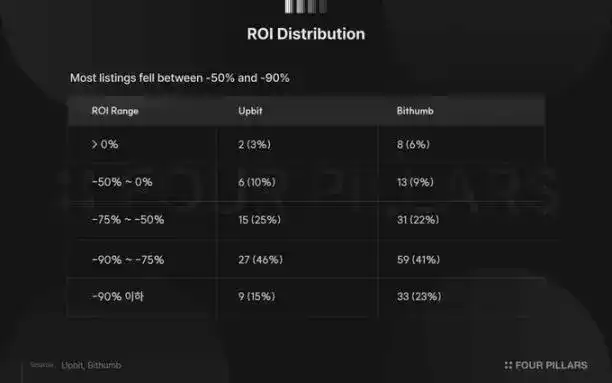
On both exchanges, over 40% of the tokens were concentrated in the loss interval of -75% to -90%. On Upbit, this interval accounted for 46%, with an additional 9 tokens (15%) suffering extreme losses exceeding 90%. Only two tokens ultimately achieved positive returns: Kite (KITE, up 232.8%) and Lombard (BARD, up 9.3%).

Bithumb's return distribution was more dispersed. It had a higher number of profitable tokens, totaling 8, but also had 33 tokens that experienced extreme losses exceeding 90%. This dispersion is partly due to the larger sample size of 144 tokens, but it also reflects that Bithumb's listing strategy covers a wider range of project types compared to Upbit.

The median return reveals a harsher reality: -80.9% for Upbit and -82.1% for Bithumb, both lower than their respective averages. This indicates that a few relatively resilient tokens pulled up the overall average, and the typical performance of newly listed tokens is actually more dismal than the surface data suggests.

Impact of Listing Timing on Performance

To examine whether the timing of listing affects subsequent results, we divided the data into two periods: the first half (January to June) and the second half (July to December) for comparison.
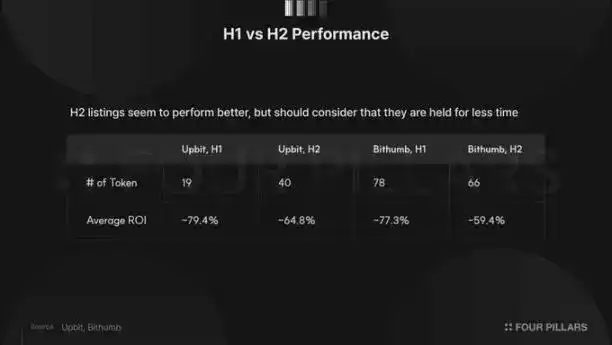
The data shows that tokens listed in the second half performed better on both exchanges. This phenomenon is intuitive: tokens listed earlier in the year experienced a longer period of decline. Given that the overall crypto market was in a downtrend in 2025, the longer the holding period, the higher the natural probability of accumulating greater losses.

It is worth noting that the performance gap between the two halves is quite significant. On Bithumb, the difference in returns between tokens listed in the first half (-77.3%) and those listed in the second half (-59.4%) is about 18 percentage points, a difference that cannot be explained by time factor alone. Possibilities include: tokens listed in the second half indeed had stronger fundamental support, or market expectations had become more rational due to the lessons learned in the first half.

The Paradox of Choice

Relationship Between Number of Listings and Performance

Throughout 2025, Upbit added 59 new KRW trading pairs, while Bithumb added 144. Bithumb's number is more than double that of Upbit and also significantly exceeds Binance's 92. Upbit is renowned for having the strictest listing standards among Korean exchanges. However, despite the vast difference in the number of listings, the portfolio returns of the two exchanges are almost identical: -69.5% for Upbit and -69.1% for Bithumb.

Analysis of Cross-Listed Tokens

To investigate further, we compared the performance of tokens listed on both exchanges with those listed only on Bithumb. The data shows that 50 tokens were listed on both Upbit and Bithumb.
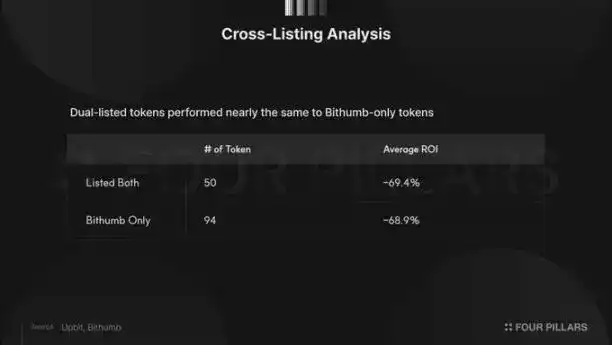
Logically, projects that manage to list on both major exchanges should possess a certain degree of industry recognition. However, the average return of these 50 tokens (-69.4%) is almost exactly the same as that of the 94 tokens listed only on Bithumb (-68.9%).

This finding leads to two conclusions:

First, listing on multiple major exchanges does not provide any guarantee for subsequent price performance.

Second, the first-day price inflation triggered by the listing event is a structural phenomenon, and its occurrence is unrelated to how much attention the project itself receives.

Whether a token has the "honor" of being listed on Upbit as well, or is quietly listed only on Bithumb, the losses ultimately borne by first-day buyers show no significant difference.

Analysis of the Few Survivors

Among the 59 tokens listed on Upbit, only KITE (up 232.8%) and BARD (up 9.3%) ultimately achieved positive returns. Only 8 tokens limited their losses to within 50%.

The 8 profitable tokens on Bithumb constitute a more diverse sample.
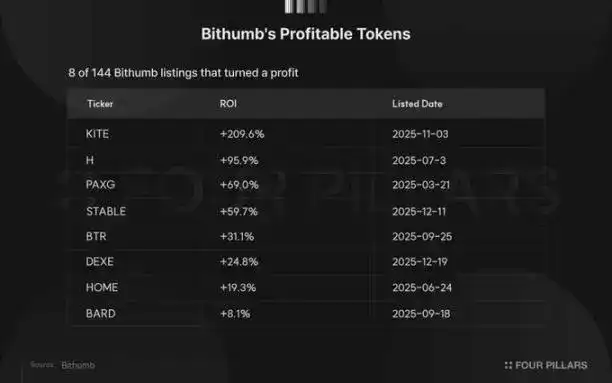
KITE recorded a gain of 209.6%, a significant outlier. However, it should be noted that this token has only been listed for four months; interpreting its performance as a sustainable long-term outcome is premature. STABLE and DEXE also require cautious viewing due to their short tracking record of only three months.

The case of PAXG is more instructive. As a token pegged 1:1 to the spot price of gold, its 69.0% gain was entirely driven by the steady rise in gold prices throughout 2025. This performance has nothing to do with cryptocurrency market fundamentals; it is merely a reflection of macro gold trends. In other words, the most reliable way to achieve profit on Bithumb was ironically not to invest in a cryptocurrency project itself.

Conclusion

This study concludes that the performance of newly listed tokens on Korean exchanges in 2025 is not fundamentally different from that on Binance at a structural level. Although the Korean market is characterized by a high proportion of retail participation, listing strategies vary among exchanges, and the regulatory environment is distinct, the average loss for first-day buyers converges around 70% across all three major exchanges.

We believe the core insight revealed by this data is: the root of the problem lies not in the listing standards of a specific exchange, nor in the quality of individual tokens, but in the structural dynamics inherent to the listing event itself. When a token is newly listed on a major exchange, concentrated retail demand pushes up the price on the first day. Over time, the price naturally regresses, causing losses for first-day buyers. The convergent performance of tokens listed on both exchanges and those listed on only one further confirms that these losses are not due to a specific exchange or token, but are a structural feature of the listing event.

It is important to note that this study measures the performance of one specific strategy: buying at the first day's closing price and holding until now. Strategies that utilize short-term price fluctuations in the days following the listing, or strategies that enter the market after a significant price correction, might yield completely different conclusions. However, such strategies require extremely precise timing, which is far removed from the actual behavior of most retail investors.

The data from 2025 provides a clear message: buying a token simply because it is newly listed on a major exchange is a systematically losing strategy, regardless of which exchange is chosen. This phenomenon is not unique to the Korean market; it is a global structural issue. The reason is not that exchanges are selecting inferior projects, but that the listing event itself creates a dynamic of concentrated demand that is persistently unfavorable to first-day buyers.

Domande pertinenti

QWhat was the average percentage loss for investors who bought new tokens on their first day of listing on major Korean exchanges (Upbit and Bithumb) in 2025 and held until March 11, 2026?

AInvestors experienced an average loss of approximately 70%. The portfolio value dropped to 31% of the original investment on both Upbit and Bithumb, equating to a 69% loss.

QHow many tokens listed on Upbit in 2025 ended up being profitable for investors who bought at the first day's closing price?

AOnly two tokens listed on Upbit in 2025 were profitable: KITE (up 232.8%) and BARD (up 9.3%).

QDid listing on multiple major exchanges (cross-listing) provide any guarantee of better performance for a token?

ANo, listing on multiple major exchanges did not provide any guarantee. The 50 tokens listed on both Upbit and Bithumb had an average return of -69.4%, which was almost identical to the -68.9% return of tokens listed only on Bithumb.

QWhat was a key structural reason identified in the article for the consistent poor performance of newly listed tokens?

AThe poor performance was attributed to a structural dynamic of the listing event itself. Concentrated retail demand artificially inflates the price on the first day, which then naturally corrects downward over time, systematically disadvantaging those who bought at the inflated first-day price.

QBesides KITE and BARD, what was another profitable token on Bithumb and what was the reason for its positive performance?

APAXG was another profitable token on Bithumb, with a gain of 69.0%. Its performance was not related to cryptocurrency market fundamentals but was solely driven by the steady rise in the spot price of gold, to which the token is pegged 1:1.

Letture associate

Has Hook Summer Really Arrived? sato, Lo0p, FLOOD Ignite the New Narrative of Uniswap v4

"Hook Summer" Arrives? Sato, Lo0p, FLOOD Ignite Uniswap v4 Narrative Amidst a slight market recovery, attention within the Ethereum ecosystem has shifted to Meme coins built on Uniswap v4's Hook protocol. Following ASTEROID, tokens like sato, sat1, Lo0p, and FLOOD have become market focal points, with market caps ranging from millions to tens of millions, bringing concentrated liquidity to a narrative-dry market. Uniswap v4 Hooks are "plugin smart contracts" that allow developers to inject custom logic at key points in a liquidity pool's lifecycle (initialization, adding/removing liquidity, swaps, etc.), making the AMM programmable. Recent representative projects include: * **sato**: Market cap peaked over $38M; uses a v4 curve mechanism for minting/burning, locking ETH as reserve. * **sat1**: Market cap briefly exceeded $10M, positioning as an "optimized sato," but later declined significantly. * **Lo0p**: Market cap neared $6.6M; a "lending AMM protocol" allowing users to borrow ETH against deposited LO0P tokens without immediate selling pressure. * **FLOOD**: Market cap approached $6M; channels trading reserves into Aave v3 to generate yield, which is retained in the pool. The emergence of these Hook-based tokens could drive long-term growth for the Uniswap ecosystem by attracting users and liquidity to v4 pools. Combined with Uniswap's activated fee switch (partially used to burn UNI), the long-term outlook for UNI appears positive. However, short-term UNI price appreciation is not directly guaranteed. Factors include the sustainability and lifecycle of these new tokens, their price volatility, overall market conditions, and regulatory pressures. Currently, Uniswap v4's TVL ($595M) lags behind v3 and v2, indicating Hook adoption still requires time to mature. In summary, the Hook ecosystem serves as "long-term nourishment" for UNI, but acts more as a "catalyst" than a direct "booster" in the short term. Note: These are early-stage experimental tokens and may carry unknown risks.

marsbit6 min fa

Has Hook Summer Really Arrived? sato, Lo0p, FLOOD Ignite the New Narrative of Uniswap v4

marsbit6 min fa

Has Hook Summer Truly Arrived? sato, Lo0p, FLOOD Ignite the New Uniswap v4 Narrative

With the broader market showing signs of recovery, a new wave of interest has emerged around Ethereum-based meme coins. Following ASTEROID, tokens like sato, sat1, Lo0p, and FLOOD, built upon the Uniswap v4 Hook protocol, are capturing market attention. Their market capitalizations range from millions to tens of millions of dollars, injecting much-needed focused liquidity into a market lacking narratives. This article explores whether this trend signifies an incoming "Hook Summer" and its potential impact on UNI's price. Hooks are essentially plug-in smart contracts for Uniswap v4 liquidity pools, allowing developers to inject custom logic at key points in a pool's lifecycle (like initialization, adding/removing liquidity, swaps). This transforms the AMM into programmable building blocks. Key highlighted projects include: * **sato**: Peaked over $38M market cap. It utilizes a v4 curve for minting/burning; buying locks ETH as reserve to mint new tokens, while selling redeems ETH from the reserve and burns tokens. * **sat1**: Market cap briefly exceeded $10M, promoted as an "optimized sato," but later declined significantly. * **Lo0p**: Reached nearly $6.6M. It's a lending AMM protocol where buying LO0P tokens locks them as collateral, allowing users to borrow ETH from the pool reserve at 40% LTV, aiming to improve capital efficiency for idle ETH in LPs. * **FLOOD**: Peaked near $6M. Its mechanism directs asset reserves from buys into Aave v3 to generate yield, with fees and interest retained in the pool to potentially influence the token's price long-term. In the long term, the development of the Hook ecosystem can attract users and liquidity to Uniswap v4, benefiting UNI's fundamentals—especially combined with the recent activation of the protocol fee switch, where a portion of fees is used to burn UNI. However, in the short term, these Hook-based tokens are unlikely to directly drive significant UNI price appreciation. Their impact is moderated by factors like token sustainability, price volatility, and broader market and regulatory conditions. Currently, Uniswap v4's TVL ($595M) still trails behind v2 and v3, indicating adoption and growth will take time. The article concludes that while the Hook ecosystem provides long-term "nourishment" for UNI, its short-term role is more of a "catalyst" than a "booster." Readers are cautioned that these are early-stage experimental tokens and may carry unknown risks.

Odaily星球日报19 min fa

Has Hook Summer Truly Arrived? sato, Lo0p, FLOOD Ignite the New Uniswap v4 Narrative

Odaily星球日报19 min fa

Interview with Michael Saylor: I Did Say I Would Sell Bitcoin, But Never a Net Sale

Interview with Michael Saylor: I Said We'd Sell Bitcoin, But Never Be a Net Seller In a recent podcast, MicroStrategy Executive Chairman Michael Saylor clarified the company's stance on potentially selling Bitcoin. Following MicroStrategy's earnings call statement about being prepared to sell BTC to fund dividends for its STRC (Strategic) credit product, Saylor emphasized the distinction between selling and being a "net seller." Saylor explained the core business model: MicroStrategy sells credit instruments like STRC and uses the proceeds to buy Bitcoin, which is viewed as "digital capital" expected to appreciate around 30-40% annually. A portion of these capital gains can then be used to pay the dividends on the credit products. He stressed that even if the company sells some Bitcoin for dividends, it simultaneously buys much more with new credit issuance. For example, after raising $3.2 billion from STRC sales in April, the dividend obligation was only $80-90 million, making the company a net buyer. The clarification aims to counter market narratives questioning the value of Bitcoin on MicroStrategy's balance sheet if it were never sold, and to dismiss claims of a "Ponzi scheme." Saylor reiterated his personal philosophy for investors: "Don't be a net seller of bitcoin" and ensure your Bitcoin holdings increase each year. Saylor also discussed Bitcoin's role as the foundation for "digital credit," noting that STRC has become the largest and most liquid preferred stock issue in the U.S., offering high risk-adjusted returns (Sharpe ratio). He highlighted Bitcoin's deep liquidity, stating that even large purchases by MicroStrategy do not move the market significantly, which is driven by macro factors, geopolitical tensions, and capital flows from ETFs and credit products. Finally, Saylor reflected on his early inspiration from sci-fi books, which motivated his path to MIT, and maintained his fundamental thesis on Bitcoin remains unchanged: it is superior digital capital enabling superior digital credit.

链捕手23 min fa

Interview with Michael Saylor: I Did Say I Would Sell Bitcoin, But Never a Net Sale

链捕手23 min fa

Beaten SK Hynix Employees in China: Year-end Bonus Less Than 5% of Korean Staff's

"SK Hynix Chinese Staff Hit Hard: Bonuses Less Than 5% of Korean Counterparts" Driven by the AI boom, South Korea's SK Hynix is experiencing record performance, with media reports predicting massive year-end bonuses for its employees, making them highly desirable in the matchmaking market. However, this prosperity starkly contrasts with the situation for the company's Chinese employees. According to reports, SK Hynix operates under a rule allocating 10% of operating profit for employee bonuses. While projections suggest Korean employees could receive bonuses reaching millions of RMB, a Chinese employee with over a decade of technical experience revealed the disparity: "If they get 3 million, Chinese staff get less than 5% of that." After adjustments based on KPI ratings, this employee's highest bonus was slightly over 100,000 RMB. Bonuses are paid annually in Korea but semi-annually in China. During the industry downturn in 2023-2024, Chinese employees received no bonus at all. The gap extends beyond bonuses. Recruitment posts for SK Hynix's Chinese factories (in Wuxi, Dalian, Chongqing) show engineer monthly salaries ranging from 10,000 to 35,000 RMB, with a 13th-month salary promised. Chinese employees also receive standard benefits like annual leave but lack stock incentives, which are reportedly unavailable to them. Furthermore, management positions in China are predominantly held by Korean personnel, though industry observers note a gradual increase in local middle managers over time. SK Hynix has confirmed the 10% bonus rule but cautioned that specific future bonus amounts remain unpredictable. The company forecasts strong demand for HBM and other high-value enterprise products for the next 2-3 years, driven by AI infrastructure investment. This focus on business-to-business markets may continue to constrain supply for consumer products, potentially prolonging price increases for components like memory.

链捕手37 min fa

Beaten SK Hynix Employees in China: Year-end Bonus Less Than 5% of Korean Staff's

链捕手37 min fa

Trading

Spot
Futures
活动图片