Bitcoin Could See 10% Jump, As Volatility Drops To 18-Month Low

newsbtcPubblicato 2022-05-05Pubblicato ultima volta 2022-05-05

Introduzione

After its third-largest weekly fall in over a year, the Bitcoin (BTC) price has finally began to rise. BTC's price has effectively rebounded from the important support level of $37,500,...

After its third-largest weekly fall in over a year, the Bitcoin (BTC) price has finally began to rise. BTC’s price has effectively rebounded from the important support level of $37,500, despite an impending Federal Reserve rate hike.
Bitcoin Poised For 10% Jump
Various analysts, like The Wolf of All Streets, Michael van de Poppe, and PlanB, are bullish on the bullish trend, with the Bitcoin price currently holding above $39,000.
In a tweet on May 4, on-chain data provider Santiment published historical data showing a 20% rally as a result of BTC transactions is negative at the same levels between February 16 and 22. The week’s Bitcoin Ratio of On-Chain Transactions Volume in Profit/Loss statistic is the third largest capitulation in a year.
As technicals improve, several analysts and traders forecast a price increase in the following days.
Michaal van de Poppe predicts that the price of Bitcoin (BTC) will rise from current levels. He stated,
“Bitcoin starts to look way better at this stage. Odds that the event tonight is a ‘Sell the rumour, Buy the News’ event are increasing.”
A prominent crypto trader, The Wolf Of All Streets, predicted a rebound in Bitcoin price as it breaks above the trend line. A big rise could be anticipated if the BTC price stabilizes over $39,000.
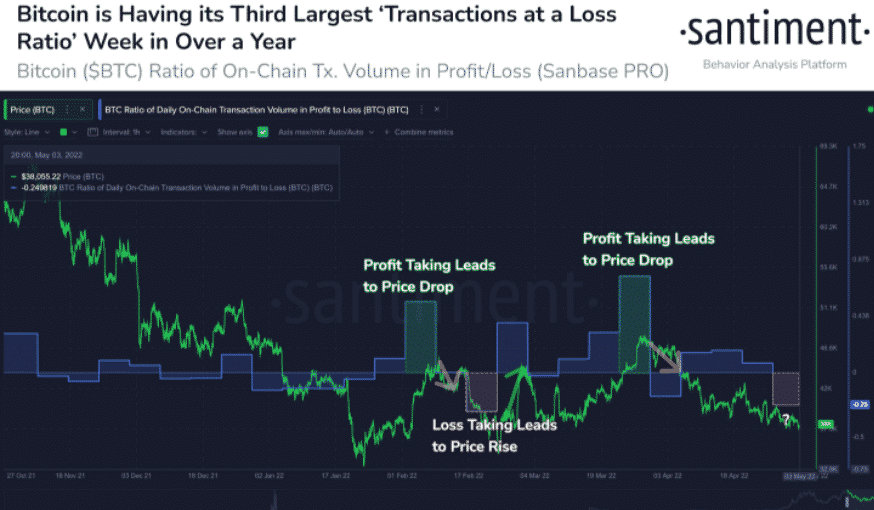
Bitcoin On-Chain Transactions Volume. Source: Santiment
According to PlanB, the original $55K S2F model, which was released in March 2019, appears to be tracking the Bitcoin price trend. He also expects Bitcoin to rise in value.
The price of Bitcoin (BTC) has regained over 5% in the previous 24 hours, stabilising near $39,000. Whales continue to accumulate at dips, resulting in a huge increase in trading volume. Furthermore, the BTC has avoided a drop below the critical support level. It suggests that a rally could happen in the next several days.
BTC Trades Sideways
BTC has been trading sideways over the past few days, with the price dropping below $40,000 on April 26. Although, after reaching the swing highs near $48,000, the price has already begun to drop. BTC retreated and lost 45 percent of its value. BTC sellers, on the other hand, are weary as the price trades sideways in a narrow range since April 25.
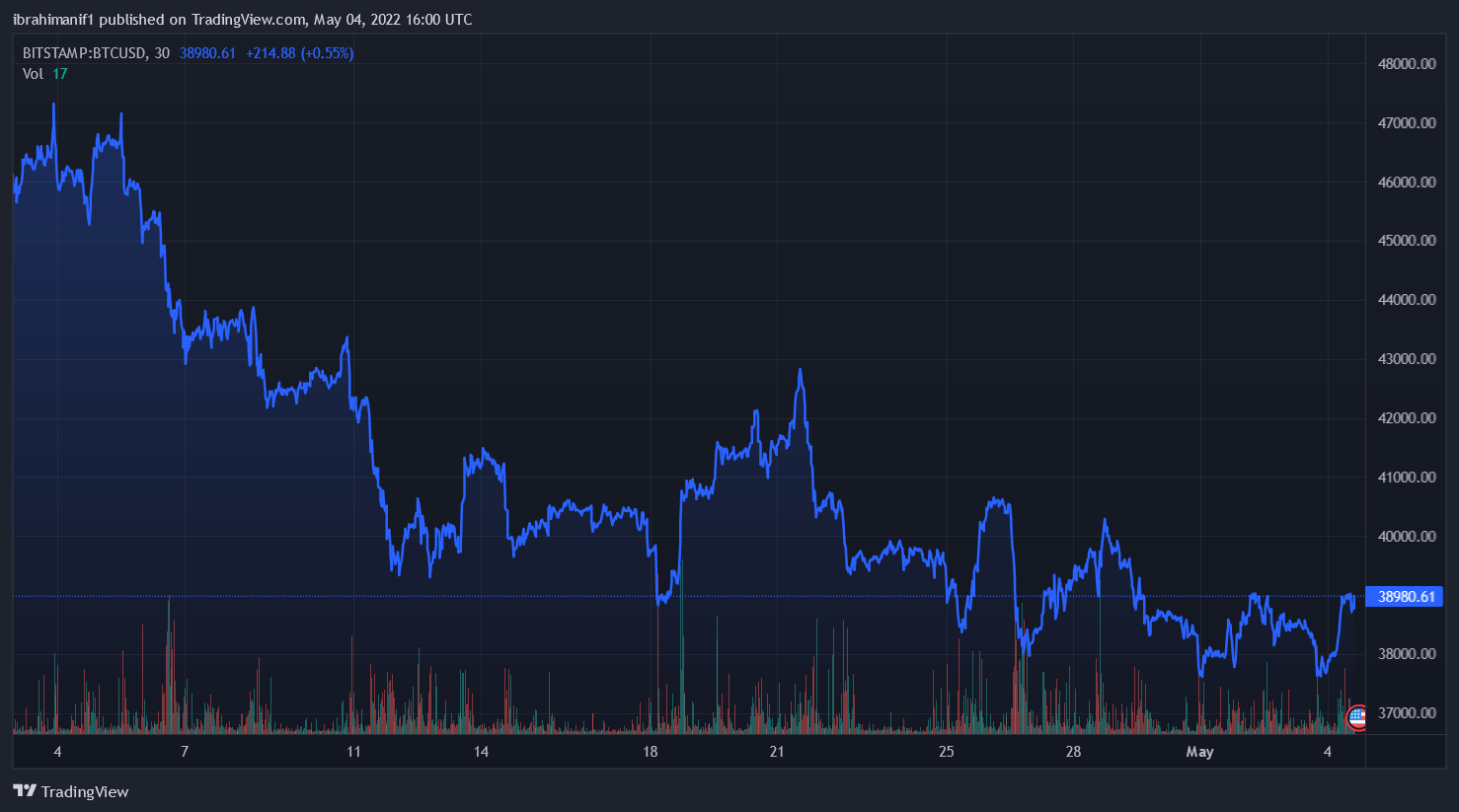
BTC/USD trades sideways. Source: TradingView
A daily close below the session’s low, on the other hand, would disprove the bullish price assumption. In that situation, $36,000 would be the lowest point on the downside.
BTC/USD is currently trading at $39,874, up 5.63 percent for the day as of publishing time. According to CoinMarketCap, the first cryptocurrency by market capitalization has a 24-hour trading volume of $35,528,442,016.
Suggested Reading | Will Bitcoin Shoot Over $40,000 — Or Drop To $35,000?
Volatility Drops
Bitcoin’s historical volatility is at 18-month lows, according to statistics released by the Buy Bitcoin Worldwide webpage. Its anticipated 60-day average value fell to 2.62%.
Bitcoin (BTC) volatility was last this low in November 2020, when the orange coin broke through $10,000 for the first time in this bullish cycle.
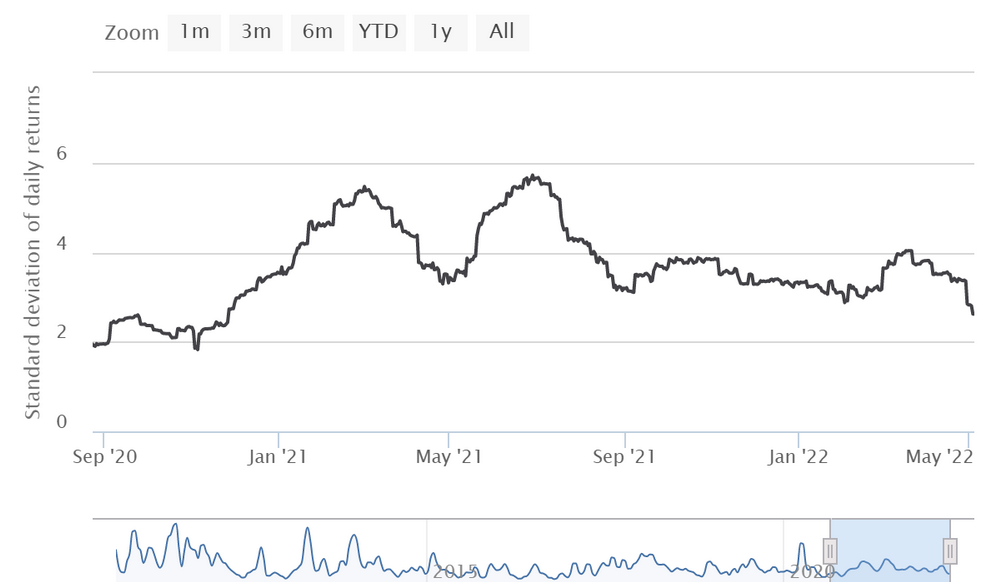
Image by Buy Bitcoin Worldwide
On April 27, 2022, thirty-day volatility reached a local low, but it is already showing signs of recovery.
The Bitcoin Volatility Index (BVOL), similar to the stock market’s VIX, shows how much Bitcoin’s price changes on a given day in relation to its previous price.
The most recent increase in Bitcoin (BTC) volatility occurred in July 2021, when the flagship cryptocurrency was twice as volatile over a 30-day period as it is now.

Letture associate

Crypto.com, Backed by Citadel Securities, Transfers XYO and XL1 into Regulated Custody

Crypto.com, with backing from Citadel Securities, has placed XYO and XL1 tokens into regulated custody. This move provides eligible institutions and high-net-worth clients with a regulated mechanism for storing, managing, and exchanging these tokens without first having to transfer assets onto an exchange. The custody structure utilizes segregated MPC wallets managed by a bankruptcy-remote entity, with private keys secured via multi-party computation. Clients benefit from cold storage, audit trails, and direct access to Crypto.com's institutional liquidity while their assets are custodied, removing the operational step of pre-trade transfers. Company leadership positioned this as a strategic step to provide "unmatched security and seamless liquidity" for digital asset organizations, and to protect and scale the XYO ecosystem. The partnership builds on an existing relationship since XYO's initial listing on the exchange. This development follows Citadel Securities' $400 million investment in Crypto.com and comes as the company expands its regulatory standing, having received conditional approval to establish a national trust bank. For institutional investors, this custody agreement addresses a key barrier by demonstrating that smaller market-cap assets like XYO and XL1 can be held under the same regulatory and security standards as larger tokens. XYO operates a large DePIN network generating real-world data for AI and robotics, with XL1 handling its blockchain transactions and infrastructure.

cryptonews.ru2 h fa

Crypto.com, Backed by Citadel Securities, Transfers XYO and XL1 into Regulated Custody

cryptonews.ru2 h fa

Less Than Two Weeks Left — Bitcoin's BIP-110 Countdown Begins as Miner Support Grows Ahead of Decisive Moment

The BIP-110 activation process for Bitcoin, which proposes a temporary soft fork to limit specific data-heavy transaction types (like Ordinals inscriptions), is entering its critical final phase. As of July 27, 2026, there are roughly 1,790 blocks remaining until the mandatory signaling window begins at block 961,632 (estimated for August 9). Starting then, nodes enforcing BIP-110 will reject blocks not signaling for the proposal. While support from miners has grown from below 1% to around 3% recently, it remains concentrated among smaller pools and independent miners, with major pools like Foundry, Antpool, ViaBTC, and F2Pool largely not signaling. Foundry's stance is particularly decisive, as it holds a large share of the network's hashrate and has tied its signaling to a client vote. Without a major pool's shift, widespread activation is unlikely. If the current low signaling levels persist after the window opens, nodes enforcing BIP-110 will follow a slower, minority chain, potentially creating a chain split from the majority chain followed by legacy (e.g., Bitcoin Core) nodes. This activation mechanism differs from past soft forks like SegWit, resembling the 2017 UASF BIP-148 more closely. Proponents argue BIP-110 is necessary to curb spam-like data transactions that increase node costs and distort fee markets, framing opposition as a contentious hard fork. Critics, however, view the activation method as a radical overreaction to a minor issue. The final outcome in the coming two weeks hinges on whether a major pool switches support, if major exchanges clarify their chain preference, and how miners actually behave once the mandatory window is open.

cryptonews.ru2 h fa

Less Than Two Weeks Left — Bitcoin's BIP-110 Countdown Begins as Miner Support Grows Ahead of Decisive Moment

cryptonews.ru2 h fa

Trading

Spot
活动图片