What would it take to do DAS with inner product arguments (IPAs)?

Vitalik ButerinPubblicato 2022-02-22Pubblicato ultima volta 2022-02-22

Introduzione

Data availability sampling (DA-sampling or DAS) today is planned to be done with KZG commitments.

Data availability sampling (DA-sampling or DAS) today is planned to be done with KZG commitments. KZG commitments have the advantage that they are very easy to work with, and have some really nice algebraic properties:
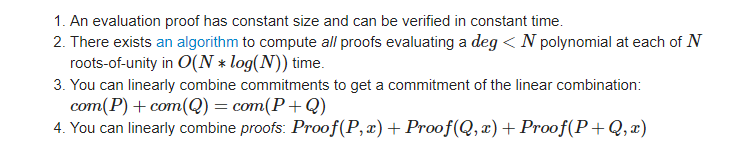
The first is a nice efficiency guarantee. The second ensures that producing a blob that can be DA-sampled is easy: if it takes O(N2) time to generate all proofs, then it would require either highly centralized actors or a complicated distributed algorithm to make it DAS-ready.

The third and the fourth are very valuable for 2D sampling, and enabling distributed block producers and efficient self-healing:

A block producer only needs to know the original M commitments to “extend the columns” with an FFT-over-the-curve and generate 2M commitments that are on the same deg<M polynomial.

You can do not only per-row reconstruction but also per-column reconstruction: if some values and proofs on a column are missing (but more than half are still available), you can do an FFT to recover the missing values and proofs.

However, KZG has a weakness: it relies on complicated pairing cryptography, and on a trusted setup. Pairings have been understood for over 20 years, and the trusted setup is a 1-of-N trust assumption with N being hundreds of participants, so the risk in practice is high and this author believes that proceeding with KZG is perfectly acceptable. However, it is worth asking the question: if we don’t want to pay the costs of KZG, can we use inner product arguments (IPAs) instead?

IPAs have the following properties:

  1. An evaluation proof has logarithmic size and can be verified in linear time (roughly 40ms for a size-4096 polynomial)
  2. There is no known efficient multi-proof generation algorithm.
  3. Commitments are elliptic curve points and you can linearly combine them just like KZG commitments
  4. There is no known way to linearly combine proofs.

Hence, we keep some properties and we lose some. In fact, we lose enough that our “current approach” to generating, distributing and self-healing proofs is no longer possible. This post describes an alternative approach that, while somewhat more clunky, still achieves the goals.

An alternative approach

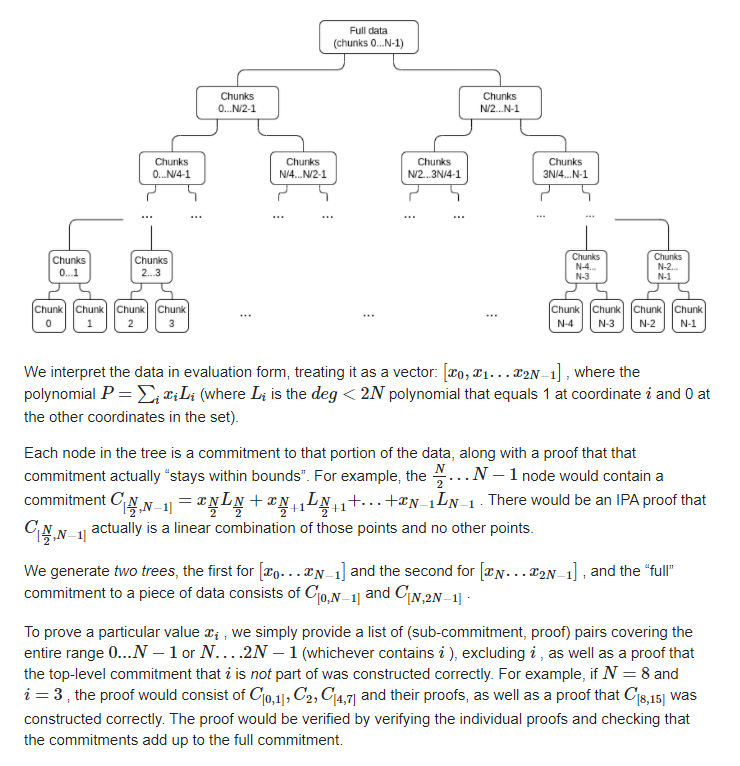
First, instead of generating 2N independent proofs for a deg<N polynoial, we generate a proof tree. This looks as follows:
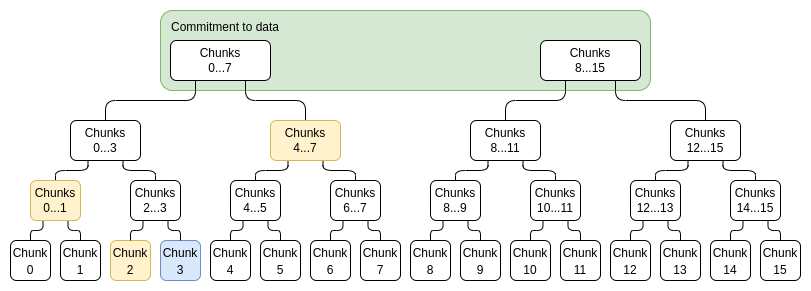
Blue: chunk 3, yellow: proof for chunk 3.

Note that to improve efficiency, each chunk does not need to be a single evaluation; instead, we can crop the tree so that eg. a chunk is a set of 16 evaluations. Given the combined size of the proofs will be larger than this regardless, we lose little from making chunks larger like this.

Generating these proofs takes O(N∗log(N)) time. Verifying a proof takes O(N) time, but note that verification of many proofs can be batched: the O(N) step of verifying an IPA is an elliptic curve linear combination, and we can check many of these with a random linear combination. O(N) field operations per proof would still be required, but this takes <1 ms.

Extension: fanout greater than 2

Instead of having a fanout of 2 at each step, we can have a higher fanout, eg. 8. Instead of one proof per commitment, we would have 7 proofs per commitment. At the bottom level, for example, we would have a proof of {1,2,3,4,5,6,7} , {0,2,3,4,5,6,7} , {0,1,3,4,5,6,7} , etc. This increases total proof generation effort by ≈(7∗7/4)/3 x (7 proofs per node, each proof 1.75x the size of the original, but 3x fewer layers, so ~4.08x more effort total), but it reduces proof size by 3x.

Proof size numbers

Suppose that we are dealing with N=128 chunks of size 32 (so we have deg<4096 polynomials), and a fanout of (4x, 4x, 8x). A single branch proof would consist of 3 IPAs, of total size 2∗(7+9+12)=56 curve points (~1792 bytes) plus 512 bytes for the chunk. This compares to 48 byte proofs for a 256 byte or 512 byte chunk today.

Generating the proofs would require a total of 2∗8192∗(3∗2+7) curve multiplications (3 * 2 for the two fanout-4 layers and 7 for the fanout-8 layer), or a total of ~212992 multiplications. Hence, this would require either a powerful computer to do quickly (a regular computer can do one multiplication in ~50 us, so this would take 10 seconds which is a little too long) or a distributed process where different nodes focus on generating proofs for different chunks.

Verifying the proofs is easy, as proof verification can be batched and only a single elliptic curve multiplication done. Hence, it should not be much slower than with KZG proofs.

Self-healing

Self-healing could not effectively be done column-by-column. But can we avoid requiring a single healer to have all of the data (all 2N chunks from each of all 2M polynomials)?

Suppose that a single row is entirely missing. It’s easy to use any column to reconstruct the value in the missing row in that column. But how to prove it?

The simplest technique is cryptoeconomic: anyone can simply post a bond claiming a value, and someone can later take that claim together with a branch proof proving a different value to slash that validator. As long as enough legitimate claims are available, someone on that row subnet can combine together the claims and reconstruct the commitment and the proofs. Validators could even be required to publish such claims for sample indices that they are assigned to.

A cryptoeconomics-free but more technically complicated and slow alternative is to pass along M branch proofs for values along that column, along with a Halo-style proof that the proofs verify correctly.


Crypto di tendenza

Letture associate

Shing-Tung Yau Invites Wang Hong and Deng Yu to Teach Back Home, After 20 Years of Rivalry, Tsinghua and Peking University Realize the Opponent Isn't Each Other

On July 23, the Fields Medal, the highest global mathematics award, was awarded to two Chinese mathematicians, Wang Hong and Deng Yu, both undergraduate classmates from Peking University's class of 2007. This marks the first time mathematicians who completed their undergraduate studies in mainland China have won the prize, with two laureates in the same year. Following the announcement, renowned mathematician Shing-Tung Yau publicly invited Wang and Deng to return to China to teach at Tsinghua University's Qiuzhen College. This invitation is the latest episode in a decades-long rivalry between Tsinghua and Peking University (PKU) for supremacy in Chinese mathematics. The competition traces back to a 1952 national university restructuring that transferred Tsinghua's entire mathematics department to PKU, leaving Tsinghua without a math program for nearly 30 years until its reinstatement in 1979. The rivalry intensified in 2005 with a public falling-out between Yau and his former student, PKU professor Gang Tian. Subsequently, Yau shifted his efforts to building Tsinghua's mathematics program from the ground up. He established the Yau Mathematical Sciences Center in 2009 and founded the Qiuzhen College in 2021, implementing an elite, accelerated "Math Leadership Program" to recruit prodigies as young as middle school students. The competition spans multiple fronts: recruiting top junior high and high school students from math olympiads, luring renowned scholars from overseas, and securing research funding. A new and fierce battleground has emerged in AI and mathematical reasoning. Both universities are heavily investing in AI research to enhance large language models' mathematical capabilities, with Tsinghua collaborating on projects like the STARE algorithm and PKU developing specialized models for geometry. Despite the intense competition, this rivalry has arguably elevated China's overall standing in mathematics. Chinese mathematicians now frequently publish in top journals and win major international awards. At the recent 17th Yau College Students Mathematics Contests, PKU students swept the top individual awards. Yau, presenting the awards, emphasized the need for inter-university collaboration to advance Chinese mathematics. The landscape is now shifting with the rise of AI in mathematical research. As AI begins to generate proofs at an unprecedented rate, the traditional metrics of competition between institutions may become less relevant. The future for mathematicians, as noted by Terence Tao, is navigating an era of "proof surplus" driven by AI, presenting a new common challenge that transcends university rivalries.

marsbit7 min fa

Shing-Tung Yau Invites Wang Hong and Deng Yu to Teach Back Home, After 20 Years of Rivalry, Tsinghua and Peking University Realize the Opponent Isn't Each Other

marsbit7 min fa

UBS Interpretation: Public Funds' Tech Holdings Hit Record High, Electronics Becomes Core Increase in Q2

According to UBS's latest China equity strategy report, in Q2 2026, mutual funds' allocations to A-share "hard tech" reached a historical high. The electronics and telecommunications sectors, along with the STAR and ChiNext boards, were the primary focus of increased holdings. The standout figure is the mutual fund allocation to the major technology sector (encompassing electronics, telecom, computers, and defense), which rose to 57.3%, with an overweight position of 18.5%—both setting new records. UBS calculations show the electronics sector alone saw a 20.2 percentage point increase in allocation for the quarter, making it the strongest area of buying. Telecom and machinery allocations also rose. This trend was reinforced by foreign capital inflows. Estimates from major securities firms indicate northbound capital turned to a net inflow of over 2.1 trillion yuan in Q2, a sharp reversal from Q1 outflows. According to UBS's sector classification, industrials and IT were the main destinations for these inflows. The shift wasn't broad-based but concentrated in specific tech areas. Concurrently, holdings in traditional sectors like consumer staples and certain cyclicals declined. The allocation to the STAR and ChiNext boards also hit record highs, indicating a broader exposure to high-growth tech assets beyond just leading industries. Furthermore, the expansion of actively managed technology-themed funds—now constituting 27.5% of total active mutual fund AUM—suggests this is a structural shift in fund focus, not merely short-term portfolio rotation. While this concentration of institutional capital can provide valuation support and liquidity for the hard tech sector, the report cautions that historically high positioning also increases susceptibility to short-term volatility, profit-taking, and external market shocks. The sustainability of the trend will depend on the concurrent realization of upward earnings revisions, stabilization of leverage, and continued foreign capital inflows, all against a backdrop of supportive policies for AI, semiconductors, and advanced manufacturing.

marsbit14 min fa

UBS Interpretation: Public Funds' Tech Holdings Hit Record High, Electronics Becomes Core Increase in Q2

marsbit14 min fa

Trading

Spot

Articoli Popolari

Come comprare ETC

Benvenuto in HTX.com! Abbiamo reso l'acquisto di Ethereum Classic (ETC) semplice e conveniente. Segui la nostra guida passo passo per intraprendere il tuo viaggio nel mondo delle criptovalute.Step 1: Crea il tuo Account HTXUsa la tua email o numero di telefono per registrarti il tuo account gratuito su HTX. Vivi un'esperienza facile e sblocca tutte le funzionalità,Crea il mio accountStep 2: Vai in Acquista crypto e seleziona il tuo metodo di pagamentoCarta di credito/debito: utilizza la tua Visa o Mastercard per acquistare immediatamente Ethereum ClassicETC.Bilancio: Usa i fondi dal bilancio del tuo account HTX per fare trading senza problemi.Terze parti: abbiamo aggiunto metodi di pagamento molto utilizzati come Google Pay e Apple Pay per maggiore comodità.P2P: Fai trading direttamente con altri utenti HTX.Over-the-Counter (OTC): Offriamo servizi su misura e tassi di cambio competitivi per i trader.Step 3: Conserva Ethereum Classic (ETC)Dopo aver acquistato Ethereum Classic (ETC), conserva nel tuo account HTX. In alternativa, puoi inviare tramite trasferimento blockchain o scambiare per altre criptovalute.Step 4: Scambia Ethereum Classic (ETC)Scambia facilmente Ethereum Classic (ETC) nel mercato spot di HTX. Accedi al tuo account, seleziona la tua coppia di trading, esegui le tue operazioni e monitora in tempo reale. Offriamo un'esperienza user-friendly sia per chi ha appena iniziato che per i trader più esperti.

153 Totale visualizzazioniPubblicato il 2024.12.10Aggiornato il 2026.06.02

Come comprare ETC

Discussioni

Benvenuto nella Community HTX. Qui puoi rimanere informato sugli ultimi sviluppi della piattaforma e accedere ad approfondimenti esperti sul mercato. Le opinioni degli utenti sul prezzo di ETC ETC sono presentate come di seguito.

活动图片