Is crypto a good investment? Why risk tolerance and dollar-cost averaging matter

ambcryptoPubblicato 2026-07-24Pubblicato ultima volta 2026-07-24

Introduzione

The article examines whether cryptocurrency is a good investment, emphasizing the critical roles of risk tolerance and dollar-cost averaging (DCA). While crypto's popularity has surged significantly—evidenced by search trends and growing institutional adoption through ETFs and tokenization—it remains a volatile, high-risk asset class. Survey data shows many investors see crypto as attractive yet risky, with it comprising about 10% of average portfolios alongside more traditional assets. Since July 2017, the total crypto market cap has grown substantially, but the potential for high rewards is accompanied by significant dangers like scams, hacks, and market downturns. The key for investors is to assess their financial goals, time horizon, and risk appetite. Recommendations include investing only what one can afford to lose (with suggested allocations as low as 1-2%), using DCA strategies during bear markets, and maintaining consistency and risk management whether investing directly in crypto assets or through ETFs.

The interest in crypto was up 300% compared to the preceding five years. At least, according to the popularity of the search term “crypto” on Google Trends.

In the long-run, the baseline popularity of crypto has grown fourfold, even as the price of Bitcoin [BTC] struggles to break out of a downturn that began last October.

This popularity can be explained by the rise of institutional investment, spot exchange-traded funds [ETFs], and developments such as real-world assets being onboarded onchain through tokenization.

Increasingly, crypto is seen as an attractive investment option. The Charles Schwab 2025 Modern Wealth Survey found that two-thirds of the surveyed American investors believe that they must look beyond traditional investment products for better investing success.

Breaking down portfolio allocation into crypto

On average, stocks comprise 25% of investors’ portfolios, followed by mutual funds at 13%, bonds at 8%, and cryptocurrencies at 10%. Half the Americans surveyed agreed that investing today requires more short-term risk than it did in the past.

The high volatility crypto has seen since its inception meant that 53% of all crypto investors considered it a high-risk venture.

With high risk, there can be big rewards.
Source: TradingView

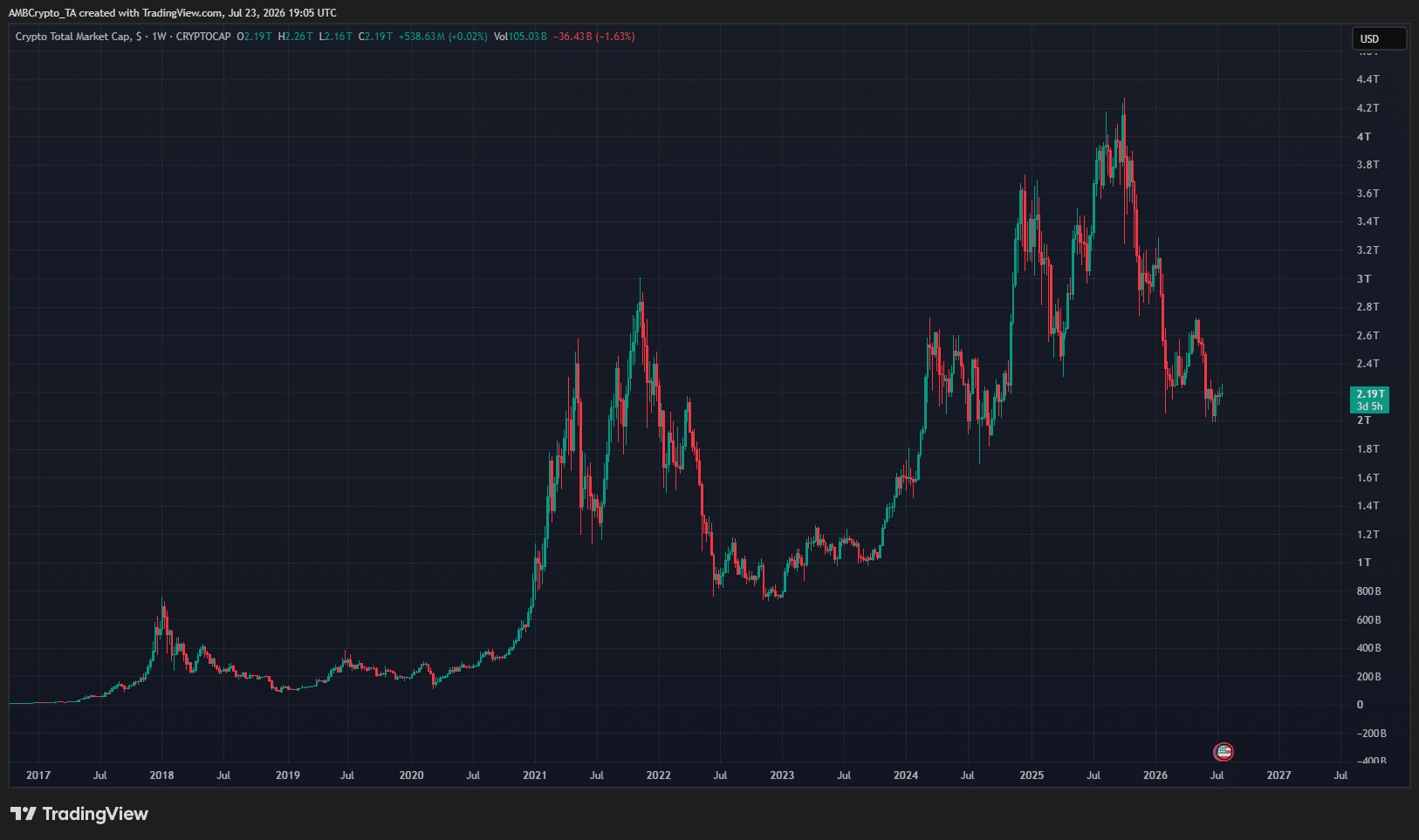
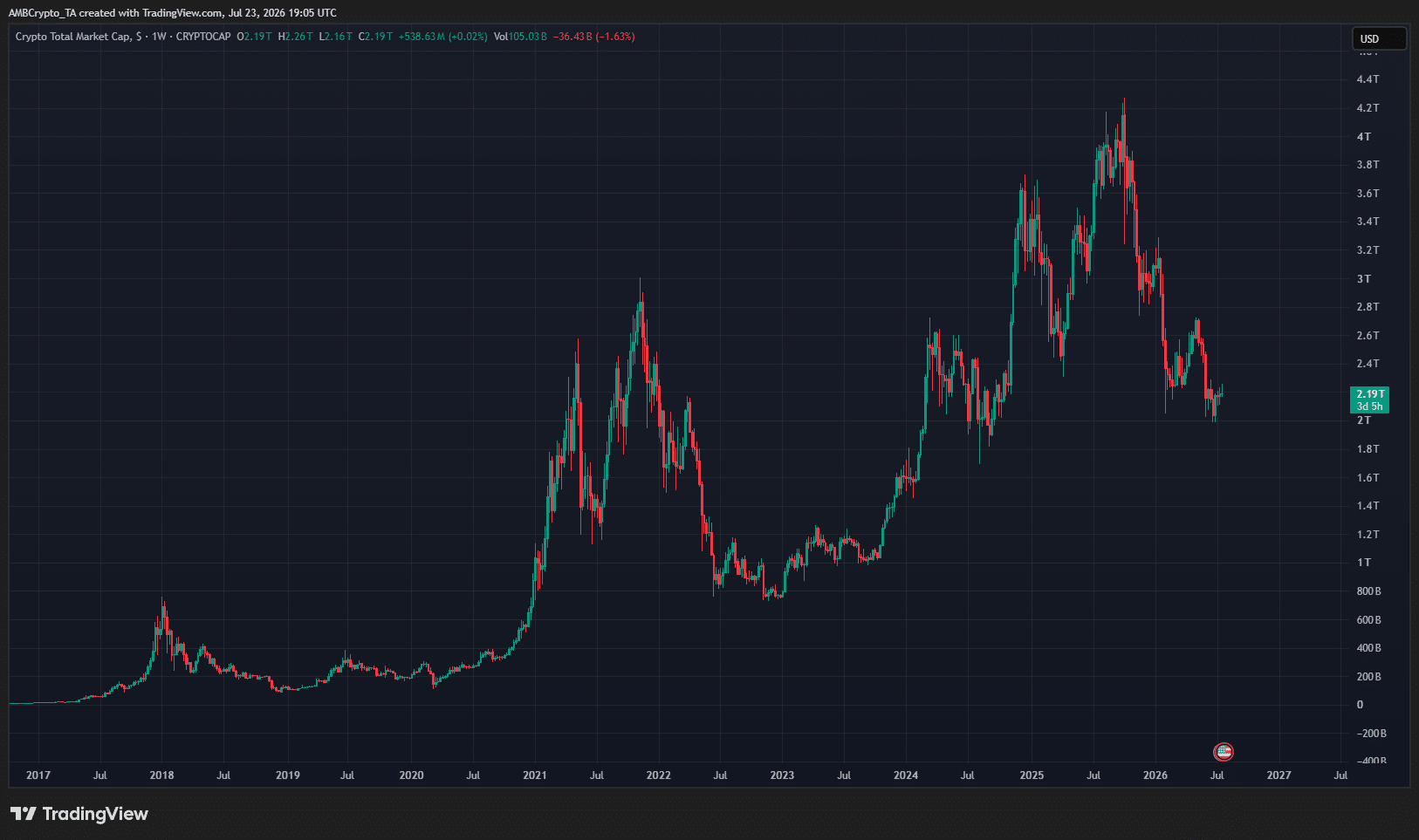
Since July 2017, the total crypto market cap has grown by around 2,600%, from $77 billion to $2.19 trillion. As a nascent asset class, its quick growth is expected to slow down over time, but still continue upward.

What you must ask yourself before considering crypto as an investment

The rewarding nature of crypto investment can easily mask the thousands upon thousands of traders and investors burnt by exchange hacks, rug pulls, scams, stolen wallet passwords, and just plain bad investment timing.

Whether crypto is good for an investor comes down to their goals, investment targets, risk appetite, and time horizon.

Investors should remember to only invest in crypto what they can afford to lose. This means that limiting the size of crypto in their portfolio to acceptable levels, per their tolerance. For example, BlackRock recommends a 1-2% allocation to Bitcoin.

Time horizon is something to consider. Those with a multi-year outlook would be less likely to react to market hype and panic cycles, while shorter-term investors might want to see steadier returns.

Depending on where crypto is in its cycle, such expectations could be pleasantly satisfied or face disastrous results.

Having some idea of dollar-cost averaging into bear markets and being comfortable with price swings, while occasionally keeping up with crypto market trends, could be a good way for investors to get some exposure to this alternative investment class.

Whether the investor chooses established exchanges and buys top-cap crypto assets, or chooses to go towards ETFs, consistency, risk management, and financial knowledge would remain key, just like with any other investment options.


Final Summary

  • Crypto can be a solid investment option, but there are many questions an investor must ask themselves before entering.
  • Rising popularity of crypto meant that 41% of surveyed Americans consider crypto a good investment, but they still view it as high risk.


Domande pertinenti

QAccording to the article, what percentage of surveyed American investors believe they need to look beyond traditional investment products for better success?

ATwo-thirds (or 66%) of the surveyed American investors.

QOn average, what percentage of investors' portfolios is allocated to cryptocurrencies according to the survey mentioned in the article?

AOn average, cryptocurrencies comprise 10% of investors' portfolios.

QWhat does BlackRock recommend as the portfolio allocation for Bitcoin?

ABlackRock recommends a 1-2% allocation to Bitcoin.

QWhat is one suggested strategy for investors to gain exposure to crypto while managing risk?

ADollar-cost averaging into bear markets is suggested as a good strategy.

QBy approximately what percentage has the total crypto market cap grown since July 2017, according to the article?

AThe total crypto market cap has grown by around 2,600% since July 2017, from $77 billion to $2.19 trillion.

Letture associate

The Verdict in Choi Tae-won's Divorce Case: Revealing the Inheritance Undercurrent Behind SK Hynix's Trillion-Won Empire

SK Group Chairman Chey Tae-won's high-profile divorce case, involving a record 1.38 trillion won settlement, has drawn attention to the succession plans for Korea's second-largest conglomerate, especially its crown jewel, SK hynix. Unlike traditional chaebol scripts centered on the eldest son, Chey's three children from his marriage to former President Roh Tae-woo's daughter, Roh Soh-yeong, are carving distinct, non-traditional paths. Eldest daughter Chey Yun-jung (b. 1989) is seen as the most evident successor. With a scientific and consulting background, she holds executive roles at SK bioscience and SK Inc.'s growth support department, focusing on future strategy and biopharma. Her marriage is to an AI infrastructure entrepreneur, not a traditional business alliance. Second daughter Chey Min-jung (b. 1991) took a unique route, voluntarily serving as a South Korean naval officer, including an anti-piracy deployment. She later worked on policy and strategy for SK hynix in Washington D.C. before co-founding an AI-driven healthcare startup. She married a former U.S. Marine Corps officer, connecting her to U.S. defense and policy circles—networks crucial for a global semiconductor giant. The only son, Chey In-geun (b. 1995), who studied physics like his father, worked briefly at SK E&S before joining McKinsey. Despite fitting the traditional "heir" profile as the eldest son, he remains silent and holds no public position or shares in SK, suggesting the old succession playbook is obsolete. As SK hynix's valuation soars, becoming a geopolitical asset in the AI era, the heirs' legitimacy is no longer automatic. They must prove themselves in fields like AI biotech, global policy, and strategic consulting. Their marriages also reflect new elite networks in tech and defense, not old political alliances. Their inheritance is the complex challenge of navigating a globalized, tech-driven world, not just a corporate throne.

marsbit10 h fa

The Verdict in Choi Tae-won's Divorce Case: Revealing the Inheritance Undercurrent Behind SK Hynix's Trillion-Won Empire

marsbit10 h fa

From OpenSea to OpenRouter: Is Alex Atallah Repeating His 'Exit at the Peak' Playbook?

From OpenSea to OpenRouter: Is Alex Atallah Repeating His "Exit at the Peak" Playbook? According to the Wall Street Journal, payments giant Stripe is in talks to acquire the AI model aggregation platform OpenRouter in a potential deal valuing the company near $100 billion. This would mark founder Alex Atallah's second creation of a company reaching a $100 billion valuation, following his co-founding of NFT marketplace OpenSea. OpenRouter, founded just over three years ago, has grown rapidly by acting as a unified gateway for developers to access over 400 AI models. It currently has about 10 million users and processes over 200 trillion tokens monthly. While the platform's annualized revenue is around $50 million, its valuation has skyrocketed from $1.3 billion in March 2026. The potential acquisition by Stripe, a company OpenRouter's founder once likened it to, represents a major expansion into AI infrastructure for the payments leader. This move echoes Atallah's previous timing with OpenSea, where he departed before the NFT market's significant downturn. For OpenRouter, selling now may be strategic. Despite its scale, its business model—charging a 5-5.5% fee on AI inference calls—faces pressure from competition, open-source models, and potential price wars among model providers, limiting its profitability narrative for an IPO. A key asset for potential acquirers like Stripe is OpenRouter's vast repository of real-world AI usage data, which offers unique insights into model performance and developer preferences that are difficult to replicate. Whether this potential deal signifies a new valuation benchmark for AI infrastructure or another market peak signal remains to be seen.

链捕手11 h fa

From OpenSea to OpenRouter: Is Alex Atallah Repeating His 'Exit at the Peak' Playbook?

链捕手11 h fa

Trading

Spot
活动图片