Announcing the Synapse Explorer

SynapsePubblicato 2023-02-23Pubblicato ultima volta 2023-02-23

Introduzione

The most advanced bridge explorer to date is here, announcing the Synapse Explorer.

The most advanced bridge explorer to date is here, announcing the Synapse Explorer.

The Synapse Explorer is a comprehensive overview of every transaction passed through the Synapse Bridge packed into a user-friendly interface. Utilizing a suite of data indexing and analytics tools built, all relevant information relating to bridging transactions, cross-chain messaging and general analytics can now be viewed in real time. The Synapse Explorer is a step function increase in cross-chain transparency, taking the bridging user experience to the next level.

Introduction

The Synapse Explorer is a generic event indexer for all Synapse Bridge events, paired with a smooth user-interface. The explorer displays transaction information in a way that is useful for monitoring activity on the Synapse Bridge. Transaction data is extremely legible and can be parsed by chain, token, address, and more. All of this information is stored in an API that anyone can access and run their own analytics on.

Building the best explorer is useful both for users and developers. For users, the Explorer is a useful tool for tracking and monitoring activity on any bridge: including detailed information on transactions and bridge status. For developers, the explorer is a valuable tool for debugging and troubleshooting problems with the Synapse Bridge, or applications built on top of the bridge. Data and messages transmitted across the bridge provide useful insights into user behavior, which helps developers improve the user experience and make their applications more effective.

A look into the Synapse Analytics suite:

The Synapse Explorer is supported by an advanced data indexing suite that supports numerous operations.

The Synapse Analytics Suite
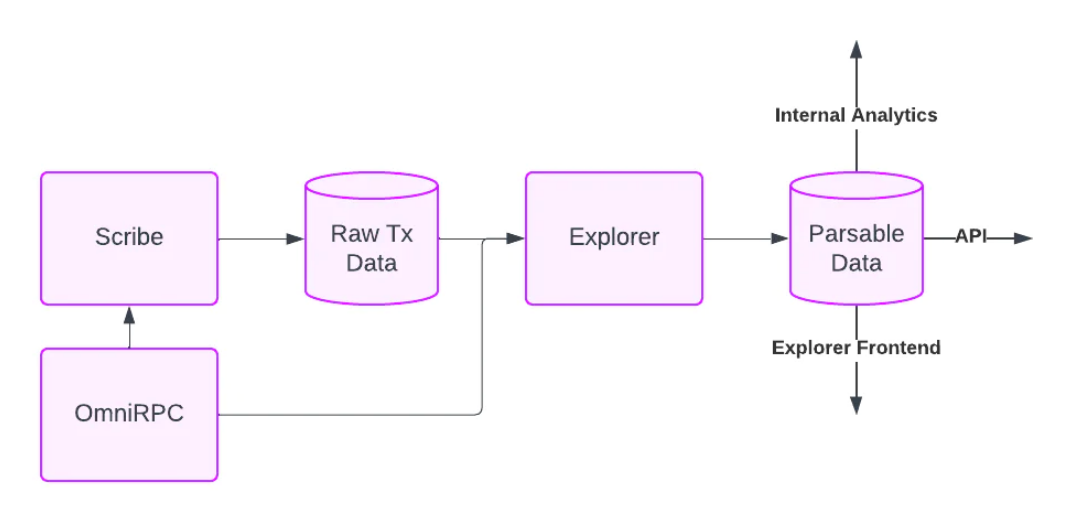
OmniRPC: OmniRPC is an RPC aggregator used to interface across Synapse-supported chains. The number of confirmations required across RPCs to produce a valid result is configurable, ensuring data integrity.

Scribe: Scribe indexes and stores Logs, Receipts, Transactions, and Blockheader data for 850+ contracts across 18 chains. Scribe is built with a reorg protection mechanism to protect data integrity.

Explorer: Downstream from Scribe, Explorer parses raw data from events emitted by Synapse contracts across all platforms - maturing data with historical prices, historical token data, and more. The Explorer provides data for analytics, our API, and the newly released frontend.

These tools will be open-sourced soon so developers can take advantage of them for their own use cases.

The Best Cross-Chain Explorer to date:

Synapse Explorer is built for transparency, to provide a crystal-clear view of all Synapse transactions. Paired with general volume statistics, users can view all transactions, with legible information about transaction status, amounts, chains, and more. Several tools help navigate this information. The search bar lets users search transactions by chain, token, and address, track the status of their own transactions, build more advanced analytics, and monitor recent activity.

Users can also interact with views that segment analytics by origin chain, destination chain, token, and address. These views are useful to asses:

Total transactions

User metrics

Advanced volume metrics

About Synapse

Synapse is a universal cross-chain liquidity network that connects blockchains by offering an extensible cross-chain communication protocol that supports assets, smart contract calls, and more. By leveraging Synapse, blockchains can easily and securely interoperate with each other, and developers can build truly cross-chain applications including cross-chain DEX, lending platforms, margining systems, derivatives markets, yield aggregators, and much more.


Crypto di tendenza

Letture associate

Deciphering the Ethereum Foundation's New Structure: Reaffirming Self-Sovereignty Amid Institutionalization Trends

Summary: The Ethereum Foundation (EF) has announced a major restructuring, laying off 20% of its staff and introducing a new five-layer operational framework. This move aims to clarify the EF's mission and reaffirm Ethereum's core principle of self-sovereignty amidst growing institutionalization in the crypto space. The five layers are: 1. **Protocol Layer**: Focuses on maintaining Ethereum's foundational "CROPS" values—Censorship-resistant, Robust, Open, Private, and Secure. This involves core technical work like secure hard forks and mitigating toxic MEV. 2. **Access Layer**: Ensures users can practically exercise self-sovereignty through actions like reading the chain and making transactions. A key principle is the "zero option," meaning a trusted, non-intermediated path must always exist as an alternative to any centralized service. 3. **User Layer**: Bridges the protocol and access layers by grounding EF's work in the real needs of users and organizations. This is seen as crucial for moving beyond a purely research-driven approach and ensuring development effectively serves the ecosystem. 4. **Community Layer**: Responsible for building and maintaining consensus around Ethereum's core values both internally and externally. This involves guarding against centralization, upholding technological neutrality, and preventing short-term commercial interests from undermining CROPS principles. 5. **Institutional Layer**: Manages EF's engagement with institutions, but with the precondition of self-sovereignty. The goal is not to make it easier for institutions to control users, but to demonstrate how Ethereum's technology can enable better integrations. The article argues that while institutional adoption brings legitimacy, it also risks diluting crypto's foundational ethos of decentralization. The new structure represents EF's effort to navigate this tension, upholding its core mission while actively engaging with a broader, more complex ecosystem.

marsbit13 min fa

Deciphering the Ethereum Foundation's New Structure: Reaffirming Self-Sovereignty Amid Institutionalization Trends

marsbit13 min fa

OpenRouter: How Did This 'AI Model Relay Station' Achieve a $10 Billion Valuation?

OpenRouter: The Model Router Building a $10B+ Company This article explores OpenRouter, a platform that aggregates access to over 400 AI models from 70+ providers (like OpenAI, Claude, Gemini) through a single API. It has grown into a unicorn with a $1.3B valuation by 2026, processing massive scale—reaching 100 trillion tokens monthly. Its core value isn't just being a "model supermarket." For developers building real-world AI applications, managing multiple models for different tasks (e.g., cheap models for titles, powerful ones for long articles) is complex. OpenRouter acts as a critical "model scheduling layer," handling routing, failover between providers, cost optimization, and enterprise features like zero-data-retention policies and budget controls. OpenRouter's business model is a "toll fee": it charges a small platform fee (5.5%) on purchased credits while passing model costs directly to users. Its revenue scales with the tokens flowing through its system, which saw explosive growth as AI apps evolved. Key growth drivers include: 1) The explosion of specialized models, increasing choice complexity; 2) AI apps shifting focus from performance to cost optimization; 3) The rise of AI agents that require more reliable, multi-step model calls. However, risks remain. Large enterprises or cloud providers (AWS, Google Cloud) could build similar internal gateways. Its position between model suppliers and developers could also create future tension over pricing and data control. To stay ahead, OpenRouter must deepen its enterprise features and prove it's more than just a request forwarder.

marsbit32 min fa

OpenRouter: How Did This 'AI Model Relay Station' Achieve a $10 Billion Valuation?

marsbit32 min fa

Bitcoin Falls Below $60,000 Again; After 20 Months, We've Reached a New Low

Bitcoin Drops Below $60,000, Hitting a 20-Month Low Bitcoin fell below the key $60,000 psychological level again, reaching a low of $59,023—its lowest point in approximately 20 months, dating back to October 2024. While it later recovered slightly to around $60,600, this marks its third significant breach of $60,000 this year. The downturn is attributed to two primary factors. First, U.S. spot Bitcoin ETFs are experiencing their longest streak of net outflows since launch, with nearly $5.94 billion withdrawn over 30 days. This creates sustained selling pressure as Authorized Participants sell Bitcoin to meet redemptions. Second, shifting macroeconomic expectations are adding pressure. Strong U.S. job data and hawkish remarks from Fed officials have increased market pricing for potential rate hikes, reversing the earlier liquidity-driven bullish sentiment and prompting a shift away from risk assets like Bitcoin. Analyst views are mixed. 21Shares maintains a bullish long-term outlook, expecting prices to recover towards $100,000, citing historical post-halving cycles and substantial ETF holdings as a base. In contrast, Arthur Hayes predicts a potential bottom around $40,000 within six months due to persistent Fed hawkishness. CryptoQuant suggests, based on on-chain data, that the market may not find a bottom until prices fall below the average investor cost basis around $53,000, potentially extending the bearish phase into late 2026 or early 2027. The immediate focus is on upcoming U.S. inflation data and Fed signals. Lower-than-expected CPI could offer relief, but confirmation of sticky inflation or continued ETF outflows may lead to further downside pressure. Bitcoin's ability to hold above $60,000 remains a critical test for the near-term market direction.

Odaily星球日报1 h fa

Bitcoin Falls Below $60,000 Again; After 20 Months, We've Reached a New Low

Odaily星球日报1 h fa

Trading

Spot
Futures

Articoli Popolari

Come comprare SYN

Benvenuto in HTX.com! Abbiamo reso l'acquisto di Synapse (SYN) semplice e conveniente. Segui la nostra guida passo passo per intraprendere il tuo viaggio nel mondo delle criptovalute.Step 1: Crea il tuo Account HTXUsa la tua email o numero di telefono per registrarti il tuo account gratuito su HTX. Vivi un'esperienza facile e sblocca tutte le funzionalità,Crea il mio accountStep 2: Vai in Acquista crypto e seleziona il tuo metodo di pagamentoCarta di credito/debito: utilizza la tua Visa o Mastercard per acquistare immediatamente SynapseSYN.Bilancio: Usa i fondi dal bilancio del tuo account HTX per fare trading senza problemi.Terze parti: abbiamo aggiunto metodi di pagamento molto utilizzati come Google Pay e Apple Pay per maggiore comodità.P2P: Fai trading direttamente con altri utenti HTX.Over-the-Counter (OTC): Offriamo servizi su misura e tassi di cambio competitivi per i trader.Step 3: Conserva Synapse (SYN)Dopo aver acquistato Synapse (SYN), conserva nel tuo account HTX. In alternativa, puoi inviare tramite trasferimento blockchain o scambiare per altre criptovalute.Step 4: Scambia Synapse (SYN)Scambia facilmente Synapse (SYN) nel mercato spot di HTX. Accedi al tuo account, seleziona la tua coppia di trading, esegui le tue operazioni e monitora in tempo reale. Offriamo un'esperienza user-friendly sia per chi ha appena iniziato che per i trader più esperti.

81 Totale visualizzazioniPubblicato il 2024.12.12Aggiornato il 2026.06.02

Come comprare SYN

Discussioni

Benvenuto nella Community HTX. Qui puoi rimanere informato sugli ultimi sviluppi della piattaforma e accedere ad approfondimenti esperti sul mercato. Le opinioni degli utenti sul prezzo di SYN SYN sono presentate come di seguito.

活动图片