【研报精选】板块轮动不在?这波“小牛市”的背后推动力是?

MarsBitPubblicato 2023-02-17Pubblicato ultima volta 2023-02-19

Introduzione

如果你的资本规模较小,也请关注较小代币。 时间最好花在研究下一个吸引注意力的叙述和主题上,而不是研究技术分析。

加密市场在 2023 年发生了怎样的变化——关于最近出现的短暂牛市的 5 个教训:

作为投资者/投机者,仔细观察 1 月的小牛市,你可以从中学到什么?

1. 板块轮动不再

流动性轮动曾经是加密市场的结构特征——在牛市开始时,大盘(BTC、ETH)涨幅最大,一旦市场参与者从中获利,流动性就转向小盘,提示他们下一步趋势。

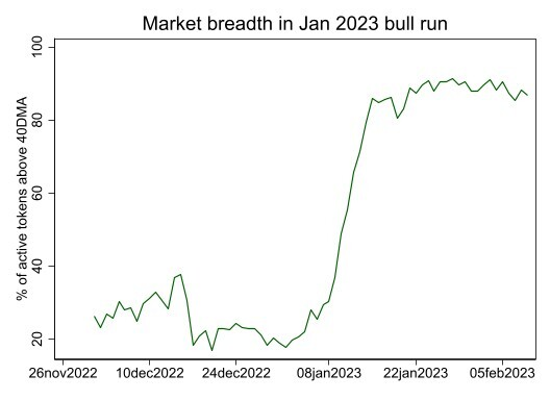
2021 年,市场的确如此转换。2023 年 1 月的最近一次(迷你)牛市显示出不同的走势。上升周期在 1 月初开始,市值排名前 1000 的代币中,80% 以上的代币价格仅用2 周的时间就升至 40 天移动平均线之上。
相比之下,早在 2019 年(类似的周期阶段),80% 的顶级代币经历了 3 个月和多个小炒作周期才上涨超过40 天移动平均线。
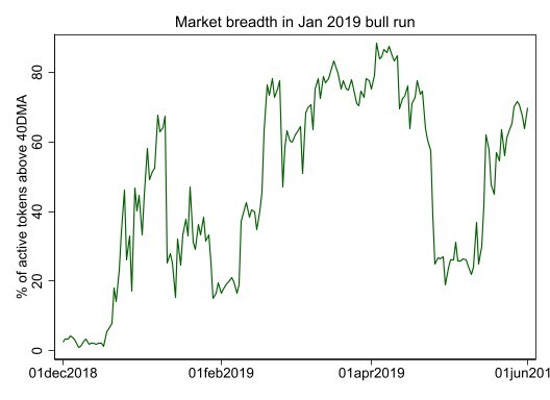
换句话说,虽然 2019 年出现了明显的流动性轮换,但现在市场不再如此发展。一旦市值上涨趋势开始,所有可以上涨的代币几乎都会同时上涨。为什么改变?有很多原因。例如,大型交易所的代币上架范围扩大了。市场参与者已经发生变化且多样化。轮换博弈已经成为每个人都想利用和抢先的众所周知的知识。此外,与几年前相比,现在场外的流动性要多得多。

我将在一分钟内谈谈这对作为个人投资者的你意味着什么。

2.失败者在市场底部引领复苏

在市场转折点走出长期熊市趋势后,导致先前低迷的受压代币也往往会引领随后的复苏。这是其他风险资产市场的结构特征,而不仅仅是加密货币。

下图显示了 2023 年 1 月,市值超2.5 亿美元代币与去年同期涨幅。研究图表并得出你自己的结论。
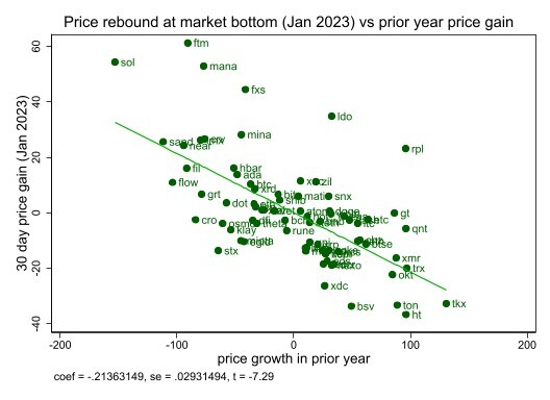
这种关系在其他市场条件下是否成立?不,这种从失败者到成长之星的现象是市场从深底部出现强烈逆转时的独特特征。

3. 市值问题(某种程度上)

在控制了上一年的价格涨幅和代币年龄之后,在最近的上涨走势中,代币市值上限与较小代币(<230 万美元的市值上限)的价格涨幅之间存在显着的负相关关系。
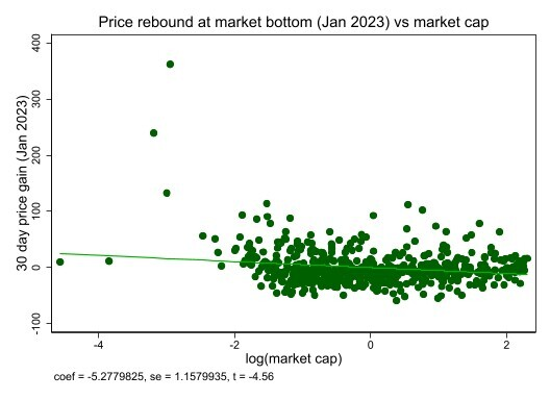
在市值较大的代币中,这种关系不存在,尤其是在 2.5 亿美元至 100 亿美元的市值范围内。

换句话说,“小代币涨幅大”的传统观点在某种程度上是正确的,但前提是你正在寻找有前途的小代币,这对任何拥有超过几千美元的人来说都是不切实际的部署,因为这些资产通常交易清淡。

4. 熊市中的周期性波动更短

熊市中的牛市运行时间更短。1 月的小牛市真正持续了一个月,大部分走势在 1 月的前两周完成。你可以观察到,这与 2022 年 7 月/ 2022 年 8 月的上涨模式是相同的。

与牛市的上升周期相比,这些运行时间明显较短。不利的宏观环境意味着暴涨更加脆弱,上涨后市场持续出现购买需求的预期十分不确定。

5. 重新思考“基本面”的含义

这不是新的交易策略,但值得你注意,因为它会持续存在。华尔街用来评估公司基本面的传统指标——例如销售额、收益、利润率——在加密领域大多毫无用处,至少在现阶段是这样。

我知道这听起来在政治上是不正确的,但任何代币的最大“基本面”是它可以吸引多少注意力。

什么是吸引注意力?例如:

· 过度炒作的主题——例如人工智能、零知识、流动性质押;

· 巨额资金计划——例如 3 亿美元的开发补助金;

· 关键人事变动——例如知名的某某回来担任首席技术官。

这是 1 月份收益最高的代币列表,市值超过 2 亿美元(不包括年龄小于 1 年的代币)。一半代币上涨是因部分注意力驱动的叙事在起作用(除此之外,如前所述,其中大部分都非常糟糕,这本身就是一个注意力驱动因素)。
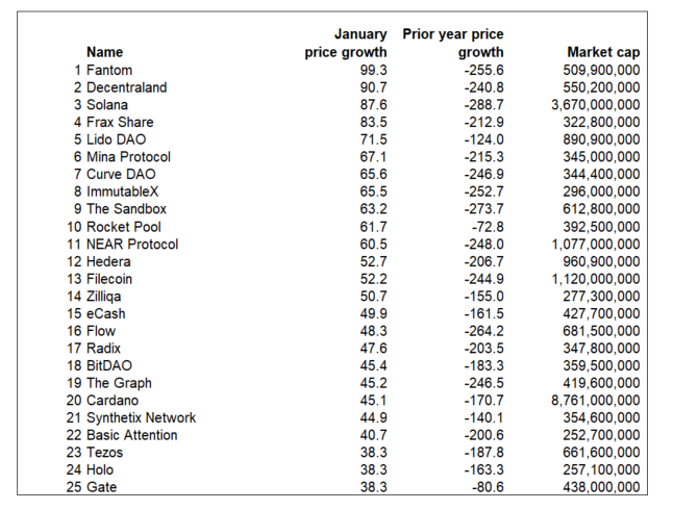
自己做一些研究。你能确定每个驱动叙事是什么吗?你可能认为某种吸引注意力的叙述是愚蠢的或不合理的。好吧,首先,告诉市场,看看它是否关心。

其次,这实际上是市场的理性行为,尽管看起来并非如此。现阶段的加密项目并不是稳定的赚钱项目。他们是实验性技术。

就实验技术性的项目而言,最重要的是它们是否会被大规模采用。什么是一个好的预测指标?他们吸引的眼球数量。

因此,注意力/叙事推动价格的现象实际上只是市场试图从现有的少量信息中推断出项目的增长前景。如果你问我,这是完全合理的。

这一切对投资者/投机者意味着什么?你可以做些什么来利用上面讨论的内容?以下是我的一些想法:

当宏观环境不利时要灵活机动。即使在最糟糕的市场中也会出现牛市,但你需要迅速采取行动,因为这些小牛市比平时更短暂。

如果你等待从大盘轮换到其他主流代币,你将处于领先地位。几乎没有任何轮换了。当市场转向时,一切都会一起上涨。

在主要下跌趋势的市场转折点,关注被击败的“失败者”。如果你的资本规模较小,也请关注较小代币。

你的时间最好花在研究下一个吸引注意力的叙述和主题上,而不是研究技术分析。

Letture associate

The Tao (τ) Law Makes EDA Go Viral

In May 2026, Huawei's semiconductor division introduced the "Tao (τ) Law" at IEEE ISCAS, shifting the industry focus from Moore's Law's geometric scaling to "time scaling." Unlike traditional approaches relying on transistor miniaturization, τ Law optimizes the time constant (τ) across device, circuit, chip, and system levels to improve information processing speed and efficiency. Huawei has already applied this principle, mass-producing 381 chips across various applications, with a target to achieve performance equivalent to 1.4nm technology by 2031. The implementation of τ Law, involving techniques like Chiplet, 3DIC, and Logic Folding, places new demands on EDA tools, highlighting gaps in current offerings. Traditional 2D or pseudo-3D EDA flows lack native support for true 3D design, cross-layer co-optimization (STCO), and coupled multi-physics analysis (thermal, power, stress), which are crucial for advanced integration. Chinese EDA companies, such as Empyrean Software, Primarius Technologies, and Xpeedic, are evolving from point-tool specialists to providing full-flow, system-level solutions. For instance, Peking University has developed a prototype "true 3D" EDA tool showing significant improvements in wirelength and timing. Empyrean Software has also launched a comprehensive 3DIC design and verification platform. The τ Law framework presents an opportunity for the domestic EDA industry to transition from achieving basic functionality to developing robust, integrated toolsets essential for next-generation chip design.

marsbit2 h fa

The Tao (τ) Law Makes EDA Go Viral

marsbit2 h fa

It's Not Jensen Huang Who Wants to Change the PC, But the PC That's Revolting Against Itself

The 40-year-old PC industry is undergoing a fundamental transformation, driven by the rise of AI PCs. At the GTC Taipei 2026 event, NVIDIA, backed by Microsoft and major PC OEMs, announced the RTX Spark super chip for Windows PCs, marking its official entry into the PC core processor market. This move aims to redefine the AI PC by shifting its core from the CPU to an AI-focused SoC (System on Chip). NVIDIA envisions the PC evolving from a personal computer to a "personal AI"—a platform where local AI Agents can autonomously perform tasks. While Intel pioneered the AI PC concept earlier in 2026, NVIDIA's aggressive push, leveraging its vast CUDA developer ecosystem of 6 million, positions it to potentially reshape the industry's long-standing Wintel (Windows-Intel) power structure. NVIDIA's strategy extends beyond hardware; it's about embedding its CUDA, RTX, and AI software stack into the PC platform itself. The article identifies key shifts: 1) The move from a CPU-centric to an AI SoC-centric architecture, similar to Apple's approach with its M-series chips. 2) The PC's evolution from a human-operated tool to a platform for human-Agent collaboration. 3) The extension of NVIDIA's data center-centric CUDA ecosystem to personal devices via RTX Spark. Ultimately, the change is driven by the broader trend of AI moving to personal devices. Companies like Intel, AMD, Qualcomm, and Apple are all participating in this shift. NVIDIA's entry accelerates the competition, but the core driver is the technology itself finding its optimal expression in the PC. The industry is reinventing itself, with the outcome hinging on execution, ecosystem development, and the creation of compelling local AI applications.

marsbit4 h fa

It's Not Jensen Huang Who Wants to Change the PC, But the PC That's Revolting Against Itself

marsbit4 h fa

Trading

Spot
Futures
活动图片




