ZetaChain 2.0 Launches With Anuma, Bringing Private Memory and AI Interoperability to Creators

TheNewsCryptoDipublikasikan tanggal 2026-01-27Terakhir diperbarui pada 2026-01-27

Abstrak

ZetaChain has launched ZetaChain 2.0, introducing Anuma—a privacy-first AI interface and interoperability layer. Anuma brings private, user-owned memory and cross-AI model interoperability to creators, enabling applications to operate across multiple AI models and blockchains without lock-in. Built by core contributor Ankur Nandwani (co-creator of Basic Attention Token), the platform emphasizes user control, encrypted memory, and built-in monetization. ZetaChain 2.0 includes an AI Portal for unified model routing and a Private Memory Layer for secure, permissioned context retention. The release also features an SDK for developers to build privacy-preserving, multi-model AI apps with global payment support. A waitlist for Anuma is now open.

San Francisco, USA, January 27th, 2026, Chainwire

What Brave helped mainstream for private browsing, Anuma brings to AI with private, user-owned memory and AI Portal-based interoperability powered by ZetaChain 2.0.

ZetaChain today announced the beta launch and public waitlist for Anuma, a privacy-first AI interface built on ZetaChain 2.0. ZetaChain also introduced ZetaChain 2.0, a new AI interoperability layer designed to help developers build applications and agents that work across AI models, preserve private user context, and monetize globally without backend infrastructure.

ZetaChain Core Contributor Ankur Nandwani previously co-created Basic Attention Token (BAT), which powers the Brave browser ecosystem with over 100M monthly active users. Brave helped mainstream privacy-first browsing by blocking trackers and ads by default. Anuma applies that same “privacy and user control by default” approach to the next major consumer interface of AI where context and memory increasingly define user experience.

AI adoption is accelerating at internet scale: McKinsey notes that ChatGPT reached 100 million users in two months, and OpenAI has reported 800 million weekly active users by late 2025. Yet the ecosystem remains fragmented, with only 9% of consumers paying for more than one AI subscription across major assistants. This combination creates lock-in at the model layer and forces developers to repeatedly rebuild the same integration, routing, state, and billing infrastructure, while privacy and data are routinely shared across applications, agents, and model providers.

ZetaChain was built to address fragmentation in Web3 by enabling universal apps — applications that can natively access assets like BTC and execute across multiple blockchains through a single platform. In 2025, the ZetaChain network scaled to more than 11.5 million users and processed more than 225 million transactions. With ZetaChain 2.0, ZetaChain is extending this unification thesis to AI so applications can operate across both chains and models, with permissions and private context built in.

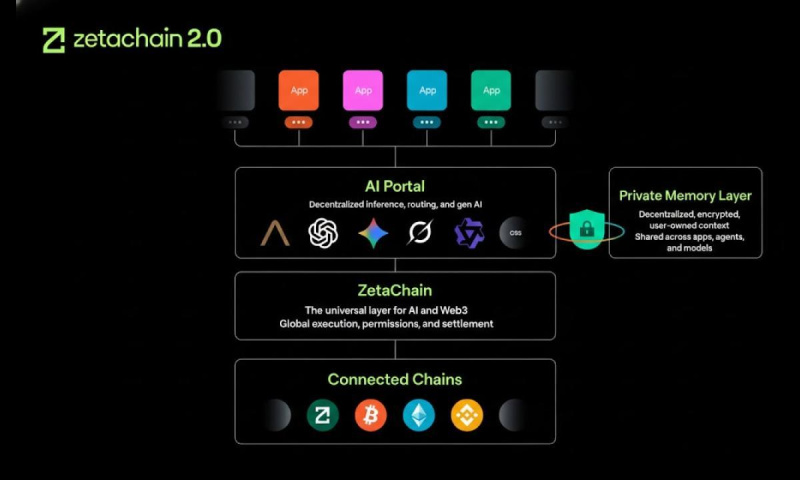
ZetaChain 2.0 is composed of two core components:

  • AI Portal: A unified routing and execution layer that allows applications to access multiple AI model providers without lock-in, with built-in support for availability, fallback, and cost-performance optimization.
  • Private Memory Layer: A protocol-level memory system designed to keep user context encrypted and permissioned, enabling persistent experiences across sessions while maintaining user control over what applications and agents can access.

Developer SDK and Platform

ZetaChain 2.0 is designed to scale as a developer platform. Alongside the protocol components, ZetaChain is releasing a developer SDK that packages private persistent memory, cross-model interoperability, and monetization primitives into a single toolkit. The goal is to make it straightforward to build privacy-first apps and agents that can maintain continuity across sessions, connect to multiple model providers, and support global monetization rails from onchain settlement to traditional payment processors without requiring teams to build bespoke infrastructure.
Anuma: First Consumer Showcase

Anuma is the first consumer AI interface built on ZetaChain 2.0. The product provides access to multiple leading AI models through a single experience, supports switching between models without losing context, and is designed so memory remains private and user-controlled. Users can request early access through the public waitlist.

“Brave and BAT proved that privacy-first defaults can win at consumer scale,” said Ankur Nandwani, Core Contributor at ZetaChain. “We’ve already unified the blockchain experience at scale, powering more than 225 million transactions. ZetaChain 2.0 extends that same approach to AI, enabling the next generation of apps and agents that run across models and chains with private, permissioned memory and global monetization by default.”

In 2023, ZetaChain announced a $27 million funding round with participation from Blockchain.com, Human Capital, VY Capital, Sky9 Capital, Jane Street Capital, VistaLabs, CMT Digital, Foundation Capital, Lingfeng Capital, GSR, and others.

About ZetaChain

ZetaChain is the universal layer for AI and Web3, letting developers build apps that run across chains and models, keep memory private, and monetize without infrastructure. With native connectivity across major blockchains and an AI interoperability stack powered by a Private Memory Layer, ZetaChain is building the foundation for the next generation of apps, agents, and experiences.

Users can follow ZetaChain on X (Twitter) and join the conversation on Discord and Telegram.

Contact

CMO
Jonathan Covey
ZetaChain
jonathan@zetachain.com

Pertanyaan Terkait

QWhat is the core innovation that ZetaChain 2.0 introduces with the launch of Anuma?

AZetaChain 2.0 introduces an AI interoperability layer with two core components: the AI Portal, a unified routing and execution layer for accessing multiple AI models, and the Private Memory Layer, a protocol-level system that keeps user context encrypted and permissioned.

QWho is Ankur Nandwani and what is his previous significant contribution mentioned in the article?

AAnkur Nandwani is a Core Contributor at ZetaChain who previously co-created the Basic Attention Token (BAT), which powers the Brave browser ecosystem with over 100 million monthly active users.

QWhat problem in the current AI ecosystem does ZetaChain 2.0 aim to solve?

AZetaChain 2.0 aims to solve the fragmentation and lock-in in the AI ecosystem, where developers are forced to repeatedly rebuild integration, routing, state, and billing infrastructure, while user privacy and data are routinely shared across applications and model providers.

QWhat are the key features of the Anuma AI interface as the first consumer showcase on ZetaChain 2.0?

AAnuma provides access to multiple leading AI models through a single experience, supports switching between models without losing context, and is designed so that user memory remains private and user-controlled.

QHow did ZetaChain demonstrate its scalability in the Web3 space prior to this announcement?

AIn 2025, the ZetaChain network scaled to more than 11.5 million users and processed more than 225 million transactions, demonstrating its ability to unify the blockchain experience at scale.

Bacaan Terkait

Bank Italia Tidak Melihat Keunggulan Sistemik Stablecoin dalam Transfer

Studi Bank Italia menunjukkan bahwa stablecoin tidak memberikan keunggulan sistemik yang berkelanjutan dalam hal biaya dan kecepatan transfer uang. Semua keuntungan hilang akibat biaya untuk deposit dan penarikan ke/dari fiat serta proses dalam infrastruktur pembayaran lokal. Peneliti membandingkan transfer 200 USDC di 10 koridor bilateral antara Italia dengan Brasil, Argentina, Jepang, UEA, dan Afrika Selatan. Metriknya adalah biaya total dan waktu penyelesaian dibandingkan layanan uang standar. Biaya akhir transfer stablecoin bervariasi dari 0,3% hingga hampir 9%, tergantung arahnya. Di koridor dengan sistem pembayaran instan, penyelesaian membutuhkan waktu kurang dari 20 menit. Sementara di daerah tanpa infrastruktur tersebut, proses memakan waktu satu hingga dua hari kerja. Biaya dan penundaan utama dikaitkan dengan pertukaran dan konversi mata uang, serta kualitas infrastruktur lokal. Komisi blockchain bukan faktor utama. Rata-rata biaya transfer uang global adalah 6,65%. Di sebagian besar koridor yang diteliti, stablecoin lebih murah dari level ini, namun dibandingkan dengan Wise, stablecoin hanya lebih unggul di tiga dari tujuh rute yang sebanding. Penulis berpendapat efeknya akan lebih terasa jika stablecoin bisa dibelanjakan langsung untuk barang/jasa tanpa konversi ke mata uang lokal. Mereka juga mencatat bahwa rezim regulasi yang melarang tidak menghilangkan permintaan akan "koin stabil", dan aturan yang terlalu ketat justru mempersulit penggunaan oleh klien ritel.

cryptonews.ru1j yang lalu

Bank Italia Tidak Melihat Keunggulan Sistemik Stablecoin dalam Transfer

cryptonews.ru1j yang lalu

Boom Bitcoin Memanas: Pernyataan Baru Saylor Picu Spekulasi Pembelian

Ketua Eksekutif MicroStrategy Inc., Michael Saylor, kembali memicu spekulasi pembelian Bitcoin baru perusahaan setelah memposting pesan "Bitcoin Drive engaged" pada 2 Agustus. Postingan hari Minggu ini disertai dengan pelacak pembelian biasa MicroStrategy, yang sejalan dengan praktik Saylor memberi sinyal perubahan treasury sebelum laporan mingguan. Laporan Saylor menunjukkan bahwa cadangan Bitcoin MicroStrategy adalah 843.775 BTC dengan nilai pasar sekitar $53,25 miliar. Dua penjualan Bitcoin baru-baru ini, total 3.588 BTC, telah mengurangi cadangan dari 847.363 BTC. Penjualan ini, menurut pengajuan SEC, ditujukan untuk mendanai pembayaran saham preferen dan menambah cadangan dolar AS. Perusahaan juga dilaporkan tidak melakukan pembelian Bitcoin dalam minggu yang berakhir 26 Juli, sambil meningkatkan cadangan dolar AS menjadi sekitar $3,75 miliar. Ekspektasi untuk pengumuman treasury pada hari Senin diperkuat oleh pola sebelumnya, di mana sinyal serupa pada hari Minggu mendahului pengungkapan cadangan uang yang lebih besar pada 27 Juli. Pembaruan data hari Senin ini akan menunjukkan apakah MicroStrategy kembali ke akumulasi Bitcoin, karena perusahaan menyeimbangkan cadangan Bitcoinnya yang besar dengan kewajiban tunai yang meningkat dan manajemen modal yang aktif. Risiko keuangan tetap tinggi setelah MicroStrategy melaporkan kerugian operasional $8,33 miliar untuk kuartal II 2026, termasuk kerugian belum terealisasi $8,32 miliar pada aset digitalnya.

cryptonews.ru1j yang lalu

Boom Bitcoin Memanas: Pernyataan Baru Saylor Picu Spekulasi Pembelian

cryptonews.ru1j yang lalu

Saham Perusahaan yang Bergerak di Bidang Kecerdasan Buatan Diperdagangkan Seperti 'Meme Coin', Sementara Bitcoin Hampir Tak Berubah Harganya — Tinjauan Mingguan

Tinjauan minggu ini menyoroti dominasi berita pasar saham tradisional dan makroekonomi atas berita kripto. Peringatan keamanan mendesak dikeluarkan untuk pengguna Coldcard terkait potensi kompromi kunci pribadi. Sementara itu, Bitcoin relatif stabil di sekitar $64.000, perhatian pasar justru terfokus pada volatilitas ekstrem di saham AI dan pasar Asia, terutama Korea Selatan yang mengalami penurunan signifikan. Likuidasi besar oleh dana "Situational Awareness" diduga berkontribusi pada penurunan ini. Di sektor kripto, tren bearish berlanjut dengan beberapa perusahaan seperti BitMart dan Storj Labs mengumumkan penutupan atau kebangkrutan. Perusahaan yang masih beroperasi, seperti Coinbase, mengalami tekanan dengan penurunan harga saham dan gelombang PHK di industri. Di sisi lain, MicroStrategy terus menambah cadangan kasnya dan membeli kembali sahamnya. Ekosistem DeFi menghadapi tantangan potensial dari kesuksesan proyek seperti Trade.xyz dan Pump.fun, yang dapat memutuskan untuk beroperasi secara mandiri. Isu perdagangan orang dalam juga mencuat di platform Hyperliquid. Sementara itu, token AI seperti Bittensor (TAO) menarik perhatian investor venture capital, meski disertai peringatan agar investor retail berhati-hati. Artikel ditutup dengan penekanan kembali pada pentingnya kewaspadaan keamanan, khususnya dalam penyimpanan aset kripto secara mandiri, di tengah potensi meningkatnya kerentanan perangkat keras dompet digital.

cryptonews.ru1j yang lalu

Saham Perusahaan yang Bergerak di Bidang Kecerdasan Buatan Diperdagangkan Seperti 'Meme Coin', Sementara Bitcoin Hampir Tak Berubah Harganya — Tinjauan Mingguan

cryptonews.ru1j yang lalu

Trading

Spot
活动图片





