ZetaChain 2.0 Launches With Anuma, Bringing Private Memory and AI Interoperability to Creators

TheNewsCryptoDipublikasikan tanggal 2026-01-27Terakhir diperbarui pada 2026-01-27

Abstrak

ZetaChain has launched ZetaChain 2.0, introducing Anuma—a privacy-first AI interface and interoperability layer. Anuma brings private, user-owned memory and cross-AI model interoperability to creators, enabling applications to operate across multiple AI models and blockchains without lock-in. Built by core contributor Ankur Nandwani (co-creator of Basic Attention Token), the platform emphasizes user control, encrypted memory, and built-in monetization. ZetaChain 2.0 includes an AI Portal for unified model routing and a Private Memory Layer for secure, permissioned context retention. The release also features an SDK for developers to build privacy-preserving, multi-model AI apps with global payment support. A waitlist for Anuma is now open.

San Francisco, USA, January 27th, 2026, Chainwire

What Brave helped mainstream for private browsing, Anuma brings to AI with private, user-owned memory and AI Portal-based interoperability powered by ZetaChain 2.0.

ZetaChain today announced the beta launch and public waitlist for Anuma, a privacy-first AI interface built on ZetaChain 2.0. ZetaChain also introduced ZetaChain 2.0, a new AI interoperability layer designed to help developers build applications and agents that work across AI models, preserve private user context, and monetize globally without backend infrastructure.

ZetaChain Core Contributor Ankur Nandwani previously co-created Basic Attention Token (BAT), which powers the Brave browser ecosystem with over 100M monthly active users. Brave helped mainstream privacy-first browsing by blocking trackers and ads by default. Anuma applies that same “privacy and user control by default” approach to the next major consumer interface of AI where context and memory increasingly define user experience.

AI adoption is accelerating at internet scale: McKinsey notes that ChatGPT reached 100 million users in two months, and OpenAI has reported 800 million weekly active users by late 2025. Yet the ecosystem remains fragmented, with only 9% of consumers paying for more than one AI subscription across major assistants. This combination creates lock-in at the model layer and forces developers to repeatedly rebuild the same integration, routing, state, and billing infrastructure, while privacy and data are routinely shared across applications, agents, and model providers.

ZetaChain was built to address fragmentation in Web3 by enabling universal apps — applications that can natively access assets like BTC and execute across multiple blockchains through a single platform. In 2025, the ZetaChain network scaled to more than 11.5 million users and processed more than 225 million transactions. With ZetaChain 2.0, ZetaChain is extending this unification thesis to AI so applications can operate across both chains and models, with permissions and private context built in.

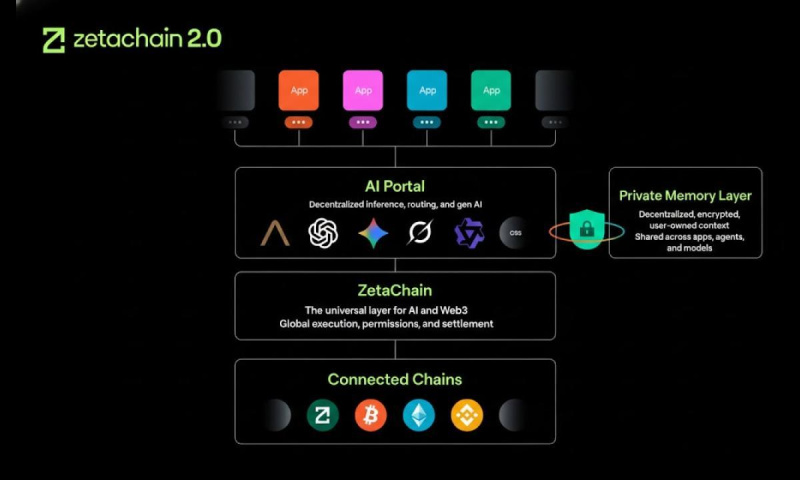
ZetaChain 2.0 is composed of two core components:

  • AI Portal: A unified routing and execution layer that allows applications to access multiple AI model providers without lock-in, with built-in support for availability, fallback, and cost-performance optimization.
  • Private Memory Layer: A protocol-level memory system designed to keep user context encrypted and permissioned, enabling persistent experiences across sessions while maintaining user control over what applications and agents can access.

Developer SDK and Platform

ZetaChain 2.0 is designed to scale as a developer platform. Alongside the protocol components, ZetaChain is releasing a developer SDK that packages private persistent memory, cross-model interoperability, and monetization primitives into a single toolkit. The goal is to make it straightforward to build privacy-first apps and agents that can maintain continuity across sessions, connect to multiple model providers, and support global monetization rails from onchain settlement to traditional payment processors without requiring teams to build bespoke infrastructure.
Anuma: First Consumer Showcase

Anuma is the first consumer AI interface built on ZetaChain 2.0. The product provides access to multiple leading AI models through a single experience, supports switching between models without losing context, and is designed so memory remains private and user-controlled. Users can request early access through the public waitlist.

“Brave and BAT proved that privacy-first defaults can win at consumer scale,” said Ankur Nandwani, Core Contributor at ZetaChain. “We’ve already unified the blockchain experience at scale, powering more than 225 million transactions. ZetaChain 2.0 extends that same approach to AI, enabling the next generation of apps and agents that run across models and chains with private, permissioned memory and global monetization by default.”

In 2023, ZetaChain announced a $27 million funding round with participation from Blockchain.com, Human Capital, VY Capital, Sky9 Capital, Jane Street Capital, VistaLabs, CMT Digital, Foundation Capital, Lingfeng Capital, GSR, and others.

About ZetaChain

ZetaChain is the universal layer for AI and Web3, letting developers build apps that run across chains and models, keep memory private, and monetize without infrastructure. With native connectivity across major blockchains and an AI interoperability stack powered by a Private Memory Layer, ZetaChain is building the foundation for the next generation of apps, agents, and experiences.

Users can follow ZetaChain on X (Twitter) and join the conversation on Discord and Telegram.

Contact

CMO
Jonathan Covey
ZetaChain
jonathan@zetachain.com

Pertanyaan Terkait

QWhat is the core innovation that ZetaChain 2.0 introduces with the launch of Anuma?

AZetaChain 2.0 introduces an AI interoperability layer with two core components: the AI Portal, a unified routing and execution layer for accessing multiple AI models, and the Private Memory Layer, a protocol-level system that keeps user context encrypted and permissioned.

QWho is Ankur Nandwani and what is his previous significant contribution mentioned in the article?

AAnkur Nandwani is a Core Contributor at ZetaChain who previously co-created the Basic Attention Token (BAT), which powers the Brave browser ecosystem with over 100 million monthly active users.

QWhat problem in the current AI ecosystem does ZetaChain 2.0 aim to solve?

AZetaChain 2.0 aims to solve the fragmentation and lock-in in the AI ecosystem, where developers are forced to repeatedly rebuild integration, routing, state, and billing infrastructure, while user privacy and data are routinely shared across applications and model providers.

QWhat are the key features of the Anuma AI interface as the first consumer showcase on ZetaChain 2.0?

AAnuma provides access to multiple leading AI models through a single experience, supports switching between models without losing context, and is designed so that user memory remains private and user-controlled.

QHow did ZetaChain demonstrate its scalability in the Web3 space prior to this announcement?

AIn 2025, the ZetaChain network scaled to more than 11.5 million users and processed more than 225 million transactions, demonstrating its ability to unify the blockchain experience at scale.

Bacaan Terkait

Narasi BTC sebagai 'Emas Digital' Apakah Sudah Gagal?

Artikel ini menganalisis Bitcoin dari sudut pandang "aset digital" atau "emas digital", tanpa memberikan saran investasi. Penulis membahas tiga hal utama: **1. Bagaimana Memandang Bitcoin sebagai Aset:** Bitcoin dianggap sebagai kelas aset baru yang unggul dibandingkan emas dalam hal: jumlah terbatas (21 juta koin), kemampuan transfer yang mudah dan aman (kunci pribadi), dan transparansi/auditabilitas penuh (blockchain). Meski awalnya digunakan di area abu-abu, regulasi semakin mengatur. Adopsi global crypto saat ini sekitar 3-4%, menandakan fase awal dengan volatilitas tinggi namun juga potensi pertumbuhan jangka panjang. **2. Memahami Penurunan Harga Terkini:** Penurunan ~50% dari puncak $126k (Okt 2025) ke ~$61k (Feb 2026) dipandang sebagai penjualan siklis yang terprediksi pasca-*halving*, dan sebagai proses "peralihan kepemilikan" historis dari *early holders* ke investor institusional melalui ETF. Data historis menunjukkan tren penurunan persentase *drawdown* setiap siklus (dari >90% ke ~50%), mengindikasikan aset yang semakin matang. **3. Pandangan Jangka Panjang:** Kerangka analisisnya adalah membandingkan kapitalisasi pasar Bitcoin (~$1.4T pada $70k) dengan emas (~$20T). Bitcoin baru mencapainya sekitar 7%. Jika narasi "emas digital" terealisasi sebagian (misal, 30-50% kapitalisasi emas), ruang naiknya masih signifikan. Risiko terbesar bukanlah Bitcoin menjadi nol, melainkan manajemen portofolio yang buruk (seperti *all-in* atau pakai leverage) dan kurangnya pemahaman mendalam, yang bisa membuat investor *exit* dipaksakan sebelum potensi jangka panjang terwujud. Kesimpulan: Volatilitas tinggi adalah "harga" untuk potensi imbal hasil tinggi. Pertanyaan kuncinya adalah apakah penurunan ini menandakan kegagalan narasi "emas digital" atau hanya fase peralihan dalam evolusinya dari aset spekulatif ke aset alokasi. Jawabannya bergantung pada keyakinan mendasar terhadap aset ini.

marsbit1j yang lalu

Narasi BTC sebagai 'Emas Digital' Apakah Sudah Gagal?

marsbit1j yang lalu

Dari Kode ke Kognisi: Panduan Panjang Evolusi Otak Robot

**Dari Kode ke Kognisi: Evolusi Otak Robot** Era robot sebelumnya bergantung pada kode yang dirancang dengan hati-hati untuk persepsi, perencanaan, dan kontrol (seperti PID), membatasi kemampuan generalisasi. Kemajuan datang dengan pembelajaran mendalam untuk persepsi visual dan pembelajaran penguatan untuk kontrol motorik, tetapi kebijakan tetap sempit. Titik balik terjadi dengan munculnya Model Bahasa Besar (LLM). LLM bertindak sebagai perencana tingkat tinggi, menerjemahkan instruksi bahasa alami menjadi urutan keterampilan atomik untuk dieksekusi oleh sistem robot tradisional (seperti ROS2). Ini adalah lompatan besar, tetapi LLM hanya penjadwal cerdas, bukan penggerak langsung. Lompatan berikutnya adalah Model Visi-Bahasa-Aksi (VLA). Model ini menggabungkan persepsi visual dan instruksi bahasa langsung ke dalam satu jaringan neural untuk menghasilkan perintah gerakan, menyatukan penalaran dan tindakan. Ini memungkinkan generalisasi yang lebih baik. Arsitektur populer (seperti di Figure AI, NVIDIA GR00T) menggunakan sistem "otak ganda": Model S2 yang besar dan lambat (7-9Hz) untuk penalaran tingkat tinggi, dan model S1 yang kecil dan cepat (200Hz) untuk menghasilkan gerakan halus. Lapisan S0 (1kHz) menangani keseimbangan dan koordinasi refleksif. Komputasi untuk kontrol keselamatan yang kritis dijalankan secara lokal di papan (mis., pada NVIDIA Jetson) karena masalah latensi dan keandalan jaringan. Cloud digunakan untuk antarmuka percakapan dan pembelajaran kumpulan data. Model sumber terbuka (seperti OpenVLA, NVIDIA GR00T, π0) sangat penting, memungkinkan startup mengadaptasi model dasar dengan data robot mereka sendiri, mempercepat inovasi. Namun, VLA masih memiliki keterbatasan: pemulihan kesalahan, efisiensi sampel, generalisasi lintas platform, perencanaan jangka panjang, dan pemahaman fisika yang mendalam. Di sinilah **Model Dunia** menjadi kunci. Model Dunia adalah jaringan neural yang memprediksi keadaan dunia masa depan berdasarkan keadaan saat ini dan tindakan yang diusulkan (misalnya, menghasilkan video yang disimulasikan). Ini memungkinkan robot untuk "berpikir sebelum bertindak", mensimulasikan berbagai skenario, mengevaluasi hasil, dan memilih tindakan terbaik sebelum eksekusi. Pendekatan ini meningkatkan pemulihan, generalisasi, perencanaan, keamanan, dan memungkinkan pembangkitan data sintetis skala besar. Arsitektur utama termasuk difusi video tingkat piksel (Cosmos/Sora), JEPA (LeCun), dan model dunia tindakan laten (Genie). Masa depan robot humanoid mungkin menggabungkan VLA dengan Model Dunia untuk perencanaan berbasis simulasi. Data (terutama melalui operasi jarak jauh) tetap menjadi penghalang utama. Sementara narasi "momen ChatGPT" untuk robot agak menyesatkan (saat ini lebih mirip era GPT-2), kemajuan menuju robot yang mampu beradaptasi secara umum sangat cepat. Evolusi dari kode buatan ke model dunia yang dipelajari secara perlahan memindahkan kecerdasan dari pikiran insinyur ke dalam sistem yang mampu memahami dan membayangkan dunia.

marsbit2j yang lalu

Dari Kode ke Kognisi: Panduan Panjang Evolusi Otak Robot

marsbit2j yang lalu

Trading

Spot
Futures
活动图片





