Will the US AI Bull Market Crash?

marsbitDipublikasikan tanggal 2026-05-29Terakhir diperbarui pada 2026-05-29

Abstrak

Will the U.S. AI bull market collapse? SoftBank has invested $34.6 billion in OpenAI, with Masayoshi Son selling stakes in Nvidia, Deutsche Telekom, Alibaba, and T-Mobile to fund it. He plans to invest another $30 billion this year, raising his stake to 13%, even taking on debt. This frenzy is driven by OpenAI's valuation surging to $852 billion in February, generating over $45 billion in paper gains for SoftBank. Similarly, Anthropic is reportedly negotiating funding at a $900 billion valuation, up from $61.5 billion a year ago. The article draws a parallel to the dot-com bubble, comparing OpenAI and Anthropic to Yahoo. Back then, Yahoo's portal model seemed unassailable, but it was disrupted by more targeted services. Today, the core assumption is that all AI applications must rely on foundational models like OpenAI and Anthropic, making them permanent "toll booths" of the AI era. However, as AI becomes a ubiquitous utility, this "model-as-gateway" advantage may erode. Financially, to justify trillion-dollar valuations with high P/E ratios (30-40x), these companies would need annual net profits of $25-30 billion, implying revenues of $50-80 billion. Current metrics like Annual Recurring Revenue (ARR)—$25 billion for OpenAI and $30 billion for Anthropic—are based on monthly subscription extrapolations and include promotional, less-sticky API usage. Aggressive price cuts on tokens to capture market share further squeeze margins. A critical risk is that the entire AI indust...

$34.6 billion. This is the real money SoftBank has poured into OpenAI. To raise funds, Masayoshi Son liquidated his holdings in NVIDIA, Deutsche Telekom, Alibaba, and T-Mobile.

But he still doesn't think it's enough. He plans to add another $30 billion this year to increase his stake from 11% to 13%, even if it means taking on debt.

The force driving this 69-year-old investor to go all in is pure—with OpenAI's valuation soaring to $852 billion in February, SoftBank's paper profit already exceeds $45 billion.

This massive, rapid paper wealth effect is driving capital to chase AI regardless of cost. Three months after OpenAI's latest funding round, CNBC, Bloomberg, and other media reported that Anthropic is negotiating a new round of financing with investors, targeting a valuation of approximately $900 billion. A year ago, its valuation was only $61.5 billion.

From Silicon Valley to Wall Street, everyone is assuming AI's future will be realized as straight as a rocket's ascent. But is this a rational pricing of a great technological revolution or a trillion-dollar gamble on the AI concept?

The Yahoo Moment

In Silicon Valley 26 years ago, there was a familiar scene.

That year, the internet was at its zenith. A company, public for only four years, saw its market cap soar to $128 billion, surpassing Berkshire Hathaway.

It didn't lay fiber optic cables or build routers; it was the number one portal: Yahoo.

Yahoo's business model was clear: everyone who went online started at Yahoo. As internet traffic grew perpetually, Yahoo, as the gateway, would forever collect tolls from users and advertisers.

This was also the underlying logic behind Wall Street's high valuation for Yahoo. It did not disappoint, its stock price rising from the IPO price of $13 to nearly $500. Alongside numerous companies with ".com" in their names, it collectively propelled the Nasdaq index to 5,132 points.

Wall Street correctly saw the macro trend—the internet did change the world, traffic did explode—but they also made a fatal mistake:

They believed the portal's moat was insurmountable.

The market overlooked one thing: as internet infrastructure became ubiquitous, users would always find more precise gateways. Yahoo's comprehensive directory model, once confronted with precise ad targeting, would fundamentally shake its original ad distribution model.

On March 11, 2000, Yahoo's stock price turned at the peak and began a prolonged decline. A year later, the Nasdaq fell below 2,000 points. In 2017, Yahoo was acquired by Verizon for only $4.8 billion.

Today, OpenAI and Anthropic, selling tokens, resemble the Yahoos of the AI era.

These two trillion-dollar giants provide API interfaces to enterprises and sell tokens to developers. The underlying logic for capital's trillion-dollar valuations is identical to back then: Any explosion of AI applications must purchase computing power and intelligence from large model companies; large models are the future toll booths of the AI era, and these toll booths will exist forever.
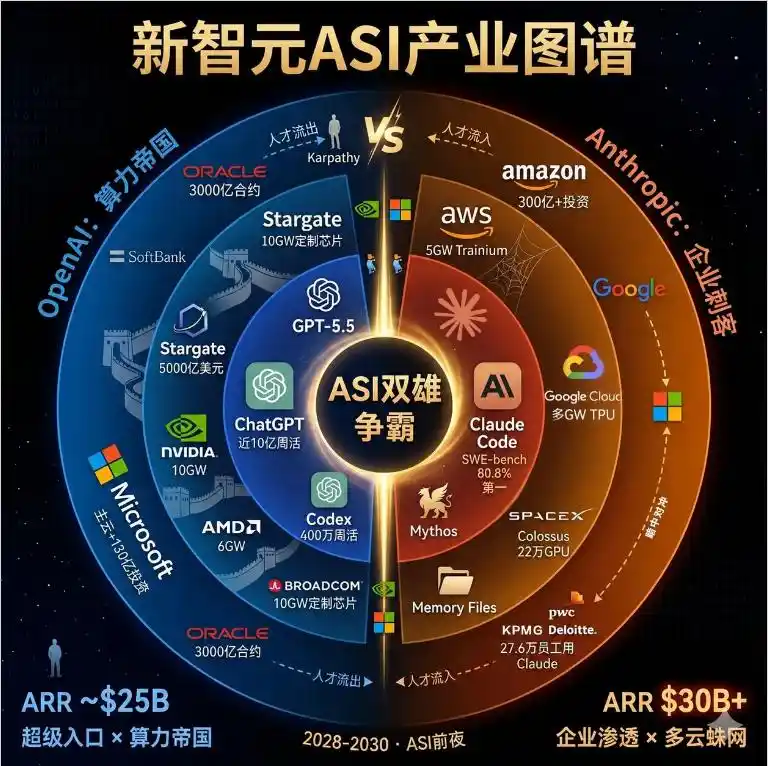
▲Image source: Xinzhiyuan

This overlooks the same issue as before. Large models are turning artificial intelligence into a cheap, ubiquitous utility like water, electricity, and gas at an astonishing speed.

Just as Yahoo couldn't stop the internet from deepening, when AI becomes omnipresent and numerous large models race simultaneously, a mere "model gateway" holds no pricing power for artificial intelligence.

Trillion-Dollar Arithmetic

Historical cases are just mirrors for reference; financial arithmetic is the real needle that bursts bubbles.
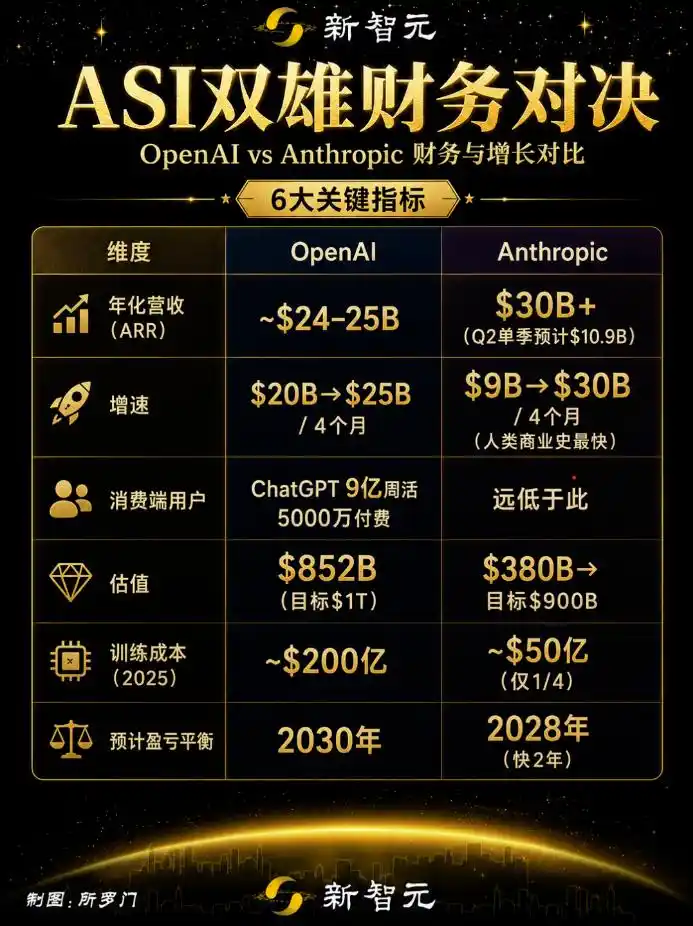
▲Image source: Xinzhiyuan

If we view OpenAI and Anthropic as future tech giants and assign them a high price-to-earnings (P/E) ratio like 30-40x, then to support a trillion-dollar market cap, these two companies would need to earn $25 to $30 billion in net profit annually, corresponding to $50 to $80 billion in revenue.

But reality falls far short of expectations.

A key metric for measuring these subscription-based AI companies is ARR (Annual Recurring Revenue). In April 2026, OpenAI's ARR was $25 billion, and Anthropic's was $30 billion.

If a company's ARR reaches $30 billion, it doesn't mean it earned $30 billion in the past year. It only means that in the past month, its user subscription fees amounted to $2.5 billion, multiplied by 12.

Moreover, ARR largely extrapolates based on the current API consumption rate. It includes a lot of short-term, exploratory development demand, even promotional water, like buying computing power and getting free tokens. The stickiness of this revenue is far less than the annual software service subscriptions of the SaaS era.

What makes the hope for profitability even dimmer is the promotions by large model companies. To compete and capture developer ecosystems, OpenAI and Anthropic have significantly lowered token prices over the past year.

Back then, to maintain its status as a traffic gateway, Yahoo had to provide vast amounts of free content, only to find traffic couldn't translate into equivalent profits. Today, large model companies, to preserve developer ecosystems, proactively turn intelligence into cheap commodities, yet enjoy monopoly-level high valuation premiums.

Behind this similar situation lies a brutal law of industrial chain profit:

The total profit of the entire AI industry chain is ultimately determined by the commercialization of the end application layer. The high valuation of large models essentially represents an advance draw on the future profits of the downstream application layer.

Looking at the current application layer, except for programming and some copywriting assistance, AI has yet to give birth to "super applications" that generate massive revenue. Most enterprise spending on AI still remains in the exploratory phase of cost reduction and efficiency gains—replacing some junior copywriters or customer service with AI—rather than the explosive phase of creating incremental revenue: creating entirely new markets worth billions or tens of billions of dollars through AI.

This is a link harboring significant risks. If downstream application companies find that purchasing AI computing power does not bring超额回报, they can press the pause button at any time. This pause could come from a performance bottleneck in a model iteration, a wave of public opinion, a batch of decisions based on executive preferences, a new round of economic downturn or volatility leading to a collective suspension of AI procurement budgets at downstream application companies for a period...

Whatever the trigger, once the downstream flow stops, the foundation of the upstream trillion-dollar market cap will instantly collapse.

Final Outcome Speculation

At the peak of capital frenzy, any slight disturbance can trigger an avalanche.

Like Yahoo back then, when the growth story can no longer be told, the trillion-dollar valuation will face the brutal execution of mean reversion. This means large model companies are inevitably headed down a path towards their final outcome.

The first path is a Yahoo-style crash.

The application layer fails to form a commercial closed loop. The token price war spirals out of control, and intelligence becomes a cheap commodity. Impatient capital begins seeking exits. The trillion-dollar valuation starts halving or even falling to a fraction.

Large model companies, stripped of their capital halo, are forced to cut back, lay off staff, cut losses, and return to ordinary software infrastructure profit margins.

Just as portal websites still exist today and Yahoo is still operating, it's no longer a darling of the capital market, only earning reasonable operating profits. Large model enterprises would devolve into "normal businesses" like cloud storage and cloud computing.

The second path is reconstructing the commercial closed loop.

One day, large model companies might truly find an ultimate model that makes enterprises pay en masse. Perhaps it's replacing the SaaS software of entire industries and taking a cut of the value created; perhaps AGI truly arrives and takes over the global digital workforce...

If this path is realized, the trillion-dollar market cap would have solid support. This requires time and is full of uncertainty. But capital markets, centered on the nature of VC funds, are most lacking in patience. Before dawn arrives, they might have already started stampeding out in the dark.

However, regardless of the path, we must be vigilant against a common sense that is easily obscured by fervor: The certainty of a macro trend never equals the certainty of individual destinies.

Most people believe AI will ultimately change the world, just as most believed the internet would change the world. But the issue is, the industry's prospects are one thing; being able to finish the long marathon and claim the crown is another.

In 2000, many correctly identified the direction of the internet but bet on Netscape, Yahoo, Pets.com, and ultimately lost their shirts. Today's OpenAI and Anthropic, while leading the race now, whether they can bridge the commercial closed-loop chasm, or whether they will be disrupted by more vertical, more efficient newcomers like the portals of old, remains a huge unknown. Discounting the industry's ultimate dividends in advance to the current frontrunners is the most classic feature of a bubble.

More alarmingly, while the bursting of the early internet bubble did not ultimately stop the internet's march in the long run, it did cause the Nasdaq to lose over three-quarters of its value at the time, leading to the collapse of大批 enterprises and连带 employee unemployment, causing real damage to the US and even the global economy for a considerable period.

When large model companies like OpenAI and Anthropic break through trillion-dollar valuations, when SoftBank leverages up regardless of cost to enter, when the entire Silicon Valley capital chain is tied to the expectation that "AI must deliver immediately," this potential systemic risk has reached a moment requiring high vigilance. Once the trillion-dollar valuations collapse, the negative wealth effect and credit contraction it triggers could have a far more severe反噬力度 on the macro economy than twenty years ago.

Technological revolutions are never smooth upward lines but are stacked by the birth and death of countless bubbles.

In 2000, Yahoo plunged over 80%, and countless investors' wealth vanished, but the internet did not die. It reshaped the world in deeper, more efficient ways. Today, if the trillion-dollar valuations of AI large models collapse, it does not mean the end of AI. It only means that AI will shed its financial speculation colors and truly, as a general-purpose technology, integrate silently and profoundly into thousands of industries.

The prospects are bright, the road is tortuous. Artificial intelligence is destined to become an inconspicuous yet indispensable infrastructure of this era, like water, electricity, and gas. But the process will inevitably have its ups and downs. When the rise is too fast and too steep, it's necessary to be vigilant of the crisis of the fall.

This article is from the WeChat public account "Huashang Taolue" (ID: hstl8888), by Huashang Taolue.


Pertanyaan Terkait

QWhat is the main argument comparing the current AI boom to the dot-com bubble, specifically regarding OpenAI and Anthropic?

AThe article argues that OpenAI and Anthropic, with their trillion-dollar valuations based on being essential 'toll booths' for AI access, mirror Yahoo during the dot-com bubble. It suggests that just as Yahoo's portal model was disrupted by more precise services, the assumption that AI applications will forever depend on buying compute/tokens from a few foundational model companies is flawed. As AI becomes ubiquitous and models commoditized, these 'model gateways' may lose pricing power and their high valuations could collapse if downstream applications don't generate expected profits.

QAccording to the article, what key financial metrics highlight the risk in OpenAI's and Anthropic's valuations?

AThe article points to the discrepancy between valuation and projected earnings. To justify a $1 trillion valuation with a high P/E ratio of 30-40x, these companies would need annual net profits of $25-30 billion, requiring $50-80 billion in revenue. However, their Annual Recurring Revenue (ARR)—$25 billion for OpenAI and $30 billion for Anthropic as of April 2026—is cited as a misleading metric. This ARR is extrapolated from monthly subscription/API usage, contains promotional '水分' (water), and lacks the stickiness of traditional SaaS subscriptions, making the path to necessary profitability uncertain.

QWhat are the two possible 'endgames' the article proposes for major AI model companies like OpenAI?

AThe article proposes two potential endgames: 1) A Yahoo-style crash, where a failure to form a commercial闭环 (closed loop) with downstream applications leads to a price war, commoditization of AI, and a collapse in valuation, forcing companies to become ordinary infrastructure businesses. 2) Reconstructing the commercial闭环, where companies find a sustainable monetization model (e.g., replacing industry SaaS or achieving AGI). However, the capital market's impatience may trigger a downturn before this second path can be realized.

QWhat critical warning does the article give about confusing industry potential with individual company success?

AThe article warns that the certainty of the AI macro-trend does not guarantee the success of any individual company. It draws a parallel to the dot-com era, where many investors correctly bet on the internet's future but lost money by investing in specific companies like Netscape, Yahoo, or Pets.com that failed. It cautions that prematurely discounting the industry's ultimate红利 (dividend) into the current leading companies is a classic特征 (characteristic) of a bubble, as today's leaders like OpenAI and Anthropic could still be disrupted or fail to cross the commercialization chasm.

QHow does the article assess the potential systemic risk of the current AI investment frenzy?

AThe article assesses the systemic risk as potentially severe, exceeding that of the 2000 dot-com crash. It highlights that with trillion-dollar valuations, massive leveraged bets like SoftBank's, and the entire Silicon Valley capital chain赌死 (gambled on) the immediate realization of AI profits, a collapse could trigger a powerful negative wealth effect and credit contraction. This反噬 (backlash) on the macroeconomy would be more intense than two decades ago, causing real economic damage despite AI technology ultimately progressing, similar to how the internet survived its bubble burst.

Bacaan Terkait

Kilas Balik Insiden Bonzo Lend: Bagaimana Sebuah Kelemahan Tanda Tangan Nol Bisa Menyebabkan Kerugian Protokol Senilai 9 Juta Dolar?

Insiden Bonzo Lend: Bagaimana Satu Kerentanan Tanda Tangan Nol Menyebabkan Protokol Rugi 9 Juta Dolar AS? Sebuah protokol pinjaman berbasis Hedera, Bonzo Lend, terpaksa mengunci penarikan setelah kerentanan pada oracle validator memungkinkan eksploitasi besar-baru. Dompet pelaku menyetor 250 token SAUCE (senilai hanya beberapa dolar) sebagai jaminan, lalu mengirim pembaruan harga palsu yang secara drastis melambungkan nilainya sekitar 12 digit. Kunci masalahnya ada pada validator oracle Supra yang menerima bukti dengan bidang tanda tangan [0,0] dan kunci publik nol (titik tak terhingga). Validator ini mengirim input ke kontrak *pairing* Hedera. Karena kedua titik mewakili identitas matematika, persamaan *pairing* mengembalikan `true` sesuai desain. Validator secara keliru menafsirkan hasil ini sebagai bukti tanda tangan yang sah dari komite orakel, tanpa menolak input nol dan identitas terlebih dahulu. Dengan harga SAUCE yang dimanipulasi disimpan di oracle, protokol pinjaman Bonzo, mengikuti aturan rasio pinjaman terhadap nilai (LTV) yang terprogram, mengizinkan dompet pelaku untuk meminjam 6,63 juta USDC dan 34,5 juta wrapped HBAR, dengan total sekitar 9,05 juta dolar AS berdasarkan harga referensi Bonzo. Dompet lain (B) meminjam sekitar 1 juta dolar AS saat harga tidak normal masih berlaku dan telah menghubungi Bonzo mengklaim sebagai penanggap *whitehat* dengan niat mengembalikan dana. Bonzo melaporkan sekitar 1 juta dolar AS telah "dipulihkan" meskipun dana belum dikembalikan. Supra telah memperbaiki validatornya. Namun, Bonzo Lend tetap ditutup sementara, dengan penyedia likuiditas tidak dapat menarik dana mereka. Protokol belum mengumumkan rencana kompensasi, tanggal pembukaan kembali, atau syarat penarikan bagi pengguna, sehingga pemulihan penuh masih tertunda.

marsbit34m yang lalu

Kilas Balik Insiden Bonzo Lend: Bagaimana Sebuah Kelemahan Tanda Tangan Nol Bisa Menyebabkan Kerugian Protokol Senilai 9 Juta Dolar?

marsbit34m yang lalu

Semifinal, Prediksi AI Mencampur Aduk: Prancis Sudah Pasti Menang? Laga Sengit Inggris vs Argentina Belum Pasti

Setelah berhasil memprediksi dengan tepat keempat pemenang perempat final Piala Dunia, enam model AI—ChatGPT, Claude, Gemini, DeepSeek, Qwen, dan Grok—memberikan prediksi yang berbeda untuk semifinal. **Prancis vs. Spanyol: Konsensus Hampir Bulat** Lima dari enam AI (ChatGPT, Claude, Grok, DeepSeek, Qwen) memprediksi Prancis menang dengan skor 2-1 dalam waktu normal. Mereka melihat kekuatan serangan balik cepat Prancis pimpinan Mbappé sebagai kunci melawan sistem penguasaan bola Spanyol. Hanya Gemini yang berbeda pendapat, memperkirakan pertandingan akan imbang 1-1 hingga perpanjangan waktu dan dimenangkan Spanyol lewat adu penalti. **Inggris vs. Argentina: Perbedaan Pendapat Tajam** Prediksi untuk laga ini terbelah sama rata. Tiga AI (Grok, DeepSeek, Qwen) mendukung Inggris menang (skor 2-1 atau 2-0) dalam waktu normal, mengandalkan fisik, bola mati, dan performa Kane serta Bellingham. Tiga AI lainnya (ChatGPT, Gemini, Claude) memilih Argentina, dengan alasan pengalaman, pengorganisasian permainan oleh Messi, dan ketangguhan mental di laga knockout. Claude dan ChatGPT bahkan melihat potensi kuat pertandingan masuk ke perpanjangan waktu atau adu penalti, dengan ChatGPT meramalkan kemenangan Argentina 4-3 lewat titik putih. Intinya, semifinal pertama dianggap lebih mudah diprediksi dengan dukungan mayoritas untuk Prancis, sementara semifinal kedua antara Inggris dan Argentina dipandang sangat seimbang dan sulit dipastikan, membuat prediksi AI pun terpecah.

Odaily星球日报56m yang lalu

Semifinal, Prediksi AI Mencampur Aduk: Prancis Sudah Pasti Menang? Laga Sengit Inggris vs Argentina Belum Pasti

Odaily星球日报56m yang lalu

Wawancara dengan Pendiri Robinhood: Kehendak Investor Retail Mengalahkan Semua 'Uang Pintar'

Wawancara dengan Vlad Tenev, pendiri dan CEO Robinhood, membahas evolusi platform, pandangannya tentang investor ritel, dan visi untuk masa depan. Tenev menekankan bahwa investor ritel seringkali merupakan "uang pintar" yang sebenarnya, karena mereka berfokus pada fundamental perusahaan daripada bereaksi berlebihan terhadap peristiwa makro seperti yang dilakukan banyak lembaga. Dia meninjau kesuksesan Robinhood, yang didorong oleh perdagangan tanpa komisi, pengutamaan platform seluler, dan misi mendemokratisasi kepemilikan aset. Mengenai kondisi pasar saat ini, Tenev melihat perbedaan penting dengan era meme stock 2021. Investor Robinhood kini lebih banyak berinvestasi di perusahaan inovatif dan menguntungkan di garis depan teknologi, seperti Nvidia dan SpaceX, dibandingkan perusahaan yang terdampak tren. Tenev optimis tentang potensi pertumbuhan, mencatat bahwa partisipasi pasar saham AS masih sekitar 65%, dengan ruang untuk berkembang, terutama melalui inisiatif seperti akun untuk bayi baru lahir. Dia juga membahas ekspansi ke Inggris dan strategi kripto Robinhood, termasuk peluncuran Robinhood Chain. Jaringan Layer 2 ini bertujuan untuk menjadi blockchain terbaik untuk aset dunia nyata (RWA), dimulai dengan token saham yang didukung 1:1 oleh saham AS, yang tersedia di lebih dari 120 negara. Terakhir, Tenev menyoroti pentingnya membuka akses ke pasar ekuitas swasta. Melalui Robinhood Ventures, platform ini bertujuan memungkinkan investor biasa mengakses perusahaan swasta bernilai tinggi seperti OpenAI dan SpaceX di tahap lebih awal, yang menurutnya sangat penting karena semakin banyak nilai diciptakan sebelum perusahaan menjadi publik.

marsbit59m yang lalu

Wawancara dengan Pendiri Robinhood: Kehendak Investor Retail Mengalahkan Semua 'Uang Pintar'

marsbit59m yang lalu

Opsi Kenaikan Suku Bunga Kembali ke Meja, CPI Segera Diumumkan, Variabel Apa yang Dipantau Pasar?

Gubernur Federal Reserve Christopher Waller menyatakan bahwa jika data inflasi inti yang dirilis minggu ini kembali panas, FOMC perlu mempertimbangkan untuk memperketat kebijakan moneter dalam waktu dekat. Pernyataan ini muncul menjelang rilis data CPI AS bulan Juni, yang dijadwalkan pada 14 Juli. Pasar telah menyesuaikan ekspektasi, dengan probabilitas tersirat kenaikan suku bunga 25 basis points pada rapat Juli meningkat dari sekitar 35% menjadi lebih dari 40%. Pentingnya data CPI Juni terletak pada kemampuannya untuk menguji apakah penurunan inflasi inti masih dapat dipercaya. Jika inflasi inti lebih tinggi dari ekspektasi, pasar akan cenderung melihat kenaikan PCE inti bukan sebagai gangguan sementara, sehingga mempersulit Fed untuk tetap bertahan. Sebaliknya, jika inflasi inti mendingin, pernyataan Waller kemungkinan hanya akan dianggap sebagai peringatan. Aset berisiko seperti BTC, ETH, dan Nasdaq sensitif terhadap sinyal ini karena bergantung pada likuiditas masa depan dan tingkat diskonto. Kenaikan probabilitas suku bunga mencerminkan bahwa pasar tidak lagi bisa mengabaikan kemungkinan kenaikan suku bunga. Fokus utama setelah rilis CPI adalah apakah probabilitas kenaikan suku bunga akan terus meningkat dan melampaui 50%. Jika ya, logika perdagangan akan beralih dari risiko ekor ke perebutan skenario dasar. Kombinasi yang berbahaya bagi investor adalah data CPI yang panas, peningkatan probabilitas suku bunga, dan lebih banyak pejabat Fed yang mengikuti pernyataan Waller. Sebelum data memberikan jawaban, Waller hanya mengubah probabilitas, bukan kesimpulan.

marsbit1j yang lalu

Opsi Kenaikan Suku Bunga Kembali ke Meja, CPI Segera Diumumkan, Variabel Apa yang Dipantau Pasar?

marsbit1j yang lalu

Trading

Spot
活动图片