Why is the RWA Boom Failing to Benefit DeFi?

marsbitDipublikasikan tanggal 2026-05-19Terakhir diperbarui pada 2026-05-19

Abstrak

The rapid growth of the tokenized real-world assets (RWA) market, now nearing $30 billion on-chain, has largely bypassed the DeFi ecosystem. Only about $2.47 billion is actively locked in DeFi protocols, indicating a penetration rate of just 9%. A major barrier is the "permissioned" architecture of most RWA products, like BlackRock's BUIDL fund, which are designed for institutional compliance. They require whitelisting, off-chain settlement, and strict investor accreditation, making them incompatible with open, permissionless DeFi applications like Aave or Uniswap. This is evident in categories like bonds/money market funds ($16.6B on-chain, $920M in DeFi) and tokenized equities ($2.7B on-chain, $78M in DeFi). Notable exceptions are private credit protocols (e.g., Maple Finance, Centrifuge) and assets like Ondo's USDY, which were designed from inception for DeFi composability, allowing them to be used freely as collateral. Morpho and Aave Horizon also demonstrate successful RWA lending integrations. However, industry reports (IOSCO, ECB) warn that growth may remain confined within traditional financial systems due to fragmented regulations, lack of unified standards, and inherent conflicts between DeFi's open logic and compliance requirements like minimum investments and fixed redemption windows. The RWA sector is effectively split into two markets: a compliant, permissioned on-chain finance market and a smaller DeFi-native market focused on composability. For DeFi penetr...

Author: Gino Matos

Compiler: Chopper, Foresight News

Data from DeFiLlama shows that the on-chain tokenized real-world asset (RWA) scale has approached $30 billion. However, only $2.47 billion is shown as the active DeFi Total Value Locked (TVL), which is the actual amount of funds deposited into third-party DeFi platform liquidity pools and participating in the ecosystem's operation.

The vast majority of other RWA assets remain outside of scenarios such as lending markets and collateral vaults, which enable free combination and interaction of crypto assets. Bonds and money market funds are the largest RWA category by scale, with an on-chain total exceeding $16.6 billion. Yet, the effective TVL flowing into the DeFi ecosystem is only $920 million. The on-chain scale of gold and commodity assets is $5.7 billion, with only $183.6 million effectively circulating in DeFi. Equity assets have an on-chain scale of $2.7 billion, but the funds that have entered the DeFi market are a mere $78.27 million.

Only the private credit sector stands out: its on-chain scale is $3.226 billion, with a DeFi effective TVL of $1.257 billion, achieving an ecosystem penetration rate of 39%. The reason behind this is that projects like Maple Finance and Centrifuge were designed from the outset as lending financial instruments, making them naturally suited for DeFi application scenarios.

In contrast, tokenized products like US Treasury bond funds, gold assets, and stock assets are designed by their issuers to cater more to institutional custody needs, with their overall architecture aligning with the operational models of traditional compliant funds.
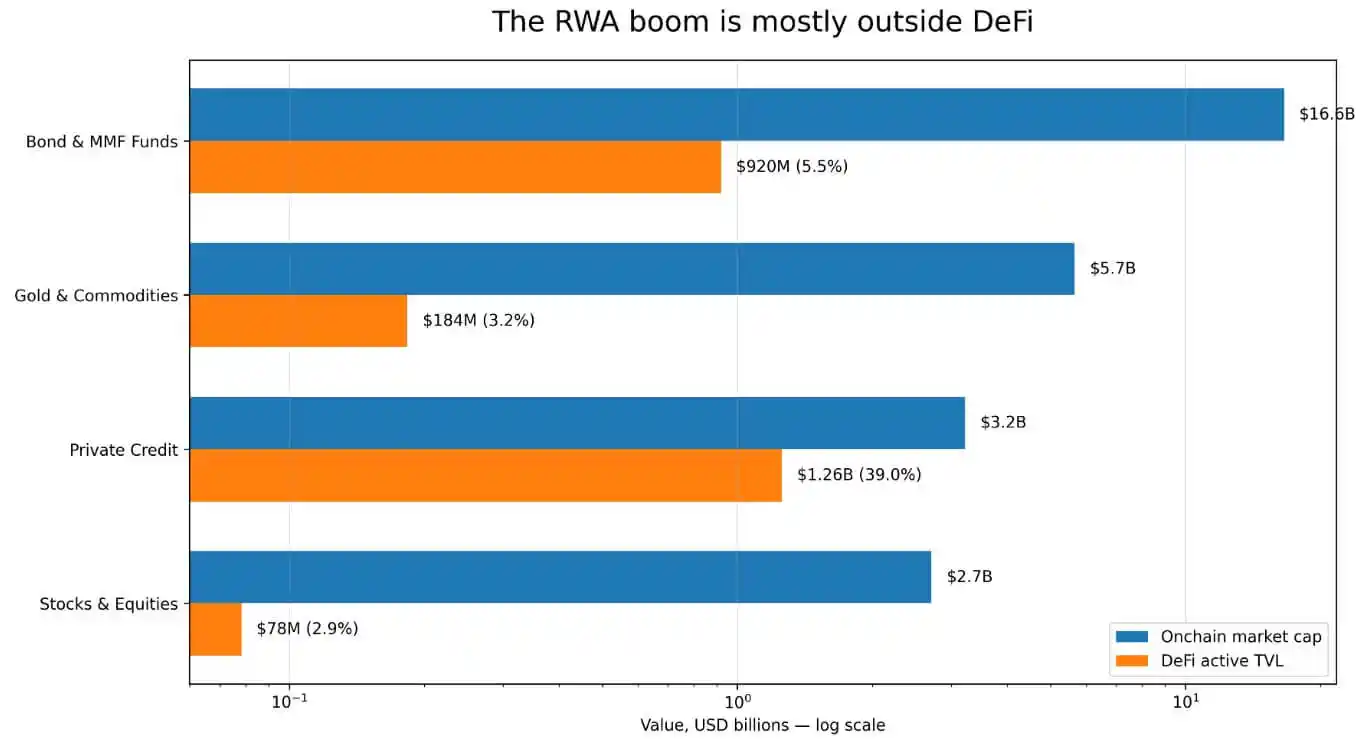
Distribution of On-Chain Market Value and DeFi Active TVL Across Four RWA Categories

Permissioned Architecture Becomes the Biggest Barrier to DeFi Composability

DeFiLlama categorizes the money market fund product BUIDL by BlackRock as a permissioned fund. Its effective TVL within the DeFi ecosystem is only $18.9 million.

The International Organization of Securities Commissions (IOSCO) pointed out in its final report on financial asset tokenization released in November 2025 that BUIDL created a permissioned system on a public blockchain for issuance, custody, secondary trading among qualified investors, dividend distribution, and redemption.

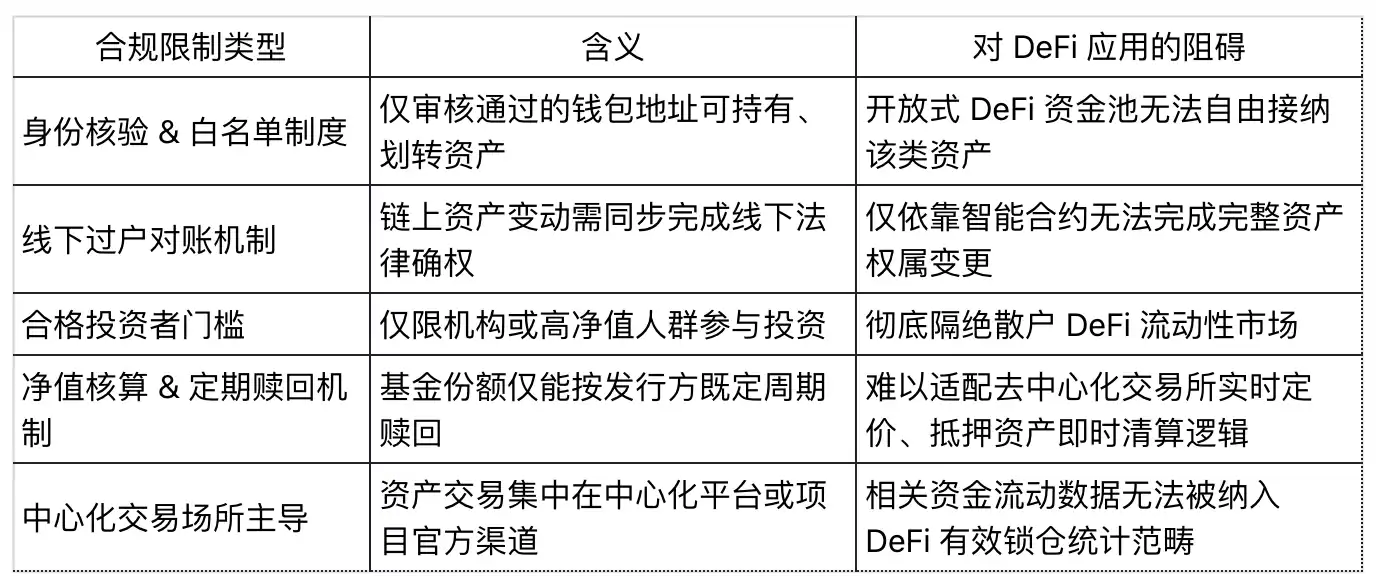
Potential investors must pass the whitelist review on the Securitize platform. Furthermore, on-chain asset transfer actions only attain full legal validity after information verification and confirmation by an offline transfer agent.

This means that BUIDL is essentially a compliant custody infrastructure built atop blockchain channels, primarily serving institutional asset custody and offline account reconciliation needs. Its smart contracts only support interactions from whitelisted addresses. Without using a compliant wrapping layer as an intermediary, they cannot be directly deposited into permissionless, open DeFi protocols like Aave or Uniswap.

In February 2026, BlackRock completed the integration of BUIDL with Uniswap, enabling partial assets to enter trading pools. However, asset access permissions are still controlled by Securitize, limited to qualified investment institutions with a net asset value of no less than $5 million; ordinary market participants still cannot participate.

IOSCO found that the vast majority of tokenized money market funds on the market currently adopt similar operational models. These assets have so far failed to deliver the high secondary market liquidity value previously anticipated by the industry.

RedStone stated bluntly in its tokenization industry report released in March 2026 that the most challenging part of asset tokenization implementation is coordinating a series of complex rules across different jurisdictions and public chain ecosystems, including compliance review, identity verification, trading permission restrictions, risk control sanctions screening, and corporate rights distribution. Looking at the current market, Morpho and Aave Horizon are among the few genuine case studies successfully implementing RWA assets in DeFi applications.

In short, each compliance and access restriction set by project parties further raises the barrier for assets to enter the DeFi ecosystem. Products like US Treasury token bonds and money market funds are themselves designed to meet the regulatory requirements of licensed institutional investors, actively incorporating various permission constraints.
Gold and commodity assets face another practical issue. CoinGecko data shows that in Q1 2026, spot trading volume for tokenized gold reached $90.7 billion, surpassing the total for the entire year of 2025. However, the vast majority of this trading occurs on centralized exchanges. The aforementioned DeFi effective TVL of $183.6 million only represents a tiny fraction circulating within the ecosystem. The enormous trading volume in centralized markets is completely outside the scope of DeFiLlama's data statistics.

Positive Outlook: Highly Compatible Products Have Set Examples

In early 2026, the TVL of Ondo's USDY exceeded $1 billion and has now achieved full coverage across nine public chain ecosystems. The Ondo Global Markets segment, launched in September 2025, focuses on tokenized US stocks and ETF assets for overseas investors. It was designed from the start to support free asset transfer and direct use as DeFi collateral. Currently, the TVL for corresponding assets is $650 million, with cumulative trading volume exceeding $12 billion.

According to RedStone statistics, the RWA deposit scale on the Morpho platform exceeds $620 million, and the total RWA-related asset scale on Aave Horizon is $423.5 million. Both lending protocols have successfully implemented mature RWA collateralized lending models.

These implementation cases fully prove that as long as the design philosophy of permissionless free circulation is upheld from the asset issuance stage, RWA assets can fully achieve composability within the DeFi ecosystem.

During an industry roundtable hosted by DWF Labs in April 2026, projects including Centrifuge, Falcon Finance, and xStocks jointly proposed the view that the RWA sector has now diverged into two major development tracks. The first prioritizes compliance with asset ownership regulations, adhering to a strictly permissioned and controlled path. The second balances compliant issuance standards while enabling secondary market circulation properties, with ecosystem composability as the core design orientation.

Graham Nelson, the person in charge of the Centrifuge project, stated that stringent whitelist access mechanisms mean each participant in a liquidity pool needs to undergo separate qualification reviews, directly blocking the path for assets to enter open DeFi.

The DeRWA solution launched by Centrifuge bypasses this barrier by wrapping the underlying primary issuance assets in a compliant manner while relaxing restrictions on secondary market asset circulation. Artem Tolkachev from Falcon Finance also mentioned that ecosystem composability and flexible exit mechanisms are the key bridges connecting real-world assets with crypto market liquidity.

The industry is optimistic that as the overall on-chain RWA asset scale approaches $50 billion, if most projects within the sector shift towards designs compatible with DeFi, the penetration rate of RWA assets in the DeFi ecosystem is expected to break through the current low level of 9%.

Negative Reality: Industry Growth May Be Confined to the Traditional Financial System

Standard Chartered Bank predicts that the global tokenized asset scale will reach $2 trillion by 2028, but it simultaneously warns that this industry boom is likely to be confined within the traditional banking and financial system, with limited growth benefits for the open crypto market.

IOSCO's research in November 2025 also corroborates this point. Constrained by the inherent access barriers and liquidity shortcomings of distributed ledger technology, the current distribution, circulation, and secondary market trading of tokenized assets still heavily rely on traditional financial infrastructure.

The European Central Bank further pointed out in its tokenization industry research report released in April 2026 that the absence of unified global standards for asset tokenization is highly prone to creating isolated asset silos. Different asset systems have their own compliance rules, settlement layers, and access mechanisms, ultimately leading to high concentration of liquidity within closed circles, making interconnection and circulation difficult.

The DeFi penetration rates of 5.5% for bonds and money funds, 3.2% for gold and commodities, and 2.9% for equities directly reflect this fragmented ecosystem pattern.

Most US Treasury tokens and money fund products on the market commonly set minimum investment thresholds, mandatory identity verification, offline asset reconciliation cycles, and fixed redemption windows tied to net asset value. These underlying rules inherently conflict with the operational logic of decentralized exchanges' real-time pricing and permissionless collateral vaults. These constraints are mandatory requirements from the regulatory level and an inevitable choice for asset issuers to adapt to the compliant environment.

Two Markets, One Industry Label

The total on-chain RWA scale of $30 billion and the effective DeFi circulation scale of $2.47 billion, while seemingly belonging to the same RWA sector, actually correspond to two completely separate markets:

  • Compliant On-Chain Financial Market: Primarily consisting of money market funds, US Treasury funds, and institutionally custodied assets. Asset transfer relies on offline transfer agent reconciliation and confirmation, following traditional financial regulations throughout.
  • DeFi Composability Ecosystem Market: Assets can be freely deposited into lending protocols, used as permissionless collateral, and integrated into various automated yield strategies for free circulation.
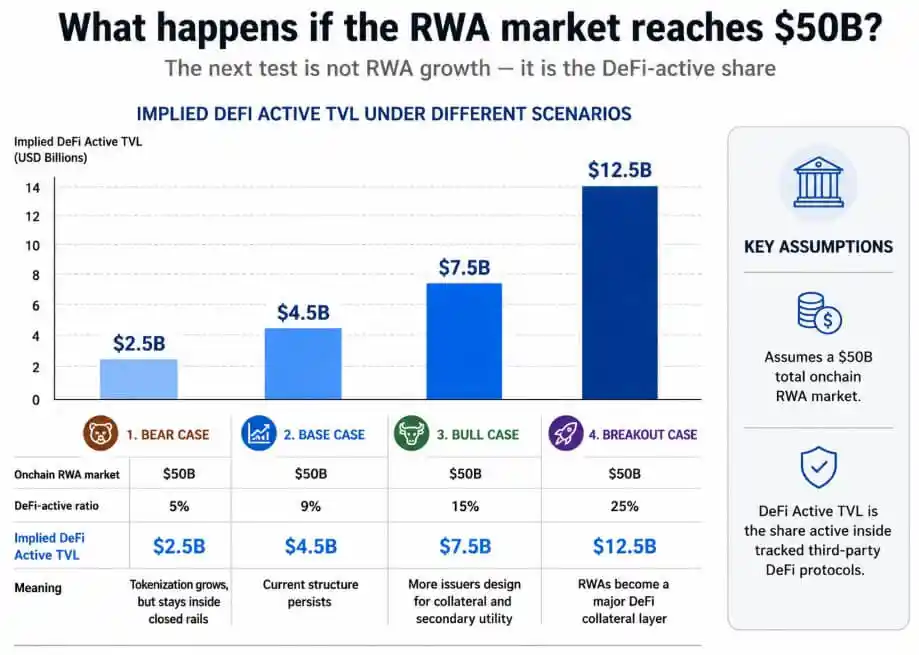
The chart above predicts the implied DeFi Active TVL under four scenarios in a $50 billion RWA market, ranging from 5% to 25%

The achievement of over $620 million in RWA deposits on Morpho and the circulation of USDY across 9 blockchains is sufficient proof that the second type of market possesses genuine development potential.

To drive the DeFi penetration rate of RWA assets beyond 9%, asset issuers must abandon the 'compliance-system-first' design approach exemplified by BlackRock's BUIDL. Instead, they should adopt underlying architectures that natively support permissionless free circulation.

Currently, $28.56 billion of on-chain RWA assets belong to the permissioned control track. This also means that most current tokenized real-world assets are, in essence, more akin to compliant on-chain traditional financial products, rather than general-purpose collateral assets suitable for open DeFi ecosystems.


Pertanyaan Terkait

QAccording to the article, what is the main reason why most tokenized real-world assets (RWA) have not been successfully integrated into DeFi ecosystems?

AThe main reason is that the majority of RWA products, such as bond and money market funds, are designed with a permissioned architecture from the outset to comply with institutional custody and traditional regulatory requirements. This includes whitelisting, mandatory identity verification, and reliance on offline settlement processes, which creates significant barriers for these assets to be used in permissionless DeFi applications like Aave or Uniswap.

QWhich RWA sector, according to the article, has shown a high degree of integration with DeFi, and what is the key factor for its success?

AThe private credit sector has shown high integration, with a 39% penetration rate into DeFi. The key factor for its success is that projects like Maple Finance and Centrifuge were designed from the beginning as lending financial tools, making them inherently compatible with DeFi application scenarios.

QWhat is the fundamental difference between the two distinct markets identified in the article under the common label of "RWA"?

AThe two distinct markets are: 1) A compliant on-chain financial market, consisting of assets like money market funds and treasuries. These assets rely on offline registrars for transfer validation and follow traditional financial regulations. 2) A DeFi-composable ecosystem market, where assets can be freely deposited into lending protocols, used as collateral, and integrated into various automated yield strategies for permissionless circulation.

QWhat solution is mentioned in the article for bridging the gap between compliant primary issuance of RWAs and their potential for secondary market circulation in DeFi?

AThe article mentions Centrifuge's "DeRWA" solution as an example. It involves creating a compliant wrapper for the underlying primary issuance asset while relaxing restrictions on the secondary market circulation of that wrapped asset, thereby enabling it to be used in open DeFi protocols.

QBased on the article's analysis, what must RWA issuers do to significantly increase the current low DeFi penetration rate of their assets?

ATo significantly increase DeFi penetration beyond the current ~9%, RWA issuers must move away from design philosophies centered on a closed, permissioned compliance system (like BlackRock's BUIDL). Instead, they need to adopt a native, permissionless architecture from the ground up that supports free and unrestricted circulation of assets within DeFi ecosystems.

Bacaan Terkait

Setelah Tiga Kuartal Berturut-Turut Turun, Bisakah Pasar Kripto Menyambut Jendela Stabilitas di Kuartal Ketiga?

Pasar kripto mengalami kuartal terburuk sejak 2022, dengan kapitalisasi pasar turun 12.6% menjadi $2.1 triliun, didorong oleh keluarnya modal dan penurunan volume perdagangan. Bitcoin dan Ethereum masing-masing jatuh 14.2% dan 25.4% di kuartal kedua. Aliran keluar bersih dari ETF Bitcoin AS mencapai $4.67 miliar, menandakan tekanan jual yang berkelanjutan. Faktor utama meliputi terputusnya hubungan dengan saham AS, kebijakan moneter Federal Reserve yang ketat, dan pelepasan aset oleh perusahaan seperti Strategy. Proses legislasi UU CLARITY yang akan memberikan kejelasan regulasi terhambat, meningkatkan premi risiko di sektor ini. Namun, ada tanda-tanda potensi stabilisasi. Aliran keluar ETF yang besar secara historis sering terjadi di akhir fase penurunan, dan para pemegang Bitcoin jangka panjang mulai menambah kepemilikan lagi. Sementara sebagian besar sektor menyusut, pasar prediksi dan aset koleksi yang ditokenisasi mencatat pertumbuhan signifikan. Pandangan untuk kuartal ketiga sangat bergantung pada pertemuan Fed akhir Juli. Sinyal kebijakan yang lunak dapat mendukung pemulihan Bitcoin, sementara sikap yang hawkish dapat memicu konsolidasi lebih lanjut. Meskipun tantangan regulasi tetap ada, indikator teknis seperti harga Bitcoin yang mendekati rata-rata bergerak 200-mingguannya menunjukkan dasar jangka panjang belum rusak. Logika pasar telah bergeser dari mengandalkan narasi ke faktor fundamental seperti kebijakan dan ekspektasi suku bunga.

marsbit18j yang lalu

Setelah Tiga Kuartal Berturut-Turut Turun, Bisakah Pasar Kripto Menyambut Jendela Stabilitas di Kuartal Ketiga?

marsbit18j yang lalu

The SpaceX Trade, Terbuka: SPCXON Mulai Diperdagangkan di WEEX

SpaceX meluncurkan IPO terbesar dalam sejarah pada Juni 2026, namun akses bagi banyak pedagang terhambat oleh batasan regional dan prosedur broker. WEEX kini menghadirkan SPCXON/USDT di pasar spotnya, sebuah instrumen tokenisasi yang memungkinkan paparan terhadap pergerakan harga SpaceX melalui akun kripto yang diselesaikan dengan USDT, tanpa memerlukan broker AS atau pembiayaan bank. SPCXON adalah produk tokenisasi yang mencerminkan ekonomi kepemilikan SpaceX bagi pedagang yang memenuhi syarat di luar AS, dengan dividen diinvestasikan kembali. Aset ini diperdagangkan di WEEX sebagai pasangan spot dengan USDT, tersedia selama jam pasar, memberikan akses mudah bagi trader kripto. Kasus investasi untuk SpaceX didasarkan pada pertumbuhan pendapatan Starlink dan pencapaian Starship, meskipun valuasinya yang tinggi (sekitar 90-110 kali pendapatan) telah memperhitungkan eksekusi sempurna selama bertahun-tahun. Faktor seperti jumlah saham publik yang terbatas dan masa buka kunci (unlock) insider pertama menjadi pertimbangan penting. Penting untuk diingat bahwa SPCXON memberikan paparan, bukan kepemilikan langsung atas saham atau hak suara. Harganya dapat diperdagangkan pada premium atau diskon terhadap nilai aset bersih. WEEX menawarkan akses ke berbagai aset TradFi yang ditokenisasi seperti ini dalam satu akun terpadu, bersama dengan pasar futures dan kampanye perdagangan dengan pool hadiah.

TheNewsCrypto18j yang lalu

The SpaceX Trade, Terbuka: SPCXON Mulai Diperdagangkan di WEEX

TheNewsCrypto18j yang lalu

Momen Perdagangan BIT: BTC Masih Tertekan oleh EMA 200 Mingguan, Setelah Ditolak Mungkin Kembali Turun, Saham Penyimpanan dan Semikonduktor yang Melonjak Malam Kemudian Mulai Anjlok di Pasar Malam

**PASAR KRIPTO & SAHAM: BTC Hadapi Resistensi, Saham Semikonduktor Turun di Perdagangan Malam** Pasar kripto melanjutkan pemulihan, dengan harga Bitcoin bertahan di sekitar $66,000 setelah rebound lebih dari 15% dari titik terendah Juli. Namun, BTC menghadapi **tembok resistensi kuat di dekat $68,000**, yang bertepatan dengan biaya rata-rata investor selama lima bulan terakhir dan titik gagalnya rebound pertengahan Juni. Secara teknis, perhatian tertuju pada **200 EMA mingguan (~$68,328) sebagai level kunci**. Jika BTC ditolak di level ini, potensi penurunan menuju support $63,000 terbuka. Analis menyoroti volume rendah dan penurunan open interest futures di CME, menandakan rebound ini lebih dipicu likuiditas rendah musim panas daripada awal bull run penuh. Di pasar saham AS, **indeks futures utama turang** setelah sesi kemarin yang kuat. Sektor semikonduktor dan penyimpanan (storage), yang melonjak pada hari Selasa (contoh: Micron +12%), **mengalami koreksi di perdagangan malam (night trading)**. ETF semikonduktor turun 2,22% dan saham Micron turun 2,29%. Meski begitu, ada sorotan positif seperti **Super Micro Computer (SMCI)** yang naik lebih dari 15% setelah melaporkan pandangan pendapatan yang kuat dan pesanan baru yang sangat besar, mengonfirmasi permintaan server AI tetap solid. Kekhawatiran makro muncul dari **kenaikan harga minyak mentah (di atas $91)** akibat ketegangan geopolitik dan **lonjakan imbal hasil (yield) obligasi pemerintah AS**, dengan imbal hasil 10-tahun mencapai sekitar 4,64%. Faktor-faktor ini dapat menambah tekanan inflasi dan membatasi ruang gerak pasar saham. Saham terkait kripto seperti Coinbase dan Robinhood naik kuat didorong oleh perkembangan regulasi yang lebih jelas di AS. Di Asia, **Korea Selatan** dan **Jepang** menunjukkan kinerja beragam. Indeks KOSPI Korea naik didukung pemulihan saham semikonduktor, sementara pasar Jepang melemah dengan **Yen terus melemah ke level terendah sejak 1986**, meningkatkan kekhawatiran akan intervensi bank sentral. **Yang Perlu Diperhatikan Selanjutnya:** * **22 Juli:** Acara AI AMD, rilis laporan keuangan dari Google (Alphabet), Tesla, IBM. * **23 Juli:** Keputusan suku bunga Bank Sentral Eropa (ECB), data klaim pengangguran AS, laporan keuangan Intel. * Perkembangan lebih lanjut dari **harga minyak, imbal hasil obligasi, dan dinamika Yen Jepang** akan menjadi penentu sentimen pasar risiko secara keseluruhan.

marsbit18j yang lalu

Momen Perdagangan BIT: BTC Masih Tertekan oleh EMA 200 Mingguan, Setelah Ditolak Mungkin Kembali Turun, Saham Penyimpanan dan Semikonduktor yang Melonjak Malam Kemudian Mulai Anjlok di Pasar Malam

marsbit18j yang lalu

Mantan Ketua CFTC dan Presiden Circle, Tarbert: Satu Pihak Menasihati Anda untuk Berpikir Jangka Panjang, di Sisi Lain Menguangkan $30 Juta Sendiri

Penulis: Zen, PANews Heath Tarbert, mantan Ketua CFTC dan Presiden Circle, baru-baru ini menyerukan kepada investor untuk mengadopsi pandangan jangka panjang terhadap saham Circle, meskipun harganya telah turun 70% dari puncaknya. Namun, ia sendiri secara konsisten menjual saham CRCL sejak perusahaan go public, menguangkan sekitar $30 juta tanpa pernah membeli saham tambahan di pasar terbuka. Tarbert, yang bergabung dengan Circle pada Juli 2023 dan menjadi Presiden pada awal 2025, dikenal sebagai pendukung kuat narasi "jangka panjang" perusahaan. Namun, sehari sebelum IPO Circle, ia menetapkan rencana perdagangan 10b5-1 untuk menjual hingga 353.290 saham dalam setahun. Dalam 13 bulan setelah IPO, ia menjual lebih dari 360.000 saham, termasuk penjualan tunggal senilai $11,5 juta pada Maret 2026. Ia bahkan menetapkan rencana 10b5-1 kedua untuk menjual hingga 160.000 saham lagi pada akhir tahun 2026. Langkah Tarbert ini menuai kecaman karena dianggap tidak konsisten dengan pesan "jangka panjang" yang ia sampaikan kepada publik. Perjalanan kariernya sering dikaitkan dengan "revolving door" antara regulator dan dunia keuangan. Setelah mengundurkan diri sebagai Ketua CFTC pada Maret 2021, ia bergabung dengan Citadel Securities hanya 27 hari kemudian sebagai Kepala Penasihat Hukum, tepat saat perusahaan itu menghadapi pengawasan ketat terkait peristiwa GameStop. Di Citadel, ia juga mendukung undang-undang yang memperluas wewenang CFTC atas pasar crypto, sementara Citadel diketahui berencana berekspansi ke aset kripto. Tarbert kemudian pindah ke Circle pada 2023, membantu perusahaan mengatasi tantangan regulasi dan akhirnya go public melalui IPO langsung. Meskipun sangat berharga bagi perusahaan, tindakannya menjual saham dalam jumlah besar sambil mendorong investor untuk bertahan menimbulkan pertanyaan tentang komitmennya yang sebenarnya terhadap masa depan jangka panjang Circle.

marsbit19j yang lalu

Mantan Ketua CFTC dan Presiden Circle, Tarbert: Satu Pihak Menasihati Anda untuk Berpikir Jangka Panjang, di Sisi Lain Menguangkan $30 Juta Sendiri

marsbit19j yang lalu

Gate Research Institute: Produk Keuangan Kripto Menggulirkan Gelombang "Wall Street-ization", Kompetisi atau Integrasi?

**Ringkasan: Gelombang "Wall Street-ization" Produk Keuangan Kripto: Kompetisi atau Integrasi?** Artikel ini membahas fenomena konvergensi antara keuangan tradisional (TradFi) dan keuangan kripto (Crypto). Meskipun Bitcoin awalnya dirancang sebagai sistem peer-to-peer yang terdesentralisasi dan bebas dari perantara seperti bank, pasar kripto kini semakin diintegrasikan ke dalam infrastruktur keuangan tradisional. **Tren "Wall Street-ization":** Dimulai dengan disetujuinya ETF spot Bitcoin pada 2024, aset kripto kini dikemas menjadi produk seperti ETF (oleh BlackRock, Fidelity, dll.), futures, dan sekuritisasi aset riil (RWA) seperti obligasi pemerintah yang ditokenisasi. Ini memberikan akses yang mudah dan teregulasi bagi investor institusional, tetapi juga berarti kekuasaan atas penerbitan, penentuan harga, kustodian, dan distribusi aset kripto semakin bergeser ke lembaga keuangan besar. **Dua Jalur Konvergensi (1+1>2):** Artikel ini menyoroti dua arah integrasi: 1. **Dari CEX ke TradFi:** Dilambangkan oleh **Gate.io**, yang berkembang dari bursa kripto menjadi platform multi-aset. Gate kini menawarkan perdagangan saham nyata (AS, Hong Kong, Korea) menggunakan USDT, menyediakan akses tanpa batas waktu ke pasar tradisional. 2. **Dari TradFi ke Crypto:** Dilambangkan oleh **Robinhood**, platform broker tradisional yang memperluas layanannya ke aset kripto (termasuk melalui akuisisi Bitstamp) dan mengembangkan produk seperti token saham di blockchain. **Tujuan Bersama: Akun Keuangan "Super" Terpadu:** Kedua jalur ini bertujuan menciptakan **akun keuangan generasi berikutnya yang terpadu**. Pengguna di masa depan mungkin dapat memperdagangkan Bitcoin, saham Apple, ETF, emas, dan obligasi pemerintah yang ditokenisasi dalam satu antarmuka yang sama, menggunakan stablecoin sebagai lapisan dana. **RWA dan Obligasi Pemerintah di On-Chain sebagai Lapisan Tengah:** Tokenisasi aset dunia nyata, terutama obligasi pemerintah AS, menyediakan aset berpenghasilan rendah risiko di ekosistem on-chain. Pasar ini tumbuh pesat (naik 40% pada paruh pertama 2026) meskipun pasar kripto turun, menunjukkan permintaan nyata. **Kesimpulan:** "Wall Street-ization" bukanlah pengambilalihan sepihak, melainkan **transformasi timbal balik**. TradFi dan Crypto saling melengkapi: Crypto mendapatkan akses ke likuiditas, kepatuhan, dan jaringan distribusi yang luas, sementara TradFi mengadopsi efisiensi, kecepatan, dan pasar 24/7 dari Crypto. Hasil akhirnya adalah pembentukan **pasar modal terpadu yang lebih efisien dan global**, di mana batas antara aset tradisional dan kripto semakin kabur.

marsbit19j yang lalu

Gate Research Institute: Produk Keuangan Kripto Menggulirkan Gelombang "Wall Street-ization", Kompetisi atau Integrasi?

marsbit19j yang lalu

Trading

Spot
活动图片




