Stargate Project Pivots: OpenAI Abandons Construction for Leasing, Wakes from 1.4 Trillion Compute Empire Dream

marsbitDipublikasikan tanggal 2026-03-17Terakhir diperbarui pada 2026-03-17

Abstrak

OpenAI has significantly restructured its ambitious Stargate project, shifting from a plan to build its own data centers to leasing computing power from cloud providers like Microsoft Azure, Oracle, and Amazon AWS. Initially announced in January 2025 with a projected investment of up to $1.4 trillion, the project's budget has been reduced by 57% to around $600 billion through 2030. The change comes after more than a year of delays, with no employees hired and no construction started, largely due to lenders' reluctance to finance the project given OpenAI’s ongoing substantial operating losses. The restructured Stargate is now organized into three teams overseeing commercial partnerships, technical engineering, and physical operations, all managed by former Intel executive Sachin Katti. Despite the shift in strategy, OpenAI still aims to deploy nearly 7 gigawatts of server capacity over three years, with investments totaling over $400 billion. The company is also developing its own AI chips in collaboration with Broadcom to reduce inference costs. Annual spending is projected to reach about $120 billion, matching Microsoft's yearly capital expenditure, even as OpenAI's revenue remains significantly lower and profitability is not expected before 2030.

1.4 trillion dollars. This was the total value of the Stargate computing blueprint presented by OpenAI CEO Sam Altman to investors at the end of 2025. Fourteen months later, that number has been slashed to 600 billion.

According to a March 16th report by The Information, OpenAI has significantly restructured the Stargate computing infrastructure project, abandoning plans to build its own data centers and fully shifting to leasing computing power from cloud service providers like Microsoft Azure, Oracle, and Amazon AWS. Stargate has been split into three functional teams, all managed by former Intel Chief Technology and AI Officer Sachin Katti.

The reason for the pivot is straightforward. Stargate was announced with great fanfare at the White House in January 2025, revealing a joint venture with SoftBank and Oracle to build large data centers, with an initial investment of $100 billion and a total investment of $500 billion over four years. However, more than a year after the project's launch, not a single employee had been hired, and no substantive development of a data center had begun. According to CNBC, lenders were unwilling to provide billions in construction financing to a company still reporting massive operating losses. OpenAI also recently withdrew from negotiations to expand the Oracle Stargate facility in Abilene, Texas.

Over a year, zero employees, zero construction started. The "build-it-ourselves" path for Stargate never truly began.
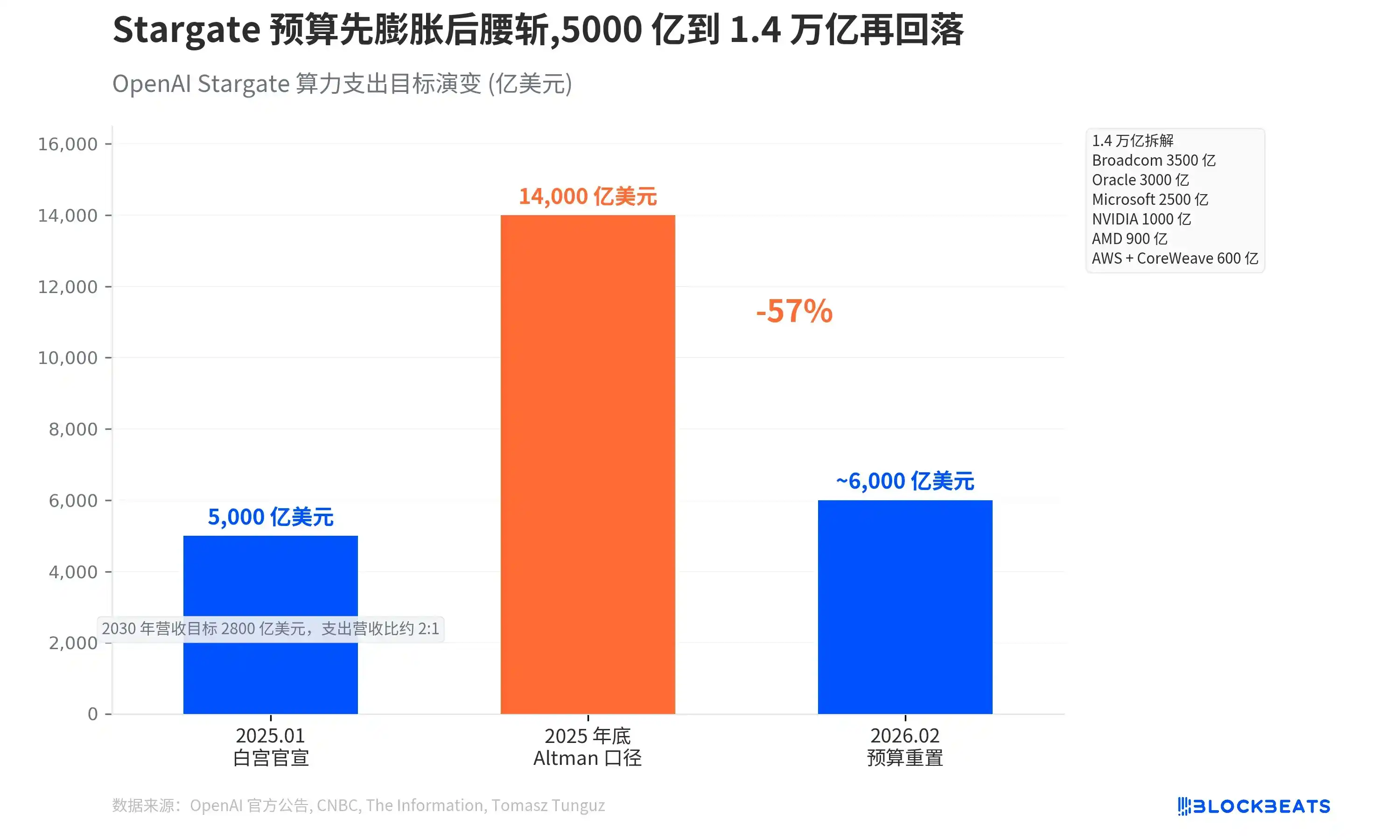
According to disassembled data from investor materials, the $1.4 trillion total commitment cited by Altman was distributed among seven suppliers. According to venture analyst Tomasz Tunguz's analysis of the investor materials, Broadcom accounted for $350 billion, Oracle $300 billion, Microsoft $250 billion, NVIDIA $100 billion, AMD $90 billion, with AWS and CoreWeave combining for $60 billion.

In February 2026, CNBC reported that this figure was reset to approximately $600 billion (by 2030), a 57% cut. The same report gave a slightly different but directionally consistent figure, with OpenAI expecting to spend $665 billion on cloud servers by 2030.

$600 billion is still a number that needs context. According to internal OpenAI forecasts, the company's revenue target for 2030 is $280 billion, meaning the cumulative spending-to-revenue ratio over five years is about 2:1. And according to internal financial data cited by ainvest, the company's projected loss for 2026 is $14 billion, with a gross margin of only 33% as reported by multiple media outlets (Note: Gross margin reflects the profitability of the product itself, while net loss is the final result after deducting all costs like R&D and management; the two can coexist).

Placing OpenAI's spending target within the panorama of the Big Tech computing arms race makes the proportions clearer.
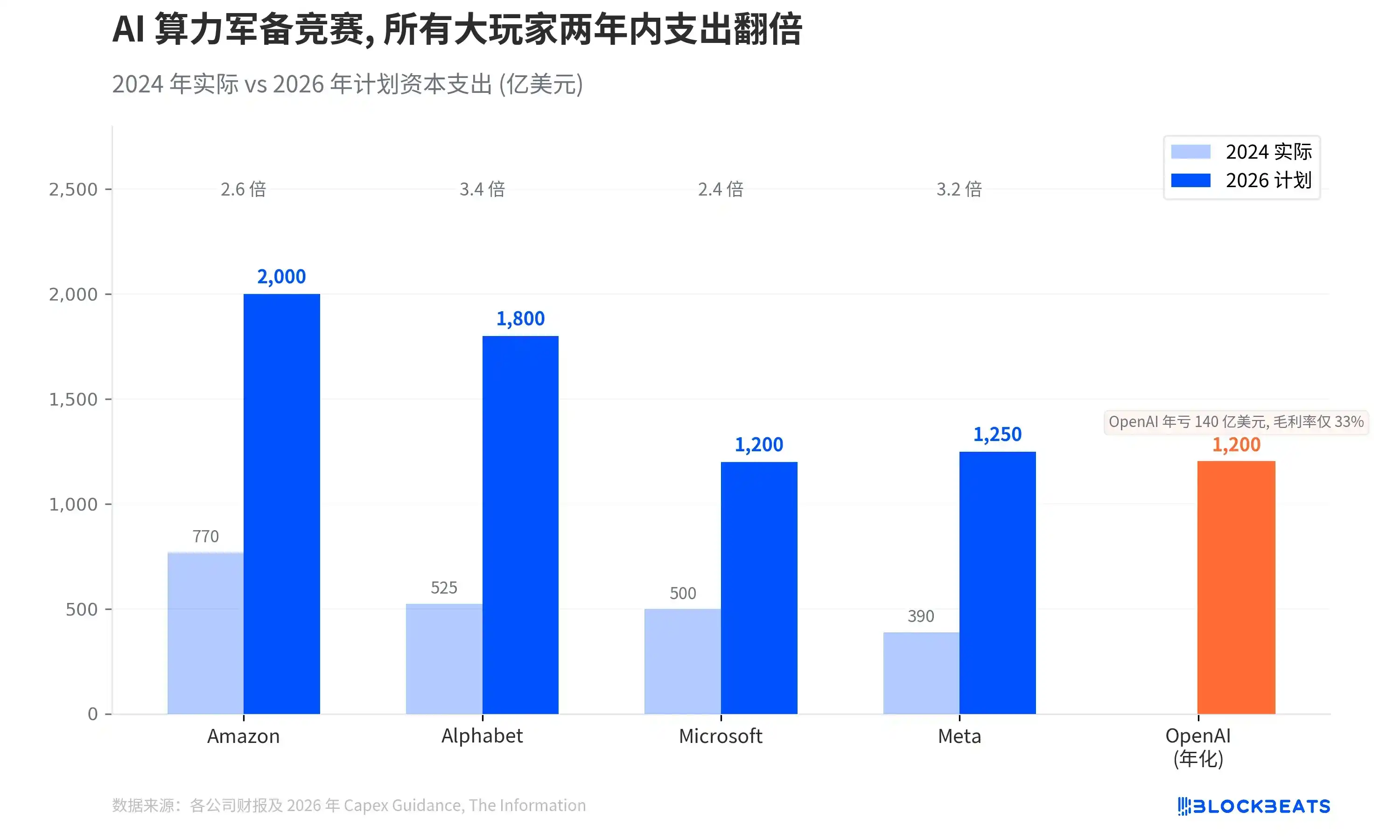
According to company financial reports and public Guidance, Amazon's planned capital expenditure for 2026 is $200 billion, Alphabet's is $180 billion, Meta's is $125 billion, and Microsoft's is approximately $120 billion. These four companies have seen their expenditures roughly double or triple within two years, totaling over $650 billion, with about three-quarters flowing into AI infrastructure.

OpenAI's $600 billion is a five-year cumulative target, annualized to about $120 billion, which is comparable to Microsoft's single-year capital expenditure. The difference is that Microsoft's annual revenue exceeds $240 billion, while OpenAI's annualized revenue has just reached $25 billion and is not expected to achieve positive cash flow before 2030.

The Stargate restructuring is more than just a change in budget numbers; the organizational adjustments reveal a deeper shift in direction.

The restructured Stargate is divided into three lines. The Epic business partnership group is led by longtime OpenAI employee and former Deloitte manager Peter Hoeschele, managing cloud contracts with Microsoft, Oracle, Amazon, and transactions with chip manufacturers. These deals include a multi-year contract with AMD (using up to 6 gigawatts of chips, costing up to 10% of AMD common stock) and an agreement with chip startup Cerebras Systems.
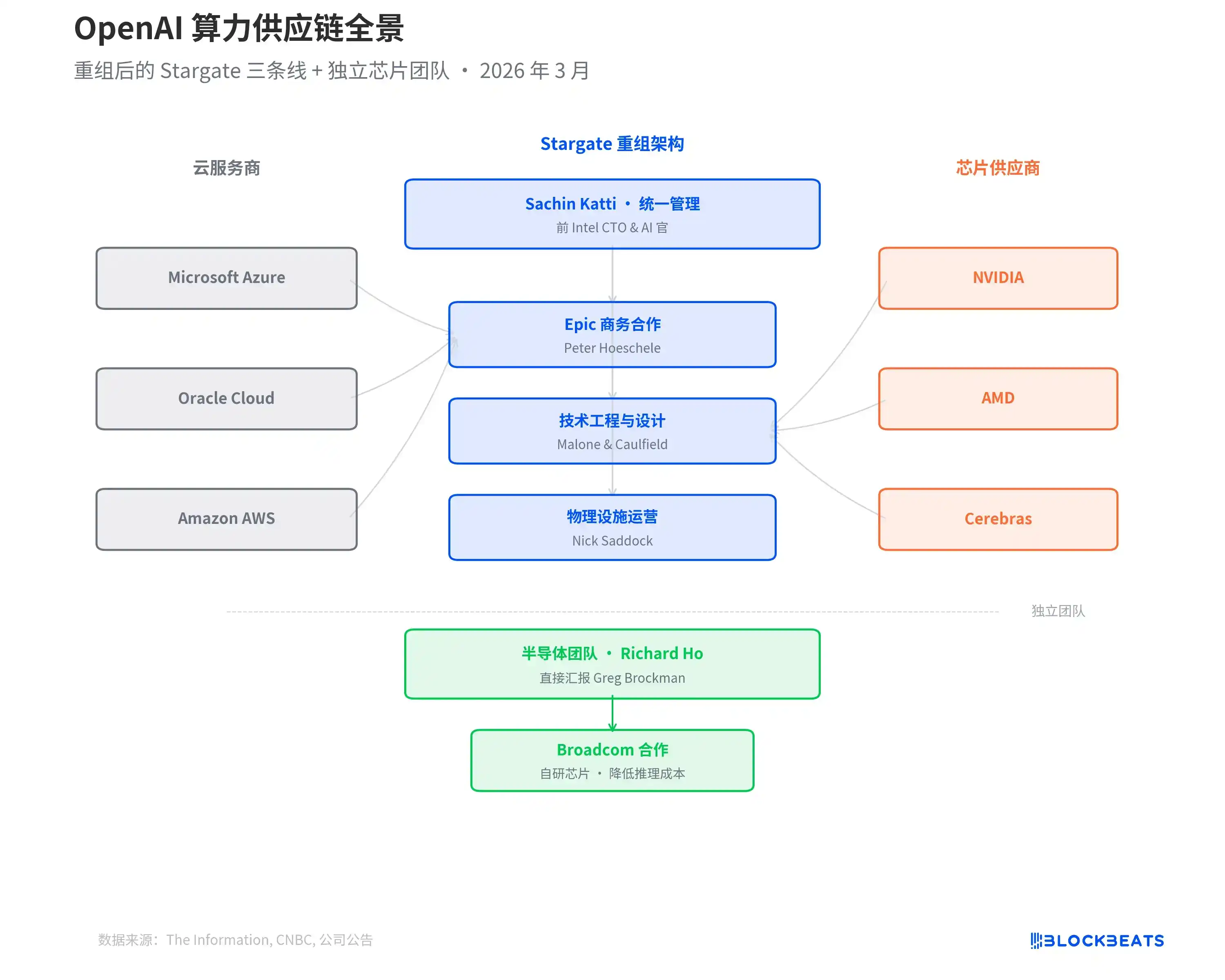
The technical engineering and design group is co-led by former Meta and Google engineer Chris Malone and former Microsoft engineering lead Adrian Caulfield, responsible for redesigning the AI server clusters used by OpenAI. The physical facilities operations group is led by former Google data center director Nick Saddock, replacing Keith Heyde who left weeks ago.

The semiconductor team led by former Google chip executive Richard Ho falls outside Katti's jurisdiction and reports directly to OpenAI President Greg Brockman. This team is collaborating with Broadcom to develop in-house chips, which OpenAI hopes will eventually reduce the inference costs of running products like ChatGPT.

The name "Stargate" remains, but what it refers to has completely changed. In January 2025, it was a joint venture with SoftBank and Oracle to build data centers. In March 2026, it is OpenAI's broad strategy for bringing gigawatt-scale server capacity online. It has gone from "I want to build my own power plant" to "I want to sign the best leases." The total planned capacity for all sites remains nearly 7 gigawatts, with a three-year investment total still exceeding $400 billion. OpenAI is shifting its computing direction towards NVIDIA's Vera Rubin platform, aiming to achieve the first gigawatt-scale capacity online in the second half of 2026.

Bacaan Terkait

Narasi BTC sebagai 'Emas Digital' Apakah Sudah Gagal?

Artikel ini menganalisis Bitcoin dari sudut pandang "aset digital" atau "emas digital", tanpa memberikan saran investasi. Penulis membahas tiga hal utama: **1. Bagaimana Memandang Bitcoin sebagai Aset:** Bitcoin dianggap sebagai kelas aset baru yang unggul dibandingkan emas dalam hal: jumlah terbatas (21 juta koin), kemampuan transfer yang mudah dan aman (kunci pribadi), dan transparansi/auditabilitas penuh (blockchain). Meski awalnya digunakan di area abu-abu, regulasi semakin mengatur. Adopsi global crypto saat ini sekitar 3-4%, menandakan fase awal dengan volatilitas tinggi namun juga potensi pertumbuhan jangka panjang. **2. Memahami Penurunan Harga Terkini:** Penurunan ~50% dari puncak $126k (Okt 2025) ke ~$61k (Feb 2026) dipandang sebagai penjualan siklis yang terprediksi pasca-*halving*, dan sebagai proses "peralihan kepemilikan" historis dari *early holders* ke investor institusional melalui ETF. Data historis menunjukkan tren penurunan persentase *drawdown* setiap siklus (dari >90% ke ~50%), mengindikasikan aset yang semakin matang. **3. Pandangan Jangka Panjang:** Kerangka analisisnya adalah membandingkan kapitalisasi pasar Bitcoin (~$1.4T pada $70k) dengan emas (~$20T). Bitcoin baru mencapainya sekitar 7%. Jika narasi "emas digital" terealisasi sebagian (misal, 30-50% kapitalisasi emas), ruang naiknya masih signifikan. Risiko terbesar bukanlah Bitcoin menjadi nol, melainkan manajemen portofolio yang buruk (seperti *all-in* atau pakai leverage) dan kurangnya pemahaman mendalam, yang bisa membuat investor *exit* dipaksakan sebelum potensi jangka panjang terwujud. Kesimpulan: Volatilitas tinggi adalah "harga" untuk potensi imbal hasil tinggi. Pertanyaan kuncinya adalah apakah penurunan ini menandakan kegagalan narasi "emas digital" atau hanya fase peralihan dalam evolusinya dari aset spekulatif ke aset alokasi. Jawabannya bergantung pada keyakinan mendasar terhadap aset ini.

marsbit8j yang lalu

Narasi BTC sebagai 'Emas Digital' Apakah Sudah Gagal?

marsbit8j yang lalu

Dari Kode ke Kognisi: Panduan Panjang Evolusi Otak Robot

**Dari Kode ke Kognisi: Evolusi Otak Robot** Era robot sebelumnya bergantung pada kode yang dirancang dengan hati-hati untuk persepsi, perencanaan, dan kontrol (seperti PID), membatasi kemampuan generalisasi. Kemajuan datang dengan pembelajaran mendalam untuk persepsi visual dan pembelajaran penguatan untuk kontrol motorik, tetapi kebijakan tetap sempit. Titik balik terjadi dengan munculnya Model Bahasa Besar (LLM). LLM bertindak sebagai perencana tingkat tinggi, menerjemahkan instruksi bahasa alami menjadi urutan keterampilan atomik untuk dieksekusi oleh sistem robot tradisional (seperti ROS2). Ini adalah lompatan besar, tetapi LLM hanya penjadwal cerdas, bukan penggerak langsung. Lompatan berikutnya adalah Model Visi-Bahasa-Aksi (VLA). Model ini menggabungkan persepsi visual dan instruksi bahasa langsung ke dalam satu jaringan neural untuk menghasilkan perintah gerakan, menyatukan penalaran dan tindakan. Ini memungkinkan generalisasi yang lebih baik. Arsitektur populer (seperti di Figure AI, NVIDIA GR00T) menggunakan sistem "otak ganda": Model S2 yang besar dan lambat (7-9Hz) untuk penalaran tingkat tinggi, dan model S1 yang kecil dan cepat (200Hz) untuk menghasilkan gerakan halus. Lapisan S0 (1kHz) menangani keseimbangan dan koordinasi refleksif. Komputasi untuk kontrol keselamatan yang kritis dijalankan secara lokal di papan (mis., pada NVIDIA Jetson) karena masalah latensi dan keandalan jaringan. Cloud digunakan untuk antarmuka percakapan dan pembelajaran kumpulan data. Model sumber terbuka (seperti OpenVLA, NVIDIA GR00T, π0) sangat penting, memungkinkan startup mengadaptasi model dasar dengan data robot mereka sendiri, mempercepat inovasi. Namun, VLA masih memiliki keterbatasan: pemulihan kesalahan, efisiensi sampel, generalisasi lintas platform, perencanaan jangka panjang, dan pemahaman fisika yang mendalam. Di sinilah **Model Dunia** menjadi kunci. Model Dunia adalah jaringan neural yang memprediksi keadaan dunia masa depan berdasarkan keadaan saat ini dan tindakan yang diusulkan (misalnya, menghasilkan video yang disimulasikan). Ini memungkinkan robot untuk "berpikir sebelum bertindak", mensimulasikan berbagai skenario, mengevaluasi hasil, dan memilih tindakan terbaik sebelum eksekusi. Pendekatan ini meningkatkan pemulihan, generalisasi, perencanaan, keamanan, dan memungkinkan pembangkitan data sintetis skala besar. Arsitektur utama termasuk difusi video tingkat piksel (Cosmos/Sora), JEPA (LeCun), dan model dunia tindakan laten (Genie). Masa depan robot humanoid mungkin menggabungkan VLA dengan Model Dunia untuk perencanaan berbasis simulasi. Data (terutama melalui operasi jarak jauh) tetap menjadi penghalang utama. Sementara narasi "momen ChatGPT" untuk robot agak menyesatkan (saat ini lebih mirip era GPT-2), kemajuan menuju robot yang mampu beradaptasi secara umum sangat cepat. Evolusi dari kode buatan ke model dunia yang dipelajari secara perlahan memindahkan kecerdasan dari pikiran insinyur ke dalam sistem yang mampu memahami dan membayangkan dunia.

marsbit9j yang lalu

Dari Kode ke Kognisi: Panduan Panjang Evolusi Otak Robot

marsbit9j yang lalu

Trading

Spot
Futures
活动图片