Netting $2.4 Million: These 9 Insider Addresses Knew the US-Iran War Best

marsbitDipublikasikan tanggal 2026-05-25Terakhir diperbarui pada 2026-05-25

Abstrak

On May 18th, Bubblemaps investigators disclosed the discovery of nine highly correlated anonymous accounts on Polymarket that netted over $2.4 million from prediction markets tied to US military actions, with a 98% win rate. The accounts focused almost exclusively on the 2026 US-Iran conflict, placing bets with uncanny precision days before key events like the "Operation Epic Fury" strike on February 28th, which eliminated Iran's Supreme Leader. Bubblemaps' analysis linked four core accounts—each profiting around $400k—and five others through synchronized timing, transaction patterns, and fund flows. The money moved through shared wallet networks, suggesting professional obfuscation. This case is six times larger than the earlier prosecution of US Army Sergeant Gannon Van Dyke for insider trading on Polymarket. While platforms like Polymarket have established AI monitoring and explicit rules against trading on stolen or confidential information, the incident has spurred controversial "insider copy-trading" services that help users follow high-success accounts, raising new regulatory questions.

Written by: Mahe, Foresight News

On May 18, Nicolas Vaiman, founder of Bubblemaps, and lead investigator Deebs (a pseudonym used by a former U.S. military officer for safety reasons) disclosed to the public: they discovered nine highly correlated anonymous accounts on Polymarket that collectively netted over $2.4 million from prediction markets related to U.S. military actions, with a winning rate as high as 98%.
Bubblemaps provided a detailed analysis of these accounts on Twitter. They almost exclusively bet on military events related to the US-Iran conflict in 2026, with timing so precise it was chilling—often placing bets just days before key actions occurred, and favoring long-odds, low-probability options.

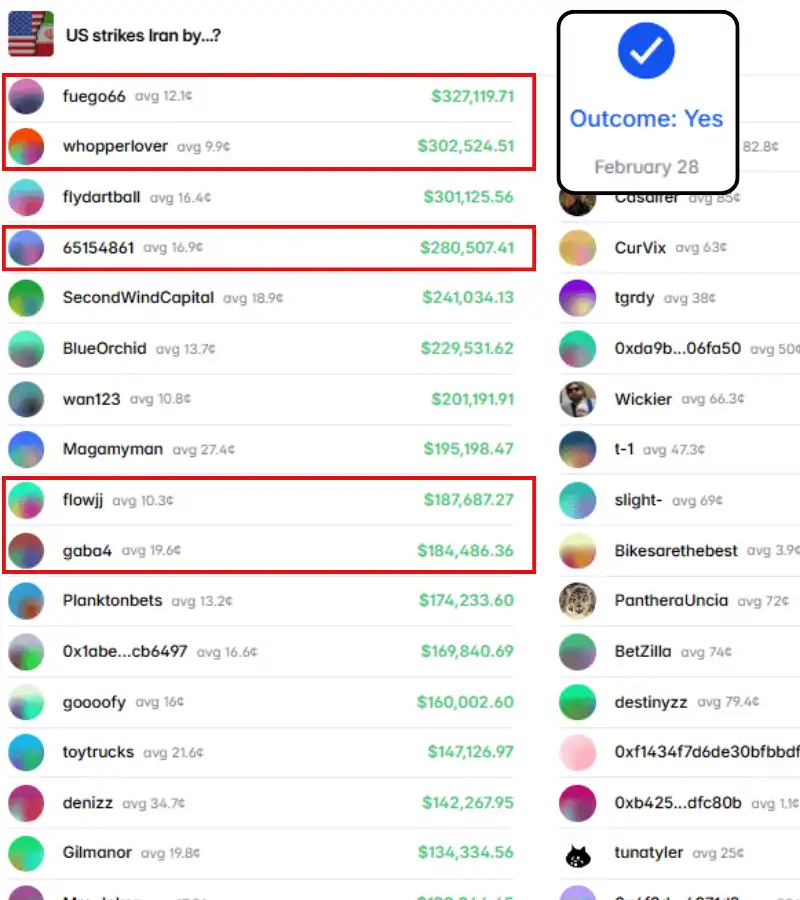
This wasn't simply "good luck." After visualizing the trades in the "Will the US strike Iran for the first time before February 28?" market on Polymarket, Bubblemaps discovered a massive pink cluster previously unmentioned on the X platform.
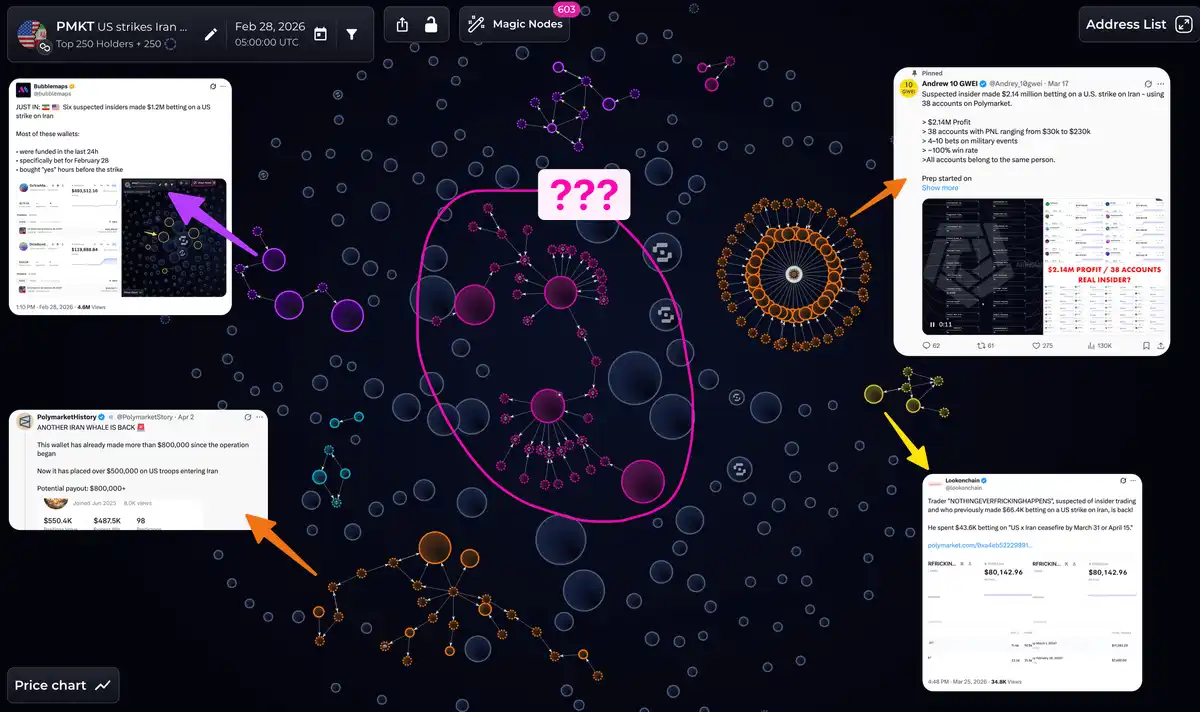
Further investigation linked the initial 4 accounts to another 5 through identical time windows, trade sizes, and fund flow paths. The nine accounts followed highly consistent funding paths: funds were transferred via centralized exchanges into a shared wallet network within an extremely short timeframe, with suspected use of professional services to hide traces.

4 Core Accounts Each Earned $400,000

In the early morning of February 28, 2026, the United States and Israel launched large-scale joint strikes codenamed "Operation Epic Fury" and "Lion's Roar." US-Israeli forces conducted nearly 900 strikes against Iran within 12 hours, targeting nuclear facilities, missile bases, military command centers, and hideouts of senior leaders. Iran's Supreme Leader Ali Khamenei and several of his family members, along with senior commanders of the Revolutionary Guard Corps, were killed in the initial strikes.

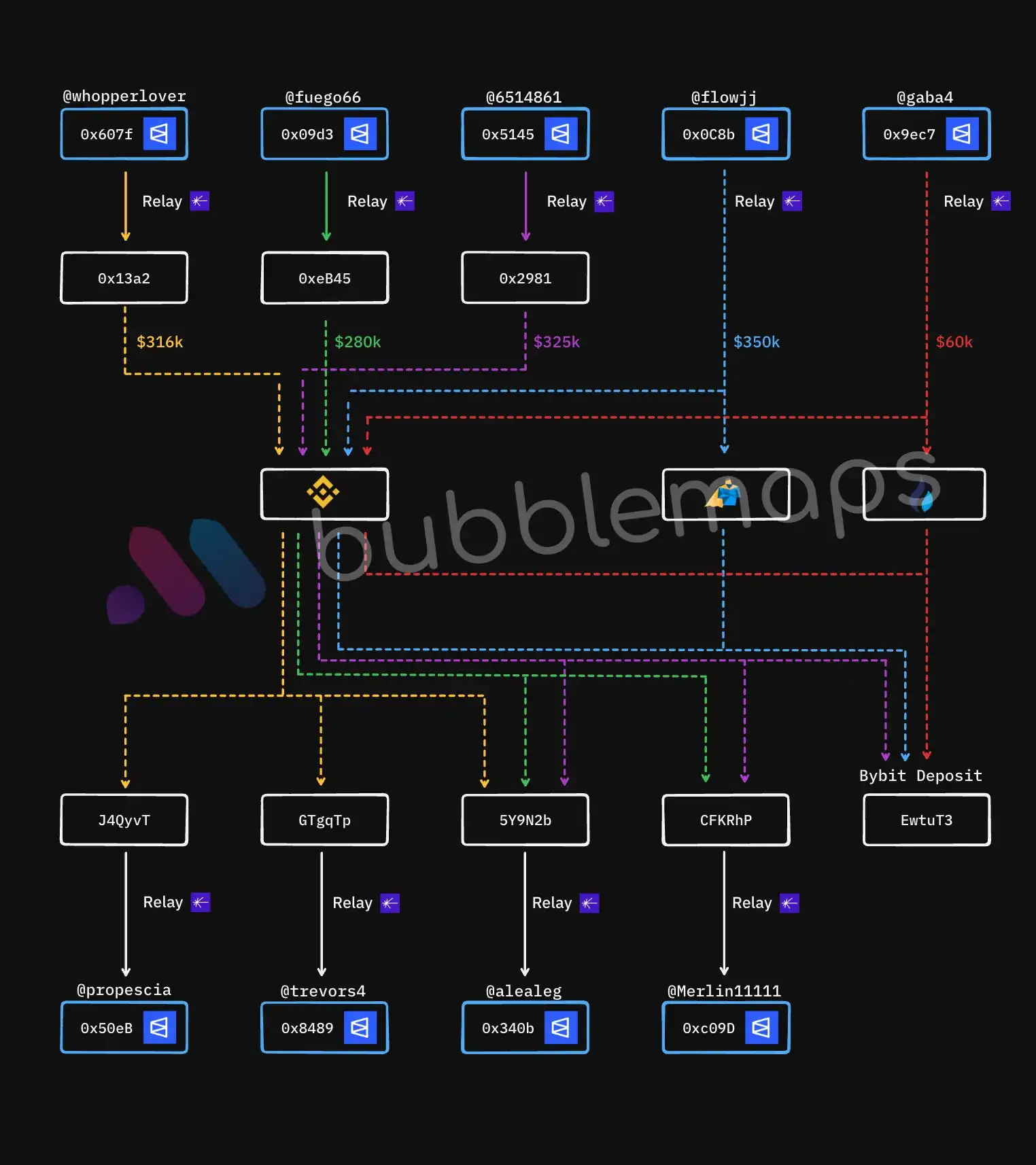
As early as the day of the February 28 strikes, Bubblemaps had publicly flagged six "fresh" accounts. Most of these accounts were created and funded within 24 hours before the strike, accurately betting on "the US will strike Iran before February 28," collectively netting about $1 million (some reports said $1.2 million). At the time, market odds were extremely low, yet these accounts heavily bet on them. Bubblemaps called it "suspected insider trading."

Five months later, the nine-account cluster they discovered was larger and had a higher win rate.
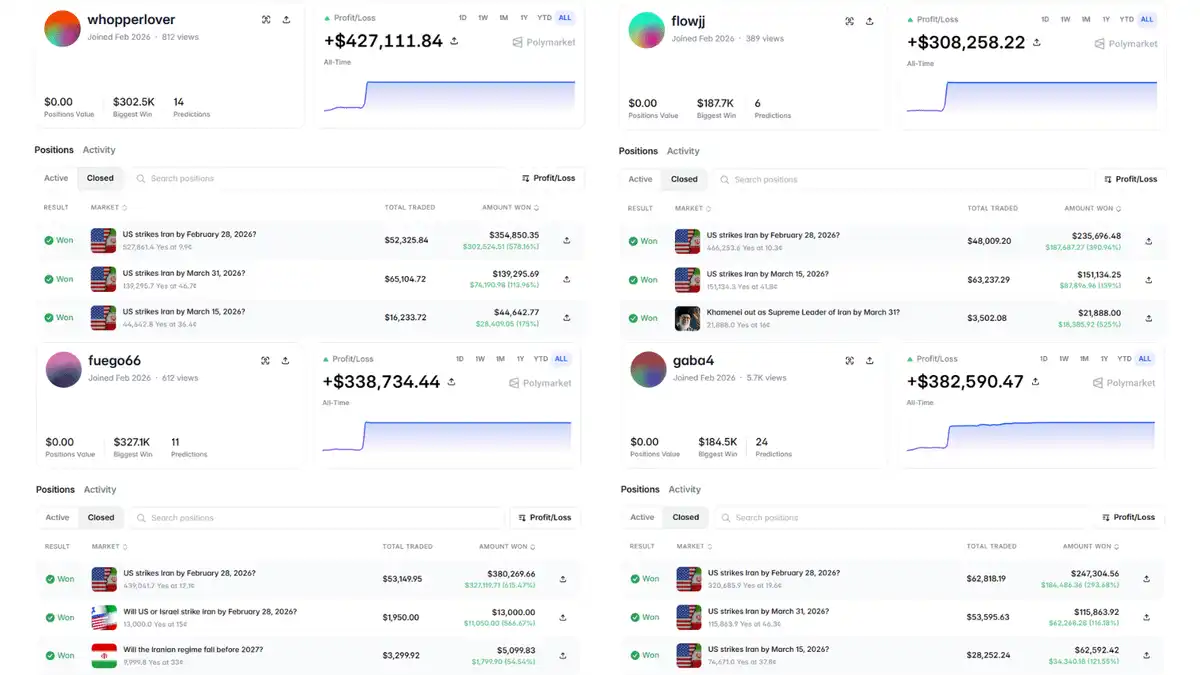
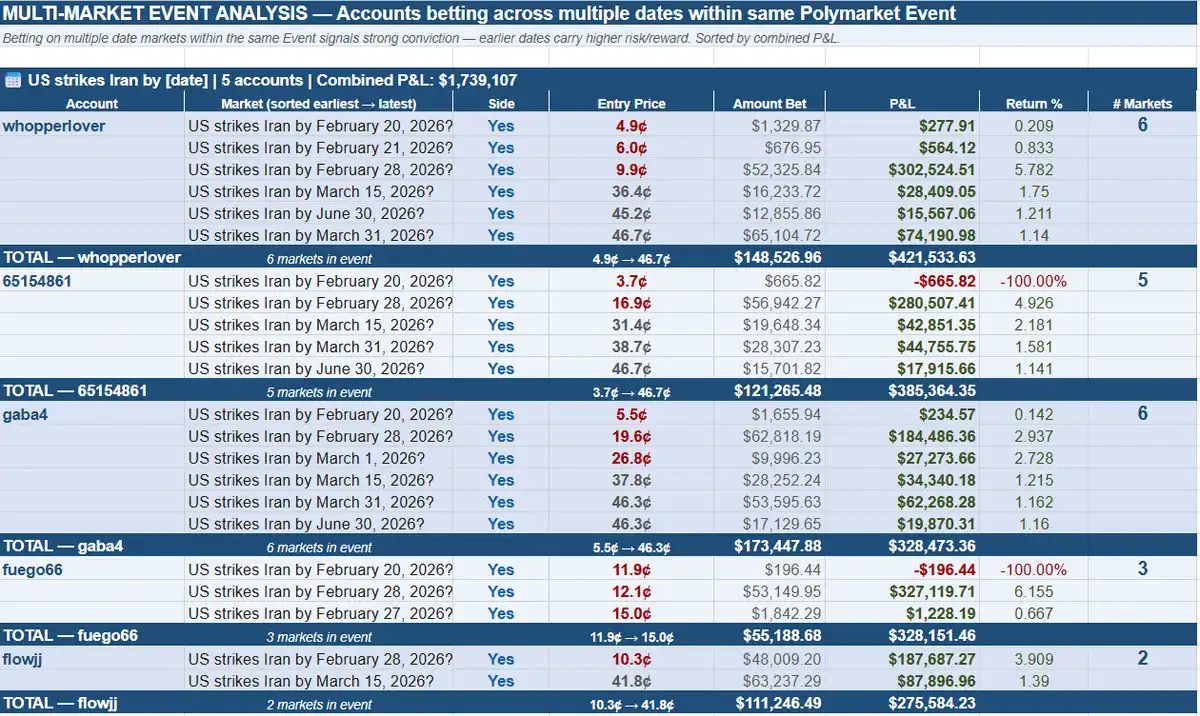
The four core accounts were created a few days before February 28, each earning about $400,000; the subsequent five accounts were linked through fund flows and trade overlaps. The nine accounts placed over 80 bets, almost all on US military actions: the first strike on February 28, the specific timing of Khamenei's elimination, the announcement of a ceasefire agreement, etc. They even placed bets spread across multiple dates to maximize gains, while occasionally placing one or two small losing bets (like on February 20), likely as cover.
Bubblemaps listed the nine Polymarket wallet addresses (including 0x09d3273fa76282ce09f4f35a87d6f087c05f4e84, etc.), emphasizing that these accounts have long dominated the profit/loss leaderboards. Funds ultimately flowed to a shared wallet network, showing signs of professionalized money laundering or service use.
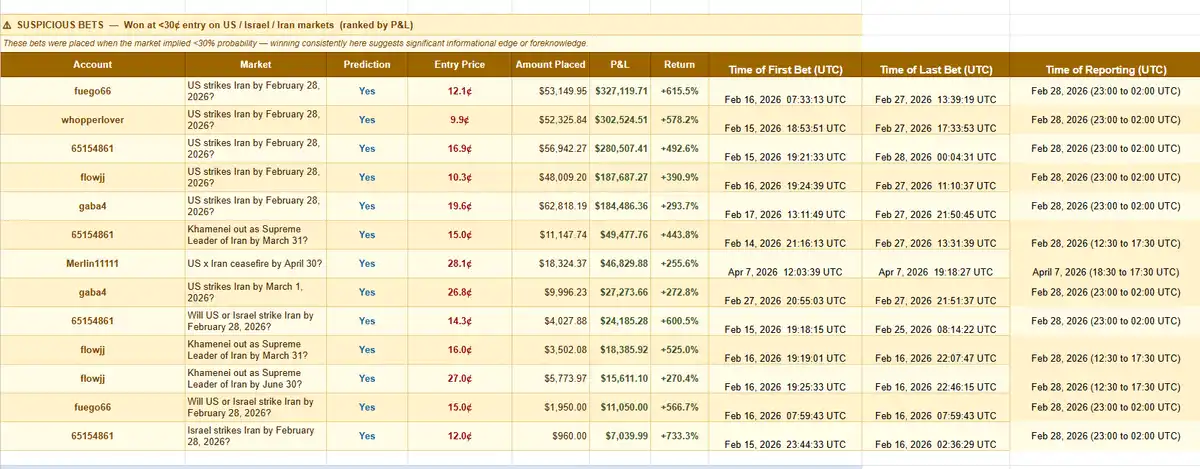
Vaiman stated bluntly: "Luck cannot explain these numbers." Deebs added that potential insider sources are numerous—government officials, military planners, intelligence analysts, even family members of military personnel.
Earlier this year, US Army Staff Sergeant Gannon Ken Van Dyke was charged with using classified intelligence to bet on special operations in Venezuela on Polymarket, investing $34,000 to profit $400,000 before quickly withdrawing funds and attempting to delete the account. Polymarket cooperated closely with law enforcement, ultimately leading to the prosecution. The Van Dyke case is seen as a landmark case for insider trading in prediction markets.

This nine-account cluster's profit is six times that amount, with a higher win rate, and is entirely concentrated on US-Iran military events.
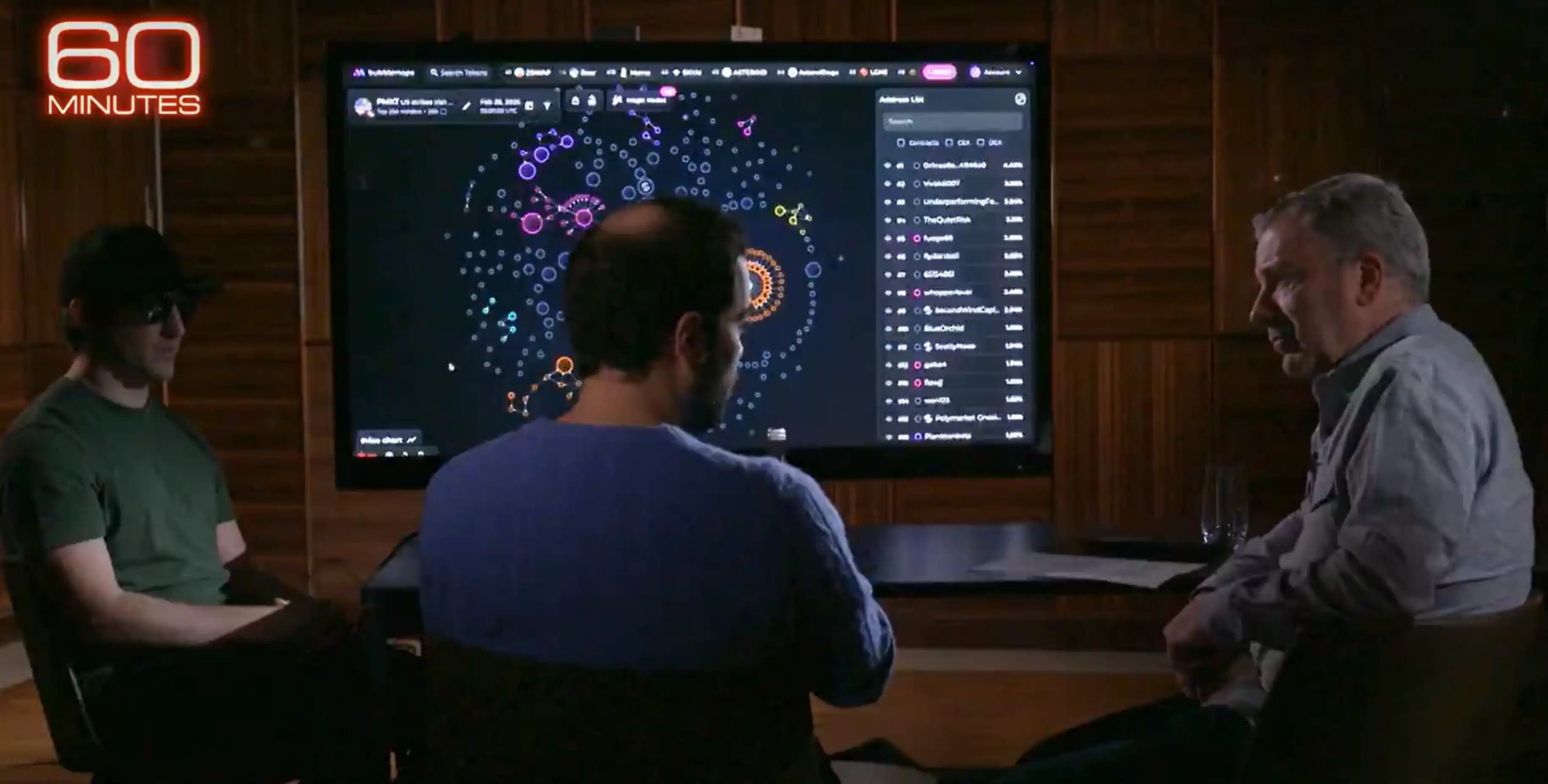
Bubblemaps exclusively shared the investigation with "60 Minutes." The segment aired on the evening of May 17, garnering significant attention. The CBS report noted that Polymarket has established AI monitoring and blockchain forensics systems, reporting suspicious activities to law enforcement authorities once detected, and emphasized that "insider trading is not welcome on the platform."

As of publication, Bubblemaps has not directly linked the nine accounts to any specific entity or government agency, stating only that "the correlation and near-perfect win rate raise serious suspicions."

Fighting Insider Trading vs. Copying Insider Trading

Insider trading makes many market participants feel the game is unfair. Prediction market platforms, including Kalshi and Polymarket, are taking more measures to combat it.

In late March this year, Polymarket updated its market integrity rules for its DeFi platform and its US exchange regulated by the U.S. Commodity Futures Trading Commission (CFTC). The updated rules clarify three core prohibited insider trading behaviors:

  • Trading using stolen confidential information—Participants may not trade any contracts if they possess confidential information about the outcome or likely outcome of an underlying event, and using that information would breach a pre-existing duty of trust or confidence owed to another person or entity.
  • Prohibition on trading using illegal insider tips—Participants may not trade using confidential information provided to them by another person, if the information was provided by someone who owed a pre-existing duty of trust or confidence to another, and the participant knows or has reason to know that the person providing the information themselves would be prohibited from trading on it.
  • Trading by those able to influence the outcome—Participants may not trade any contracts if they have authority or influence sufficient to affect the outcome of the underlying event.

However, rules always have loopholes. Since insider trading cannot be completely eradicated, some ill-intentioned so-called "insider copy-trading projects" have also sparked controversy. These applications compile trading accounts with abnormally high win rates for users, or flag suspiciously timed, abnormally sized trades, helping users copy these trades with one click.

Kreo's selling point is helping users "find insider traders before others." Polycool directly posts a "Polymarket Insider Trading Guide" on its website, stating "This isn't the stock market, betting with non-public information won't land you in jail, the rules for decentralized prediction markets are completely different."

A question then arises: does copying trades from insider trading addresses constitute a violation?

There has been no official response yet.

However, so-called "insider copy-trading platforms" like PolyGUN and Polycule have suffered hacker attacks this year, incurring losses ranging from tens of thousands to hundreds of thousands of dollars.


Pertanyaan Terkait

QWhat did Bubblemaps investigators discover about a group of anonymous accounts on Polymarket?

ABubblemaps investigators discovered nine highly correlated anonymous accounts that collectively netted over $2.4 million from prediction markets related to US military actions, with a win rate of 98%. They were primarily focused on US-Iran conflict events in 2026.

QAccording to the article, what characteristics made the trading activity of these nine accounts highly suspicious?

AThe accounts were highly suspicious because they placed bets almost exclusively on US-Iran military events, their timing was unnervingly precise (often days before key actions), they preferred low-odds, long-term options, and they used shared wallet networks and professional services to obscure fund flows.

QWhat is the name of the US soldier mentioned in the article who was charged for insider trading on Polymarket, and what was his profit?

AThe US soldier mentioned is US Army Staff Sergeant Gannon Ken Van Dyke. He was charged for using classified intelligence to bet on a Venezuelan special operations event on Polymarket, investing $34,000 and making a profit of $400,000.

QWhat are the three core types of prohibited insider trading behaviors outlined in Polymarket's updated market integrity rules?

AThe three core prohibited behaviors are: 1) Trading using stolen confidential information. 2) Trading using illegal insider information provided by someone who breached a duty of trust. 3) Trading by individuals who have the authority or influence to affect the outcome of the event.

QWhat controversial practice related to potential insider trading has emerged on prediction market platforms according to the article?

AThe controversial practice is the emergence of 'insider copy-trading' platforms or applications. These services identify accounts with suspiciously high win rates or anomalous trades, allowing users to copy their bets, essentially attempting to profit from potential insider information.

Bacaan Terkait

Bitcoin Mengincar Dukungan $60.000 Saat Serangan Iran Menghantam Pasar Kripto

Pedagang Bitcoin mengawasi level support $60.000 setelah dana ETF Bitcoin AS mengalami penarikan $519 juta dalam sehari, memperpanjang aliran keluar yang telah mengguncang pasar. Cryptocurrency ini turun 4,5% pada hari Rabu, menyentuh rendah harian $65.700 sebelum pulih ke sekitar $67.100. Penurunan ini terjadi dalam rentang pelemahan yang dimulai ketika Bitcoin jatuh di bawah $73.000 awal pekan ini, dipicu oleh serangan AS baru terhadap target Iran yang mengganggu ketenangan sementara pasca pembicaraan gencatan senjata. Penarikan dari dana spot Bitcoin mencapai $1,44 miliar selama seminggu, total mingguan terberat di tahun 2026. Laporan serangan rudal di markas Armada ke-5 AS di Bahrain menambah ketegangan di pasar yang sudah tegang akibat konflik, yang memengaruhi harga minyak, kekhawatiran inflasi, dan prospek pemotongan suku bunga. Bitcoin kini turun sekitar 47% dari puncak Oktober 2025 sebesar $126.000, dengan setiap gejolak konflik memicu gelombang penjualan baru. Tekanan juga datang dari kenaikan harga minyak mentah Brent di atas $106 per barel pada pertengahan April 2026, yang meningkatkan kekhawatiran inflasi. Analis teknis kini berfokus pada level pertahanan berikutnya, mencatat bahwa Bitcoin telah kehilangan level $72.000 dan $68.000. Penutupan di bawah $65.000 dapat membuka jalan menuju uji level $60.000, yang kini menjadi fokus utama pasar untuk menentukan apakah penurunan ini hanya jeda atau awal dari tren bearish yang lebih dalam.

bitcoinist1j yang lalu

Bitcoin Mengincar Dukungan $60.000 Saat Serangan Iran Menghantam Pasar Kripto

bitcoinist1j yang lalu

Pengakuan Seorang KOL Pasar Saham AS: Pasar Bull AI Belum Berakhir, Tapi Risiko Sudah Dekat

Sebagai seorang yang sangat optimis terhadap AI, penulis mengakui bahwa meskipun pasar bull AI belum berakhir, risiko semakin mendekat. Penulis merefleksikan keberhasilannya dalam perdagangan saham seperti NVDA, AMD, dan lainnya selama 2,5 tahun terakhir, yang lebih disebabkan oleh kondisi pasar yang bullish secara keseluruhan daripada pilihan saham yang brilian. Esai ini mengidentifikasi empat pilar yang mendukung pasar bull saat ini: (1) Fundamental mikro perusahaan yang tampak sangat solid (gelembung PE rendah), (2) Likuiditas makro yang melimpah dan deregulasi, (3) Rantai pasokan semikonduktor yang tegang dan kurang terkendali, serta (4) Ekspektasi pendapatan dari model AI (seperti OpenAI dan Anthropic) yang sangat tinggi untuk membenarkan pengeluaran modal besar (capex) hyperscaler. Namun, penulis memperingatkan adanya "titik kelemahan" (fatal flaw). Kekurangan kapasitas komputasi menyebabkan penurunan kualitas output model (seperti Opus 4.8), yang dapat memperlambat pertumbuhan penggunaan token dan mempertanyakan kelayakan ekonomi capex besar-besaran. Jika ekspektasi terhadap pertumbuhan pendapatan model AI goyah, seluruh narasi yang mendukung valuasi semikonduktor bisa runtuh, mengungkap sifat siklisnya. Kesimpulannya, gelembung PE rendah ini tangguh namun rentan. Penulis menyarankan untuk tetap berpartisipasi (stay long) tetapi dengan kewaspadaan tinggi, selalu siap untuk bereaksi cepat jika "DJ" (penanda perubahan tren) menghentikan musiknya. Revolusi AI akan terus berlanjut, tetapi pasar mungkin akan mengalami koreksi yang menyakitkan.

marsbit1j yang lalu

Pengakuan Seorang KOL Pasar Saham AS: Pasar Bull AI Belum Berakhir, Tapi Risiko Sudah Dekat

marsbit1j yang lalu

Trading

Spot
Futures

Artikel Populer

Cara Membeli WAR

Selamat datang di HTX.com! Kami telah membuat pembelian WAR (WAR) menjadi mudah dan nyaman. Ikuti panduan langkah demi langkah kami untuk memulai perjalanan kripto Anda.Langkah 1: Buat Akun HTX AndaGunakan alamat email atau nomor ponsel Anda untuk mendaftar akun gratis di HTX. Rasakan perjalanan pendaftaran yang mudah dan buka semua fitur.Dapatkan Akun SayaLangkah 2: Buka Beli Kripto, lalu Pilih Metode Pembayaran AndaKartu Kredit/Debit: Gunakan Visa atau Mastercard Anda untuk membeli WAR (WAR) secara instan.Saldo: Gunakan dana dari saldo akun HTX Anda untuk melakukan trading dengan lancar.Pihak Ketiga: Kami telah menambahkan metode pembayaran populer seperti Google Pay dan Apple Pay untuk meningkatkan kenyamanan.P2P: Lakukan trading langsung dengan pengguna lain di HTX.Over-the-Counter (OTC): Kami menawarkan layanan yang dibuat khusus dan kurs yang kompetitif bagi para trader.Langkah 3: Simpan WAR (WAR) AndaSetelah melakukan pembelian, simpan WAR (WAR) di akun HTX Anda. Selain itu, Anda dapat mengirimkannya ke tempat lain melalui transfer blockchain atau menggunakannya untuk memperdagangkan mata uang kripto lainnya.Langkah 4: Lakukan trading WAR (WAR)Lakukan trading WAR (WAR) dengan mudah di pasar spot HTX. Cukup akses akun Anda, pilih pasangan perdagangan, jalankan trading, lalu pantau secara real-time. Kami menawarkan pengalaman yang ramah pengguna baik untuk pemula maupun trader berpengalaman.

263 Total TayanganDipublikasikan pada 2024.12.11Diperbarui pada 2026.06.02

Cara Membeli WAR

Diskusi

Selamat datang di Komunitas HTX. Di sini, Anda bisa terus mendapatkan informasi terbaru tentang perkembangan platform terkini dan mendapatkan akses ke wawasan pasar profesional. Pendapat pengguna mengenai harga WAR (WAR) disajikan di bawah ini.

活动图片












