Could This Be BTC's 2028 Diamond Bottom?

marsbitDipublikasikan tanggal 2026-02-27Terakhir diperbarui pada 2026-02-27

Abstrak

The article "Is This the 2028 Diamond Bottom for BTC?" analyzes Bitcoin's sharp and unexplained price decline in early 2026, describing it as the worst start to a year since 2016. Unlike previous major crashes—such as the 2018 ICO bust or the 2022 collapse triggered by Luna and FTX—this downturn lacks a clear catalyst, deepening market fear and uncertainty. Quantitative indicators suggest the market is in a state of extreme panic, with a "fear and greed index" of 11, levels historically seen only during major bottoms like the 2018 $3K low or the 2022 $16K FTX crisis. Other metrics, however—such as MVRV, price relative to the 200-week moving average, and miner shutdown proximity—have not yet reached typical bottom signals. Despite the bearish sentiment, some positive signs exist: significant USDT outflows indicate reduced leverage, and large short-term whales are facing substantial losses, which may limit further selling pressure. The author does not definitively call a bottom but argues that extreme fear often precedes strong rebounds and that $65K may offer a relatively high margin of safety. Historically, periods of irrational pessimism have often later been viewed as diamond-bottom opportunities.

Author: Chain Research Society

Could This Be BTC's 2028 Diamond Bottom?

2026 has undoubtedly been Bitcoin's worst start to a year in the past decade.

From the opening drop on January 1st to now, BTC has fallen from $109K to $65K, a year-to-date decline of 24%. ETH has fared even worse, dropping 34%. This is BTC's worst start to a year since 2016.

But this time is different. This crash seems to have no reason.

I. An Unexplained Drop is the Deepest Fear

In 2018, it fell 73% because the ICO bubble burst, with countless shitcoins going to zero. In 2022, it fell 77% due to the Luna collapse, Three Arrows Capital, and the FTX implosion. Every crash had a clear reason.

Every time, you knew where the enemy was and how long it would take to rebuild trust. So what about 2026?

• No exchange blow-ups

• No algorithmic stablecoin collapses

• No major hacks

• No country banning BTC

It just fell. Fortune magazine said: The worst start ever, but without a clear crash catalyst.

A crash with a reason often leads to a vengeful rebound once the negative news is exhausted; but an unexplained drop is like a slow bleed. When everyone asks why it's falling but gets no answer, panic escalates exponentially.

II. Have the Bottom-Fishing Indicators Bottomed Out?

Current quantitative indicators show the market has entered an irrational selling vacuum zone.

According to the latest data on February 25th, our bottom-fishing model currently shows a signal of only 1/5, indicating it's still early for a true bottom (Data source: fuckbtc).

❌ MVRV < 1.0

❌ Price ≤ 200-week moving average

❌ Price < P25

✅ Fear & Greed Index ≤ 25 (Extreme Fear: 11)

❌ Approaching miner shutdown price (Nearly half the machines are close to shutting down)
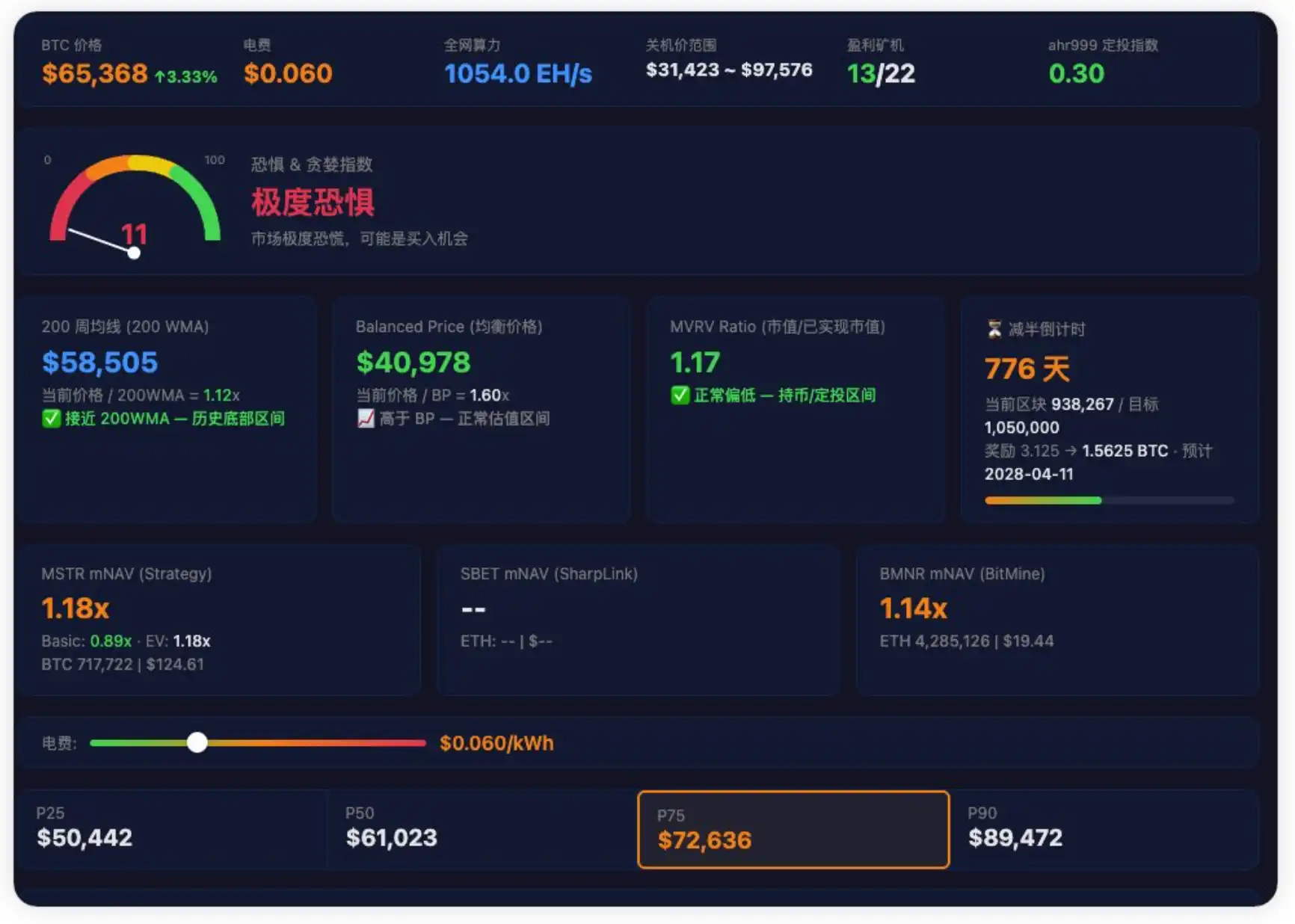
This level of extreme fear has only appeared historically at the end of 2018 at $3,000 and during the FTX crisis at $16,000. Although the price is still at $65,000, the market's psychological defense line has retreated to doomsday mode.

III. Positive Signals Under the Ice: Who's Exiting? Who's Bagholding?

Despite the freezing sentiment, there are also some positive signals:

1. USDT has seen a net outflow of $3B over 60 days. A similar scale of contraction last occurred at the end of 2022 during the FTX crash, when BTC was at $16K. BTC is now at $64K, four times higher than then.

The intensity of capital withdrawal is similar, indicating that场内杠杆 (on-exchange leverage) and weak hands have been cleaned out quite thoroughly.

2. Short-term whales have unrealized losses of $26B. Most of these players built positions between $90K-$120K and are now down 40%. The selling pressure for further significant declines should be less substantial.

Historical experience suggests that when large funds are bagholding at this depth, active selling pressure tends to dry up—because selling at a loss loses its logical meaning.

➤ My View

I am not predicting this is the bottom (it likely isn't).

But I know:

• Extreme Fear (11) has appeared.

• Historically, unexplained drops often fall deeper but also rebound more fiercely.

• At the $65K level, the margin of safety is already relatively high.

Those who called $3K the bottom in 2018 were right. Those who called $16K the bottom in 2022 were right. Those calling $64K the bottom in 2026—might be right, might be wrong.

I don't know.

But what I do know is: Panic always passes. Once trust is rebuilt, the price returns.

If you are still holding cash at this level, at least you have avoided the most violent drawdown phase. Historically, sentiment often bottoms before the price.

History repeats: After the Mt.Gox hack in 2015, people also thought trust could not be rebuilt; but looking back, every unexplained darkest hour eventually became the diamond bottom leading to the next cycle. The $64,000 of 2026 might just be the number you look back on in 2028, regretting not having bought more.


Pertanyaan Terkait

QWhat is the current market sentiment for Bitcoin according to the Fear and Greed Index mentioned in the article?

AThe Fear and Greed Index is at 11, indicating extreme fear'.

QWhat is the author's view on whether $64,000 is the bottom price for Bitcoin in 2026?

AThe author does not predict that $64,000 is definitely the bottom, stating it 'might be right, might be wrong,' but highlights that it offers a relatively high margin of safety and could be seen as a 'diamond bottom' in hindsight by 2028.

QWhat positive signals does the article mention that are happening beneath the surface of the market panic?

AThe positive signals mentioned are: 1) USDT has seen a net outflow of $3B over 60 days, indicating leveraged and floating筹码 have been cleaned out. 2) Short-term whales are facing $26B in unrealized losses, which suggests selling pressure may be exhausted as cutting losses lacks logical sense at this depth.

QHow does the article characterize the current Bitcoin price drop compared to the crashes of 2018 and 2022?

AThe article states that unlike the 2018 crash (caused by ICO bubble burst) and the 2022 crash (caused by Luna collapse, Three Arrows Capital, and FTX implosion), the 2026 drop has no clear catalyst or reason, which creates a deeper fear as it is a form of chronic blood loss rather than a sharp event with a known enemy.

QAccording to the 'buy the dip' model cited (fuckbtc), how many of its 5 signals were triggered as of February 25th?

AOnly 1 out of the 5 signals from the 'buy the dip' model was triggered as of February 25th. The Fear and Greed index was ≤25 (it was 11), but the other four conditions (MVRV

Bacaan Terkait

Bank Italia Tidak Melihat Keunggulan Sistemik Stablecoin dalam Transfer

Studi Bank Italia menunjukkan bahwa stablecoin tidak memberikan keunggulan sistemik yang berkelanjutan dalam hal biaya dan kecepatan transfer uang. Semua keuntungan hilang akibat biaya untuk deposit dan penarikan ke/dari fiat serta proses dalam infrastruktur pembayaran lokal. Peneliti membandingkan transfer 200 USDC di 10 koridor bilateral antara Italia dengan Brasil, Argentina, Jepang, UEA, dan Afrika Selatan. Metriknya adalah biaya total dan waktu penyelesaian dibandingkan layanan uang standar. Biaya akhir transfer stablecoin bervariasi dari 0,3% hingga hampir 9%, tergantung arahnya. Di koridor dengan sistem pembayaran instan, penyelesaian membutuhkan waktu kurang dari 20 menit. Sementara di daerah tanpa infrastruktur tersebut, proses memakan waktu satu hingga dua hari kerja. Biaya dan penundaan utama dikaitkan dengan pertukaran dan konversi mata uang, serta kualitas infrastruktur lokal. Komisi blockchain bukan faktor utama. Rata-rata biaya transfer uang global adalah 6,65%. Di sebagian besar koridor yang diteliti, stablecoin lebih murah dari level ini, namun dibandingkan dengan Wise, stablecoin hanya lebih unggul di tiga dari tujuh rute yang sebanding. Penulis berpendapat efeknya akan lebih terasa jika stablecoin bisa dibelanjakan langsung untuk barang/jasa tanpa konversi ke mata uang lokal. Mereka juga mencatat bahwa rezim regulasi yang melarang tidak menghilangkan permintaan akan "koin stabil", dan aturan yang terlalu ketat justru mempersulit penggunaan oleh klien ritel.

cryptonews.ru26m yang lalu

Bank Italia Tidak Melihat Keunggulan Sistemik Stablecoin dalam Transfer

cryptonews.ru26m yang lalu

Boom Bitcoin Memanas: Pernyataan Baru Saylor Picu Spekulasi Pembelian

Ketua Eksekutif MicroStrategy Inc., Michael Saylor, kembali memicu spekulasi pembelian Bitcoin baru perusahaan setelah memposting pesan "Bitcoin Drive engaged" pada 2 Agustus. Postingan hari Minggu ini disertai dengan pelacak pembelian biasa MicroStrategy, yang sejalan dengan praktik Saylor memberi sinyal perubahan treasury sebelum laporan mingguan. Laporan Saylor menunjukkan bahwa cadangan Bitcoin MicroStrategy adalah 843.775 BTC dengan nilai pasar sekitar $53,25 miliar. Dua penjualan Bitcoin baru-baru ini, total 3.588 BTC, telah mengurangi cadangan dari 847.363 BTC. Penjualan ini, menurut pengajuan SEC, ditujukan untuk mendanai pembayaran saham preferen dan menambah cadangan dolar AS. Perusahaan juga dilaporkan tidak melakukan pembelian Bitcoin dalam minggu yang berakhir 26 Juli, sambil meningkatkan cadangan dolar AS menjadi sekitar $3,75 miliar. Ekspektasi untuk pengumuman treasury pada hari Senin diperkuat oleh pola sebelumnya, di mana sinyal serupa pada hari Minggu mendahului pengungkapan cadangan uang yang lebih besar pada 27 Juli. Pembaruan data hari Senin ini akan menunjukkan apakah MicroStrategy kembali ke akumulasi Bitcoin, karena perusahaan menyeimbangkan cadangan Bitcoinnya yang besar dengan kewajiban tunai yang meningkat dan manajemen modal yang aktif. Risiko keuangan tetap tinggi setelah MicroStrategy melaporkan kerugian operasional $8,33 miliar untuk kuartal II 2026, termasuk kerugian belum terealisasi $8,32 miliar pada aset digitalnya.

cryptonews.ru28m yang lalu

Boom Bitcoin Memanas: Pernyataan Baru Saylor Picu Spekulasi Pembelian

cryptonews.ru28m yang lalu

Saham Perusahaan yang Bergerak di Bidang Kecerdasan Buatan Diperdagangkan Seperti 'Meme Coin', Sementara Bitcoin Hampir Tak Berubah Harganya — Tinjauan Mingguan

Tinjauan minggu ini menyoroti dominasi berita pasar saham tradisional dan makroekonomi atas berita kripto. Peringatan keamanan mendesak dikeluarkan untuk pengguna Coldcard terkait potensi kompromi kunci pribadi. Sementara itu, Bitcoin relatif stabil di sekitar $64.000, perhatian pasar justru terfokus pada volatilitas ekstrem di saham AI dan pasar Asia, terutama Korea Selatan yang mengalami penurunan signifikan. Likuidasi besar oleh dana "Situational Awareness" diduga berkontribusi pada penurunan ini. Di sektor kripto, tren bearish berlanjut dengan beberapa perusahaan seperti BitMart dan Storj Labs mengumumkan penutupan atau kebangkrutan. Perusahaan yang masih beroperasi, seperti Coinbase, mengalami tekanan dengan penurunan harga saham dan gelombang PHK di industri. Di sisi lain, MicroStrategy terus menambah cadangan kasnya dan membeli kembali sahamnya. Ekosistem DeFi menghadapi tantangan potensial dari kesuksesan proyek seperti Trade.xyz dan Pump.fun, yang dapat memutuskan untuk beroperasi secara mandiri. Isu perdagangan orang dalam juga mencuat di platform Hyperliquid. Sementara itu, token AI seperti Bittensor (TAO) menarik perhatian investor venture capital, meski disertai peringatan agar investor retail berhati-hati. Artikel ditutup dengan penekanan kembali pada pentingnya kewaspadaan keamanan, khususnya dalam penyimpanan aset kripto secara mandiri, di tengah potensi meningkatnya kerentanan perangkat keras dompet digital.

cryptonews.ru39m yang lalu

Saham Perusahaan yang Bergerak di Bidang Kecerdasan Buatan Diperdagangkan Seperti 'Meme Coin', Sementara Bitcoin Hampir Tak Berubah Harganya — Tinjauan Mingguan

cryptonews.ru39m yang lalu

Trading

Spot
活动图片




