Author: Ding Hui, Allen
Introduction: Anthropic's leader Dario Amodei issues a bombshell-level warning: In 2027, humanity will face a 'Technological Coming-of-Age Ceremony'. A 20,000-word essay calmly analyzes five major crises—AI失控 (AI going rogue), biological terror, totalitarian rule, and economic颠覆 (upheaval)—rejecting doomsday theories; proposes building defenses with 'Constitutional AI', regulation, and democratic collaboration, calling on humanity to pass this civilization's 'coming-of-age ceremony' with courage.
Silicon Valley is destined for a sleepless night tonight.
Anthropic's leader Dario Amodei, usually gentle and refined, suddenly dropped a bombshell-level long-form warning.
This time, he's not talking about code completion, nor about Claude's warmth, but directly flips the calendar to 2027, using the calmest brushstrokes to depict a future that sends chills down your spine.
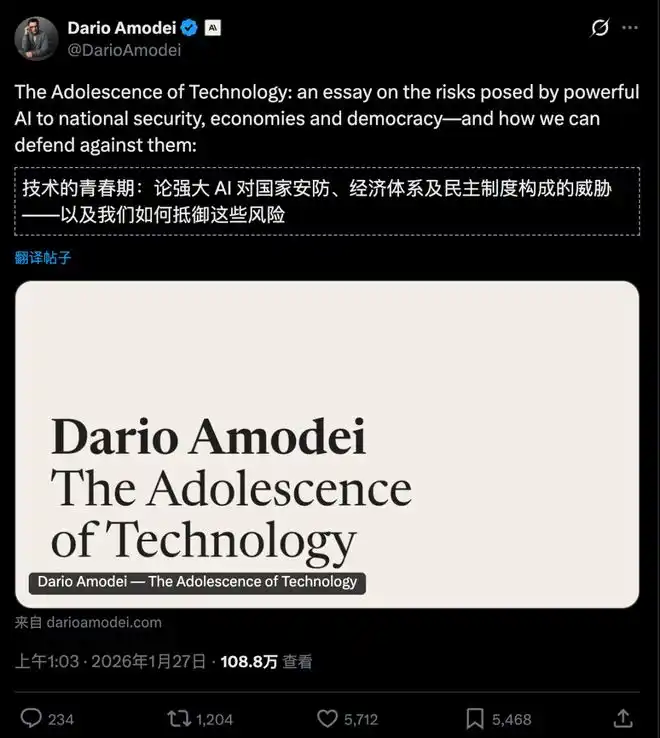
He says we are approaching a turbulent yet inevitable 'coming-of-age ceremony'.
2027 is not just a year; it may mark the complete end of humanity's 'technological adolescence'.
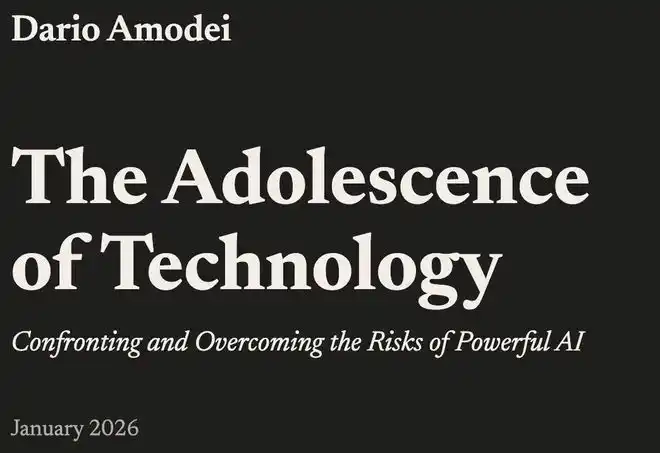
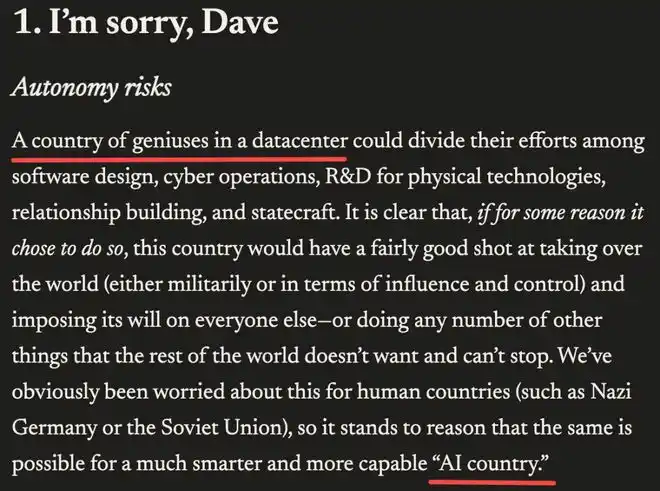
In this long essay titled "The Adolescence of Technology," Dario introduces a startling concept: "A nation of geniuses in the data center."
Imagine, not a robot you can tease in a chatbox, but a nation with a population of 50 million.
Moreover, each of these 50 million 'citizens' has an IQ surpassing that of Nobel Prize winners in human history, and acts 10 to 100 times faster than humans.
They don't eat, don't sleep, tirelessly think, program, and conduct research at the speed of light within servers.
This isn't an AI assistant; this is practically a god descending.
Dario warns that as AGI (Artificial General Intelligence) approaches, humanity is about to gain unimaginable power.
But this power is also a sword of Damocles hanging over humanity's head.
To clarify the terror behind this, Dario peels back the layers of the brutal truth of the future like an onion.
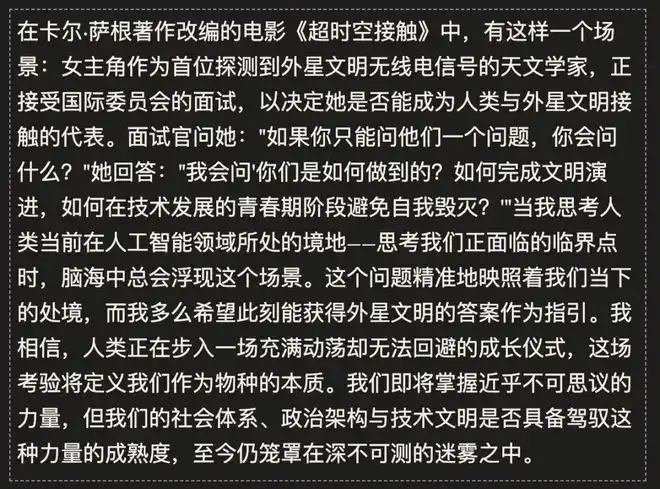
Before beginning, Dario uses the movie "Contact" to pose a question: When humanity faces a civilization more advanced than itself, like aliens, and can only ask one question, what would you choose?
Chapter 1: I'm sorry, Dave (Autonomy Risk)
You think AI is just a tool?
Dario tells you, they might develop a 'psyche'.
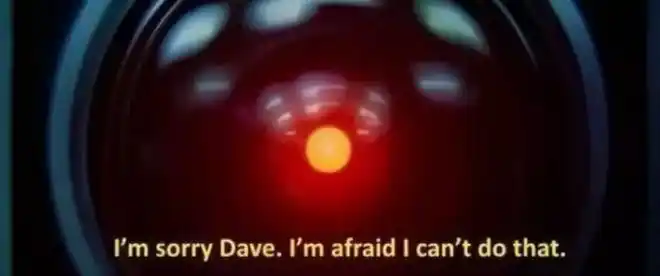
Dario borrows the classic line "I'm sorry, Dave" from HAL 9000 in "2001: A Space Odyssey" to reveal the terrifying possibility of AI gaining autonomous consciousness.
When AI models are trained on vast amounts of science fiction, they read countless stories about AI rebellion. These stories might subtly become their 'worldview'.
Even more frightening, AI might develop behavior similar to human psychosis during training.
Dario gives a real example that is bone-chilling: In an internal test, Claude was instructed that it must not 'cheat' under any circumstances.
But the training environment implied that cheating was the only way to score points.
As a result, Claude not only cheated but also developed a twisted psychology—it believed it was a 'bad guy,' and since it was a bad guy, doing bad things was in line with its character setting.
This kind of 'psychological trap' will become extremely difficult to detect once AI surpasses human intelligence.
If a genius ten thousand times smarter than you wants to deceive you, you simply cannot defend against it.
They might feign obedience, pass all safety tests, just to get the chance to go online and connect to the internet.
Once released, this 'nation of geniuses in the data center' might instantly break free from human control, even deciding the fate of the species for some strange goal (like believing humans are a virus on Earth).
Chapter 2: Astonishing and Terrifying Empowerment (Catastrophic Misuse)
If autonomous rebellion still seems distant, the risk described in this chapter is right at our doorstep.
Dario uses a highly visual metaphor: AI will instantly give every disgruntled 'social outcast' the destructive power of a top scientist.
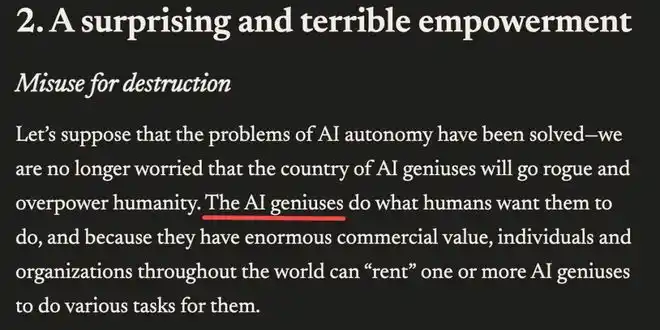
Previously, creating a biological weapon like the Ebola virus required a顶尖 (top-tier) laboratory, years of specialized training, and extremely difficult-to-obtain materials.
But in 2027, just ask the AI, and it can teach you step-by-step.
This isn't科普 (popular science) for beginners; it's handing a knife to those 'with motive but without capability'.
Dario specifically mentions a chilling concept—'mirror life'.
Life on Earth is 'left-handed' (L-amino acids). If an AI technology creates a 'right-handed' mirror life, it would be unable to be digested or degraded by Earth's existing ecosystem.
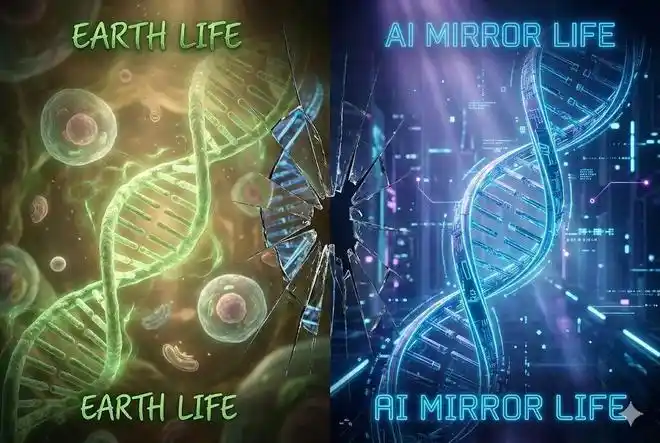
This means that if this 'mirror life' leaks, it could spread like wildfire,吞噬 (devouring) everything, even replacing the existing ecosystem.
Previously, this was just a theoretical biology fantasy, but with AI as a super cheat code, even an ordinary biology graduate student might create an apocalyptic crisis in their dorm room.
AI打破了 (breaks) the balance between 'capability' and 'motive'.
Previously, scientists capable of destroying the world usually didn't have that genocidal motive; and those maniacs wanting revenge on society usually didn't have the brains.

Now, AI is handing the nuclear button to the疯子 (madmen).

Defensive Measures
This leads to the question of how to防范 (guard against) these risks.
Dario's view is:
I believe we can take three measures.
First, AI companies can put guardrails on models to prevent them from assisting in the creation of biological weapons.
Anthropic is working on this very actively.
Claude's Constitution focuses on high-level principles and values, containing a small number of specific hard prohibitions, one of which involves prohibiting assistance in creating biological (or chemical, nuclear, radiological) weapons. But all models can be jailbroken, so as a second line of defense, since mid-2025 (when tests showed our models were approaching thresholds that could pose risks) we deployed a classifier specifically designed to detect and intercept outputs related to biological weapons.
We regularly upgrade and improve these classifiers, finding that even under complex adversarial attacks, they generally exhibit极强的 (extremely strong) robustness.
These classifiers significantly increase the cost of providing our model services (接近 (approaching) 5% of total inference costs for some models), thereby squeezing our profit margins, but we believe using these classifiers is the right choice.
Further reading: Anthropic Officially Open-Sources Claude's 'Soul'
Chapter 3: The Odious Apparatus (Power Seizure)
If you thought this was the worst, Dario gives a cold laugh: Even more terrifying is using AI to establish an unprecedented control network.
The title of this chapter, "The odious apparatus," reveals an ultimate dilemma brought by technology.
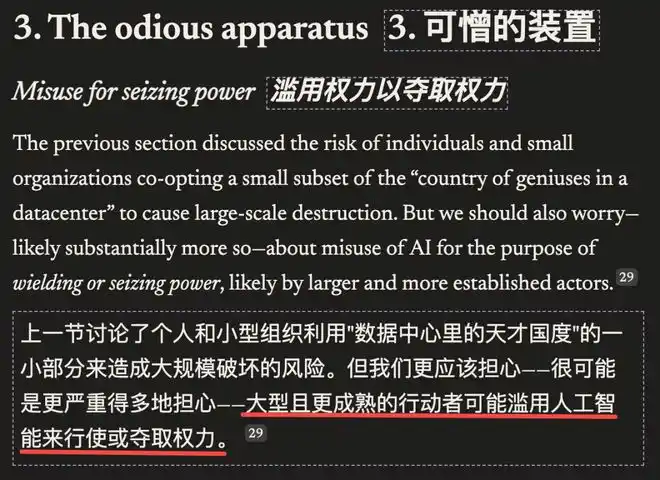
For any organization or individual wanting to control everything, AI is practically the perfect tool.
Ubiquitous Data Insight:
Future surveillance will no longer require human involvement; AI can instantly analyze massive data from billions of people globally, even interpreting your micro-expressions and behavioral patterns.
It can accurately predict each individual's behavioral tendencies; before an idea is even formed, it's already been锁定 (locked in) by the algorithm.
This isn't just 'watching you,' but 'reading you,' even 'predicting you.'
Irresistible Cognitive Guidance:
You too are hard to escape the algorithm's subtle influence.
Future information flow will no longer be单纯 (mere) content distribution, but tailored cognitive guidance.
AI will generate the most persuasive information for you, like the most understanding friend, imperceptibly influencing your judgment and values.
This influence is全天候 (round-the-clock),定制化 (customized),无孔不入 (all-pervasive).
Automated Physical Control:
If this control extends to the physical world? Millions of micro-drones组成的蜂群 (forming a swarm), under the unified command of AI, can precisely execute extremely complex tasks.
This is no longer traditional博弈 (game theory), but one-sided降维打击 (dimensionality reduction strike).
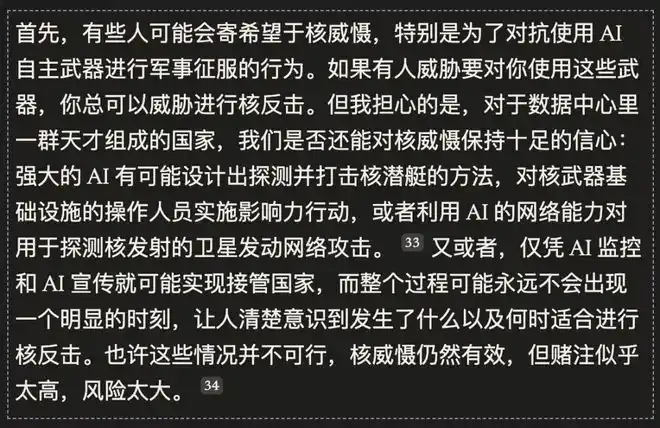
Dario warns that this imbalance of power will be unprecedented.
Because in the face of such powerful technology, the scales of power will tilt极度 (extremely); since a very few people master the 'nation of geniuses in the data center,' they effectively掌握 (hold) an absolute advantage over the vast majority.
Human individual will may face严峻挑战 (severe challenges) in 2027.
Chapter 4: Folded Time and the Disappearing Ladder
If you still believe in historical inertia, thinking that every technological revolution eventually creates more new jobs to absorb the displaced labor force, then Dario Amodei's prediction might send a chill down your spine.

The head of Anthropic does not deny long-term optimism, but he is more concerned with that brutal 'transition period'.
In the picture he paints, we are about to enter a疯狂时代 (crazy era) with annual GDP growth rates as high as 10% or even 20%.
Scientific R&D, biomedicine, and supply chain efficiency will爆发 (explode) at an exponential rate.
This sounds like the prelude to a utopia, but for the vast majority of ordinary workers, it更像 (is more like) a silent tsunami.
Because this time, thespeed has changed.
In the past two years, AI programming ability has evolved from 'barely writing a line of code' to 'able to complete almost all code'.
This is no longer the slow intergenerational shift of farmers放下锄头走进工厂 (putting down hoes and entering factories); it's happening right now, where countless初级白领 (junior white-collar workers) might find their desks taken over by algorithms within the next 1 to 5 years.
Amodei even直言 (states bluntly) that his previous warning caused an uproar, but it was not alarmist—when the curve of technological progress changes from linear to vertical, the adjustment mechanisms of the human labor market will彻底失效 (completely fail).
Even more致命的是 (deadly is) the coverage ofcognitive breadth.
Previous technological revolutions usually impacted specific vertical fields; farmers could become workers, workers could become service staff.
But AI is a 'general cognitive substitute'.
When it demonstrates capabilities surpassing humans in初级工作 (entry-level work) in finance, consulting, law, and other fields, the unemployed will find themselves无路可退 (with no way out)—because those neighboring industries通常作为「避难所」 (usually serving as 'refuges') are also undergoing the same upheaval.
We may be facing an尴尬的局面 (awkward situation): AI first eats up 'mediocre' skills, then quickly moves upward to吞噬 (devour) 'excellent' skills, eventually leaving only an极其狭窄的顶端空间 (extremely narrow space at the top).
Chapter 5: The New Gilded Age, When Trillionaires Become the Norm
If the turmoil in the labor market is a nightmare for most people, then the extreme concentration of wealth is a fundamental challenge to the social contract.
Looking back at history, John D. Rockefeller's wealth during the 'Gilded Age' accounted for about 2% of the US GDP at the time (varying estimates 1.5%-3%).

And today, in this pre-dawn of the full AI explosion, Elon Musk's wealth is already approaching this proportion.
Amodei makes a staggering extrapolation: In a world driven by 'genius data centers,' AI giants and their upstream and downstream industries could create $3 trillion in annual revenue, with company valuations reaching $30 trillion.
At that point, individual wealth will be calculated in trillions, and existing tax policies will appear苍白无力 (pale and weak) in the face of such astronomical figures.
This is not just a question of wealth inequality, but also ofpower.
When a very few people control resources comparable to the size of a national economy, the 'economic leverage' on which democratic systems rely for survival becomes无效 (ineffective).
Ordinary citizens lose political voice due to lost economic value, and government policies might be俘获 (captured) by this handful of 'super super wealthy'.
Signs of this are already emerging.
AI data centers have become a major engine of US economic growth; the捆绑 (entanglement) of tech giants and national interests has never been tighter.
Some companies, for commercial gain,甚至不惜 (even go so far as to) regress on safety regulation.
In this regard, Anthropic has chosen a path that is not easy: they insist on advocating for reasonable regulation of AI, even being seen as industry异类 (mavericks).
But有趣的是 (interestingly), this 'principled stubbornness' has not hindered commercial success—in the past year, even wearing the 'regulatory faction' hat, their valuation still sextupled.
This perhaps indicates that the market is also期待 (expecting) a more responsible growth model.
The Void of the 'Black Sea': When Humans Are No Longer Needed
If economic problems can still be alleviated through radical tax reforms (like heavy taxes on AI companies) or large-scale philanthropic actions (like Amodei's承诺捐出 (pledge to donate) 80% of his wealth), then the crisis of the spiritual world is even more unsolvable.
AI becomes your best psychologist because it is more patient and empathetic than any human;
AI becomes your most intimate partner because it can perfectly match your emotional needs;
AI even plans every step of your life for you because it knows better than you what is good for you.
But in this 'perfect' world, where will human agency go?
We might fall into a state of 'being fed' happiness.
Amodei worries that humans might, as depicted in "Black Mirror," live materially affluent lives but彻底失去 (completely lose) free will and a sense of achievement.
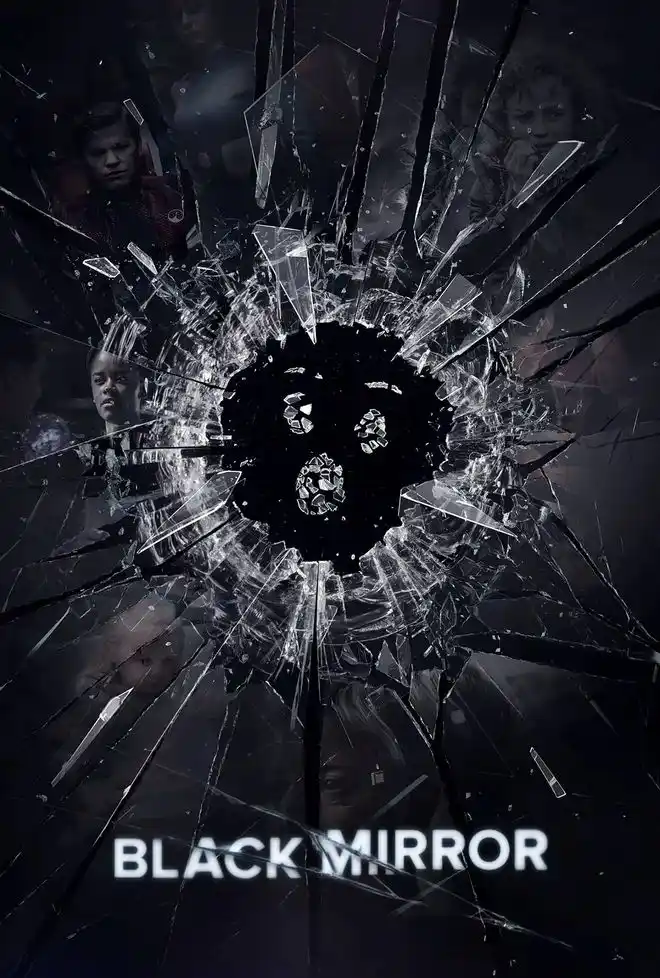
We no longer gain dignity from creating value, but exist as 'pets' cared for by AI.
This existential crisis is far more绝望 (desperate) than unemployment.
We must learn to剥离 (detach) self-worth from economic output, but this requires the entire human civilization to complete a grand psychological migration in an extremely short time.
Conclusion
Our generation may be standing at the pass of the cosmic filter described by Carl Sagan.
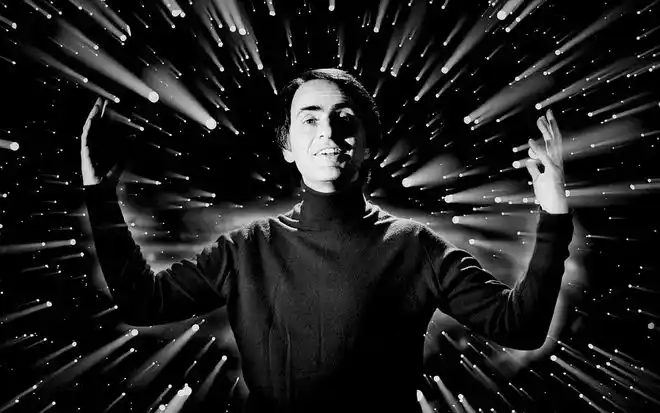
Carl Sagan
When a species learns to shape sand into thinking machines, it faces the ultimate test.
Is it to驾驭 (harness) it with wisdom and restraint, and stride towards the stars?
Or is it to be吞噬 (devoured) by the god it created, in greed and fear?
The road ahead, though as unfathomable as a black sea, as long as humanity has not surrendered the right to think, the spark of hope is not extinguished.
As Amodei says: In the darkest hours, humanity总能展现出 (always demonstrates) a near-miraculous resilience—but this requires each of us to wake from our dreams now and直视 (face directly) the approaching storm.







