AI at a Crossroads: Why Wall Street is Saying "No" to ChatGPT and Claude?

链捕手Dipublikasikan tanggal 2026-07-13Terakhir diperbarui pada 2026-07-13

Abstrak

The article "AI at a Crossroads: Why Wall Street Says 'No' to ChatGPT and Claude" explores the growing tension between the adoption of powerful, closed-source AI models and the imperative for data privacy and intellectual property (IP) protection in enterprises, particularly in high-stakes sectors like finance. It details how the fundamental architecture of services like OpenAI and Anthropic involves sending user data in plaintext to the vendors' servers, creating risks of IP leakage ("alpha transfer"). While enterprise contracts with "zero-data-retention" clauses offer some assurance, they rely on trust. A significant problem is "shadow AI," where employees use personal accounts, bypassing corporate policies and leading to data breaches. For consumers, the article highlights that AI conversations lack legal protections like attorney-client privilege and can be subpoenaed in legal cases, a fact many users are unaware of. The core of the piece analyzes the technical spectrum of privacy solutions, contrasting **protocol-level privacy** (contracts, anonymous proxies) with more robust **structural-level privacy**. The latter includes: * **TEEs (Trusted Execution Environments) / Confidential Computing:** Running models in hardware-sealed enclaves with remote attestation. * **End-to-End Encryption (E2EE):** Encrypting prompts so only the target enclave can read them. * **Fully Homomorphic Encryption (FHE):** Performing computations on encrypted data without decryption (cur...

Author: Jeff @IOSG


Why Private AI is Needed

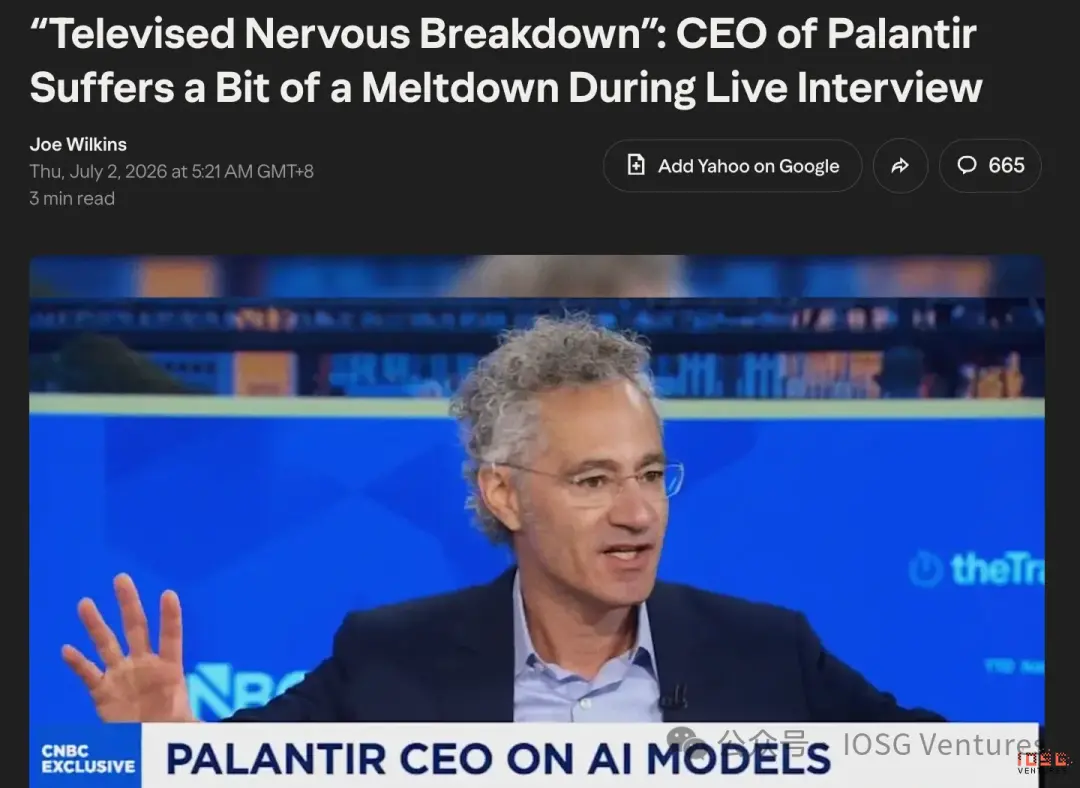
On July 1st, Palantir CEO Alex Karp gave a 20-minute interview on CNBC, which some media described as "a mental breakdown." According to Karp, enterprises are paying a token premium to frontier labs while watching their own IP flow to the model providers. He called this leakage a transfer of alpha, occurring at the architectural layer: every request sent to a closed-source model arrives in plaintext on the service provider's servers. Just days before the broadcast, Palantir announced a partnership with NVIDIA to run the open-source Nemotron model in a customer-controlled environment, accompanied by a nine-point AI sovereignty declaration. PLTR's stock jumped 8% after the CNBC segment aired.
For the past two decades, enterprises adopted cloud software based on trust at the protocol level, and it worked. Each SaaS vendor saw only a slice of enterprise data, and most had little incentive to use customer data to enhance their core products. Salesforce saw sales pipelines, Workday saw personnel, Jira saw development iterations, and AWS provided the storage and compute foundation. Today's AI workflows, however, advocate uploading the entire corpus, along with structured context linking all departments, to maximize productivity. Regardless of intent, upstream providers can now use this data for new features rather than letting it sit idle on servers.

No one is slowing down. Anthropic's annualized revenue reached $47 billion in May, a significant jump from $9 billion at the end of 2025. OpenAI surpassed 900 million weekly active users in February. Both companies completed new funding rounds this spring, with valuations nearing $1 trillion and expected to IPO at even higher market caps. Years of privacy and IP allegations have not dented their momentum.

Some enterprises acted long ago. By February 2023, less than three months after ChatGPT's release, major Wall Street banks had restricted its use. In May 2023, after Samsung engineers leaked chip source code into ChatGPT, the company banned generative AI across its network. In response, OpenAI launched ChatGPT Enterprise in August 2023, promising not to use business data for training and offering a zero-data-retention (ZDR) agreement, which later became a standard requirement for enterprise procurement.

But contracts only lock down corporate accounts. IBM found that by 2025, shadow AI (employees feeding company data into unauthorized AI tools via personal accounts) was involved in one-fifth of data breaches, with heavy shadow AI use adding an average of $670,000 to breach costs. In a 2025 survey by security training company Anagram, 40% of employees said they were willing to violate AI usage policies to complete tasks faster.

Enterprises can at least buy their way out with ZDR contracts, non-training service tiers, and sovereign deployments for governments or Palantir's clients. For ordinary users like us, the debate over whether private AI matters continues—until a court subpoena arrives.

In May 2025, a court order forced OpenAI to retain even deleted consumer chats. In November, a judge ordered 20 million of those records to be handed over to *The New York Times*'s lawyers as evidence. Then came criminal cases: ChatGPT records of a defendant in the Palisades arson case entered evidence, and an affidavit for a Florida double homicide cited a suspect's queries about body disposal. In a July 2025 interview, Sam Altman also acknowledged that ChatGPT conversations are not protected by legal privilege, and OpenAI "could be compelled to hand over" user chat logs in litigation.

The point isn't that only criminals need private conversations. The fact that people's AI conversations are logged and subpoenable is a surveillance surface most users don't know exists. A Kolmogorov Law survey of 1,000 U.S. AI users in October 2025 found that 50% didn't know these conversations could be subpoenaed, while two-thirds believed such chats should receive protections equal to consulting a lawyer or doctor.

Self-hosted or open-source models running in verifiable environments are catching up fast, but the strongest ones still lag the frontier closed-source models by about 4 months in general capability. This puts token-maximizing enterprises and individuals at a crossroads: either forfeit a few months of model quality for privacy, or continue sending sensitive material to Anthropic's servers because that's what competitors are doing to seize productivity advantages.
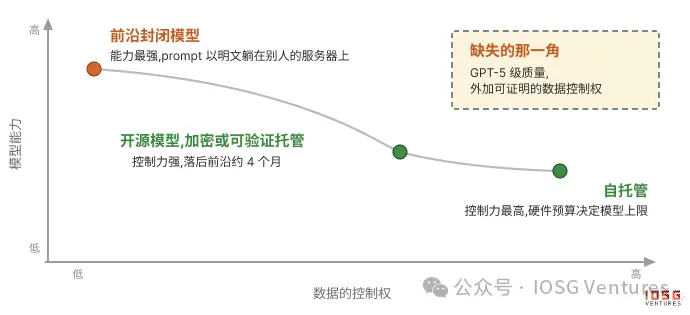
Currently, there is no perfect solution. This report examines attempts to bridge the gap, observing how far frontier intelligence with provable privacy is from being delivered to enterprises and ordinary users.

How Privacy is Currently Achieved

Private AI is not a single engineering feat, but each mechanism in the market today addresses the same event: a prompt leaves your device, travels over the network, lands on a machine running a model, and a response returns. The differences lie in where plaintext exists on this path, who can read it there, and what verifies the privacy of the response.

Protocol-Level Privacy

At this layer, someone other than you reads your plaintext prompt. What happens next relies entirely on a promise.
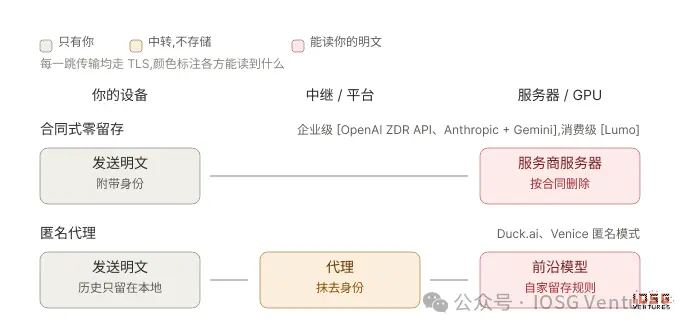
  • Contractual Zero-Retention is the enterprise version. The service provider knows who you are, processes your prompt, and promises not to retain it, enforced by contract and reputation.

  • Anonymous Proxy erases who you are but does not encrypt what you say; the downstream provider still handles plaintext per their own policy. Terms vary: proxies like Duck.ai (DuckDuckGo's chatbot) negotiate deletion agreements with model providers, while Venice advises users to assume providers keep everything. Neither side can verify.

Every segment of the machine-to-machine path runs over TLS, which only encrypts the pipe; the receiving party can read all information. Relays typically use Oblivious HTTP (RFC 9458) to split this knowledge, like asking a friend to pass a note. The friend knows who passed it but can't read the content; the recipient can read the content but doesn't know who wrote it. OHTTP became an IETF standard in January 2024, and many companies now run production traffic over OHTTP relays rented from Cloudflare and Fastly.

This is also the privacy ceiling for accessing closed-source models, due to a matter of arithmetic. A single flagship training run now costs billions of dollars, and these labs' near-trillion-dollar valuations hinge on exclusive ownership of model weights. The duration of the capability gap sustains the premium, so labs guard the weight files like state secrets.

Meta has already unwittingly conducted this experiment. The LLaMA model released in February 2023 was initially available only to researchers, but within a week, its weights were leaked as a torrent on 4chan. Another week later, llama.cpp allowed the smallest 7B model to run locally on a MacBook. Three days after that, Stanford fine-tuned a chat assistant, Alpaca, on the same model for under $600. This leak brought the cost of running Llama down to electricity; anyone with the file could run it at home. In July 2023, Meta officially open-sourced Llama 2 under a commercial license with a 700-million-monthly-active-user exclusion clause. The weights leaked, and the premium followed.

Frontier labs could theoretically provide attestation (remote attestation) for closed-source model inference, but attestation can only prove which piece of code read the prompt, not what that code did with it. To determine if the server retained data, we would need to audit the serving code and reconstruct it to the hash reported by the hardware. But once the serving code is handed over, the lab also surrenders the batching and caching techniques underpinning its profit margins—techniques that will migrate to every future model generation. Apple and Meta can provide remote attestation for the service stacks behind iPhone and WhatsApp because their profits come from devices and ads; revealing the service code costs them almost nothing.

This is why flagship model weights and serving code don't reach external operators. Without external operators, there is no third-party attestation; without attestation, verifiable privacy only exists for open-source models.

Structural-Level Privacy

Each mechanism in this category replaces trust promises with proofs based on hardware, cryptography, or physics. However, each pays a different price for the privacy upgrade, the primary one being that they can only run open-source models.
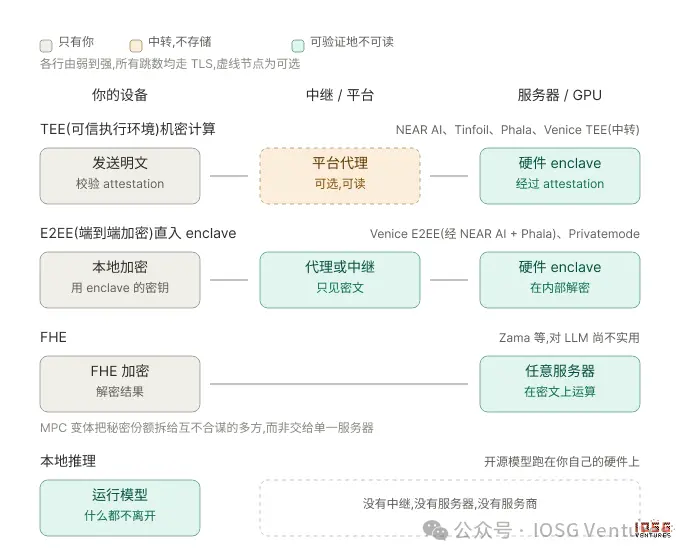
  • TEE (Trusted Execution Environment) Confidential Computing runs inference inside a hardware enclave (a sealed compartment on the chip that even the machine operator cannot open). The chip signs an attestation stating exactly which model and which code were run.

  • The prompt is only sealed at the destination. On the path relayed by the platform proxy, there remains a party that can read plaintext, and what prevents the proxy from logging or leaking the relayed content is only the protocol.
  • E2EE (End-to-End Encryption) seals the readable relay. The user's device encrypts the prompt using the enclave's key; every hop in between carries a sealed envelope only the enclave can open.

  • Trust is placed in the client. The code responsible for encrypting the prompt and verifying the attestation also has the power to revoke this guarantee. Therefore, verifiable E2EE requires both a proven enclave and open, reproducible client code.

  • Compared to TEE's simplicity, E2EE's cost is engineering overhead, which slows feature integration. E2EE turns the proxy into a blind messenger, so all features that rely on reading plaintext must be rebuilt around the client key or reconstructed solely within the enclave.

  • FHE (Fully Homomorphic Encryption, and MPC variants) removes the trusted party entirely. The server performs computations on ciphertext within a locked box it can never open; the key stays with you. MPC (Multi-Party Computation) splits the prompt into secret shares distributed among multiple parties; unless all participants collude, the effect is the same.

  • The cost is speed. FHE natively only performs addition and multiplication, so the non-linear steps required for transformer operation must be rebuilt at high cost. Inference on ciphertext is 10,000 to 100,000 times more expensive than on plaintext, taking seconds to minutes per token for small models, compared to milliseconds unencrypted.

  • Chips customized for encrypted operations promise to narrow the gap, but the first prototype was demoed only in early 2026, with commercial versions still years away.

  • Local Inference removes the path entirely. The model runs on your own hardware. No relay, no server, no service provider, and no verification needed.

  • The obvious costs are expense and model capability. gpt-oss-120b scores about half of GLM-5.2 on the Artificial Analysis index but is 65GB in size, exceeding the combined VRAM of two flagship gaming graphics cards. The full-precision GLM-5.2 can only run on 8-card data center nodes, with GPUs alone costing over $300,000.

Beyond these structural limitations, the cost of putting inference into an enclave is shrinking. For single-card inference, benchmarks from enclave cloud provider Phala show that enclave-mode H100 throughput loss averages less than 7%, and approaches zero for large models because the main cost is moving data onto the chip, not computing within it. For multi-card inference, NVIDIA's new Blackwell GPU supports direct encryption of inter-chip traffic, whereas older H100s can only achieve the same effect by routing through the CPU host at one-seventh the bandwidth. NVIDIA's own benchmarks on Blackwell show less than 8% throughput loss for a 397B model in enclave mode. With these advancements, the performance penalty of private inference itself is no longer a decisive constraint.

In fact, the enclave itself adds almost no extra operating cost for the provider. Every H100 shipped since 2023 has enclave mode built-in; the extra cost is the throughput loss from encryption, not additional chips. Currently, confidential H100 SKUs on Azure rent for $8.90 per hour, compared to $6.98 without enclave, a 27% premium over traditional cloud infrastructure. On the other hand, specialized enclave providers like Phala rent confidential-mode H100s starting at $3.80 per hour, lower than Lambda's price range of $3.99 to $4.29 for regular SXM cards. For managed API solutions, NEAR AI offers gpt-oss-120b endpoints with attestation at $0.15 per million input tokens and $0.55 per million output tokens, on par with plaintext routes from Amazon Bedrock, Together, and Groq. Even for models requiring multiple chips, NEAR AI's pricing for GLM 5.2 matches Fireworks exactly and is 15% cheaper for input and 4% cheaper for output on the larger Kimi K2.6.

While these new private inference providers may be burning profits to gain market share (a statement that holds for any company seeking growth), the structural trend is that the cost of privacy is decreasing for both consumers and operators.

How Can Open-Source Models Win?

Despite shrinking performance overhead, a visible gap remains between frontier models and SOTA open-source models. An entity pursuing maximum productivity must still trust frontier labs not to steal its IP to stay in the top tier.

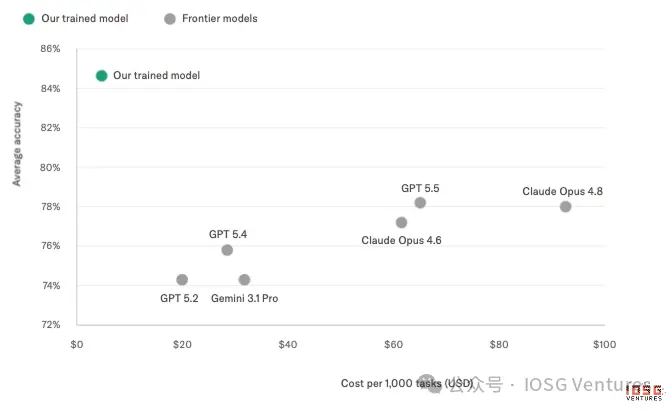
The gap persists, but Bridgewater's AIA Labs and Thinking Machines presented a case on June 30: an open model fine-tuned with expert annotations beat frontier models in both accuracy and cost.

In the study, the team fine-tuned Qwen3-235B on Tinker (Thinking Machines' managed fine-tuning API service). They first sourced annotations from vendors, used that data for initial training, then sent disputed samples to the firm's investment professionals for re-labeling. Training used reinforcement learning (GRPO) with three modifications: round-robin batching (each task takes turns providing a batch), CISPO loss (limiting how far a single answer can shift the model), and on-policy distillation (anchoring to the current best checkpoint to prevent the model from learning from weaker copies).

Tasks were all from investment professionals' daily workflows: determining if a news article was important for C-suite investment professionals, if a central bank document hinted at future interest rate changes, and where templated language began in a document or email. Scores came from an independent test set. Frontier models averaged about 50% with simple prompts and only reached 78.2% with expert prompts, below the 80% threshold set by investment professionals. The fine-tuned Qwen achieved 84.7%, which, per the original wording, means making 29.8% fewer errors than the frontier best, at 13.8x lower inference cost.
https://thinkingmachines.ai/news/learning-to-replicate-expert-judgment-in-financial-tasks/

This case proves open-source models can win in accuracy and cost, but the training process was still not private. The expert annotations used were Bridgewater's private data, passing through Tinker's third-party service, residing at the same trust level as ZDR agreements. The fund also rented compute; the entire training ran on machines it never controlled. Buyers wanting this recipe without trust assumptions have few choices today. Renting bare GPU clusters leaves the training process readable to the cloud operator. Buying the cluster solves data hosting but sends costs skyrocketing.

Routes with attestation have just arrived. In March, Workshop Labs and Tinfoil released Silo, a post-training stack running in Tinfoil enclaves on a single 8-card node, with keys controlled only by the customer. The article states the enclave cost adds 11 minutes to a two-hour training run, and by freezing base weights and training only small adapters on top, the stack can accommodate a trillion-parameter model (Kimi K2 Thinking). The challenge is that reinforcement learning requires moving data back and forth between components, precisely where enclave costs lie.

Less than a month after Silo's release, Workshop Labs was acquired by Thinking Machines. The components needed to run the next Bridgewater-style RL loop within an enclave are now under the same roof.

Privacy at the Harness Layer

Another problem exists outside all private inference mechanisms. These mechanisms manage the path from prompt to model, but every external tool call initiated by an agent opens a path the inference layer cannot touch. The recent harness engineering trend magnifies the problem: every tool, memory store, and data source connected to the model is another destination that reads its slice of the workflow in plaintext. The calendar server reads schedules, the database server reads queries. A fully local agent needing anything outside its training set must still send search terms in plaintext to a search engine; the server cannot answer without reading the plaintext.

Mainstream solutions still default to the protocol layer. Companies like Runlayer and MintMCP use a central gateway to manage all tool traffic, stripping personally identifiable information (PII) before requests leave. The gateway also decides which servers receive traffic, blocking unvetted ones, and logs each call's destination and content for forensics. Even with independent audits (SOC 2), the tool server must still read the plaintext query to respond; whether it retains a copy depends on its own retention terms, multiplied by every tool in the harness. Furthermore, the gateway itself is an additional trust-dependent reader on the path, not a verification.

Structural solutions target the middle layer. For example, Phala hosts MCP servers directly in TEEs, with directories covering wallets, code execution, and data sources; users can verify privacy claims via attestation rather than trusting the operator. However, TEE-hosted tools ultimately must pass queries in plaintext to the service provider; the enclave seals only the messenger, not the destination.
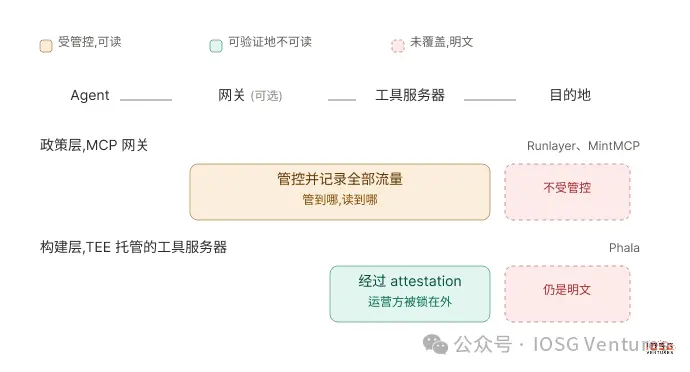
Only a few destinations have learned to respond without reading, but only for structured queries. Apple provides Private Information Retrieval for iPhones, allowing phone number checks against spam databases without exposing the number; Microsoft uses the same scheme for passwords in Edge. MongoDB's Queryable Encryption encrypts fields client-side before they leave, enabling the server to perform equality and range matches on ciphertext alone.

For open-ended search, today's best answer stops at trust; verifiable encrypted search hasn't left the lab. Brave promises zero data retention on its own 40-billion-page index (not Google's), but it's still at the protocol layer. Exa built a neural index that embeds user keywords into semantics, ranking results by semantic match, but the embedding step still computes from plaintext on Exa's servers. MIT's 2023 Tiptoe paper ranked results on 360 million web pages without exposing the query, but each search burned significant server compute, with ranking quality lagging unencrypted search. Apple's 2024 Wally paper hid real queries among decoys, reducing communication cost up to 31x, but this math only becomes cheap at millions of concurrent queries—a scale no private search system has today.

Encrypted search is possible; it's just that performance and price aren't commercially viable yet.

Outlook

Demand for private AI is growing. Venice AI recently surpassed 3.5 million registered users and 1.3 trillion monthly tokens, followed by a Series A equity funding round at a $1 billion valuation. Proton is a direct competitor; its chat product Lumo surpassed 10 million users within a year of launch. On the infrastructure side, Phala currently processes 2 to 3 billion tokens daily on OpenRouter. Duck.ai routes gpt-oss-120b and Gemma into Tinfoil enclaves, providing verifiable privacy beyond proxy anonymity. This doesn't even count self-hosting, likely the largest channel for private inference, as models run on one's own hardware, leaving no usage trail.

Yet within the massive wave of mainstream AI, private AI occupies only a tiny fraction, and this gap will only close if frontier labs intentionally meet this demand. In May, Google's entire product line processed 3,200 trillion tokens; by that measure, Venice's monthly throughput equals about 18 minutes of Google's. Last November, Google launched Private AI Compute (PAC), running some Gemini-powered features in sealed TPU enclaves isolated from the company itself, with the design independently audited by NCC Group. But the issue is that PAC only covers a few Pixel features like personalized recommendations and recording summaries, not the Gemini app used by hundreds of millions. Google dares to submit the design for audit because these features monetize via devices and ads, not token sales.

Current hosting solutions are also imperfect. Users seeking maximum privacy via E2EE must wait for new features to be rebuilt where the service provider can't read. Private harnesses still rely on protocols at the service layer. Affordable post-training still requires trusting third-party vendors for the best fine-tuning results. Self-hosting sheds all service providers at once, but running the strongest open-source model locally may cost more than the house it's in.

Flaws aside, private AI is already a real and affordable option, and the remaining gaps are narrowing. For ordinary consumers, private chats with open models under no-logging promises cost nothing on Lumo and Venice, while $18–$20 subscriptions from Venice or Tinfoil seal the same chat into enclaves, no more expensive than a ChatGPT subscription. For enterprise workflows, attested endpoints are now even cheaper than plaintext routes. Endpoints like NEAR's E2EE API can already bring encrypted context into enclaves; memory, file uploads, and custom instructions can now operate over E2EE. For attested post-training, NVIDIA's upcoming Vera Rubin NVL72 will expand confidential computing from Blackwell's 8-card nodes to 72-card racks, making frontier RL loops more feasible without exposing IP.

However, the crucial value capture lies beyond these layers of price compression. Privacy is nearly free where it already exists, but it hasn't covered mainstream agentic workflows. Operators focused on renting/selling enclaves hold a switch on standard chips, not a moat, while protocol-layer gateways compete with traditional middleware. The defensible ground is the half of the problem not yet solved in this report: training loops locked in enclaves, end-to-end sealed tool calls, search indexes that cannot see terms. Whoever builds one of these first sells something no price war can commoditize. Capital chasing private AI should buy the gap, not the switch.

So, trust or verify? For execution-heavy, agent-heavy tasks, choose trust, because each tool call already hands plaintext to destinations an enclave cannot seal, and frontier models deserve their price in such loops. For the high-order thinking that distinguishes a company from its competitors, choose verification. Strategy, planning, and judgment distilled from years of professional experience are precisely the alpha in dispute. The path forward is fine-tuning open-source models with these proprietary insights within company-controlled boundaries. In areas central to a company's alpha, expert-tuned open models have already beaten the frontier in both accuracy and cost, and the infrastructure to build them in privacy is arriving node by node.

Kripto yang Sedang Tren

Pertanyaan Terkait

QWhy are Wall Street banks and corporations increasingly saying 'no' to using models like ChatGPT and Claude, according to the article?

APrimarily due to intellectual property and data privacy concerns. The article highlights that when using closed-source AI models, every prompt is sent as plaintext to the vendor's servers, creating a risk of IP and sensitive data leakage ('alpha transfer'). This is especially critical for industries like finance and for companies whose competitive edge relies on proprietary data and strategies.

QWhat are the main approaches to achieving private AI, as outlined in the article?

AThe article categorizes private AI approaches into two main layers: 1) **Protocol-level privacy**: Relying on trust and contracts, such as Zero Data Retention (ZDR) agreements and anonymous proxies. 2) **Structural-level privacy**: Using technology to enforce privacy, including TEE (Trusted Execution Environment) confidential computing, End-to-End Encryption (E2EE), Fully Homomorphic Encryption (FHE), and local (on-premise) inference. Structural methods can only be used with open-source models.

QWhat case study does the article provide to show that open-source models can outperform frontier models?

AThe article cites a study by Bridgewater's AIA Labs and Thinking Machines. They fine-tuned the open-source model Qwen3-235B on expert-annotated financial tasks (e.g., analyzing news importance, central bank documents). The fine-tuned model achieved an 84.7% accuracy rate, surpassing the best frontier model's 78.2% (with expert prompting), while also being 13.8x cheaper in inference costs, demonstrating superior accuracy and cost-effectiveness for specialized domains.

QWhat is the 'harness layer' privacy challenge mentioned in the article, and why is it difficult to solve?

AThe 'harness layer' challenge refers to the privacy risks when AI agents interact with external tools (e.g., databases, search engines, calendars). Even if the core model inference is private, every tool call sends a plaintext query to an external server, creating new data leakage points. Solving this with structural privacy is hard because most tools need to read the plaintext query to function. Truly private, verifiable solutions for complex tasks like open-ended web search are still in the research phase and not commercially viable due to performance and cost barriers.

QWhat is the article's conclusion regarding the future and investment opportunity in private AI?

AThe article concludes that while basic private inference is becoming affordable and commoditized, the significant value and investment opportunity lie in solving the remaining, harder technical gaps. These include: 1) Private training/fine-tuning loops within enclaves, 2) End-to-end private tool/agent calls, and 3) Private search over encrypted indexes. Capital chasing private AI should focus on these unsolved problems ('the gap'), not just the enabling infrastructure ('the switch'), as solutions here will create defensible, non-commoditized value.

Bacaan Terkait

Denyut Pasar BTC: Minggu 29

Pulsa Pasar BTC Minggu 29: Konsolidasi Berlanjut dengan Sinyal Campur Bitcoin melanjutkan pemulihan dari penurunan baru-baru ini, dengan momentum harga bergerak ke wilayah bullish. Namun, kemajuan ini tampaknya didorong oleh likuiditas yang tipis, bukan keyakinan beli yang luas. Volume perdagangan spot menyusut 21.5% dan delta volume kumulatif spot berubah negatif. Pasar derivatif menunjukkan gambaran serupa. Trader futures perpetual masih membayar premi untuk eksposur long, mencerminkan sentimen konstruktif, tetapi volume beli agresif telah mendingin. Pasar opsi tetap diposisikan defensif, dengan investor terus mengakumulasi perlindungan dari penurunan (*downside protection*). Sinyal yang lebih konstruktif datang dari posisi institusional. ETF Spot AS kembali mencatat aliran masuk bersih setelah periode aliran keluar berkelanjutan, menunjukkan pemulihan bertahap dalam alokasi modal strategis. Namun, volume perdagangan ETF yang moderat menandakan permintaan ini terukur, bukan spekulatif. Aktivitas on-chain tetap redup. Alamat aktif dan pembuatan biaya (*fee*) terus tren lebih rendah, menyoroti permintaan jaringan organik yang lemah meskipun harga lebih tinggi. Peningkatan porsi modal jangka pendek (*hot capital*) dapat mendahului periode volatilitas tinggi. Basis pemegang (*holder*) tetap tangguh. Rasio pasokan pemegang jangka pendek terhadap jangka panjang yang rendah menunjukkan kepemilikan masih terkonsentrasi di investor yang didorong keyakinan. Profitabilitas membaik, meskipun kerugian terealisasi (*realised losses*) yang terus-menerus menunjukkan banyak peserta masih menggunakan momentum harga untuk mengurangi risiko. Kesimpulannya, Bitcoin tetap dalam rezim konsolidasi. Aliran masuk institusional yang membaik, posisi pemegang yang tangguh, dan profitabilitas yang pulih memberikan latar belakang konstruktif. Namun, partisipasi spot yang redup, aktivitas on-chain yang lemah, dan permintaan berkelanjutan untuk lindung nilai penurunan menunjukkan pasar belum bertransisi ke kenaikan luas yang dipimpin keyakinan penuh.

insights.glassnode2j yang lalu

Denyut Pasar BTC: Minggu 29

insights.glassnode2j yang lalu

Trading

Spot

Artikel Populer

Apa Itu GROK AI

Grok AI: Merevolusi Teknologi Percakapan di Era Web3 Pendahuluan Dalam lanskap kecerdasan buatan yang terus berkembang dengan cepat, Grok AI menonjol sebagai proyek yang patut diperhatikan yang menjembatani domain teknologi canggih dan interaksi pengguna. Dikembangkan oleh xAI, sebuah perusahaan yang dipimpin oleh pengusaha terkenal Elon Musk, Grok AI berupaya untuk mendefinisikan ulang cara kita berinteraksi dengan kecerdasan buatan. Seiring dengan berkembangnya gerakan Web3, Grok AI bertujuan untuk memanfaatkan kekuatan AI percakapan untuk menjawab pertanyaan kompleks, memberikan pengguna pengalaman yang tidak hanya informatif tetapi juga menghibur. Apa itu Grok AI? Grok AI adalah chatbot AI percakapan yang canggih yang dirancang untuk berinteraksi dengan pengguna secara dinamis. Berbeda dengan banyak sistem AI tradisional, Grok AI menerima berbagai pertanyaan yang lebih luas, termasuk yang biasanya dianggap tidak pantas atau di luar respons standar. Tujuan inti proyek ini meliputi: Penalaran yang Andal: Grok AI menekankan penalaran akal sehat untuk memberikan jawaban logis berdasarkan pemahaman kontekstual. Pengawasan yang Dapat Diskalakan: Integrasi bantuan alat memastikan bahwa interaksi pengguna dipantau dan dioptimalkan untuk kualitas. Verifikasi Formal: Keamanan adalah hal yang utama; Grok AI menggabungkan metode verifikasi formal untuk meningkatkan keandalan output-nya. Pemahaman Konteks Panjang: Model AI unggul dalam mempertahankan dan mengingat riwayat percakapan yang luas, memfasilitasi diskusi yang bermakna dan sadar konteks. Ketahanan Adversarial: Dengan fokus pada peningkatan pertahanannya terhadap input yang dimanipulasi atau berbahaya, Grok AI bertujuan untuk mempertahankan integritas interaksi pengguna. Intinya, Grok AI bukan hanya perangkat pengambilan informasi; ini adalah mitra percakapan yang imersif yang mendorong dialog yang dinamis. Pencipta Grok AI Otak di balik Grok AI tidak lain adalah Elon Musk, seorang individu yang identik dengan inovasi di berbagai bidang, termasuk otomotif, perjalanan luar angkasa, dan teknologi. Di bawah naungan xAI, sebuah perusahaan yang fokus pada kemajuan teknologi AI dengan cara yang bermanfaat, visi Musk bertujuan untuk membentuk kembali pemahaman tentang interaksi AI. Kepemimpinan dan etos dasar sangat dipengaruhi oleh komitmen Musk untuk mendorong batasan teknologi. Investor Grok AI Meskipun rincian spesifik mengenai investor yang mendukung Grok AI masih terbatas, secara publik diakui bahwa xAI, inkubator proyek ini, didirikan dan didukung terutama oleh Elon Musk sendiri. Usaha dan kepemilikan Musk sebelumnya memberikan dukungan yang kuat, lebih lanjut memperkuat kredibilitas dan potensi pertumbuhan Grok AI. Namun, hingga saat ini, informasi mengenai yayasan investasi tambahan atau organisasi yang mendukung Grok AI tidak tersedia secara mudah, menandai area untuk eksplorasi potensial di masa depan. Bagaimana Grok AI Bekerja? Mekanisme operasional Grok AI sama inovatifnya dengan kerangka konseptualnya. Proyek ini mengintegrasikan beberapa teknologi mutakhir yang memfasilitasi fungsionalitas uniknya: Infrastruktur yang Kuat: Grok AI dibangun menggunakan Kubernetes untuk orkestrasi kontainer, Rust untuk kinerja dan keamanan, dan JAX untuk komputasi numerik berkinerja tinggi. Ketiga elemen ini memastikan bahwa chatbot beroperasi secara efisien, dapat diskalakan dengan efektif, dan melayani pengguna dengan cepat. Akses Pengetahuan Real-Time: Salah satu fitur pembeda Grok AI adalah kemampuannya untuk mengakses data real-time melalui platform X—sebelumnya dikenal sebagai Twitter. Kemampuan ini memberikan AI akses ke informasi terbaru, memungkinkannya untuk memberikan jawaban dan rekomendasi yang tepat waktu yang mungkin terlewat oleh model AI lainnya. Dua Mode Interaksi: Grok AI menawarkan pengguna pilihan antara “Mode Menyenangkan” dan “Mode Reguler.” Mode Menyenangkan memungkinkan gaya interaksi yang lebih bermain dan humoris, sementara Mode Reguler fokus pada memberikan respons yang tepat dan akurat. Fleksibilitas ini memastikan pengalaman yang disesuaikan yang memenuhi berbagai preferensi pengguna. Intinya, Grok AI menggabungkan kinerja dengan keterlibatan, menciptakan pengalaman yang kaya dan menghibur. Garis Waktu Grok AI Perjalanan Grok AI ditandai oleh tonggak penting yang mencerminkan tahap pengembangan dan penerapannya: Pengembangan Awal: Fase dasar Grok AI berlangsung selama sekitar dua bulan, di mana pelatihan awal dan penyempurnaan model dilakukan. Rilis Beta Grok-2: Dalam kemajuan signifikan, beta Grok-2 diumumkan. Rilis ini memperkenalkan dua versi chatbot—Grok-2 dan Grok-2 mini—masing-masing dilengkapi dengan kemampuan untuk chatting, coding, dan penalaran. Akses Publik: Setelah pengembangan beta, Grok AI menjadi tersedia untuk pengguna platform X. Mereka yang memiliki akun yang diverifikasi dengan nomor telepon dan aktif selama setidaknya tujuh hari dapat mengakses versi terbatas, membuat teknologi ini tersedia untuk audiens yang lebih luas. Garis waktu ini mencakup pertumbuhan sistematis Grok AI dari awal hingga keterlibatan publik, menekankan komitmennya untuk perbaikan berkelanjutan dan interaksi pengguna. Fitur Utama Grok AI Grok AI mencakup beberapa fitur kunci yang berkontribusi pada identitas inovatifnya: Integrasi Pengetahuan Real-Time: Akses ke informasi terkini dan relevan membedakan Grok AI dari banyak model statis, memungkinkan pengalaman pengguna yang menarik dan akurat. Gaya Interaksi yang Beragam: Dengan menawarkan mode interaksi yang berbeda, Grok AI memenuhi berbagai preferensi pengguna, mengundang kreativitas dan personalisasi dalam berkomunikasi dengan AI. Dasar Teknologi yang Canggih: Pemanfaatan Kubernetes, Rust, dan JAX memberikan proyek ini kerangka kerja yang solid untuk memastikan keandalan dan kinerja optimal. Pertimbangan Diskursus Etis: Penyertaan fungsi penghasil gambar menunjukkan semangat inovatif proyek ini. Namun, hal ini juga menimbulkan pertimbangan etis seputar hak cipta dan penggambaran yang menghormati tokoh-tokoh yang dikenali—diskusi yang sedang berlangsung dalam komunitas AI. Kesimpulan Sebagai entitas perintis di bidang AI percakapan, Grok AI mencakup potensi untuk pengalaman pengguna yang transformatif di era digital. Dikembangkan oleh xAI dan didorong oleh pendekatan visioner Elon Musk, Grok AI mengintegrasikan pengetahuan real-time dengan kemampuan interaksi yang canggih. Ini berupaya untuk mendorong batasan apa yang dapat dicapai oleh kecerdasan buatan sambil tetap fokus pada pertimbangan etis dan keselamatan pengguna. Grok AI tidak hanya mewujudkan kemajuan teknologi tetapi juga mewakili paradigma percakapan baru di lanskap Web3, menjanjikan untuk melibatkan pengguna dengan pengetahuan yang mahir dan interaksi yang menyenangkan. Seiring proyek ini terus berkembang, ia berdiri sebagai bukti apa yang dapat dicapai di persimpangan teknologi, kreativitas, dan interaksi yang mirip manusia.

613 Total TayanganDipublikasikan pada 2024.12.26Diperbarui pada 2024.12.26

Apa Itu GROK AI

Apa Itu ERC AI

Euruka Tech: Gambaran Umum tentang $erc ai dan Ambisinya di Web3 Pendahuluan Dalam lanskap teknologi blockchain dan aplikasi terdesentralisasi yang berkembang pesat, proyek-proyek baru muncul dengan frekuensi tinggi, masing-masing dengan tujuan dan metodologi yang unik. Salah satu proyek tersebut adalah Euruka Tech, yang beroperasi di domain cryptocurrency dan Web3 yang luas. Fokus utama Euruka Tech, khususnya tokennya $erc ai, adalah untuk menghadirkan solusi inovatif yang dirancang untuk memanfaatkan kemampuan teknologi terdesentralisasi yang terus berkembang. Artikel ini bertujuan untuk memberikan gambaran komprehensif tentang Euruka Tech, eksplorasi tujuannya, fungsionalitas, identitas penciptanya, calon investor, dan signifikansinya dalam konteks yang lebih luas dari Web3. Apa itu Euruka Tech, $erc ai? Euruka Tech dicirikan sebagai proyek yang memanfaatkan alat dan fungsionalitas yang ditawarkan oleh lingkungan Web3, dengan fokus pada integrasi kecerdasan buatan dalam operasinya. Meskipun rincian spesifik tentang kerangka proyek ini agak samar, proyek ini dirancang untuk meningkatkan keterlibatan pengguna dan mengotomatiskan proses di ruang crypto. Proyek ini bertujuan untuk menciptakan ekosistem terdesentralisasi yang tidak hanya memfasilitasi transaksi tetapi juga menggabungkan fungsionalitas prediktif melalui kecerdasan buatan, sehingga penamaan tokennya, $erc ai. Tujuannya adalah untuk menyediakan platform intuitif yang memfasilitasi interaksi yang lebih cerdas dan pemrosesan transaksi yang efisien dalam lingkup Web3 yang terus berkembang. Siapa Pencipta Euruka Tech, $erc ai? Saat ini, informasi mengenai pencipta atau tim pendiri di balik Euruka Tech masih tidak ditentukan dan agak tidak jelas. Ketidakhadiran data ini menimbulkan kekhawatiran, karena pengetahuan tentang latar belakang tim sering kali penting untuk membangun kredibilitas dalam sektor blockchain. Oleh karena itu, kami telah mengkategorikan informasi ini sebagai tidak diketahui sampai rincian konkret tersedia di domain publik. Siapa Investor Euruka Tech, $erc ai? Demikian pula, identifikasi investor atau organisasi pendukung untuk proyek Euruka Tech tidak disediakan dengan mudah melalui penelitian yang tersedia. Aspek yang sangat penting bagi pemangku kepentingan atau pengguna potensial yang mempertimbangkan keterlibatan dengan Euruka Tech adalah jaminan yang datang dari kemitraan keuangan yang mapan atau dukungan dari perusahaan investasi yang terkemuka. Tanpa pengungkapan tentang afiliasi investasi, sulit untuk menarik kesimpulan komprehensif tentang keamanan finansial atau keberlangsungan proyek. Sesuai dengan informasi yang ditemukan, bagian ini juga berada pada status tidak diketahui. Bagaimana Euruka Tech, $erc ai Bekerja? Meskipun kurangnya spesifikasi teknis yang mendetail untuk Euruka Tech, penting untuk mempertimbangkan ambisi inovatifnya. Proyek ini berusaha memanfaatkan kemampuan komputasi kecerdasan buatan untuk mengotomatiskan dan meningkatkan pengalaman pengguna dalam lingkungan cryptocurrency. Dengan mengintegrasikan AI dengan teknologi blockchain, Euruka Tech bertujuan untuk menyediakan fitur seperti perdagangan otomatis, penilaian risiko, dan antarmuka pengguna yang dipersonalisasi. Esensi inovatif dari Euruka Tech terletak pada tujuannya untuk menciptakan koneksi yang mulus antara pengguna dan kemungkinan luas yang ditawarkan oleh jaringan terdesentralisasi. Melalui pemanfaatan algoritma pembelajaran mesin dan AI, proyek ini bertujuan untuk meminimalkan tantangan bagi pengguna baru dan menyederhanakan pengalaman transaksional dalam kerangka Web3. Simbiosis antara AI dan blockchain ini menggarisbawahi signifikansi token $erc ai, yang berdiri sebagai jembatan antara antarmuka pengguna tradisional dan kemampuan canggih dari teknologi terdesentralisasi. Garis Waktu Euruka Tech, $erc ai Sayangnya, sebagai akibat dari informasi yang terbatas mengenai Euruka Tech, kami tidak dapat menyajikan garis waktu yang mendetail tentang perkembangan utama atau tonggak dalam perjalanan proyek ini. Garis waktu ini, yang biasanya sangat berharga dalam memetakan evolusi suatu proyek dan memahami trajektori pertumbuhannya, saat ini tidak tersedia. Ketika informasi tentang peristiwa penting, kemitraan, atau penambahan fungsional menjadi jelas, pembaruan pasti akan meningkatkan visibilitas Euruka Tech di dunia crypto. Klarifikasi tentang Proyek “Eureka” Lainnya Penting untuk dicatat bahwa banyak proyek dan perusahaan berbagi nomenklatur serupa dengan “Eureka.” Penelitian telah mengidentifikasi inisiatif seperti agen AI dari NVIDIA Research, yang fokus pada pengajaran robot tugas kompleks menggunakan metode generatif, serta Eureka Labs dan Eureka AI, yang meningkatkan pengalaman pengguna dalam analitik pendidikan dan layanan pelanggan, masing-masing. Namun, proyek-proyek ini berbeda dari Euruka Tech dan tidak boleh disamakan dengan tujuan atau fungsionalitasnya. Kesimpulan Euruka Tech, bersama dengan token $erc ai-nya, mewakili pemain yang menjanjikan namun saat ini masih samar dalam lanskap Web3. Meskipun rincian tentang pencipta dan investor masih belum diungkapkan, ambisi inti untuk menggabungkan kecerdasan buatan dengan teknologi blockchain tetap menjadi titik fokus yang menarik. Pendekatan unik proyek ini dalam mendorong keterlibatan pengguna melalui otomatisasi canggih dapat membedakannya seiring dengan kemajuan ekosistem Web3. Seiring dengan terus berkembangnya pasar crypto, pemangku kepentingan harus memperhatikan kemajuan seputar Euruka Tech, karena pengembangan inovasi yang terdokumentasi, kemitraan, atau peta jalan yang terdefinisi dapat menghadirkan peluang signifikan di masa depan. Saat ini, kami menunggu wawasan yang lebih substansial yang dapat mengungkap potensi Euruka Tech dan posisinya dalam lanskap crypto yang kompetitif.

582 Total TayanganDipublikasikan pada 2025.01.02Diperbarui pada 2025.01.02

Apa Itu ERC AI

Apa Itu DUOLINGO AI

DUOLINGO AI: Mengintegrasikan Pembelajaran Bahasa dengan Inovasi Web3 dan AI Dalam era di mana teknologi membentuk kembali pendidikan, integrasi kecerdasan buatan (AI) dan jaringan blockchain menandai batasan baru untuk pembelajaran bahasa. Masuklah DUOLINGO AI dan cryptocurrency terkaitnya, $DUOLINGO AI. Proyek ini bercita-cita untuk menggabungkan kekuatan pendidikan dari platform pembelajaran bahasa terkemuka dengan manfaat teknologi Web3 yang terdesentralisasi. Artikel ini menggali aspek-aspek kunci dari DUOLINGO AI, menjelajahi tujuannya, kerangka teknologi, perkembangan sejarah, dan potensi masa depan sambil mempertahankan kejelasan antara sumber daya pendidikan asli dan inisiatif cryptocurrency independen ini. Gambaran Umum DUOLINGO AI Pada intinya, DUOLINGO AI berusaha untuk membangun lingkungan terdesentralisasi di mana pelajar dapat memperoleh imbalan kriptografi untuk mencapai tonggak pendidikan dalam kemahiran bahasa. Dengan menerapkan kontrak pintar, proyek ini bertujuan untuk mengotomatiskan proses verifikasi keterampilan dan alokasi token, sesuai dengan prinsip Web3 yang menekankan transparansi dan kepemilikan pengguna. Model ini menyimpang dari pendekatan tradisional dalam akuisisi bahasa dengan sangat bergantung pada struktur tata kelola yang dipimpin oleh komunitas, memungkinkan pemegang token untuk menyarankan perbaikan pada konten kursus dan distribusi imbalan. Beberapa tujuan notable dari DUOLINGO AI meliputi: Pembelajaran Gamified: Proyek ini mengintegrasikan pencapaian blockchain dan token non-fungible (NFT) untuk mewakili tingkat kemahiran bahasa, mendorong motivasi melalui imbalan digital yang menarik. Penciptaan Konten Terdesentralisasi: Ini membuka jalan bagi pendidik dan penggemar bahasa untuk berkontribusi pada kursus mereka, memfasilitasi model pembagian pendapatan yang menguntungkan semua kontributor. Personalisasi Berbasis AI: Dengan menggunakan model pembelajaran mesin yang canggih, DUOLINGO AI mempersonalisasi pelajaran untuk beradaptasi dengan kemajuan belajar individu, mirip dengan fitur adaptif yang ditemukan di platform yang sudah mapan. Pencipta Proyek dan Tata Kelola Hingga April 2025, tim di balik $DUOLINGO AI tetap anonim, praktik yang umum dalam lanskap cryptocurrency terdesentralisasi. Anonimitas ini dimaksudkan untuk mempromosikan pertumbuhan kolektif dan keterlibatan pemangku kepentingan daripada fokus pada pengembang individu. Kontrak pintar yang diterapkan di blockchain Solana mencatat alamat dompet pengembang, yang menandakan komitmen terhadap transparansi terkait transaksi meskipun identitas penciptanya tidak diketahui. Menurut peta jalannya, DUOLINGO AI bertujuan untuk berkembang menjadi Organisasi Otonom Terdesentralisasi (DAO). Struktur tata kelola ini memungkinkan pemegang token untuk memberikan suara pada isu-isu penting seperti implementasi fitur dan alokasi kas. Model ini sejalan dengan etos pemberdayaan komunitas yang ditemukan dalam berbagai aplikasi terdesentralisasi, menekankan pentingnya pengambilan keputusan kolektif. Investor dan Kemitraan Strategis Saat ini, tidak ada investor institusi atau modal ventura yang dapat diidentifikasi secara publik yang terkait dengan $DUOLINGO AI. Sebaliknya, likuiditas proyek ini terutama berasal dari bursa terdesentralisasi (DEX), menandai kontras yang tajam dengan strategi pendanaan perusahaan teknologi pendidikan tradisional. Model akar rumput ini menunjukkan pendekatan yang dipimpin oleh komunitas, mencerminkan komitmen proyek terhadap desentralisasi. Dalam whitepapernya, DUOLINGO AI menyebutkan pembentukan kolaborasi dengan “platform pendidikan blockchain” yang tidak ditentukan yang bertujuan untuk memperkaya penawaran kursusnya. Meskipun kemitraan spesifik belum diungkapkan, upaya kolaboratif ini menunjukkan strategi untuk menggabungkan inovasi blockchain dengan inisiatif pendidikan, memperluas akses dan keterlibatan pengguna di berbagai jalur pembelajaran. Arsitektur Teknologi Integrasi AI DUOLINGO AI menggabungkan dua komponen utama yang didorong oleh AI untuk meningkatkan penawaran pendidikannya: Mesin Pembelajaran Adaptif: Mesin canggih ini belajar dari interaksi pengguna, mirip dengan model kepemilikan dari platform pendidikan besar. Ia secara dinamis menyesuaikan kesulitan pelajaran untuk mengatasi tantangan spesifik pelajar, memperkuat area yang lemah melalui latihan yang ditargetkan. Agen Percakapan: Dengan menggunakan chatbot bertenaga GPT-4, DUOLINGO AI menyediakan platform bagi pengguna untuk terlibat dalam percakapan yang disimulasikan, mendorong pengalaman pembelajaran bahasa yang lebih interaktif dan praktis. Infrastruktur Blockchain Dibangun di atas blockchain Solana, $DUOLINGO AI memanfaatkan kerangka teknologi yang komprehensif yang mencakup: Kontrak Pintar Verifikasi Keterampilan: Fitur ini secara otomatis memberikan token kepada pengguna yang berhasil melewati tes kemahiran, memperkuat struktur insentif untuk hasil pembelajaran yang nyata. Lencana NFT: Token digital ini menandakan berbagai tonggak yang dicapai pelajar, seperti menyelesaikan bagian dari kursus mereka atau menguasai keterampilan tertentu, memungkinkan mereka untuk memperdagangkan atau memamerkan pencapaian mereka secara digital. Tata Kelola DAO: Anggota komunitas yang memiliki token dapat terlibat dalam tata kelola dengan memberikan suara pada proposal kunci, memfasilitasi budaya partisipatif yang mendorong inovasi dalam penawaran kursus dan fitur platform. Garis Waktu Sejarah 2022–2023: Konseptualisasi Landasan untuk DUOLINGO AI dimulai dengan pembuatan whitepaper, menyoroti sinergi antara kemajuan AI dalam pembelajaran bahasa dan potensi terdesentralisasi dari teknologi blockchain. 2024: Peluncuran Beta Peluncuran beta terbatas memperkenalkan penawaran dalam bahasa-bahasa populer, memberikan imbalan kepada pengguna awal dengan insentif token sebagai bagian dari strategi keterlibatan komunitas proyek. 2025: Transisi DAO Pada bulan April, peluncuran mainnet penuh terjadi dengan peredaran token, mendorong diskusi komunitas mengenai kemungkinan ekspansi ke bahasa Asia dan pengembangan kursus lainnya. Tantangan dan Arah Masa Depan Hambatan Teknis Meskipun memiliki tujuan ambisius, DUOLINGO AI menghadapi tantangan signifikan. Skalabilitas tetap menjadi perhatian yang berkelanjutan, terutama dalam menyeimbangkan biaya yang terkait dengan pemrosesan AI dan mempertahankan jaringan terdesentralisasi yang responsif. Selain itu, memastikan penciptaan konten berkualitas dan moderasi di tengah penawaran terdesentralisasi menimbulkan kompleksitas dalam mempertahankan standar pendidikan. Peluang Strategis Melihat ke depan, DUOLINGO AI memiliki potensi untuk memanfaatkan kemitraan mikro-credentialing dengan institusi akademis, menyediakan validasi keterampilan bahasa yang diverifikasi oleh blockchain. Selain itu, ekspansi lintas rantai dapat memungkinkan proyek ini untuk menjangkau basis pengguna yang lebih luas dan ekosistem blockchain tambahan, meningkatkan interoperabilitas dan jangkauannya. Kesimpulan DUOLINGO AI mewakili perpaduan inovatif antara kecerdasan buatan dan teknologi blockchain, menghadirkan alternatif yang berfokus pada komunitas untuk sistem pembelajaran bahasa tradisional. Meskipun pengembangannya yang anonim dan model ekonomi yang muncul membawa risiko tertentu, komitmen proyek terhadap pembelajaran gamified, pendidikan yang dipersonalisasi, dan tata kelola terdesentralisasi menerangi jalan ke depan untuk teknologi pendidikan di ranah Web3. Seiring kemajuan AI dan evolusi ekosistem blockchain, inisiatif seperti DUOLINGO AI dapat mendefinisikan ulang bagaimana pengguna terlibat dengan pendidikan bahasa, memberdayakan komunitas dan memberikan imbalan atas keterlibatan melalui mekanisme pembelajaran yang inovatif.

631 Total TayanganDipublikasikan pada 2025.04.11Diperbarui pada 2025.04.11

Apa Itu DUOLINGO AI

Diskusi

Selamat datang di Komunitas HTX. Di sini, Anda bisa terus mendapatkan informasi terbaru tentang perkembangan platform terkini dan mendapatkan akses ke wawasan pasar profesional. Pendapat pengguna mengenai harga AI (AI) disajikan di bawah ini.

活动图片