6,000 CEOs Admit AI 'Did Nothing', Yet It Was Used to Lay Off 40,000 People in Q1 This Year

marsbitDipublikasikan tanggal 2026-04-20Terakhir diperbarui pada 2026-04-20

Abstrak

A study by the National Bureau of Economic Research (NBER) surveying 6000 executives across four countries reveals that nearly 90% of businesses report AI has had "no measurable impact" on employment or productivity over the past three years. Despite global AI investments exceeding $250 billion in 2024, only 12% of CEOs reported both cost reductions and revenue growth from AI. Contrastingly, in Q1 2026, the industry saw 78,557 tech job cuts, with 47.9% attributed to AI and automation. Critics label this contradiction an "AI version of the Solow Paradox," referencing the visible lack of AI's effect in productivity data amid widespread adoption. While some leaders, like Anthropic’s CEO, predict AI will eliminate half of entry-level white-collar jobs, others accuse firms of "AI washing"—using AI as a pretext for layoffs originally planned due to over-hiring or weak demand. However, companies like IBM and Cognizant are bucking the trend by increasing entry-level hiring and retraining staff to work alongside AI. Economists suggest a "J-curve" effect may be underway, where initial productivity stagnation is followed by significant gains, as was seen with IT in the 1990s. The transition remains challenging, with true productivity improvements expected within 6–12 months.

Author: Claude, Deep Tide TechFlow

Deep Tide Guide: A survey of 6,000 executives in four countries by the National Bureau of Economic Research (NBER) shows that nearly 90% of companies believe AI has had "no impact" on employment and productivity over the past three years. However, in Q1 2026, the tech industry laid off 78,557 people, with 47.9% attributed to AI. While productivity data remains blank, a wave of layoffs is surging in the name of AI. Economists compare this contradiction to an AI version of the "computer paradox" proposed by Robert Solow, winner of the 1987 Nobel Prize in Economics.
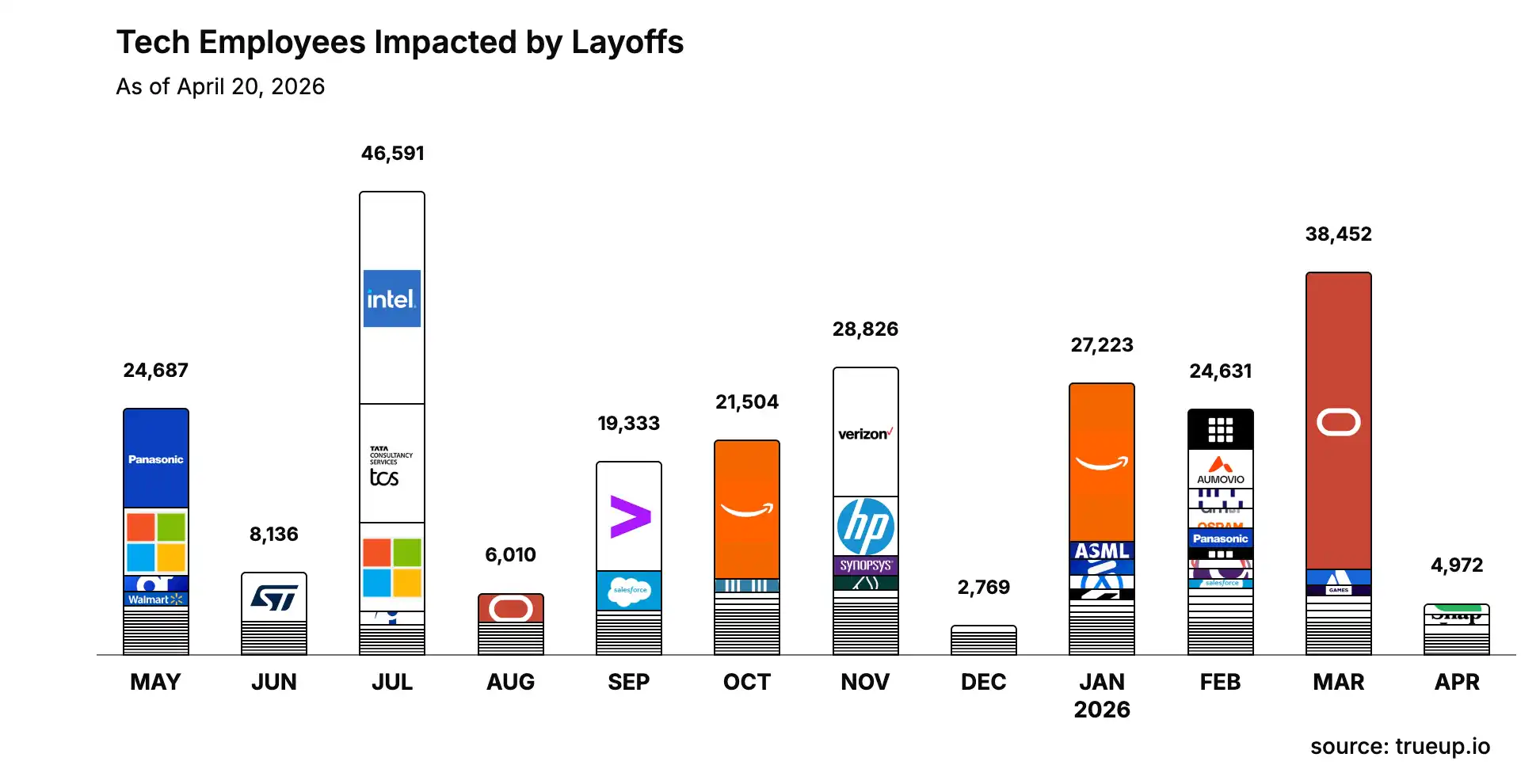
$250 billion invested, nearly 90% of companies say AI hasn't brought any productivity improvements. Meanwhile, tech companies are conducting large-scale layoffs in the name of AI.

This is the most absurd scene in the current AI industry.

According to a Fortune magazine report on April 19, a study published by NBER in February covering 6,000 corporate executives in the US, UK, Germany, and Australia found that nearly 90% of respondent companies said AI had no measurable impact on their employment and productivity over the past three years. Although two-thirds of executives are using AI, their average weekly usage is only 1.5 hours, and 25% of respondents said they don't use AI at work at all.

On the other hand, according to Nikkei Asia citing RationalFX data, from January 1 to early April 2026, the tech industry has laid off 78,557 people, with 37,638 (47.9%) explicitly attributed to AI and workflow automation. Over 76% of the layoffs occurred in the United States.

Apollo chief economist Torsten Slok directly quoted the classic statement of Robert Solow, winner of the 1987 Nobel Prize in Economics, summarizing the current situation as the AI version of the "Solow Paradox." Solow's original words were: "You can see the computer age everywhere but in the productivity statistics."

Slok's judgment almost exactly maps to today. AI is nowhere to be found in employment data, productivity data, or inflation data.

90% of Companies See No AI Effect, $250 Billion Investment Return Questioned

The data from this NBER study is quite solid. Among the four countries, 69% of companies use AI to some extent, with the US highest (78%) and Germany lowest (65%). But using it is one thing, effectiveness is another: over 90% of managers said AI had no impact on their company's employment size, and 89% said it had no impact on labor productivity (measured by sales per capita).

According to Stanford University's 2025 AI Index Report, global AI investment in 2024 exceeded $250 billion. PwC's 2026 Global CEO Survey shows that only 12% of CEOs said AI brought both cost reduction and revenue growth, while 56% of CEOs reported no significant financial benefits.

Slok pointed out in his blog post that aside from the "Magnificent Seven," AI has no visible impact on profit margins and earnings expectations.

This is not an isolated opinion. A 2024 MIT study predicted that AI would only boost productivity by 0.5% over the next decade. The study's author, Nobel laureate Daron Acemoglu, said at the time: "0.5% is better than zero. But relative to the promises of the industry and tech media, it is indeed disappointing."

A study published by Boston Consulting Group (BCG) in March this year revealed a counterintuitive phenomenon: when employees use fewer than three AI tools, productivity increases; but after using four or more tools, self-rated productivity drops significantly, with employees reporting "brain fog" and more minor errors. BCG calls this "AI Brain Overload."

ManpowerGroup's 2026 Global Talent Barometer shows that among nearly 14,000 employees in 19 countries, the routine use rate of AI rose by 13% in 2025, but confidence in AI's practicality plummeted by 18%.

Nearly 80,000 Layoffs in Q1, Is AI the Biggest "Scapegoat" or the Real Culprit?

While productivity data remains blank, the layoff wave is advancing at an alarming rate.

According to Nikkei Asia, the tech industry laid off 78,557 people in Q1 2026, with 47.9% attributed to AI implementation and workflow automation. Oracle recently quietly laid off over 10,000 people, with the saved funds redirected to data center construction. Anthropic CEO Dario Amodei and Ford CEO Jim Farley have both publicly stated that AI will eliminate half of US entry-level white-collar jobs within the next five years. Stanford University research also shows that junior programming and customer service positions are already being impacted, with related job postings dropping 13% over three years.
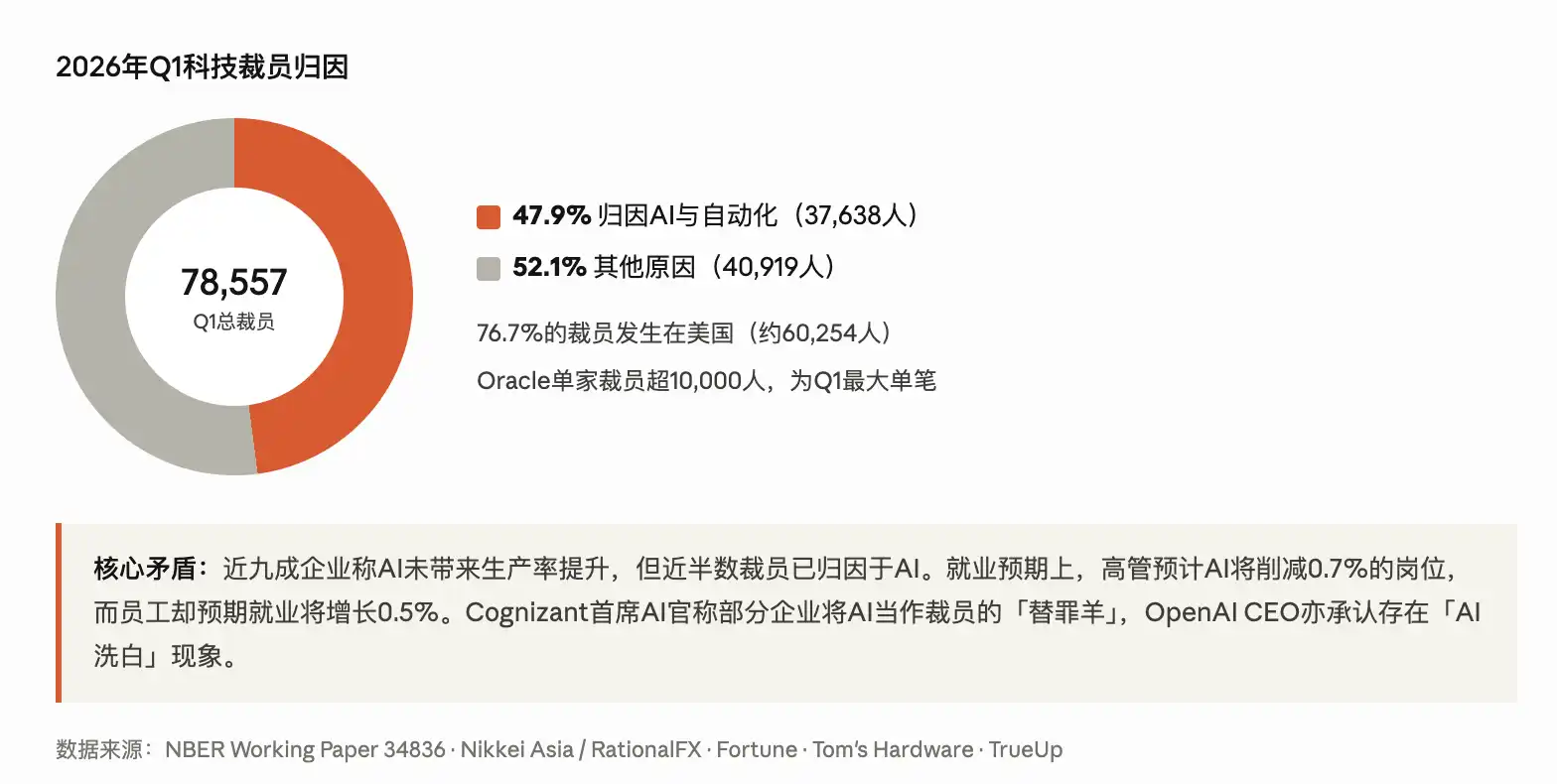
An MIT simulation study provided even more startling numbers: AI could replace 11.7% of the US workforce, involving approximately $1.2 trillion in total wages.

But how many of these layoffs are truly driven by AI?

Cognizant Chief AI Officer Babak Hodjat was blunt with Nikkei Asia: "I'm not sure if these layoffs are directly related to actual productivity gains. Sometimes, AI is just a scapegoat on the financial level—companies overstaffed, want to downsize, and then blame it on AI."

OpenAI CEO Sam Altman also acknowledged the existence of "AI washing" at the India AI Impact Summit, "There's a certain percentage of 'AI washing,' where people blame layoffs that were going to happen anyway on AI, but there are also some jobs that are being genuinely replaced by AI."

Deutsche Bank analysts directly named this phenomenon "AI redundancy washing," believing companies attribute layoffs to AI because "it sends a more positive signal to investors than admitting weak demand or previous over-hiring."

IBM Increases Entry-Level Hiring Against the Trend, Cognizant Refuses Layoffs

Not all companies are following the trend.

IBM tripled its entry-level hiring in 2026. The company's Chief Human Resources Officer, Nickle LaMoreaux, logic is: while AI can perform many entry-level tasks, eliminating these positions would destroy the talent pipeline for cultivating future middle managers, endangering the company's long-term leadership reserves.

Cognizant—a process outsourcing giant highly dependent on human resources—also stated it will not lay off people because of AI. The company has established AI labs in San Francisco and Bangalore to develop custom AI agents for clients (as off-the-shelf generic AI products don't perform well in enterprise environments, with performance and security issues), but its employees will be trained to work alongside AI, not be replaced by it.

Hodjat emphasized: "There will be a large number of young graduates who can't find jobs and lack domain expertise. You have to hire them and let them learn on the job how to use AI in various fields."

Data from the European Central Bank also supports this view from another angle: companies that deploy and invest in AI on a large scale are more likely to be expanding hiring.

J-Curve or Mirage: When Will the AI Productivity Inflection Point Arrive?

Historical experience offers some hope.

IT investment in the 1970s and 80s also seemed ineffective, but from 1995 to 2005, IT-driven productivity growth reached 1.5%. Stanford University Digital Economy Lab Director Erik Brynjolfsson wrote in the Financial Times that the AI productivity inflection point may have begun to appear: US productivity grew 2.7% last year, Q4 GDP tracking growth was 3.7%, but only 181,000 new jobs were added in the same period—this decoupling of job growth from GDP growth might be a signal that AI is starting to work. Former Pimco CEO Mohamed El-Erian also noticed the same decoupling phenomenon.

A study by the Stanford Institute for Economic Policy Research, using web browsing data from 200,000 US households, found that AI improved efficiency in online tasks like job searching, travel planning, and shopping by 76% to 176%. However, researchers found that users spent the saved time socializing and watching TV instead of working or learning new skills.

Apollo's Slok describes AI's future impact as a "J-curve": first a period of declining performance, followed by an exponential leap. But he also points out that unlike the IT era of the 80s, where innovators had monopoly pricing power, today's AI tools face fierce competition and continuously falling prices. Therefore, AI's value creation lies not in the product itself, but in "how generative AI is used and deployed across economic sectors."

Hodjat's judgment is perhaps the most practical: in another 6 to 12 months, companies will begin to see the real productivity improvements brought by AI, and "this transition period will be painful for all of us."


Pertanyaan Terkait

QWhat is the main contradiction highlighted in the article regarding AI's impact on businesses?

AThe main contradiction is that while nearly 90% of surveyed companies report that AI has had no measurable impact on employment or productivity over the past three years, tech companies have attributed 47.9% of their Q1 2026 layoffs (37,638 jobs) to AI and workflow automation.

QWhat historical economic concept is used to describe the current AI productivity paradox?

AThe current situation is described as an AI version of the 'Solow Paradox,' a concept from Nobel laureate Robert Solow, who in 1987 stated, 'You can see the computer age everywhere but in the productivity statistics.'

QAccording to the article, what is 'AI redundancy washing'?

A'AI redundancy washing' is a term used by Deutsche Bank analysts to describe the phenomenon where companies attribute layoffs to AI implementation to present a more positive signal to investors, rather than admitting to weak demand or previous over-hiring.

QWhich companies are cited as examples of not following the trend of AI-driven layoffs?

AIBM and Cognizant are cited as examples. IBM tripled its entry-level hiring to preserve its future leadership pipeline, while Cognizant refuses to lay off employees and instead trains them to work alongside AI.

QWhat does the 'J curve' refer to in the context of AI's future impact?

AThe 'J curve' describes the predicted trajectory of AI's impact: an initial period of underwhelming performance and productivity data, followed by a future period of exponential growth and significant productivity gains as the technology is more effectively deployed across the economy.

Bacaan Terkait

Agen Mengambil Alih Hak Distribusi Lalu Lintas, Apa yang Diperebutkan Tencent, ByteDance, dan Alibaba?

Artikel ini membahas persaingan ketat antara raksasa teknologi China—Tencent, ByteDance (Douyin), dan Alibaba—dalam memperebutkan hak penguasaan distribusi aliran di era AI melalui pengembangan *agent* pintar. Alibaba fokus pada transformasi dengan aplikasi Qianwen yang kini menjadi *super-agent*, terintegrasi dengan ekosistem seperti Taobao dan Alipay untuk menangani tugas kompleks. Mereka juga meluncurkan platform *agent* bisnis "Wukong" dan membuka ekosistem Qianwen ke merek eksternal seperti Luckin Coffee. ByteDance, dengan Doubao (3 miliar pengguna bulanan), mengejar strategi "ada di mana-mana" baik di perangkat lunak maupun keras. Mereka mengembangkan platform pengembangan *agent* Kouzi dan berekspansi ke perangkat keras seperti ponsel AI dan kacamata pintar. Tencent memegang "kartu as" tersembunyi: *agent* AI yang terintegrasi dalam WeChat, yang memungkinkan pengguna mengakses dan menggunakan jutaan *mini-program* secara langsung melalui perintah suara. Ini berpotensi mengubah WeChat menjadi sistem operasi layanan berbasis AI. Inti persaingan ini adalah pergeseran dari ekonomi perhatian (memperpanjang waktu pengguna) ke ekonomi niat (menyelesaikan kebutuhan dengan efisien). Hak distribusi aliran berpindah dari klik manual pengguna ke keputusan yang didelegasikan ke *agent* AI. Perusahaan yang menjadi lapisan eksekusi default bagi *agent* akan mendominasi nilai bisnis di era baru ini, di mana konektivitas layanan dan kompatibilitas API menjadi kunci.

marsbit34m yang lalu

Agen Mengambil Alih Hak Distribusi Lalu Lintas, Apa yang Diperebutkan Tencent, ByteDance, dan Alibaba?

marsbit34m yang lalu

Nasdaq Terjun 4% dalam Semalam, $1,3 Triliun Menguap, Pasar Saham AS Dihantam Tiga Pukulan Sekaligus

**Ringkasan Artikel: Nasdaq Jatuh 4% dalam Satu Malam, AS$1,3 Triliu Menguap, Tiga Pemicu Serangan Ganda pada Saham AS** Pada 5 Juni, pasar saham AS mengalami hari terburuk sejak krisis tarif April 2025. Indeks Nasdaq anjlok 4,18%, S&P 500 turun 2,64%, dan Dow Jones merosot 695 poin. Lebih dari AS$1,3 triliun nilai pasar perusahaan chip AS menguap. Kerugian drastis ini dipicu oleh tiga faktor yang berbarengan: 1. **Laporan Keuangan Broadcom Retakkan Narasi AI:** Meski pendapatan chip AI Broadcom melonjak 143%, panduan untuk kuartal berikutnya sedikit di bawah ekspektasi paling optimis. Ini memicu keraguan atas asumsi pertumbuhan eksponensial tanpa batas di sektor AI, menyebabkan aksi jual besar-besaran di seluruh rantai pasokan semikonduktor. Saham Broadcom sendiri jatuh 12,6%, sementara indeks Philadelphia Semiconductor ambruk 10,26%. 2. **Data Lapangan Kerja Terlalu Kuat, Racun bagi Pasar:** Laporan non-farm payroll AS bulan Mei menunjukkan penambahan 172.000 pekerjaan, jauh melampaui ekspektasi 80.000. Dalam konteks tekanan inflasi akibat perang Iran dan harga minyak tinggi (di atas $90/barel), data kuat ini justru memperkuat ekspektasi bahwa Federal Reserve (The Fed) mungkin tidak akan memotong suku bunga, bahkan berpotensi menaikkannya. Ekspektasi suku bunga yang lebih tinggi sangat merugikan valuasi saham teknologi berbasis pertumbuhan tinggi. 3. **Bayangan Inflasi dari Perang Iran:** Blokade Selat Hormuz oleh Iran sejak Februari terus mendongkrak harga energi global. Inflasi sisi penawaran ini membatasi ruang gerak The Fed dan mengikis konsensus bahwa inflasi telah terkendali, menambah ketidakpastian kebijakan moneter. Ketiga faktor ini saling memperkuat, menyerang fondasi keyakinan pasar: narasi pertumbuhan AI tanpa batas, ekspektasi pelonggaran moneter The Fed, dan konsensus inflasi yang mereda. Jatuhnya pasar dengan cepat menyebar ke bursa global di Asia dan Eropa. Apakah ini awal pecahnya gelembung AI? Mungkin lebih tepat disebut sebagai **penetapan ulang valuasi** daripada keruntuhan narasi sepenuhnya. Permintaan chip AI tetap nyata dan kuat (terbukti dari pertumbuhan 143% Broadcom), tetapi pasar mulai mempertanyakan kemampuannya untuk terus tumbuh pada laju eksponensial seperti yang dibayangkan, dan menilai ulang harga yang pantas dibayar untuk ekspektasi tersebut. Arah pasar selanjutnya akan sangat bergantung pada pertemuan The Fed bulan Juni, panduan dari perusahaan AI lainnya, dan perkembangan situasi di Timur Tengah.

marsbit58m yang lalu

Nasdaq Terjun 4% dalam Semalam, $1,3 Triliun Menguap, Pasar Saham AS Dihantam Tiga Pukulan Sekaligus

marsbit58m yang lalu

Dari Blokir Doubao hingga Sambut Glory, Mengapa WeChat Tiba-tiba "Berganti Wajah"?

Dari memblokir "Doubao" hingga berkolaborasi dengan "Honor": Mengapa WeChat tiba-tiba berubah sikap? WeChat, yang dimiliki Tencent, kini bekerja sama dengan produsen ponsel seperti Honor, Huawei, Xiaomi, OPPO, dan vivo untuk meluncurkan kemampuan A2A, memungkinkan asisten AI sistem ponsel (seperti YOYO Honor) memanggil fungsi WeChat melalui perintah suara, seperti mengirim pesan atau menelepon. Ini adalah perubahan besar mengingat sebelumnya WeChat dengan ketat memblokir upaya pihak ketiga (termasuk ponsel "Doubao" ByteDance) yang mengontrol aplikasinya melalui simulasi klik (GUI Agent). Perubahan ini didorong oleh tekanan kompetisi AI Tencent. Meskipun memiliki WeChat dengan 1,4 miliar pengguna bulanan, aplikasi AI-nya sendiri tertinggal dari pesaing seperti "Doubao" dan "Tongyi Qianwen". WeChat kini memprioritaskan pengembangan "agen AI" internal yang memanfaatkan ekosistem mini-programnya. Namun, untuk menjangkau pengguna, WeChat perlu terhubung dengan asisten AI tingkat sistem di ponsel, yang merupakan pintu masuk AI pertama bagi banyak pengguna. Kolaborasi A2A memungkinkan hal ini: asisten ponsel bertindak sebagai "operator" yang meneruskan perintah ke WeChat, yang kemudian mengeksekusinya di dalam lingkungannya sendiri. Skema ini menjaga kendali dan keamanan data WeChat, tidak seperti pendekatan GUI yang dianggap sebagai "perampasan". Bagi produsen ponsel, kolaborasi ini menarik karena jalur GUI terbukti tidak dapat diandalkan dan mudah diblokir. Meskipun mereka juga memiliki ambisi membangun ekosistem AI sendiri (seperti konsep AHI Honor), kerja sama A2A membuka akses yang sah dan terkontrol ke fungsi WeChat, sekaligus memungkinkan mereka fokus pada pengembangan kemampuan AI lainnya di luar WeChat. Kerja sama ini menggunakan mekanisme otorisasi ganda (pengguna dan aplikasi) untuk keamanan. Pada akhirnya, kolaborasi ini adalah bentuk "jabat tangan" strategis: Tencent mendapatkan pintu masuk AI di tingkat sistem ponsel, sementara produsen ponsel mendapatkan akses yang sah ke fungsi WeChat untuk meningkatkan kegunaan asisten AI mereka. Ini menandai babak baru dalam perebutan pintu masuk di era AI, di mana WeChat berusaha menjadi "sistem operasi layanan", sementara produsen ponsel beralih menjadi penyedia ekosistem AI. Pertarungan untuk menguasai interaksi utama pengguna dengan AI di perangkat mereka baru saja dimulai.

marsbit2j yang lalu

Dari Blokir Doubao hingga Sambut Glory, Mengapa WeChat Tiba-tiba "Berganti Wajah"?

marsbit2j yang lalu

Trading

Spot
Futures

Artikel Populer

Cara Membeli PEOPLE

Selamat datang di HTX.com! Kami telah membuat pembelian ConstitutionDAO (PEOPLE) menjadi mudah dan nyaman. Ikuti panduan langkah demi langkah kami untuk memulai perjalanan kripto Anda.Langkah 1: Buat Akun HTX AndaGunakan alamat email atau nomor ponsel Anda untuk mendaftar akun gratis di HTX. Rasakan perjalanan pendaftaran yang mudah dan buka semua fitur.Dapatkan Akun SayaLangkah 2: Buka Beli Kripto, lalu Pilih Metode Pembayaran AndaKartu Kredit/Debit: Gunakan Visa atau Mastercard Anda untuk membeli ConstitutionDAO (PEOPLE) secara instan.Saldo: Gunakan dana dari saldo akun HTX Anda untuk melakukan trading dengan lancar.Pihak Ketiga: Kami telah menambahkan metode pembayaran populer seperti Google Pay dan Apple Pay untuk meningkatkan kenyamanan.P2P: Lakukan trading langsung dengan pengguna lain di HTX.Over-the-Counter (OTC): Kami menawarkan layanan yang dibuat khusus dan kurs yang kompetitif bagi para trader.Langkah 3: Simpan ConstitutionDAO (PEOPLE) AndaSetelah melakukan pembelian, simpan ConstitutionDAO (PEOPLE) di akun HTX Anda. Selain itu, Anda dapat mengirimkannya ke tempat lain melalui transfer blockchain atau menggunakannya untuk memperdagangkan mata uang kripto lainnya.Langkah 4: Lakukan trading ConstitutionDAO (PEOPLE)Lakukan trading ConstitutionDAO (PEOPLE) dengan mudah di pasar spot HTX. Cukup akses akun Anda, pilih pasangan perdagangan, jalankan trading, lalu pantau secara real-time. Kami menawarkan pengalaman yang ramah pengguna baik untuk pemula maupun trader berpengalaman.

636 Total TayanganDipublikasikan pada 2024.12.12Diperbarui pada 2026.06.02

Cara Membeli PEOPLE

Diskusi

Selamat datang di Komunitas HTX. Di sini, Anda bisa terus mendapatkan informasi terbaru tentang perkembangan platform terkini dan mendapatkan akses ke wawasan pasar profesional. Pendapat pengguna mengenai harga PEOPLE (PEOPLE) disajikan di bawah ini.

活动图片