NFTs That Can Earn Stock Tokens? What Exactly is StonkBrokers?

Foresight NewsDipublikasikan tanggal 2026-07-21Terakhir diperbarui pada 2026-07-21

Abstrak

Title: How StonkBrokers Connects NFTs to Stock Token Earnings StonkBrokers is an NFT project from the Web3 development team Clutch Labs (CLUTCH) built on Robinhood Chain. It consists of 4,444 "pixel broker" NFTs. Unlike typical NFTs, each one is linked to an ERC-6551 token-bound account, meaning it functions as its own wallet capable of holding assets like stock tokens. The project's ecosystem includes: 1. **STONKBROKER (ERC-20 Token)**: The fungible token connected to the NFTs via the Anvil AMM. Users can trade tokens for NFTs at a base rate of 666,666 STONKBROKER (plus ETH fees). 2. **NFT Activation & Rewards**: NFT holders must spend STONKBROKER tokens to "activate" their NFT into one of five tiers, which determines their weight in receiving stock token rewards. These rewards are funded by 70% of the ETH trading fees generated on the Anvil AMM. 3. **Lending**: NFTs can be used as collateral to borrow STONKBROKER tokens. 4. **Future Products**: The roadmap includes the Stonk Launcher (a token launchpad) and the Stonk Exchange (a "vote-directed DEX" based on Uniswap V3), scheduled for late July and August 2026, respectively. The project aims to provide NFTs with ongoing utility as active financial agents rather than static collectibles. Its token (STONKBROKER) and NFT collection have seen significant price increases recently. However, the project's long-term viability depends on successful product delivery, sustainable protocol revenue, and navigating risks like market vo...


Author: KarenZ, Foresight News


Most NFTs, once bought and sent to a wallet, have a primary job of "sitting around."


StonkBrokers, however, has assigned 4444 pixel brokers an on-chain job: each NFT comes with its own wallet capable of receiving stock tokens; holders can use the project's token to activate it, increase its reward weight, or pledge it for loans. Around these NFTs and the related token STONKBROKER, CLUTCH is also planning token issuance and decentralized exchange products.


The market has shown high enthusiasm for this design. According to GMGN data, the StonkBrokers token STONKBROKER once saw its market capitalization exceed $15 million, with a 24-hour increase of over 300%, rising more than 14 times in the past 2 days, and is currently oscillating around $13 million. OpenSea data shows the StonkBrokers NFT floor price has also risen to 1.88 ETH, up over 306% in 24 hours.
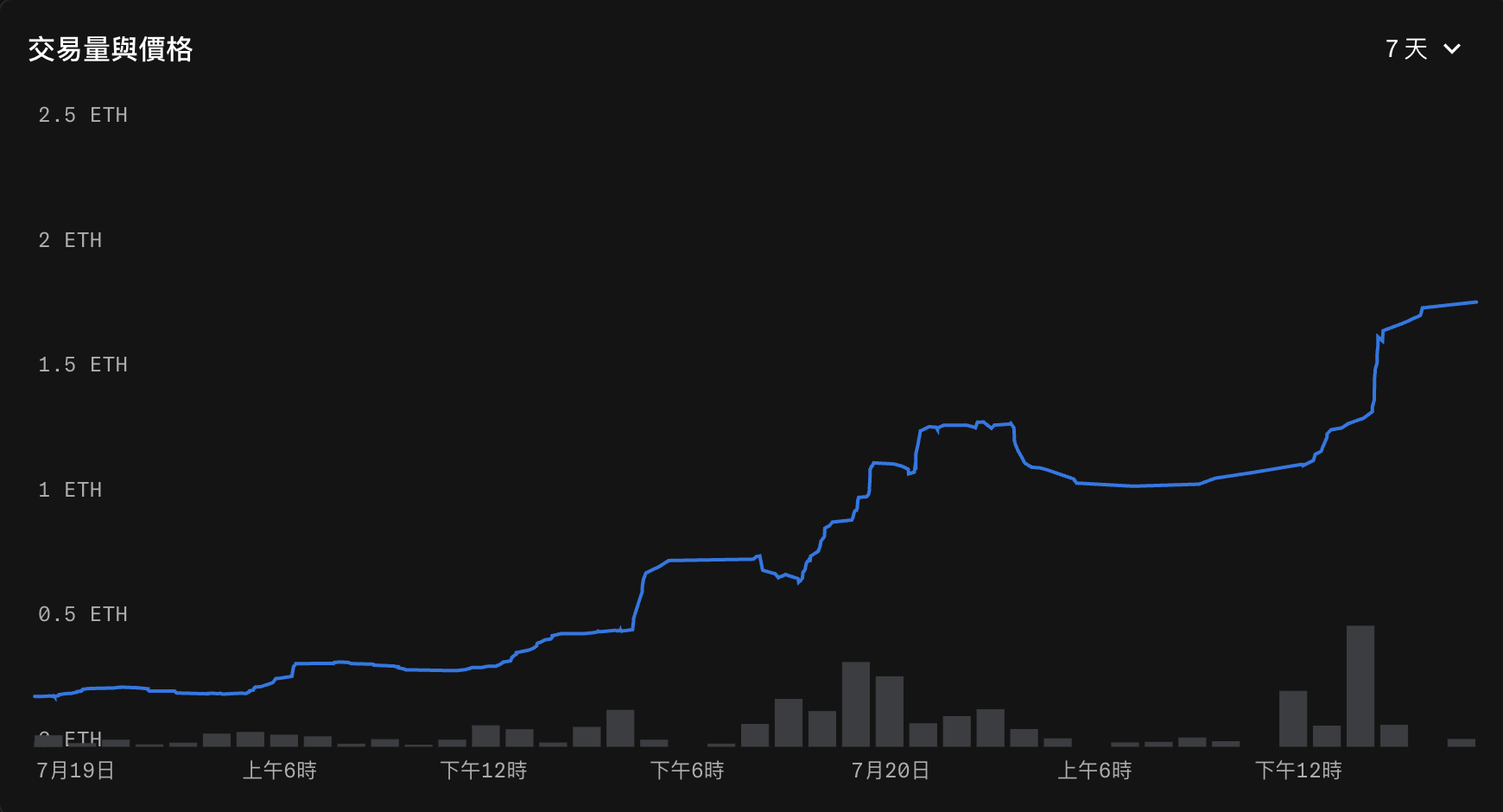

StonkBrokers NFT trading volume and price, Source: OpenSea


Who is CLUTCH, and What is StonkBrokers?


CLUTCH, more fully known as Clutch Labs, is an independent Web3 development team focused on on-chain market infrastructure. Its publicly disclosed products involve directions such as prediction markets, NFT liquidity protocols, perpetual contracts, on-chain games, and AI Agents.


The CLUTCH website lists 0xSimpleFarmer as a project builder, and their X account also introduces themself as the founder of Clutch Markets.


CLUTCH didn't start developing products with StonkBrokers. According to the timeline on its website, the team initially entered the market with on-chain parlay prediction markets and subsequently launched products like prediction markets, Clutch Puppies, Pixel Pups, an NFT marketplace, and the Anvil NFT AMM on networks such as Arbitrum, ApeChain, and Ethereum.


StonkBrokers can be understood as CLUTCH's combinatorial attempt, applying their previous experience with NFTs, AMMs, and DeFi on the Robinhood Chain.


The project was originally an experimental development by the team on the Robinhood Chain testnet during the Arbitrum Buildathon. 0xSimpleFarmer stated that this test version was showcased by the Robinhood Chain team at the event. About seven months later, the project launched on the Robinhood Chain mainnet on July 17, 2026, and completed the issuance of 4444 NFTs.


The mainnet launch of StonkBrokers was described by the project as a "free mint," but "free" here only refers to the NFT mint price being 0, not that all participants could obtain NFTs at zero cost. Users needed to burn the Pup Cup NFT on Ethereum or the Clutch Puppies NFT on ApeChain before the deadline to receive corresponding StonkBrokers minting slots, with one old NFT corresponding to one slot. This channel is now closed, and all 4,444 StonkBrokers have been minted. To obtain an NFT now, one must purchase it through the Anvil AMM or on the secondary market.


How Do NFTs, Bound Accounts, and the STONKBROKER Token Connect?


Each StonkBroker NFT is associated with an ERC-6551 Token-Bound Account.


In simple terms, an NFT is not just a picture in a wallet; it itself possesses an on-chain account. This account can hold ERC-20 tokens or other on-chain assets, and control of the account follows the transfer of NFT ownership: whoever owns the NFT can control its bound wallet.


The NFT receives initial stock tokens upon minting, and subsequent stock token rewards also go directly into the corresponding bound account. If a StonkBroker's bound account holds stock tokens, these assets will transfer along with the NFT to the new holder.


The StonkBroker NFT is a non-fungible ERC-721 asset, with a total supply of 4444; STONKBROKER is a freely divisible and transferable ERC-20 token. The two are connected via CLUTCH's Anvil NFT AMM.


The protocol sets a base redemption unit of 666,666 STONKBROKER tokens for each NFT. Users can pay 666,666 STONKBROKER plus a transaction fee in ETH to the Anvil treasury to redeem the next NFT from the treasury; if a specific token ID is desired, they can use the "snipe" function to select a designated NFT (with a higher ETH fee). The project's current documentation lists ETH transaction fees as 10% for regular redemption and 15% for designated NFT redemption. Relevant parameters should still be verified against the actual trading interface and contract calls.


This structure can, to some extent, address liquidity issues for certain NFTs. Traditional NFT trading relies on buyers and sellers placing orders; if an NFT temporarily has no buyer, the holder might find it difficult to exit immediately. Anvil establishes a protocol-based redemption channel between NFTs and ERC-20 tokens of the same series.


It's important to note that "each NFT corresponds to 666,666 tokens" should not be misinterpreted as a risk-free price guarantee. Both NFTs and STONKBROKER will fluctuate with market trading, and the actual value paid or received by users is also affected by token price, ETH fees, treasury inventory, and protocol parameters.


Furthermore, Anvil provides a protocol-level redemption channel with a 10%/15% ETH fee, which is better than having no liquidity, but it is not a low-cost, high-efficiency liquidity solution.


From Activation to Clock In: How Are Stock Token Rewards Generated?


However, initial stock token funding and subsequent rewards are two different mechanisms. Subsequent stock token rewards supported by Anvil trading fees will only be distributed to already activated StonkBrokers, with weights calculated based on activation level.


Merely holding a StonkBroker does not mean automatically receiving subsequent stock token rewards. Holders need to first activate the NFT using STONKBROKER tokens on the project's page to include it in the reward distribution system.


The current StonkBrokers documentation sets five activation tiers: the base tier requires 66,666 STONKBROKER, the highest tier requires 1,666,666, with corresponding reward weights increasing from 1x to approximately 3.33x.
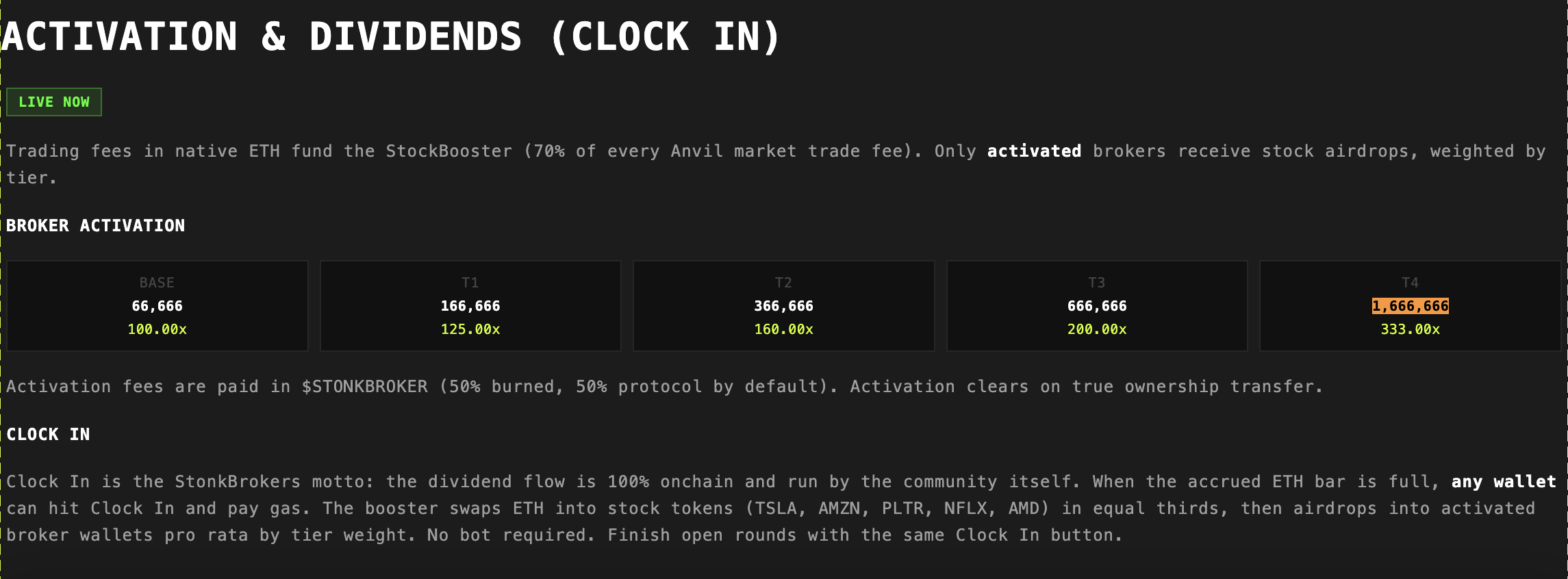


According to current contract parameters, the StonkBroker activation fee is set by default to 50% burned and 50% sent to the protocol; after a genuine ownership transfer of the NFT, the previous activation status is cleared, and the new holder needs to reactivate. However, stock tokens already deposited into the bound account are not cleared.


The funds for stock token rewards currently primarily come from Anvil's ETH transaction fees. According to the current documentation, 70% of these fees go to StockBooster, and 30% go to the protocol. When StockBooster accumulates to a set condition, any user can call the "Clock In" function and pay Gas, triggering the protocol to swap ETH for the currently configured stock tokens, which are then distributed to the bound wallets of each NFT based on activation level weights.


The whole process can be simplified as:


Trading NFTs on Anvil generates ETH fees → 70% of fees go to StockBooster → Community users call Clock In → ETH is swapped for stock tokens → Stock tokens enter the bound accounts of activated NFTs.


From NFT Lending to Launcher and vDEX


On top of this, StonkBrokers also offers NFT collateralized lending functionality. Holders can lock their NFT into the Loan Vault to borrow principal denominated in STONKBROKER. Documentation lists the principal benchmark as 666,666 STONKBROKER, with borrowing fees prepaid in ETH and calculated based on loan duration, a 15% annualized fee rate, and the ETH market value of the NFT.


Borrowing fees are also distributed with 70% going to StockBooster and 30% to the protocol. After the borrower repays the agreed amount of STONKBROKER, they can retrieve the NFT; if overdue, additional ETH fees must be paid, and persistent default may lead to loss of the pledged NFT.


Furthermore, StonkBrokers will subsequently launch the launch platform Stonk Launcher and Stonk Exchange on July 30.


Among these, the launch platform supports fixed-price, bonding curve, and custom launch configurations. According to the project design, this step will also automatically create LP positions, fee distribution contracts, and the token's own staking vault. Token holders can deposit newly issued tokens into the staking vault and share the corresponding LP fees proportionally.


The project describes Stonk Launcher as a launch platform governed by STONKBROKER holders and activated StonkBroker NFTs, sharing governance and fee streams. A portion of the fees and royalties generated by Launcher is planned to support stock token rewards. Specific allocation ratios and implementation methods still need to be verified against the officially deployed mainnet contracts.


The Stonk Exchange, accompanying Launcher, is scheduled to launch on August 29 at 8:00 PM Eastern Time, corresponding to the morning of August 30 Beijing time. The project calls it a "Vote Directed DEX," or vDEX for short, meaning a DEX where the flow of trading fees can be determined by voting.


At the basic trading level, Stonk Exchange plans to adopt the Uniswap V3 architecture. Users can perform token swaps, create concentrated liquidity pools, and allocate funds within custom price ranges. Unlike traditional AMMs that spread liquidity uniformly across the entire price range, Uniswap V3 liquidity providers can concentrate their capital in price ranges expected to be more active to improve capital efficiency. However, once the price moves outside the selected range, the LP position may stop earning trading fees and face risks like impermanent loss.


Project documentation outlines three tiers of trading fees: 0.05% primarily for relatively stable trading pairs, 0.3% for ordinary pairs, and 1% for assets with lower liquidity or higher volatility. STONKBROKER is planned as a governance tool, allowing holders to vote on the direction of some fee flows, such as which liquidity pools or ecosystem incentive programs receive support.


It's important to distinguish that existing information does not confirm that trading fees generated by Stonk Exchange will be fixedly directed to StockBooster or the stock token reward system. What can be confirmed currently is that the flow of these fees will be determined by STONKBROKER governance mechanisms; whether they are used for stock token rewards still depends on the contract design and governance outcomes at that time.


Conclusion


The most noteworthy aspect of StonkBrokers might not be "how much ETH an NFT rose to" or "how high the token's market cap climbed," but rather its attempt to answer a long-standing question plaguing the NFT market: beyond being a profile picture or community status symbol, can an NFT become a truly operable on-chain account and maintain an ongoing relationship with trading, lending, and RWA?


CLUTCH has already deployed part of the mechanism to the mainnet, but subsequent modules like Stonk Launcher and Stonk Exchange still await delivery. Whether StonkBrokers ultimately forms a sustainable on-chain financial system or merely completes a high-volatility product experiment under attention remains to be answered by real protocol revenue, subsequent product implementation, and more thorough security verification.


Simultaneously, the Robinhood Chain ecosystem is still in its early stages, with network activity, asset liquidity, and infrastructure maturity all requiring observation. StonkBrokers also faces uncertainties such as smart contract security, team delivery, governance parameter adjustments, and regulatory policy changes. Its NFTs, STONKBROKER token, and related stock tokens may all experience significant price volatility. The stock token rewards mentioned by the project are not equivalent to stable returns or traditional stock dividends, and participants still need to fully assess the associated risks.


Pertanyaan Terkait

QWhat is StonkBrokers and how does it utilize NFTs?

AStonkBrokers is a Web3 project built on Robinhood Chain that utilizes 4,444 unique pixel broker NFTs. Each NFT is associated with an ERC-6551 Token-Bound Account, essentially giving it its own wallet capable of receiving tokenized stock rewards. These NFTs can be activated with the project's native token (STONKBROKER) to increase their reward weight, used as collateral for loans, and traded through the Anvil NFT AMM.

QWhat is the purpose of the STONKBROKER token within the ecosystem?

AThe STONKBROKER token is the ERC-20 utility and governance token of the StonkBrokers ecosystem. Its primary functions include: activating StonkBroker NFTs to qualify them for stock token rewards and increase their reward weight, serving as the quote asset for NFT/ERC-20 swaps on the Anvil AMM, and being the currency for governance votes that direct fee flows within the upcoming Stonk Exchange (vDEX).

QHow does the 'stock token' reward mechanism for activated NFTs work?

AStock token rewards for activated NFTs are funded primarily by ETH transaction fees generated from trading NFTs on the Anvil AMM. 70% of these fees go into a 'StockBooster' pool. When a user triggers the 'Clock In' function, the protocol swaps the accumulated ETH in the StockBooster for the configured stock tokens. These tokens are then distributed to the Token-Bound Accounts of all *activated* NFTs, with the amount each receives weighted by its activation level.

QWhat is the Stonk Exchange (vDEX), and how does it differ from a traditional DEX?

AStonk Exchange is a planned decentralized exchange (DEX) that the article calls a 'Vote Directed DEX' (vDEX). While it will be built on Uniswap V3 architecture for core trading functionality, its key differentiator is governance. Holders of STONKBROKER tokens can vote to direct where a portion of the trading fees generated on the exchange are allocated, such as to specific liquidity pools or ecosystem incentive programs.

QWhat are some of the key risks or challenges associated with StonkBrokers mentioned in the article?

AThe article highlights several risks: 1) The project's full vision (Stonk Launcher and Stonk Exchange) is not yet deployed. 2) The ecosystem is built on the early-stage Robinhood Chain, which may have limited network activity and liquidity. 3) The project faces standard Web3 risks like smart contract security, team execution, and potential regulatory changes. 4) All assets (NFTs, STONKBROKER, stock tokens) are subject to high price volatility, and stock token rewards are not guaranteed stable income or traditional dividends.

Bacaan Terkait

Setelah Tiga Kuartal Berturut-Turut Turun, Bisakah Pasar Kripto Menyambut Jendela Stabilitas di Kuartal Ketiga?

Pasar kripto mengalami kuartal terburuk sejak 2022, dengan kapitalisasi pasar turun 12.6% menjadi $2.1 triliun, didorong oleh keluarnya modal dan penurunan volume perdagangan. Bitcoin dan Ethereum masing-masing jatuh 14.2% dan 25.4% di kuartal kedua. Aliran keluar bersih dari ETF Bitcoin AS mencapai $4.67 miliar, menandakan tekanan jual yang berkelanjutan. Faktor utama meliputi terputusnya hubungan dengan saham AS, kebijakan moneter Federal Reserve yang ketat, dan pelepasan aset oleh perusahaan seperti Strategy. Proses legislasi UU CLARITY yang akan memberikan kejelasan regulasi terhambat, meningkatkan premi risiko di sektor ini. Namun, ada tanda-tanda potensi stabilisasi. Aliran keluar ETF yang besar secara historis sering terjadi di akhir fase penurunan, dan para pemegang Bitcoin jangka panjang mulai menambah kepemilikan lagi. Sementara sebagian besar sektor menyusut, pasar prediksi dan aset koleksi yang ditokenisasi mencatat pertumbuhan signifikan. Pandangan untuk kuartal ketiga sangat bergantung pada pertemuan Fed akhir Juli. Sinyal kebijakan yang lunak dapat mendukung pemulihan Bitcoin, sementara sikap yang hawkish dapat memicu konsolidasi lebih lanjut. Meskipun tantangan regulasi tetap ada, indikator teknis seperti harga Bitcoin yang mendekati rata-rata bergerak 200-mingguannya menunjukkan dasar jangka panjang belum rusak. Logika pasar telah bergeser dari mengandalkan narasi ke faktor fundamental seperti kebijakan dan ekspektasi suku bunga.

marsbit23j yang lalu

Setelah Tiga Kuartal Berturut-Turut Turun, Bisakah Pasar Kripto Menyambut Jendela Stabilitas di Kuartal Ketiga?

marsbit23j yang lalu

The SpaceX Trade, Terbuka: SPCXON Mulai Diperdagangkan di WEEX

SpaceX meluncurkan IPO terbesar dalam sejarah pada Juni 2026, namun akses bagi banyak pedagang terhambat oleh batasan regional dan prosedur broker. WEEX kini menghadirkan SPCXON/USDT di pasar spotnya, sebuah instrumen tokenisasi yang memungkinkan paparan terhadap pergerakan harga SpaceX melalui akun kripto yang diselesaikan dengan USDT, tanpa memerlukan broker AS atau pembiayaan bank. SPCXON adalah produk tokenisasi yang mencerminkan ekonomi kepemilikan SpaceX bagi pedagang yang memenuhi syarat di luar AS, dengan dividen diinvestasikan kembali. Aset ini diperdagangkan di WEEX sebagai pasangan spot dengan USDT, tersedia selama jam pasar, memberikan akses mudah bagi trader kripto. Kasus investasi untuk SpaceX didasarkan pada pertumbuhan pendapatan Starlink dan pencapaian Starship, meskipun valuasinya yang tinggi (sekitar 90-110 kali pendapatan) telah memperhitungkan eksekusi sempurna selama bertahun-tahun. Faktor seperti jumlah saham publik yang terbatas dan masa buka kunci (unlock) insider pertama menjadi pertimbangan penting. Penting untuk diingat bahwa SPCXON memberikan paparan, bukan kepemilikan langsung atas saham atau hak suara. Harganya dapat diperdagangkan pada premium atau diskon terhadap nilai aset bersih. WEEX menawarkan akses ke berbagai aset TradFi yang ditokenisasi seperti ini dalam satu akun terpadu, bersama dengan pasar futures dan kampanye perdagangan dengan pool hadiah.

TheNewsCrypto23j yang lalu

The SpaceX Trade, Terbuka: SPCXON Mulai Diperdagangkan di WEEX

TheNewsCrypto23j yang lalu

Momen Perdagangan BIT: BTC Masih Tertekan oleh EMA 200 Mingguan, Setelah Ditolak Mungkin Kembali Turun, Saham Penyimpanan dan Semikonduktor yang Melonjak Malam Kemudian Mulai Anjlok di Pasar Malam

**PASAR KRIPTO & SAHAM: BTC Hadapi Resistensi, Saham Semikonduktor Turun di Perdagangan Malam** Pasar kripto melanjutkan pemulihan, dengan harga Bitcoin bertahan di sekitar $66,000 setelah rebound lebih dari 15% dari titik terendah Juli. Namun, BTC menghadapi **tembok resistensi kuat di dekat $68,000**, yang bertepatan dengan biaya rata-rata investor selama lima bulan terakhir dan titik gagalnya rebound pertengahan Juni. Secara teknis, perhatian tertuju pada **200 EMA mingguan (~$68,328) sebagai level kunci**. Jika BTC ditolak di level ini, potensi penurunan menuju support $63,000 terbuka. Analis menyoroti volume rendah dan penurunan open interest futures di CME, menandakan rebound ini lebih dipicu likuiditas rendah musim panas daripada awal bull run penuh. Di pasar saham AS, **indeks futures utama turang** setelah sesi kemarin yang kuat. Sektor semikonduktor dan penyimpanan (storage), yang melonjak pada hari Selasa (contoh: Micron +12%), **mengalami koreksi di perdagangan malam (night trading)**. ETF semikonduktor turun 2,22% dan saham Micron turun 2,29%. Meski begitu, ada sorotan positif seperti **Super Micro Computer (SMCI)** yang naik lebih dari 15% setelah melaporkan pandangan pendapatan yang kuat dan pesanan baru yang sangat besar, mengonfirmasi permintaan server AI tetap solid. Kekhawatiran makro muncul dari **kenaikan harga minyak mentah (di atas $91)** akibat ketegangan geopolitik dan **lonjakan imbal hasil (yield) obligasi pemerintah AS**, dengan imbal hasil 10-tahun mencapai sekitar 4,64%. Faktor-faktor ini dapat menambah tekanan inflasi dan membatasi ruang gerak pasar saham. Saham terkait kripto seperti Coinbase dan Robinhood naik kuat didorong oleh perkembangan regulasi yang lebih jelas di AS. Di Asia, **Korea Selatan** dan **Jepang** menunjukkan kinerja beragam. Indeks KOSPI Korea naik didukung pemulihan saham semikonduktor, sementara pasar Jepang melemah dengan **Yen terus melemah ke level terendah sejak 1986**, meningkatkan kekhawatiran akan intervensi bank sentral. **Yang Perlu Diperhatikan Selanjutnya:** * **22 Juli:** Acara AI AMD, rilis laporan keuangan dari Google (Alphabet), Tesla, IBM. * **23 Juli:** Keputusan suku bunga Bank Sentral Eropa (ECB), data klaim pengangguran AS, laporan keuangan Intel. * Perkembangan lebih lanjut dari **harga minyak, imbal hasil obligasi, dan dinamika Yen Jepang** akan menjadi penentu sentimen pasar risiko secara keseluruhan.

marsbit23j yang lalu

Momen Perdagangan BIT: BTC Masih Tertekan oleh EMA 200 Mingguan, Setelah Ditolak Mungkin Kembali Turun, Saham Penyimpanan dan Semikonduktor yang Melonjak Malam Kemudian Mulai Anjlok di Pasar Malam

marsbit23j yang lalu

Mantan Ketua CFTC dan Presiden Circle, Tarbert: Satu Pihak Menasihati Anda untuk Berpikir Jangka Panjang, di Sisi Lain Menguangkan $30 Juta Sendiri

Penulis: Zen, PANews Heath Tarbert, mantan Ketua CFTC dan Presiden Circle, baru-baru ini menyerukan kepada investor untuk mengadopsi pandangan jangka panjang terhadap saham Circle, meskipun harganya telah turun 70% dari puncaknya. Namun, ia sendiri secara konsisten menjual saham CRCL sejak perusahaan go public, menguangkan sekitar $30 juta tanpa pernah membeli saham tambahan di pasar terbuka. Tarbert, yang bergabung dengan Circle pada Juli 2023 dan menjadi Presiden pada awal 2025, dikenal sebagai pendukung kuat narasi "jangka panjang" perusahaan. Namun, sehari sebelum IPO Circle, ia menetapkan rencana perdagangan 10b5-1 untuk menjual hingga 353.290 saham dalam setahun. Dalam 13 bulan setelah IPO, ia menjual lebih dari 360.000 saham, termasuk penjualan tunggal senilai $11,5 juta pada Maret 2026. Ia bahkan menetapkan rencana 10b5-1 kedua untuk menjual hingga 160.000 saham lagi pada akhir tahun 2026. Langkah Tarbert ini menuai kecaman karena dianggap tidak konsisten dengan pesan "jangka panjang" yang ia sampaikan kepada publik. Perjalanan kariernya sering dikaitkan dengan "revolving door" antara regulator dan dunia keuangan. Setelah mengundurkan diri sebagai Ketua CFTC pada Maret 2021, ia bergabung dengan Citadel Securities hanya 27 hari kemudian sebagai Kepala Penasihat Hukum, tepat saat perusahaan itu menghadapi pengawasan ketat terkait peristiwa GameStop. Di Citadel, ia juga mendukung undang-undang yang memperluas wewenang CFTC atas pasar crypto, sementara Citadel diketahui berencana berekspansi ke aset kripto. Tarbert kemudian pindah ke Circle pada 2023, membantu perusahaan mengatasi tantangan regulasi dan akhirnya go public melalui IPO langsung. Meskipun sangat berharga bagi perusahaan, tindakannya menjual saham dalam jumlah besar sambil mendorong investor untuk bertahan menimbulkan pertanyaan tentang komitmennya yang sebenarnya terhadap masa depan jangka panjang Circle.

marsbitKemarin 08:09

Mantan Ketua CFTC dan Presiden Circle, Tarbert: Satu Pihak Menasihati Anda untuk Berpikir Jangka Panjang, di Sisi Lain Menguangkan $30 Juta Sendiri

marsbitKemarin 08:09

Gate Research Institute: Produk Keuangan Kripto Menggulirkan Gelombang "Wall Street-ization", Kompetisi atau Integrasi?

**Ringkasan: Gelombang "Wall Street-ization" Produk Keuangan Kripto: Kompetisi atau Integrasi?** Artikel ini membahas fenomena konvergensi antara keuangan tradisional (TradFi) dan keuangan kripto (Crypto). Meskipun Bitcoin awalnya dirancang sebagai sistem peer-to-peer yang terdesentralisasi dan bebas dari perantara seperti bank, pasar kripto kini semakin diintegrasikan ke dalam infrastruktur keuangan tradisional. **Tren "Wall Street-ization":** Dimulai dengan disetujuinya ETF spot Bitcoin pada 2024, aset kripto kini dikemas menjadi produk seperti ETF (oleh BlackRock, Fidelity, dll.), futures, dan sekuritisasi aset riil (RWA) seperti obligasi pemerintah yang ditokenisasi. Ini memberikan akses yang mudah dan teregulasi bagi investor institusional, tetapi juga berarti kekuasaan atas penerbitan, penentuan harga, kustodian, dan distribusi aset kripto semakin bergeser ke lembaga keuangan besar. **Dua Jalur Konvergensi (1+1>2):** Artikel ini menyoroti dua arah integrasi: 1. **Dari CEX ke TradFi:** Dilambangkan oleh **Gate.io**, yang berkembang dari bursa kripto menjadi platform multi-aset. Gate kini menawarkan perdagangan saham nyata (AS, Hong Kong, Korea) menggunakan USDT, menyediakan akses tanpa batas waktu ke pasar tradisional. 2. **Dari TradFi ke Crypto:** Dilambangkan oleh **Robinhood**, platform broker tradisional yang memperluas layanannya ke aset kripto (termasuk melalui akuisisi Bitstamp) dan mengembangkan produk seperti token saham di blockchain. **Tujuan Bersama: Akun Keuangan "Super" Terpadu:** Kedua jalur ini bertujuan menciptakan **akun keuangan generasi berikutnya yang terpadu**. Pengguna di masa depan mungkin dapat memperdagangkan Bitcoin, saham Apple, ETF, emas, dan obligasi pemerintah yang ditokenisasi dalam satu antarmuka yang sama, menggunakan stablecoin sebagai lapisan dana. **RWA dan Obligasi Pemerintah di On-Chain sebagai Lapisan Tengah:** Tokenisasi aset dunia nyata, terutama obligasi pemerintah AS, menyediakan aset berpenghasilan rendah risiko di ekosistem on-chain. Pasar ini tumbuh pesat (naik 40% pada paruh pertama 2026) meskipun pasar kripto turun, menunjukkan permintaan nyata. **Kesimpulan:** "Wall Street-ization" bukanlah pengambilalihan sepihak, melainkan **transformasi timbal balik**. TradFi dan Crypto saling melengkapi: Crypto mendapatkan akses ke likuiditas, kepatuhan, dan jaringan distribusi yang luas, sementara TradFi mengadopsi efisiensi, kecepatan, dan pasar 24/7 dari Crypto. Hasil akhirnya adalah pembentukan **pasar modal terpadu yang lebih efisien dan global**, di mana batas antara aset tradisional dan kripto semakin kabur.

marsbitKemarin 08:07

Gate Research Institute: Produk Keuangan Kripto Menggulirkan Gelombang "Wall Street-ization", Kompetisi atau Integrasi?

marsbitKemarin 08:07

Trading

Spot
活动图片




