Mining Stocks Are Moving Further Away from Crypto

链捕手Dipublikasikan tanggal 2026-07-17Terakhir diperbarui pada 2026-07-17

Abstrak

Title: Mining Stocks Are Drifting Away from Crypto Summary: Despite Bitcoin (BTC) falling approximately 46% over the past year, leading Bitcoin mining stocks (e.g., HUT, WULF, IREN) have surged significantly. This divergence stems from a fundamental shift in how the market values these companies. Their stock prices are no longer tied primarily to crypto prices, mining output, or hash rates. Instead, investors are now pricing them as AI infrastructure plays. Mining companies possess critical assets for AI data centers: pre-permitted land, grid-connected power capacity, and operational expertise for high-load facilities—resources facing severe shortages and long lead times for new entrants. For example, CleanSpark signed a 20-year, ~$6.6 billion infrastructure lease for an AI data center, while Marathon Digital acquired a project with up to 2 GW of planned power capacity. Analysts note a strong correlation between a mining company's market valuation and its contracted or potential AI power capacity in North America. CoinShares predicts that by year-end, up to 70% of revenue for listed miners could come from AI/HPC, compared to about 30% at the start of 2026. However, this re-rating introduces new risks: 1) Valuation volatility linked to the broader AI/semiconductor sector, 2) Potentially low baseline return rates (estimated at 4-5% for some firms), and 3) Execution risks including massive financing needs, regulatory permits, and tenant quality. This strategic pivot is also ...

Author: Zhou, ChainCatcher

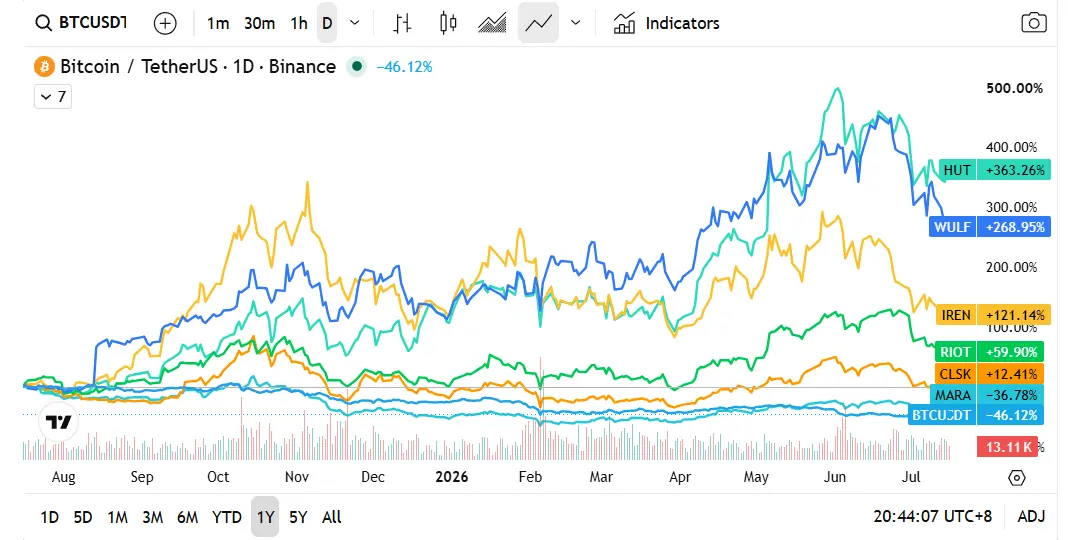
According to RootData market data, over the past year, BTC has fallen by 46.12% cumulatively, yet Bitcoin mining stocks have not declined in sync. Among them, HUT is up 363.26%, WULF up 268.95%, IREN up 121.14%, RIOT up 59.90%, and CLSK up 12.41%.
This round of gains is not built upon an improvement in the fundamentals of mining. June operational data shows that, despite consecutive downward adjustments in mining difficulty, CleanSpark, BitFuFu, and Canaan still saw month-on-month production declines ranging from 9% to 29%.

It is not difficult to see that the market's focus has shifted. Since July, CleanSpark signed a 20-year infrastructure lease with an initial period contract value of $6.6 billion, TeraWulf planned to raise $3.5 billion to expand a data center campus, and MARA acquired a Texas project company with a planned power capacity of up to 2 GW for up to $600 million.

Mining stock prices no longer revolve solely around coin prices, production output, and hashrate; the market has begun valuing them by a different set of logic.

The Source of Mining Stock Volatility Is No Longer On-Chain

At the beginning of the month, a typical dislocation occurred in the market, with mining stocks experiencing an overall pullback of about 20%, while BTC remained stable around $64,000.

On the production side, in June, CleanSpark produced 614 BTC, lower than 671 BTC in May, down 9% month-on-month. Its nominal hashrate was 50 EH/s, while its average operational hashrate was only 42.6 EH/s. The gap widened from 3.8 EH/s in May to 7.4 EH/s, indicating downtime or load reduction.

BitFuFu produced 125 BTC, down 29.4% month-on-month. Its total hashrate dropped from 19.5 EH/s to 15.3 EH/s, primarily dragged down by a reduction in third-party hosted hashrate from 16.3 EH/s to 11.8 EH/s.

Canaan produced 64 BTC, down 29% month-on-month, attributing part of the reason to grid maintenance at mining facilities.

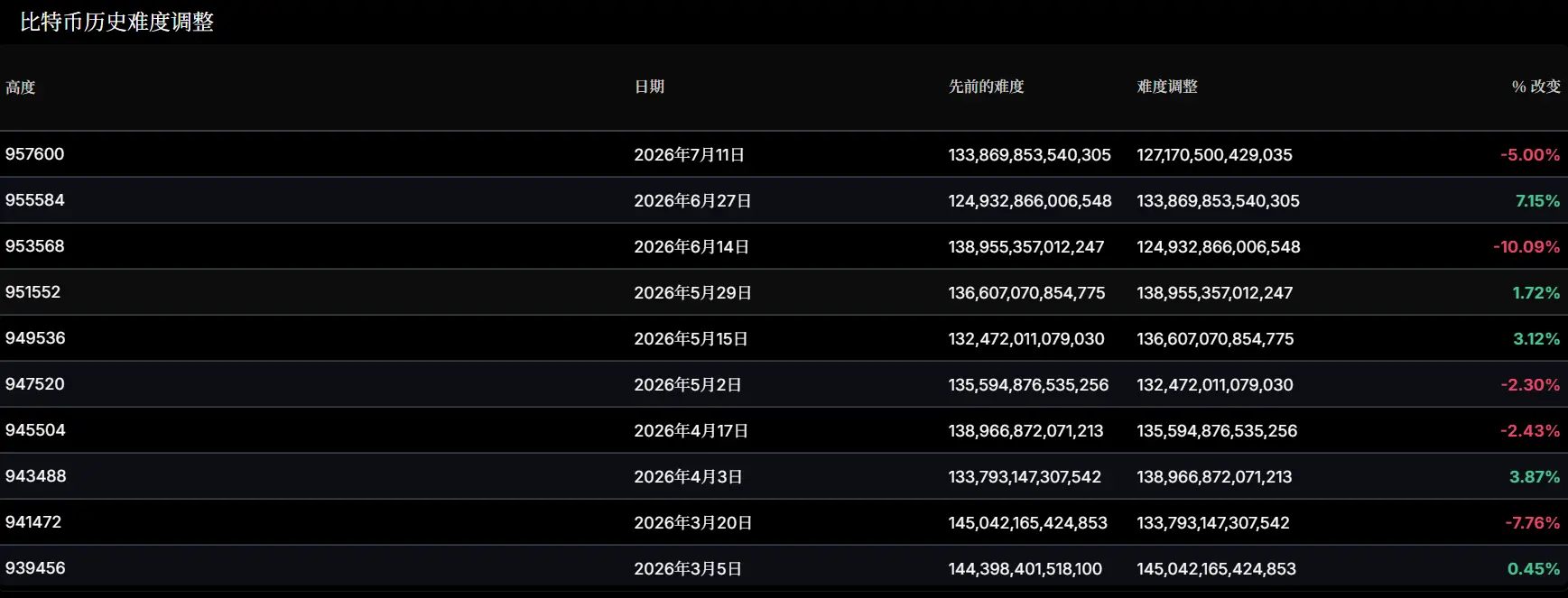
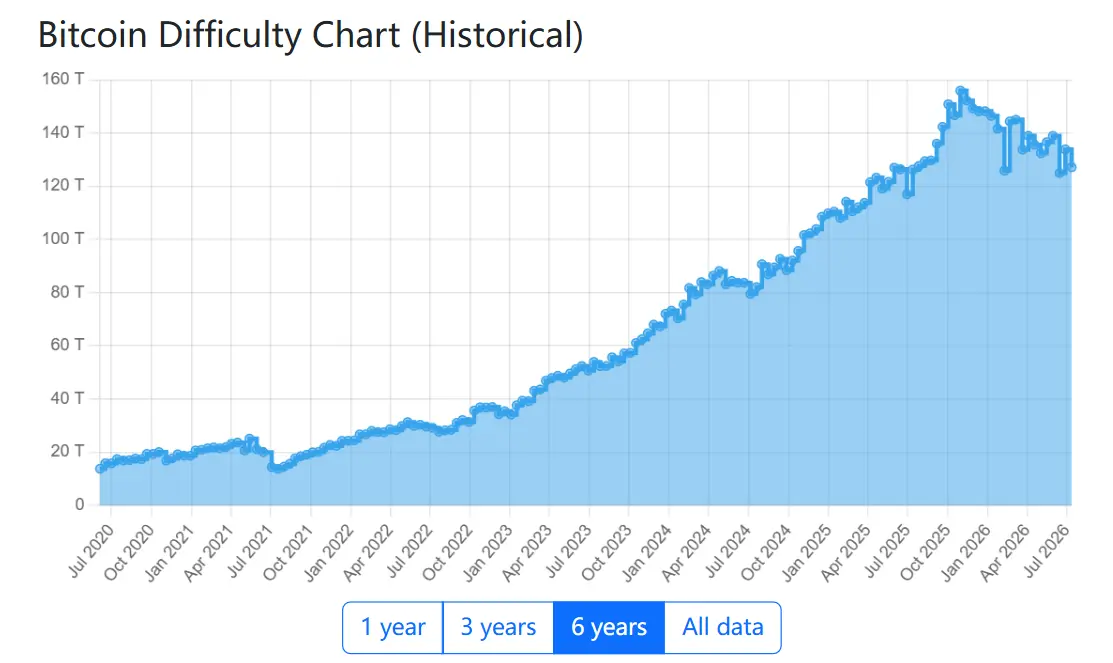
This round of production decline occurred after consecutive difficulty reductions. On June 14th, the Bitcoin network difficulty decreased by 10.09%, the second-largest negative adjustment in 2026. On July 11th, it dropped another 5% to 127.17 T, a cumulative decline of about 18% from the high point of around 155 T in November 2025.

A decrease in difficulty should allow miners remaining in the network to mine more coins per unit of hashrate, yet production output continues to decline.
On the other hand, amidst market downturn and pressure on profitability, some miners are continuously exiting the network or shutting down equipment. Galaxy Research states that miners are entering a capitulation period, representing the largest drawdown since China's comprehensive crackdown on Bitcoin mining in 2021.

The reason for the shakeout is straightforward. According to CoinShares' Q1 2026 mining report, the average cash production cost for listed miners had risen to about $79,995 in Q4 2025. JPMorgan estimates the current production cost at around $78,000, while BTC is currently trading near $64,000. The price gap has persisted for five months, with about 20% of miners operating at a loss.

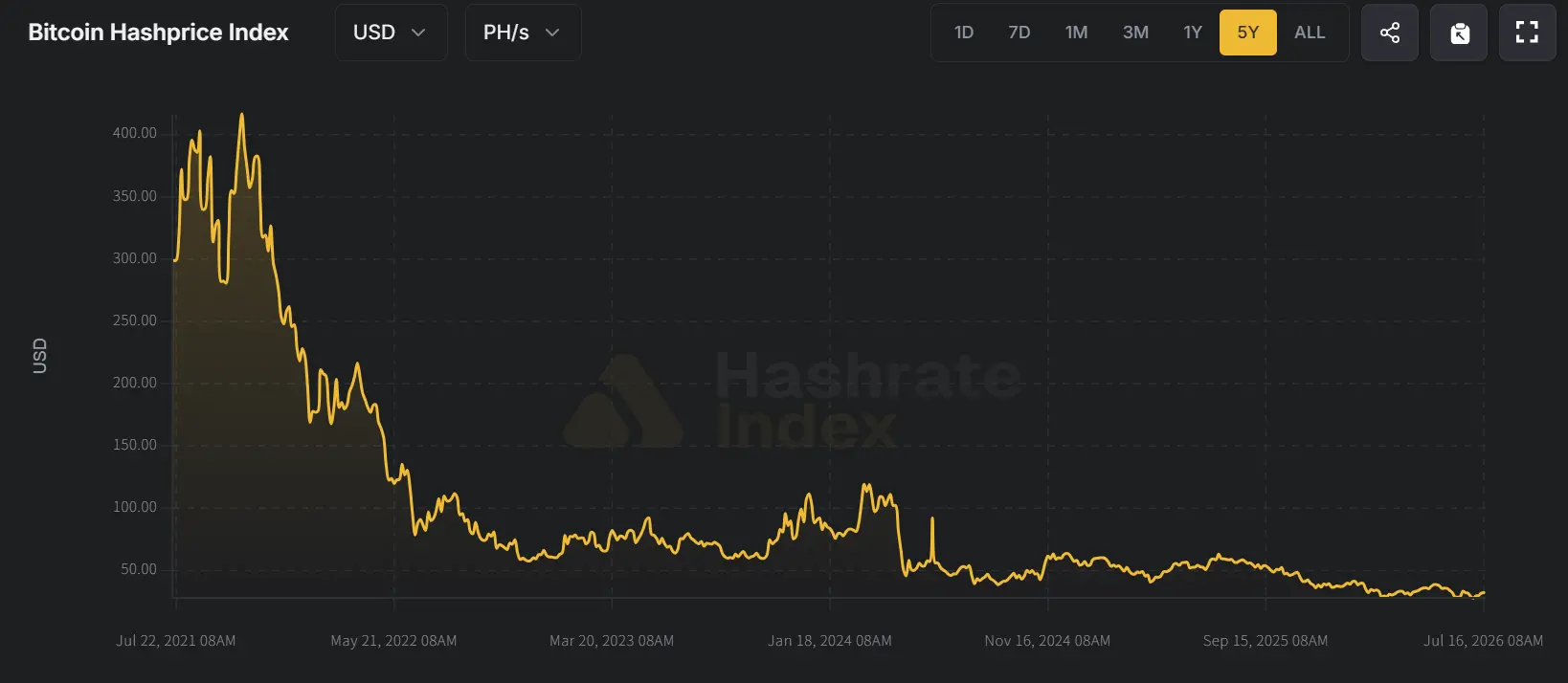
According to Hashrate Index data, around March 2026, the hashprice once fell to a post-halving low of $28 to $30 per PH/s per day. It is currently around $32, still within the lowest historical range.
Reclassified into the AI Infrastructure Valuation Framework

The new logic is not complicated. What AI data centers currently lack the most are grid-connected power capacity, contiguous land, cooling systems, and building shells – resources that miners happen to possess.

They have large-scale grid connection capabilities, sites that can be retrofitted, existing operational systems, and are more familiar with the construction pace of high-load facilities.

PJM data shows that AI infrastructure projects put into operation in 2025 took over seven years on average, with about three years to secure an Interconnection Service Agreement and another four years waiting for grid connection. An already grid-connected mining site essentially skips these seven years, and this is where the value of mining companies lies.

Take CleanSpark for example. On July 14th, the company announced signing a 20-year triple-net lease with an undisclosed, highly investment-grade technology company for its Sandersville campus in Georgia. The initial term contract revenue is about $6.6 billion, corresponding to 175 MW of critical IT load, with delivery starting in Q4 2027. The market reaction was strong, with CLSK rising up to 22% intraday.

Also in July, MARA spent up to $600 million to acquire a Texas campus project company with a planned power capacity of up to 2 GW. However, this company holds a Letter of Intent with a power company. The gap between a Letter of Intent and actual power connection is precisely those seven years.

Furthermore, the credit market is also pricing them with new metrics. According to Bloomberg, TeraWulf plans to raise $3.5 billion led by Morgan Stanley, including leveraged loans and high-yield bonds, to expand its Justified Data campus in Horse Cave, Kentucky. This marks its first foray into the leveraged loan market. Lenders are also beginning to examine miners' balance sheets as infrastructure assets.

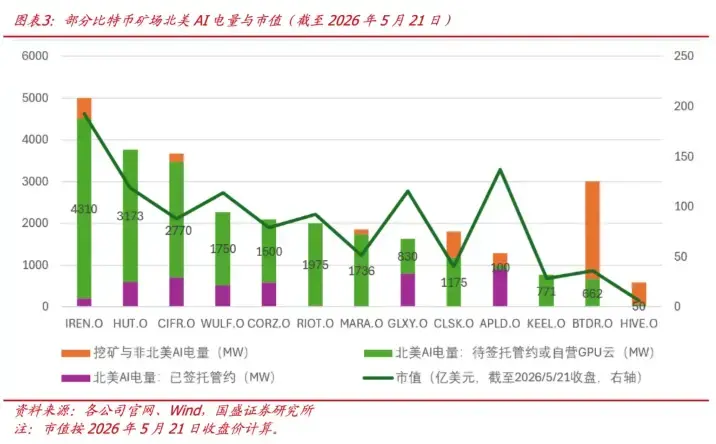
According to Guosheng Securities research, as of early May 2026, signed site hosting, bare metal, and cloud contracts within the sector totaled approximately 3,201 MW of critical IT load, with a total contract value exceeding $91.4 billion. The agency also found that the market capitalization of companies in the sector showed a clear positive correlation with their AI power capacity reserves in North America and their already contracted AI power capacity.
CoinShares expects that by the end of 2026, up to 70% of revenue for listed miners will come from AI and HPC, compared to about 30% at the beginning of the year. TeraWulf has already arrived first; its Q1 HPC leasing revenue was $21 million, surpassing its mining business revenue of less than $13 million for the first time.

The Cost of Revaluation: Three Layers of Risk

The first layer of risk comes from valuation.

If miners are revalued as AI infrastructure, it also means they must bear the overall volatility of the AI narrative.

A 10x Research report stated that Bitcoin mining stocks have largely decoupled from the coin price trend. Since April 2026, RIOT's stock price has shown increased correlation with the Philadelphia Semiconductor ETF.

Bitcoin mining companies are now deeply tied to the AI theme. Currently, the AI theme revolves more around the global supply chain and competition rather than crypto adoption or financial digitization. Moreover, the performance of Chinese LLM concept stocks and the prospects of the South Korean semiconductor supply chain are directly affecting Bitcoin mining stock trends.
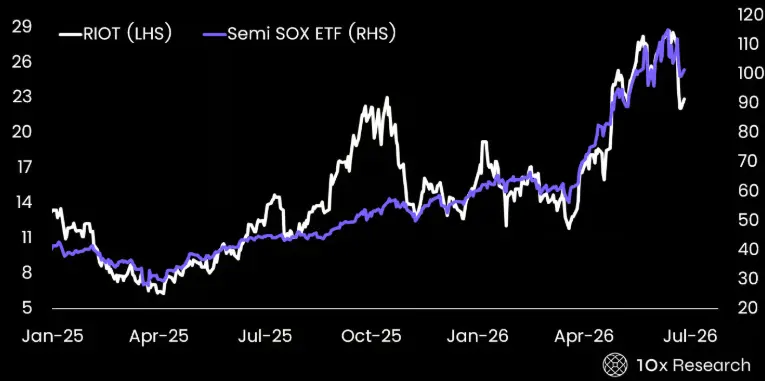
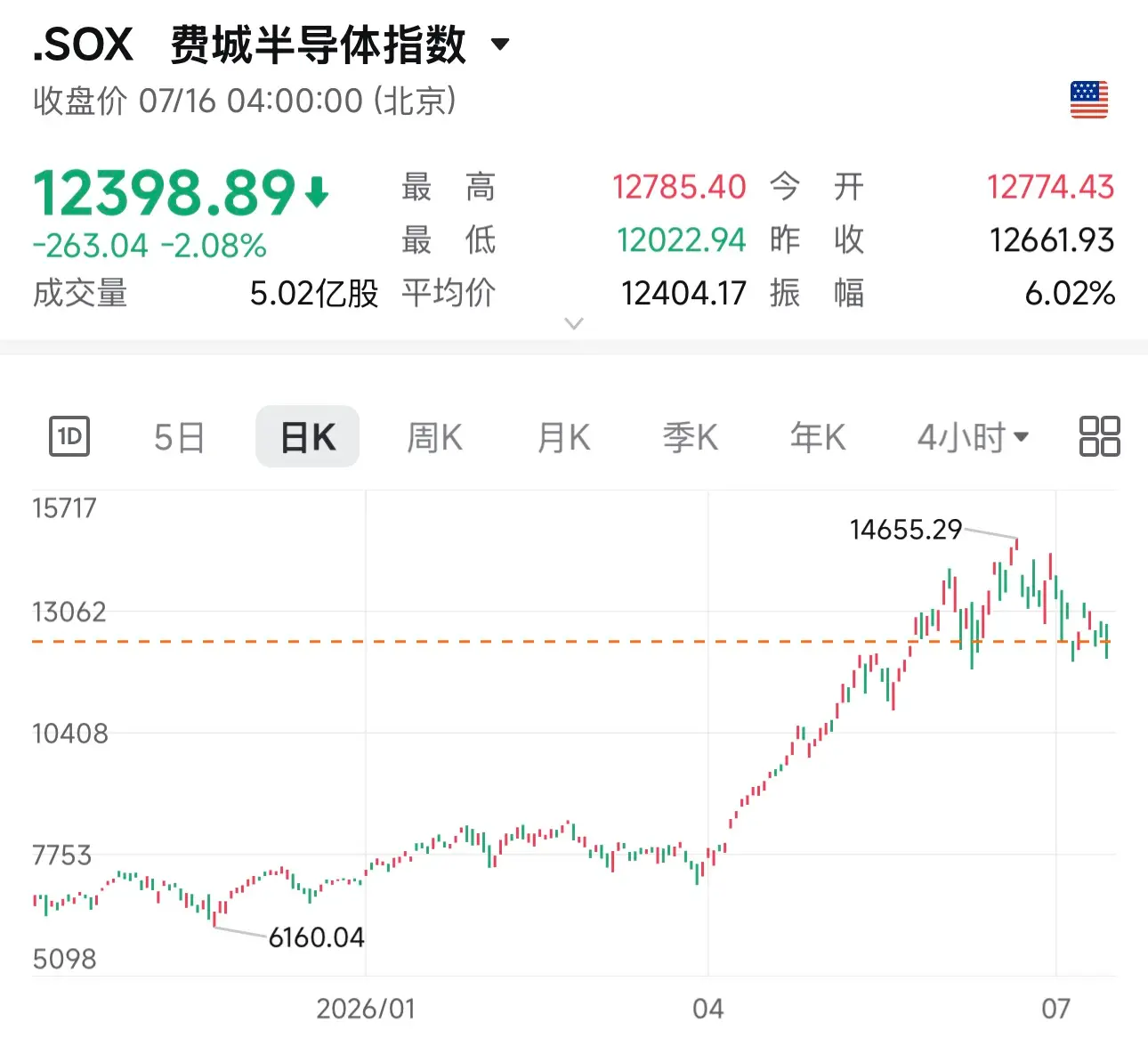
After a significant rally in these sectors, risk appetite is contracting. The Philadelphia Semiconductor Index fell 10.8% over ten trading sessions, with Reuters estimating an evaporation of about $1.3 trillion in market cap across the industry. The root causes identified include doubts about AI infrastructure investment returns, dot-com bubble-level valuations, and a more hawkish Fed.
The second layer of risk comes from return rates.

According to a Bernstein report, Core Scientific's five-year average return on assets from its cooperation with CoreWeave reached 75%, but the driver was the capital expenditure structure rather than the deal terms, with the tenant covering $750 million of the $855 million total cost through revenue prepayments. Riot achieved a 23% return by retrofitting existing mining sites.

However, these two are not industry benchmarks. The report notes that the industry baseline return rate actually falls at TeraWulf 5%, Cipher 4%, CleanSpark 4%.

A report on July 1st stated that Meta plans to launch Meta Compute, selling excess AI training and inference computing power to enterprise clients. That day, the Philadelphia Semiconductor Index fell 6.3%. The next day, SK Hynix CEO Kwak Noh-Jung announced that the SK Group will invest 100 trillion won in South Korea to build AI data centers in phases, starting with 5 GW and eventually expanding to 15 GW.

Meta, as the largest buyer, saying it has excess capacity, and chipmakers saying they will build their own facilities, while miners sign 15 to 20-year long-term contracts, not realized revenue. That's how the 20% pullback in mining stocks at the beginning of the month occurred.

The third layer of risk comes from execution.

Miners are now priced based on the future, not realized revenue. Taking CleanSpark as an example, the company just signed a $6.6 billion long-term contract, but its current revenue still entirely comes from Bitcoin mining; the AI business has not yet generated substantial revenue, with the first delivery not until Q4 2027.

Valuation has moved ahead first, but realization must overcome three major hurdles:

The first hurdle is financing capability. According to CleanSpark's 8-K filing, the campus construction cost is $10 to $12 million per megawatt. For 175 MW, this corresponds to $1.75 to $2.1 billion in capital expenditure, which has not yet been raised. The filing also explicitly states that failure to meet any of the financing, construction, or delivery milestones will trigger rent reductions or even lease termination.

The second hurdle is regulatory approvals. On July 14th, New York Governor Kathy Hochul signed an executive order suspending the issuance of state-level permits for large data centers, with the threshold being a grid demand of over 50 MW. The New York State Department of Environmental Conservation has suspended all discretionary permits not deemed complete before July 14th. The suspension period is tied to the completion of a Generic Environmental Impact Statement rather than a fixed date, up to one year.

The third hurdle is tenant quality. Bernstein points out that tenant quality directly affects the valuation level of miners. Hyperscale cloud providers bring more stable cash flows and lower financing costs, while small GPU cloud service providers correspond to higher operational risks and capital costs.

Miners' Selling Logic Decouples from Coin Price

With the change in valuation logic, miners' behavior has also changed. However, a more direct impact of this shift on the crypto space is reflected in how miners sell coins.

According to industry reports, listed miners collectively sold approximately 32,000 BTC in Q1 2026, a scale that has already exceeded the full year of 2025. Among them, Riot produced 1,473 BTC in Q1 but sold 3,778 BTC in the same period, more than double its production. Its holdings dropped to 15,680 BTC, down 18% year-on-year.

In the past, miners sold coins mainly based on mining cash flow logic – to pay electricity bills, repay loans, and maintain daily operations – holding back during low prices and waiting for a rebound to sell. Now, there is an additional layer of transformation financing logic. Selling coins also makes room for building stations, acquiring land, covering capex, and longer-term AI construction plans.

Therefore, even if the coin price does not experience extreme volatility, miners may continue selling coins.

The same logic also determines whether the hashrate that has left will return.

In the past, hashrate exiting the network was assumed to return when coin prices rebounded and difficulty dropped. After China's comprehensive crackdown on mining in 2021, difficulty plunged 46% but recovered within half a year. But now, what's leaving may not just be mining machines, but also the supporting power supply and capital expenditure.
Current mainstream AI contracts are mostly long-term agreements of over 10 years. Once miners lock their sites, power, and financing structures into such contracts, these resources are unlikely to return flexibly to BTC mining as they did before.

Therefore, mining companies are moving further away from crypto. More accurately, the capital market has already begun valuing them based on their form after leaving the pure mining framework.

They will still affect the Bitcoin network and still generate revenue from mining, but the pursuit of power, land, and long-term leases is turning them into a different type of company.


Kripto yang Sedang Tren

Pertanyaan Terkait

QWhat is the main argument of the article regarding the relationship between Bitcoin mining stocks and the cryptocurrency market?

AThe article argues that Bitcoin mining stocks are increasingly decoupling from the cryptocurrency market. Their prices and valuations are now driven less by Bitcoin's price, mining output, and network hash rate, and more by their potential as infrastructure providers for AI and high-performance computing, leveraging their access to power, land, and existing facilities.

QWhat evidence does the article provide to show the divergence between mining stock performance and Bitcoin's price?

AThe article cites RootData showing that over the past year, BTC price fell by 46.12%, while major mining stocks saw significant gains: HUT (+363.26%), WULF (+268.95%), IREN (+121.14%), RIOT (+59.90%), and CLSK (+12.41%). It also highlights an instance where mining stocks corrected by ~20% while BTC remained stable around $64,000.

QAccording to the article, what new valuation framework is being applied to Bitcoin mining companies?

AThe market is now valuing mining companies as AI infrastructure providers. Their assets—grid-connected power capacity, land parcels, cooling systems, and existing building shells—are highly sought after for building AI data centers. Their valuation is becoming correlated with their AI power reserve capacity and signed contracts rather than just crypto metrics.

QWhat are the three key risks associated with this shift in valuation logic, as outlined in the article?

A1. Valuation Risk: Mining stocks are now exposed to the broader volatility of the AI investment narrative and semiconductor sector performance. 2. Return Risk: The baseline financial returns on these AI infrastructure projects for many miners are relatively low (e.g., 4-5%), and competition from large tech companies building their own capacity threatens demand. 3. Execution Risk: Future revenue is not guaranteed and depends on successful financing, obtaining regulatory permits, and the quality/reliability of the tenant companies signing the long-term leases.

QHow has the shift in business focus affected the selling behavior of mining companies regarding their Bitcoin holdings?

AMining companies are selling Bitcoin more aggressively, not just for operational cash flow but also to fund their transition and capital expenditures for AI infrastructure projects. For example, Riot sold 3,778 BTC in Q1 2026 while producing only 1,473, reducing its holdings. This selling pressure can persist even without extreme Bitcoin price movements, driven by long-term transformation goals.

Bacaan Terkait

Setelah Tiga Kuartal Berturut-Turut Turun, Bisakah Pasar Kripto Menyambut Jendela Stabilitas di Kuartal Ketiga?

Pasar kripto mengalami kuartal terburuk sejak 2022, dengan kapitalisasi pasar turun 12.6% menjadi $2.1 triliun, didorong oleh keluarnya modal dan penurunan volume perdagangan. Bitcoin dan Ethereum masing-masing jatuh 14.2% dan 25.4% di kuartal kedua. Aliran keluar bersih dari ETF Bitcoin AS mencapai $4.67 miliar, menandakan tekanan jual yang berkelanjutan. Faktor utama meliputi terputusnya hubungan dengan saham AS, kebijakan moneter Federal Reserve yang ketat, dan pelepasan aset oleh perusahaan seperti Strategy. Proses legislasi UU CLARITY yang akan memberikan kejelasan regulasi terhambat, meningkatkan premi risiko di sektor ini. Namun, ada tanda-tanda potensi stabilisasi. Aliran keluar ETF yang besar secara historis sering terjadi di akhir fase penurunan, dan para pemegang Bitcoin jangka panjang mulai menambah kepemilikan lagi. Sementara sebagian besar sektor menyusut, pasar prediksi dan aset koleksi yang ditokenisasi mencatat pertumbuhan signifikan. Pandangan untuk kuartal ketiga sangat bergantung pada pertemuan Fed akhir Juli. Sinyal kebijakan yang lunak dapat mendukung pemulihan Bitcoin, sementara sikap yang hawkish dapat memicu konsolidasi lebih lanjut. Meskipun tantangan regulasi tetap ada, indikator teknis seperti harga Bitcoin yang mendekati rata-rata bergerak 200-mingguannya menunjukkan dasar jangka panjang belum rusak. Logika pasar telah bergeser dari mengandalkan narasi ke faktor fundamental seperti kebijakan dan ekspektasi suku bunga.

marsbitKemarin 08:40

Setelah Tiga Kuartal Berturut-Turut Turun, Bisakah Pasar Kripto Menyambut Jendela Stabilitas di Kuartal Ketiga?

marsbitKemarin 08:40

The SpaceX Trade, Terbuka: SPCXON Mulai Diperdagangkan di WEEX

SpaceX meluncurkan IPO terbesar dalam sejarah pada Juni 2026, namun akses bagi banyak pedagang terhambat oleh batasan regional dan prosedur broker. WEEX kini menghadirkan SPCXON/USDT di pasar spotnya, sebuah instrumen tokenisasi yang memungkinkan paparan terhadap pergerakan harga SpaceX melalui akun kripto yang diselesaikan dengan USDT, tanpa memerlukan broker AS atau pembiayaan bank. SPCXON adalah produk tokenisasi yang mencerminkan ekonomi kepemilikan SpaceX bagi pedagang yang memenuhi syarat di luar AS, dengan dividen diinvestasikan kembali. Aset ini diperdagangkan di WEEX sebagai pasangan spot dengan USDT, tersedia selama jam pasar, memberikan akses mudah bagi trader kripto. Kasus investasi untuk SpaceX didasarkan pada pertumbuhan pendapatan Starlink dan pencapaian Starship, meskipun valuasinya yang tinggi (sekitar 90-110 kali pendapatan) telah memperhitungkan eksekusi sempurna selama bertahun-tahun. Faktor seperti jumlah saham publik yang terbatas dan masa buka kunci (unlock) insider pertama menjadi pertimbangan penting. Penting untuk diingat bahwa SPCXON memberikan paparan, bukan kepemilikan langsung atas saham atau hak suara. Harganya dapat diperdagangkan pada premium atau diskon terhadap nilai aset bersih. WEEX menawarkan akses ke berbagai aset TradFi yang ditokenisasi seperti ini dalam satu akun terpadu, bersama dengan pasar futures dan kampanye perdagangan dengan pool hadiah.

TheNewsCryptoKemarin 08:33

The SpaceX Trade, Terbuka: SPCXON Mulai Diperdagangkan di WEEX

TheNewsCryptoKemarin 08:33

Momen Perdagangan BIT: BTC Masih Tertekan oleh EMA 200 Mingguan, Setelah Ditolak Mungkin Kembali Turun, Saham Penyimpanan dan Semikonduktor yang Melonjak Malam Kemudian Mulai Anjlok di Pasar Malam

**PASAR KRIPTO & SAHAM: BTC Hadapi Resistensi, Saham Semikonduktor Turun di Perdagangan Malam** Pasar kripto melanjutkan pemulihan, dengan harga Bitcoin bertahan di sekitar $66,000 setelah rebound lebih dari 15% dari titik terendah Juli. Namun, BTC menghadapi **tembok resistensi kuat di dekat $68,000**, yang bertepatan dengan biaya rata-rata investor selama lima bulan terakhir dan titik gagalnya rebound pertengahan Juni. Secara teknis, perhatian tertuju pada **200 EMA mingguan (~$68,328) sebagai level kunci**. Jika BTC ditolak di level ini, potensi penurunan menuju support $63,000 terbuka. Analis menyoroti volume rendah dan penurunan open interest futures di CME, menandakan rebound ini lebih dipicu likuiditas rendah musim panas daripada awal bull run penuh. Di pasar saham AS, **indeks futures utama turang** setelah sesi kemarin yang kuat. Sektor semikonduktor dan penyimpanan (storage), yang melonjak pada hari Selasa (contoh: Micron +12%), **mengalami koreksi di perdagangan malam (night trading)**. ETF semikonduktor turun 2,22% dan saham Micron turun 2,29%. Meski begitu, ada sorotan positif seperti **Super Micro Computer (SMCI)** yang naik lebih dari 15% setelah melaporkan pandangan pendapatan yang kuat dan pesanan baru yang sangat besar, mengonfirmasi permintaan server AI tetap solid. Kekhawatiran makro muncul dari **kenaikan harga minyak mentah (di atas $91)** akibat ketegangan geopolitik dan **lonjakan imbal hasil (yield) obligasi pemerintah AS**, dengan imbal hasil 10-tahun mencapai sekitar 4,64%. Faktor-faktor ini dapat menambah tekanan inflasi dan membatasi ruang gerak pasar saham. Saham terkait kripto seperti Coinbase dan Robinhood naik kuat didorong oleh perkembangan regulasi yang lebih jelas di AS. Di Asia, **Korea Selatan** dan **Jepang** menunjukkan kinerja beragam. Indeks KOSPI Korea naik didukung pemulihan saham semikonduktor, sementara pasar Jepang melemah dengan **Yen terus melemah ke level terendah sejak 1986**, meningkatkan kekhawatiran akan intervensi bank sentral. **Yang Perlu Diperhatikan Selanjutnya:** * **22 Juli:** Acara AI AMD, rilis laporan keuangan dari Google (Alphabet), Tesla, IBM. * **23 Juli:** Keputusan suku bunga Bank Sentral Eropa (ECB), data klaim pengangguran AS, laporan keuangan Intel. * Perkembangan lebih lanjut dari **harga minyak, imbal hasil obligasi, dan dinamika Yen Jepang** akan menjadi penentu sentimen pasar risiko secara keseluruhan.

marsbitKemarin 08:32

Momen Perdagangan BIT: BTC Masih Tertekan oleh EMA 200 Mingguan, Setelah Ditolak Mungkin Kembali Turun, Saham Penyimpanan dan Semikonduktor yang Melonjak Malam Kemudian Mulai Anjlok di Pasar Malam

marsbitKemarin 08:32

Mantan Ketua CFTC dan Presiden Circle, Tarbert: Satu Pihak Menasihati Anda untuk Berpikir Jangka Panjang, di Sisi Lain Menguangkan $30 Juta Sendiri

Penulis: Zen, PANews Heath Tarbert, mantan Ketua CFTC dan Presiden Circle, baru-baru ini menyerukan kepada investor untuk mengadopsi pandangan jangka panjang terhadap saham Circle, meskipun harganya telah turun 70% dari puncaknya. Namun, ia sendiri secara konsisten menjual saham CRCL sejak perusahaan go public, menguangkan sekitar $30 juta tanpa pernah membeli saham tambahan di pasar terbuka. Tarbert, yang bergabung dengan Circle pada Juli 2023 dan menjadi Presiden pada awal 2025, dikenal sebagai pendukung kuat narasi "jangka panjang" perusahaan. Namun, sehari sebelum IPO Circle, ia menetapkan rencana perdagangan 10b5-1 untuk menjual hingga 353.290 saham dalam setahun. Dalam 13 bulan setelah IPO, ia menjual lebih dari 360.000 saham, termasuk penjualan tunggal senilai $11,5 juta pada Maret 2026. Ia bahkan menetapkan rencana 10b5-1 kedua untuk menjual hingga 160.000 saham lagi pada akhir tahun 2026. Langkah Tarbert ini menuai kecaman karena dianggap tidak konsisten dengan pesan "jangka panjang" yang ia sampaikan kepada publik. Perjalanan kariernya sering dikaitkan dengan "revolving door" antara regulator dan dunia keuangan. Setelah mengundurkan diri sebagai Ketua CFTC pada Maret 2021, ia bergabung dengan Citadel Securities hanya 27 hari kemudian sebagai Kepala Penasihat Hukum, tepat saat perusahaan itu menghadapi pengawasan ketat terkait peristiwa GameStop. Di Citadel, ia juga mendukung undang-undang yang memperluas wewenang CFTC atas pasar crypto, sementara Citadel diketahui berencana berekspansi ke aset kripto. Tarbert kemudian pindah ke Circle pada 2023, membantu perusahaan mengatasi tantangan regulasi dan akhirnya go public melalui IPO langsung. Meskipun sangat berharga bagi perusahaan, tindakannya menjual saham dalam jumlah besar sambil mendorong investor untuk bertahan menimbulkan pertanyaan tentang komitmennya yang sebenarnya terhadap masa depan jangka panjang Circle.

marsbitKemarin 08:09

Mantan Ketua CFTC dan Presiden Circle, Tarbert: Satu Pihak Menasihati Anda untuk Berpikir Jangka Panjang, di Sisi Lain Menguangkan $30 Juta Sendiri

marsbitKemarin 08:09

Gate Research Institute: Produk Keuangan Kripto Menggulirkan Gelombang "Wall Street-ization", Kompetisi atau Integrasi?

**Ringkasan: Gelombang "Wall Street-ization" Produk Keuangan Kripto: Kompetisi atau Integrasi?** Artikel ini membahas fenomena konvergensi antara keuangan tradisional (TradFi) dan keuangan kripto (Crypto). Meskipun Bitcoin awalnya dirancang sebagai sistem peer-to-peer yang terdesentralisasi dan bebas dari perantara seperti bank, pasar kripto kini semakin diintegrasikan ke dalam infrastruktur keuangan tradisional. **Tren "Wall Street-ization":** Dimulai dengan disetujuinya ETF spot Bitcoin pada 2024, aset kripto kini dikemas menjadi produk seperti ETF (oleh BlackRock, Fidelity, dll.), futures, dan sekuritisasi aset riil (RWA) seperti obligasi pemerintah yang ditokenisasi. Ini memberikan akses yang mudah dan teregulasi bagi investor institusional, tetapi juga berarti kekuasaan atas penerbitan, penentuan harga, kustodian, dan distribusi aset kripto semakin bergeser ke lembaga keuangan besar. **Dua Jalur Konvergensi (1+1>2):** Artikel ini menyoroti dua arah integrasi: 1. **Dari CEX ke TradFi:** Dilambangkan oleh **Gate.io**, yang berkembang dari bursa kripto menjadi platform multi-aset. Gate kini menawarkan perdagangan saham nyata (AS, Hong Kong, Korea) menggunakan USDT, menyediakan akses tanpa batas waktu ke pasar tradisional. 2. **Dari TradFi ke Crypto:** Dilambangkan oleh **Robinhood**, platform broker tradisional yang memperluas layanannya ke aset kripto (termasuk melalui akuisisi Bitstamp) dan mengembangkan produk seperti token saham di blockchain. **Tujuan Bersama: Akun Keuangan "Super" Terpadu:** Kedua jalur ini bertujuan menciptakan **akun keuangan generasi berikutnya yang terpadu**. Pengguna di masa depan mungkin dapat memperdagangkan Bitcoin, saham Apple, ETF, emas, dan obligasi pemerintah yang ditokenisasi dalam satu antarmuka yang sama, menggunakan stablecoin sebagai lapisan dana. **RWA dan Obligasi Pemerintah di On-Chain sebagai Lapisan Tengah:** Tokenisasi aset dunia nyata, terutama obligasi pemerintah AS, menyediakan aset berpenghasilan rendah risiko di ekosistem on-chain. Pasar ini tumbuh pesat (naik 40% pada paruh pertama 2026) meskipun pasar kripto turun, menunjukkan permintaan nyata. **Kesimpulan:** "Wall Street-ization" bukanlah pengambilalihan sepihak, melainkan **transformasi timbal balik**. TradFi dan Crypto saling melengkapi: Crypto mendapatkan akses ke likuiditas, kepatuhan, dan jaringan distribusi yang luas, sementara TradFi mengadopsi efisiensi, kecepatan, dan pasar 24/7 dari Crypto. Hasil akhirnya adalah pembentukan **pasar modal terpadu yang lebih efisien dan global**, di mana batas antara aset tradisional dan kripto semakin kabur.

marsbitKemarin 08:07

Gate Research Institute: Produk Keuangan Kripto Menggulirkan Gelombang "Wall Street-ization", Kompetisi atau Integrasi?

marsbitKemarin 08:07

Trading

Spot

Artikel Populer

Cara Membeli DATA

Selamat datang di HTX.com! Kami telah membuat pembelian DATA Network (DATA) menjadi mudah dan nyaman. Ikuti panduan langkah demi langkah kami untuk memulai perjalanan kripto Anda.Langkah 1: Buat Akun HTX AndaGunakan alamat email atau nomor ponsel Anda untuk mendaftar akun gratis di HTX. Rasakan perjalanan pendaftaran yang mudah dan buka semua fitur.Dapatkan Akun SayaLangkah 2: Buka Beli Kripto, lalu Pilih Metode Pembayaran AndaKartu Kredit/Debit: Gunakan Visa atau Mastercard Anda untuk membeli DATA Network (DATA) secara instan.Saldo: Gunakan dana dari saldo akun HTX Anda untuk melakukan trading dengan lancar.Pihak Ketiga: Kami telah menambahkan metode pembayaran populer seperti Google Pay dan Apple Pay untuk meningkatkan kenyamanan.P2P: Lakukan trading langsung dengan pengguna lain di HTX.Over-the-Counter (OTC): Kami menawarkan layanan yang dibuat khusus dan kurs yang kompetitif bagi para trader.Langkah 3: Simpan DATA Network (DATA) AndaSetelah melakukan pembelian, simpan DATA Network (DATA) di akun HTX Anda. Selain itu, Anda dapat mengirimkannya ke tempat lain melalui transfer blockchain atau menggunakannya untuk memperdagangkan mata uang kripto lainnya.Langkah 4: Lakukan trading DATA Network (DATA)Lakukan trading DATA Network (DATA) dengan mudah di pasar spot HTX. Cukup akses akun Anda, pilih pasangan perdagangan, jalankan trading, lalu pantau secara real-time. Kami menawarkan pengalaman yang ramah pengguna baik untuk pemula maupun trader berpengalaman.

82 Total TayanganDipublikasikan pada 2026.07.01Diperbarui pada 2026.07.01

Cara Membeli DATA

Diskusi

Selamat datang di Komunitas HTX. Di sini, Anda bisa terus mendapatkan informasi terbaru tentang perkembangan platform terkini dan mendapatkan akses ke wawasan pasar profesional. Pendapat pengguna mengenai harga DATA (DATA) disajikan di bawah ini.

活动图片












