Hyperliquid Pre-IPO Contract Priced at $7.2 for CXMT, Foreign Capital Intervenes in Chinese Storage Narrative via DeFi

marsbitDipublikasikan tanggal 2026-07-16Terakhir diperbarui pada 2026-07-16

Abstrak

On the eve of Changxin Technologies' (CXMT) highly anticipated STAR Market IPO, a novel DeFi platform is enabling a pre-market price discovery. Trade.xyz has deployed a CXMT perpetual contract on the Hyperliquid blockchain, currently trading around $7.2 USDC (implying a market cap of ~$482B). This marks the first time such a "pre-IPO" derivative has targeted a Chinese A-share company. The article highlights several key drivers: overseas investors, restricted by China's 500,000 yuan (~$69,000) STAR Market access threshold, are using this contract as a direct entry point to bet on the "China storage substitution" narrative. Changxin, the world's fourth-largest DRAM supplier, is seen as a major beneficiary of the current AI-driven memory chip shortage. Furthermore, the 24/7, leveraged, and shortable nature of the perpetual contract contrasts with A-shares' T+1 settlement and lack of short-selling mechanisms for such stocks, potentially offering a hedging tool. While the $3.5 trillion implied valuation aligns with optimistic analyst projections, the article notes a critical divergence from similar contracts for U.S. listings like SpaceX: due to capital controls, direct arbitrage between the A-share and the on-chain contract is virtually impossible, meaning a price gap may persist. Nonetheless, the very existence of this parallel market underscores intense global investor interest in China's semiconductor rise, complementing the landmark IPO itself, which aims to raise up to $92...

Author: Claude, Shenchao TechFlow

Shenchao Guide: Changxin Technology's STAR Market IPO is priced at 8.66 yuan/share, raising 57.9 billion yuan, with subscriptions starting on July 16. On the eve of subscription, Trade.xyz deployed a CXMT perpetual contract on Hyperliquid. The current trading price is 7.2 USDC (approximately 52 yuan/share). The 24-hour trading volume is $1.32 million, open interest is $2.41 million, and the implied market cap is about 3.5 trillion yuan, at the upper end of institutional expectations of 2-3 trillion yuan. This is the first time a pre-IPO contract on-chain has targeted a STAR Market IPO, and it's the most direct entry point for overseas investors to intervene in the "Chinese Storage Substitution" narrative.
Changxin Technology hasn't rung the bell at the Shanghai Stock Exchange, but price discovery in the crypto market has already begun.

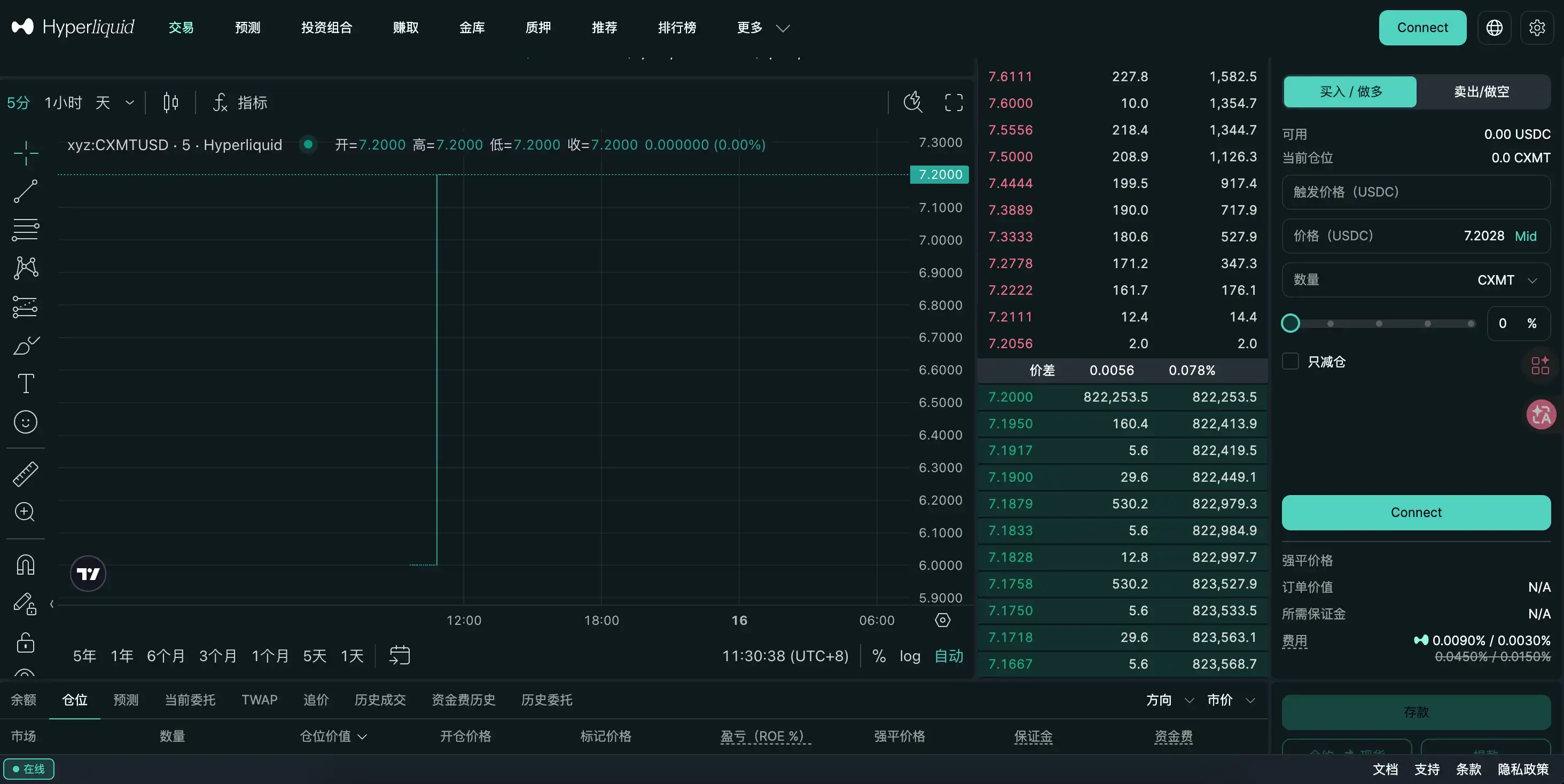
According to a Bloomberg report on July 15, Trade.xyz deployed a Changxin Technology (CXMT) perpetual contract on the Hyperliquid blockchain, with contract code xyz:CXMTUSD. As of writing, the contract's 24-hour trading volume is approximately $1.32 million, open interest is about $2.41 million, and the funding rate is 0.0014%. The price has risen from an initial mark price of around $6 to $7.2, a 20% increase in 24 hours.

This is not Hyperliquid's first attempt at pre-IPO pricing. In May this year, before AI chip company Cerebras went public, the Hyperliquid pre-IPO contract price differed from the Nasdaq opening price by only 1.3%. In June, on SpaceX's IPO day, the on-chain contract saw a single-day trading volume of $1.38 billion. However, targeting a STAR Market-listed company is a first.

$7.2 Equals Approximately 52 Yuan/Share, Implied Market Cap of ~3.5 Trillion Yuan

The contract tracks the per-share price in USDC, using the same logic as the pre-IPO contracts for SpaceX and Cerebras.

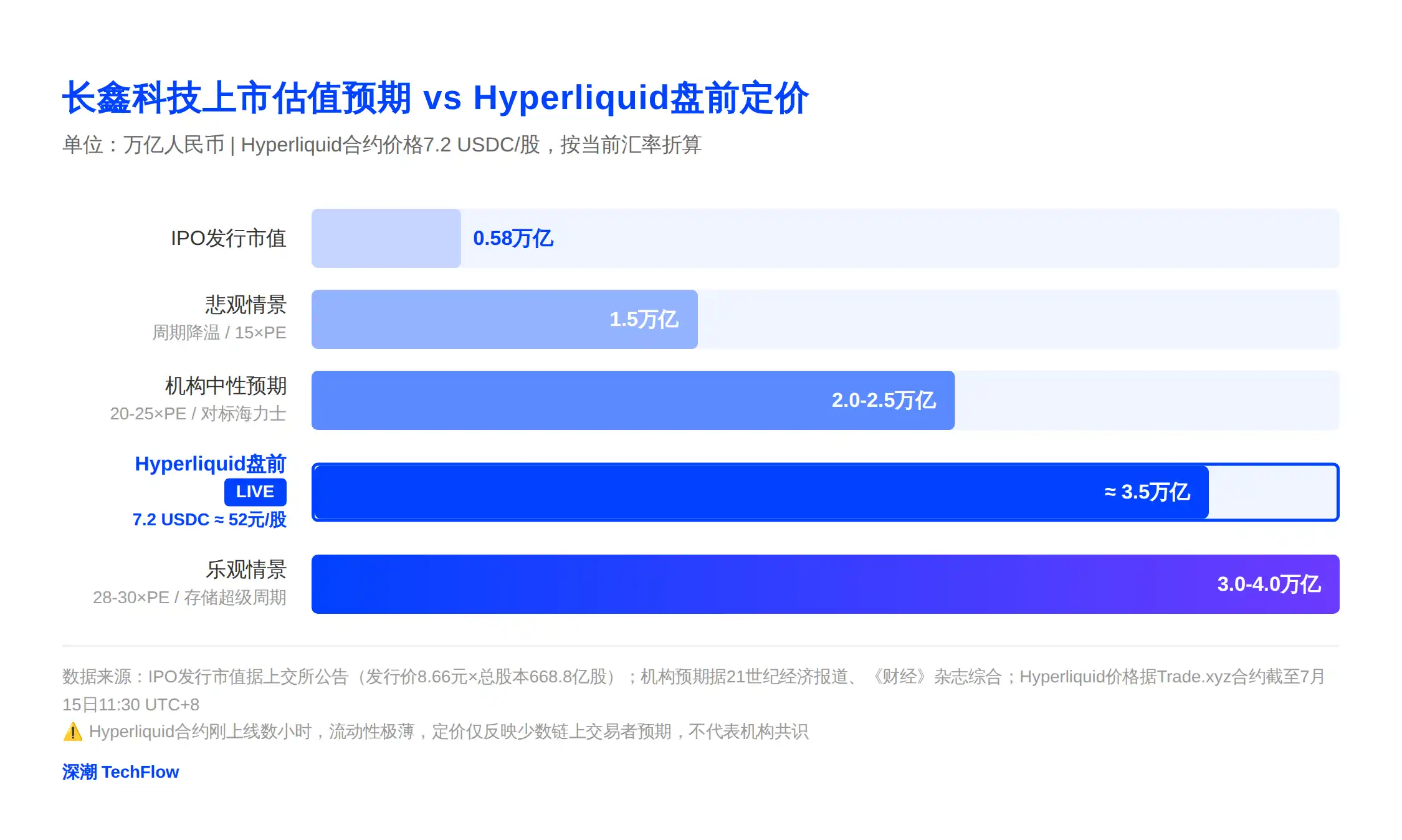
Converted at the current exchange rate, $7.2 is approximately 52 yuan/share. Multiplying by the total post-issuance shares of 66.88 billion, the implied total market capitalization is about 3.5 trillion yuan, roughly 6 times the IPO issuance market cap of 579.2 billion yuan.

This pricing falls within the optimistic range of sell-side institutional expectations. The 21st Century Business Herald quoted investment banking sources saying that Changxin Technology's post-listing valuation is expected to reach 2 to 2.5 trillion yuan; Caijing Magazine, synthesizing calculations from multiple institutions, gave an optimistic scenario of 3 to 4+ trillion yuan. Hyperliquid's pre-market pricing of 3.5 trillion yuan sits between the upper end of the neutral range and the lower end of the optimistic range.

Another interpretation: If these on-chain traders' judgment is accurate, Changxin Technology's stock price may open around 50 yuan on its first trading day, about 6 times the 8.66 yuan issue price. The average first-day gain for STAR Market IPOs in the first half of this year was 489%, so a 6x opening is not unrealistic.

With less than 24 hours since the contract launched, the $1.32 million trading volume and $2.41 million open interest represent preliminary liquidity for the on-chain market, but there's still an order-of-magnitude gap compared to the $1.38 billion single-day trading volume on SpaceX's listing day. This price reflects the directional judgment of early participants, not institutional-grade pricing.
A-Shares Can't Be Sold on Purchase Day, No Short Selling: Perpetual Contracts Naturally Fill the Gap

Why would crypto traders care about a Chinese A-share? The views of some investors on overseas social media platforms might explain. The structural limitations of the A-share market are precisely the opportunity for perpetual contracts.

There are two structural limitations in the A-share market. T+1 settlement means you cannot sell on the same day you buy, and short selling (securities lending) is not available for individual STAR Market stocks. For a stock like Changxin Technology, which may experience massive volatility on its first trading day, A-share holders face an awkward situation: even if they profit from the daily limit-up, they cannot lock in that profit on the same day, fully exposed to the risk of a high-open low-close the next day.

The perpetual contracts on Hyperliquid don't have these restrictions. They trade 24/7, allow both long and short positions, and leverage is adjustable. In theory, investors holding Changxin Technology A-shares could open short positions on Hyperliquid to hedge overnight risks.

However, the absence of an arbitrage path is a real issue. Cerebras and SpaceX listed on Nasdaq, allowing global investors to freely arbitrage between the underlying stock and the contract, leading to rapid price convergence. Changxin Technology is listing on the Shanghai Stock Exchange's STAR Market. The 500,000 yuan asset threshold and QFII quota restrictions prevent the vast majority of overseas retail investors from directly buying the underlying shares.

A price gap may persist long-term between the contract price and the actual A-share trading price, for which investors need to price in an additional premium.

Foreign Capital Can't Buy A-Shares, DeFi Becomes the Entry Point for the "Chinese Storage Substitution" Narrative

Blockchain.News explicitly stated in its report: The CXMT contract provides overseas traders with a channel to bypass the STAR Market's 500,000 yuan threshold.

This demand isn't fabricated. Changxin Technology is the world's fourth-largest DRAM supplier, with a 7.7% global market share in Q1. SemiAnalysis predicts it may surpass Micron to become the world's third-largest by year-end. Apple has begun testing Changxin Technology's DRAM chips for devices in the Chinese market (according to the Financial Times report on July 8). Expected net profit attributable to shareholders for the first half of 2026 is 50 to 57 billion yuan, with a profit margin of about 70%, on par with SK Hynix's 73% and Samsung's 81%.

For a company like this going public, global storage industry investors are paying attention, but most can't buy it. Crypto research firm Citrini has repeatedly recommended Hyperliquid's perpetual contract scenario in paid research reports, while also being bullish on Changxin Technology.

Given foreign capital's inability to directly participate in A-shares, the Hyperliquid contract may become the most convenient channel for them to engage with the "Chinese Storage Substitution" theme.

From a broader perspective, this is the first time DeFi infrastructure is being used to create a parallel pricing market for a STAR Market target. Hyperliquid's HIP-3 framework allows any entity staking 500,000 HYPE tokens (worth approximately $28 million) to deploy a perpetual contract. Trade.xyz, utilizing this mechanism, has successively launched pre-IPO contracts for companies like SpaceX, Cerebras, OpenAI, and Anthropic, generating over $1.46 billion in cumulative trading volume. After TradingView integrated data sources from Hyperliquid and Trade.xyz on July 2, price charts for on-chain perpetual contracts have entered mainstream market terminals.

It's worth noting that Hyperliquid's Policy Center and TradeXYZ recently met with the SEC's Crypto Assets and Cyber Unit to discuss cryptocurrency regulation. Based on the current regulatory trajectory, US regulation is the primary compliance focus for the platform; the Chinese regulatory risk brought by A-share targets is not currently within its consideration.

(Note: Hyperliquid is not available to users in China.)

57.9B in Fundraising, 66B H1 Net Profit: Changxin Technology Itself is the Event of the Year

Returning to the A-share context, even without the Hyperliquid contract, Changxin Technology's IPO itself is already a landmark event in the 2026 Chinese capital market.

The issue price is 8.66 yuan/share. Based on the initial issuance of 6.688 billion shares, it's expected to raise 57.9 billion yuan, nearly double the original plan of 29.5 billion yuan. If the over-allotment option is fully exercised, the fundraising amount will reach 66.6 billion yuan, making it the largest IPO in Asia this year and the largest semiconductor IPO in A-share history. The price-to-earnings (P/E) ratio is 308.92x, far exceeding the industry average of 76.32x. However, the market isn't concerned because the Q1 net profit of 33 billion yuan is rapidly diluting the valuation. The company expects revenue of 110 to 120 billion yuan and net profit attributable to shareholders of 50 to 57 billion yuan for the first half of 2026, representing year-over-year growth exceeding 2244%.

More importantly, timing. The global DRAM market is in a rare super-cycle boom. Samsung, SK Hynix, and Micron are shifting significant capacity to HBM high-bandwidth memory required for AI servers, leading to tight supply of consumer-grade DRAM. In Q1, DRAM contract prices surged 90% to 95% quarter-over-quarter, the largest single-quarter increase in history. Changxin Technology focuses on consumer-grade DDR5 and LPDDR5X products, with a monthly capacity of 200,000 to 300,000 wafers. It is one of the few global manufacturers expanding production of consumer-grade DRAM against the trend, capturing the capacity gap strategically left by the three giants.

On the A-share IPO subscription side, all 71 new IPOs in the first half of this year rose on their debut, with STAR Market IPOs averaging a 489% first-day gain. Retail investors can participate in the online subscription on July 16, subscription code 787825, with an estimated listing date of July 27.

For A-share investors, the July 16 subscription is the main gate. For overseas investors, Hyperliquid's CXMT contract has opened a side door. After the official listing on July 27, whether the contract price can quickly converge to the actual trading price like Cerebras will be a key test to see if this model can be replicated for A-shares. But even if the price doesn't converge, the mere existence of this parallel market itself demonstrates that global capital's interest in the Chinese storage substitution narrative is more than just talk.


Pertanyaan Terkait

QWhat is the key innovation highlighted in the article regarding Hyperliquid's deployment of the CXMT perpetual contract?

AThe key innovation is that it's the first time a pre-listing perpetual contract on-chain has targeted a company (Changxin Technology) conducting an IPO on China's A-share STAR Market, creating a parallel pricing market for overseas investors unable to access it directly.

QAccording to the article, what are the two main structural limitations of China's A-share market that create an opportunity for the CXMT perpetual contract on Hyperliquid?

AThe two main limitations are the T+1 settlement rule (preventing same-day selling of purchased shares) and the inability to short sell stocks on the STAR Market. These create hedging needs that the 24/7, two-way trading on Hyperliquid can address.

QWhat does the current CXMT contract price of 7.2 USDC imply for Changxin Technology's potential post-IPO market capitalization, and how does this compare to institutional expectations?

AThe 7.2 USDC price (~52 RMB/share) implies a total market capitalization of approximately 3.5 trillion RMB. This figure is at the upper end of institutional expectations, which ranged from 2-2.5 trillion RMB to an optimistic 3-4 trillion RMB or more.

QHow does the article suggest the CXMT perpetual contract serves overseas investors interested in the 'China storage substitution' narrative?

AThe article suggests the contract provides the most direct and accessible entry point for overseas investors to gain exposure to the 'China storage substitution' narrative, as they are largely unable to directly invest in Changxin Technology's A-shares due to the STAR Market's 500,000 RMB asset threshold and QFII quota restrictions.

QWhat is the significance of the convergence (or lack thereof) between the CXMT contract price on Hyperliquid and the actual trading price on the STAR Market after July 27th, according to the article?

AThe convergence (or lack thereof) will be a key test for whether this model of on-chain pre-listing contracts can be successfully replicated for A-share stocks. Successful convergence would validate the price discovery mechanism, but even without convergence, the existence of this parallel market demonstrates significant global capital interest in the narrative.

Bacaan Terkait

Setelah Tiga Kuartal Berturut-Turut Turun, Bisakah Pasar Kripto Menyambut Jendela Stabilitas di Kuartal Ketiga?

Pasar kripto mengalami kuartal terburuk sejak 2022, dengan kapitalisasi pasar turun 12.6% menjadi $2.1 triliun, didorong oleh keluarnya modal dan penurunan volume perdagangan. Bitcoin dan Ethereum masing-masing jatuh 14.2% dan 25.4% di kuartal kedua. Aliran keluar bersih dari ETF Bitcoin AS mencapai $4.67 miliar, menandakan tekanan jual yang berkelanjutan. Faktor utama meliputi terputusnya hubungan dengan saham AS, kebijakan moneter Federal Reserve yang ketat, dan pelepasan aset oleh perusahaan seperti Strategy. Proses legislasi UU CLARITY yang akan memberikan kejelasan regulasi terhambat, meningkatkan premi risiko di sektor ini. Namun, ada tanda-tanda potensi stabilisasi. Aliran keluar ETF yang besar secara historis sering terjadi di akhir fase penurunan, dan para pemegang Bitcoin jangka panjang mulai menambah kepemilikan lagi. Sementara sebagian besar sektor menyusut, pasar prediksi dan aset koleksi yang ditokenisasi mencatat pertumbuhan signifikan. Pandangan untuk kuartal ketiga sangat bergantung pada pertemuan Fed akhir Juli. Sinyal kebijakan yang lunak dapat mendukung pemulihan Bitcoin, sementara sikap yang hawkish dapat memicu konsolidasi lebih lanjut. Meskipun tantangan regulasi tetap ada, indikator teknis seperti harga Bitcoin yang mendekati rata-rata bergerak 200-mingguannya menunjukkan dasar jangka panjang belum rusak. Logika pasar telah bergeser dari mengandalkan narasi ke faktor fundamental seperti kebijakan dan ekspektasi suku bunga.

marsbitKemarin 08:40

Setelah Tiga Kuartal Berturut-Turut Turun, Bisakah Pasar Kripto Menyambut Jendela Stabilitas di Kuartal Ketiga?

marsbitKemarin 08:40

The SpaceX Trade, Terbuka: SPCXON Mulai Diperdagangkan di WEEX

SpaceX meluncurkan IPO terbesar dalam sejarah pada Juni 2026, namun akses bagi banyak pedagang terhambat oleh batasan regional dan prosedur broker. WEEX kini menghadirkan SPCXON/USDT di pasar spotnya, sebuah instrumen tokenisasi yang memungkinkan paparan terhadap pergerakan harga SpaceX melalui akun kripto yang diselesaikan dengan USDT, tanpa memerlukan broker AS atau pembiayaan bank. SPCXON adalah produk tokenisasi yang mencerminkan ekonomi kepemilikan SpaceX bagi pedagang yang memenuhi syarat di luar AS, dengan dividen diinvestasikan kembali. Aset ini diperdagangkan di WEEX sebagai pasangan spot dengan USDT, tersedia selama jam pasar, memberikan akses mudah bagi trader kripto. Kasus investasi untuk SpaceX didasarkan pada pertumbuhan pendapatan Starlink dan pencapaian Starship, meskipun valuasinya yang tinggi (sekitar 90-110 kali pendapatan) telah memperhitungkan eksekusi sempurna selama bertahun-tahun. Faktor seperti jumlah saham publik yang terbatas dan masa buka kunci (unlock) insider pertama menjadi pertimbangan penting. Penting untuk diingat bahwa SPCXON memberikan paparan, bukan kepemilikan langsung atas saham atau hak suara. Harganya dapat diperdagangkan pada premium atau diskon terhadap nilai aset bersih. WEEX menawarkan akses ke berbagai aset TradFi yang ditokenisasi seperti ini dalam satu akun terpadu, bersama dengan pasar futures dan kampanye perdagangan dengan pool hadiah.

TheNewsCryptoKemarin 08:33

The SpaceX Trade, Terbuka: SPCXON Mulai Diperdagangkan di WEEX

TheNewsCryptoKemarin 08:33

Momen Perdagangan BIT: BTC Masih Tertekan oleh EMA 200 Mingguan, Setelah Ditolak Mungkin Kembali Turun, Saham Penyimpanan dan Semikonduktor yang Melonjak Malam Kemudian Mulai Anjlok di Pasar Malam

**PASAR KRIPTO & SAHAM: BTC Hadapi Resistensi, Saham Semikonduktor Turun di Perdagangan Malam** Pasar kripto melanjutkan pemulihan, dengan harga Bitcoin bertahan di sekitar $66,000 setelah rebound lebih dari 15% dari titik terendah Juli. Namun, BTC menghadapi **tembok resistensi kuat di dekat $68,000**, yang bertepatan dengan biaya rata-rata investor selama lima bulan terakhir dan titik gagalnya rebound pertengahan Juni. Secara teknis, perhatian tertuju pada **200 EMA mingguan (~$68,328) sebagai level kunci**. Jika BTC ditolak di level ini, potensi penurunan menuju support $63,000 terbuka. Analis menyoroti volume rendah dan penurunan open interest futures di CME, menandakan rebound ini lebih dipicu likuiditas rendah musim panas daripada awal bull run penuh. Di pasar saham AS, **indeks futures utama turang** setelah sesi kemarin yang kuat. Sektor semikonduktor dan penyimpanan (storage), yang melonjak pada hari Selasa (contoh: Micron +12%), **mengalami koreksi di perdagangan malam (night trading)**. ETF semikonduktor turun 2,22% dan saham Micron turun 2,29%. Meski begitu, ada sorotan positif seperti **Super Micro Computer (SMCI)** yang naik lebih dari 15% setelah melaporkan pandangan pendapatan yang kuat dan pesanan baru yang sangat besar, mengonfirmasi permintaan server AI tetap solid. Kekhawatiran makro muncul dari **kenaikan harga minyak mentah (di atas $91)** akibat ketegangan geopolitik dan **lonjakan imbal hasil (yield) obligasi pemerintah AS**, dengan imbal hasil 10-tahun mencapai sekitar 4,64%. Faktor-faktor ini dapat menambah tekanan inflasi dan membatasi ruang gerak pasar saham. Saham terkait kripto seperti Coinbase dan Robinhood naik kuat didorong oleh perkembangan regulasi yang lebih jelas di AS. Di Asia, **Korea Selatan** dan **Jepang** menunjukkan kinerja beragam. Indeks KOSPI Korea naik didukung pemulihan saham semikonduktor, sementara pasar Jepang melemah dengan **Yen terus melemah ke level terendah sejak 1986**, meningkatkan kekhawatiran akan intervensi bank sentral. **Yang Perlu Diperhatikan Selanjutnya:** * **22 Juli:** Acara AI AMD, rilis laporan keuangan dari Google (Alphabet), Tesla, IBM. * **23 Juli:** Keputusan suku bunga Bank Sentral Eropa (ECB), data klaim pengangguran AS, laporan keuangan Intel. * Perkembangan lebih lanjut dari **harga minyak, imbal hasil obligasi, dan dinamika Yen Jepang** akan menjadi penentu sentimen pasar risiko secara keseluruhan.

marsbitKemarin 08:32

Momen Perdagangan BIT: BTC Masih Tertekan oleh EMA 200 Mingguan, Setelah Ditolak Mungkin Kembali Turun, Saham Penyimpanan dan Semikonduktor yang Melonjak Malam Kemudian Mulai Anjlok di Pasar Malam

marsbitKemarin 08:32

Mantan Ketua CFTC dan Presiden Circle, Tarbert: Satu Pihak Menasihati Anda untuk Berpikir Jangka Panjang, di Sisi Lain Menguangkan $30 Juta Sendiri

Penulis: Zen, PANews Heath Tarbert, mantan Ketua CFTC dan Presiden Circle, baru-baru ini menyerukan kepada investor untuk mengadopsi pandangan jangka panjang terhadap saham Circle, meskipun harganya telah turun 70% dari puncaknya. Namun, ia sendiri secara konsisten menjual saham CRCL sejak perusahaan go public, menguangkan sekitar $30 juta tanpa pernah membeli saham tambahan di pasar terbuka. Tarbert, yang bergabung dengan Circle pada Juli 2023 dan menjadi Presiden pada awal 2025, dikenal sebagai pendukung kuat narasi "jangka panjang" perusahaan. Namun, sehari sebelum IPO Circle, ia menetapkan rencana perdagangan 10b5-1 untuk menjual hingga 353.290 saham dalam setahun. Dalam 13 bulan setelah IPO, ia menjual lebih dari 360.000 saham, termasuk penjualan tunggal senilai $11,5 juta pada Maret 2026. Ia bahkan menetapkan rencana 10b5-1 kedua untuk menjual hingga 160.000 saham lagi pada akhir tahun 2026. Langkah Tarbert ini menuai kecaman karena dianggap tidak konsisten dengan pesan "jangka panjang" yang ia sampaikan kepada publik. Perjalanan kariernya sering dikaitkan dengan "revolving door" antara regulator dan dunia keuangan. Setelah mengundurkan diri sebagai Ketua CFTC pada Maret 2021, ia bergabung dengan Citadel Securities hanya 27 hari kemudian sebagai Kepala Penasihat Hukum, tepat saat perusahaan itu menghadapi pengawasan ketat terkait peristiwa GameStop. Di Citadel, ia juga mendukung undang-undang yang memperluas wewenang CFTC atas pasar crypto, sementara Citadel diketahui berencana berekspansi ke aset kripto. Tarbert kemudian pindah ke Circle pada 2023, membantu perusahaan mengatasi tantangan regulasi dan akhirnya go public melalui IPO langsung. Meskipun sangat berharga bagi perusahaan, tindakannya menjual saham dalam jumlah besar sambil mendorong investor untuk bertahan menimbulkan pertanyaan tentang komitmennya yang sebenarnya terhadap masa depan jangka panjang Circle.

marsbitKemarin 08:09

Mantan Ketua CFTC dan Presiden Circle, Tarbert: Satu Pihak Menasihati Anda untuk Berpikir Jangka Panjang, di Sisi Lain Menguangkan $30 Juta Sendiri

marsbitKemarin 08:09

Gate Research Institute: Produk Keuangan Kripto Menggulirkan Gelombang "Wall Street-ization", Kompetisi atau Integrasi?

**Ringkasan: Gelombang "Wall Street-ization" Produk Keuangan Kripto: Kompetisi atau Integrasi?** Artikel ini membahas fenomena konvergensi antara keuangan tradisional (TradFi) dan keuangan kripto (Crypto). Meskipun Bitcoin awalnya dirancang sebagai sistem peer-to-peer yang terdesentralisasi dan bebas dari perantara seperti bank, pasar kripto kini semakin diintegrasikan ke dalam infrastruktur keuangan tradisional. **Tren "Wall Street-ization":** Dimulai dengan disetujuinya ETF spot Bitcoin pada 2024, aset kripto kini dikemas menjadi produk seperti ETF (oleh BlackRock, Fidelity, dll.), futures, dan sekuritisasi aset riil (RWA) seperti obligasi pemerintah yang ditokenisasi. Ini memberikan akses yang mudah dan teregulasi bagi investor institusional, tetapi juga berarti kekuasaan atas penerbitan, penentuan harga, kustodian, dan distribusi aset kripto semakin bergeser ke lembaga keuangan besar. **Dua Jalur Konvergensi (1+1>2):** Artikel ini menyoroti dua arah integrasi: 1. **Dari CEX ke TradFi:** Dilambangkan oleh **Gate.io**, yang berkembang dari bursa kripto menjadi platform multi-aset. Gate kini menawarkan perdagangan saham nyata (AS, Hong Kong, Korea) menggunakan USDT, menyediakan akses tanpa batas waktu ke pasar tradisional. 2. **Dari TradFi ke Crypto:** Dilambangkan oleh **Robinhood**, platform broker tradisional yang memperluas layanannya ke aset kripto (termasuk melalui akuisisi Bitstamp) dan mengembangkan produk seperti token saham di blockchain. **Tujuan Bersama: Akun Keuangan "Super" Terpadu:** Kedua jalur ini bertujuan menciptakan **akun keuangan generasi berikutnya yang terpadu**. Pengguna di masa depan mungkin dapat memperdagangkan Bitcoin, saham Apple, ETF, emas, dan obligasi pemerintah yang ditokenisasi dalam satu antarmuka yang sama, menggunakan stablecoin sebagai lapisan dana. **RWA dan Obligasi Pemerintah di On-Chain sebagai Lapisan Tengah:** Tokenisasi aset dunia nyata, terutama obligasi pemerintah AS, menyediakan aset berpenghasilan rendah risiko di ekosistem on-chain. Pasar ini tumbuh pesat (naik 40% pada paruh pertama 2026) meskipun pasar kripto turun, menunjukkan permintaan nyata. **Kesimpulan:** "Wall Street-ization" bukanlah pengambilalihan sepihak, melainkan **transformasi timbal balik**. TradFi dan Crypto saling melengkapi: Crypto mendapatkan akses ke likuiditas, kepatuhan, dan jaringan distribusi yang luas, sementara TradFi mengadopsi efisiensi, kecepatan, dan pasar 24/7 dari Crypto. Hasil akhirnya adalah pembentukan **pasar modal terpadu yang lebih efisien dan global**, di mana batas antara aset tradisional dan kripto semakin kabur.

marsbitKemarin 08:07

Gate Research Institute: Produk Keuangan Kripto Menggulirkan Gelombang "Wall Street-ization", Kompetisi atau Integrasi?

marsbitKemarin 08:07

Trading

Spot
活动图片




