First Long-Horizon Doc2Repo Training Dataset: Code Agents Move Beyond Bug Fixing and Begin Creating Repositories

marsbitDipublikasikan tanggal 2026-06-25Terakhir diperbarui pada 2026-06-25

Abstrak

With the advancement of LLM Code Agents, the research focus is shifting towards long-horizon, real-world tasks, moving beyond simple bug fixes to full repository generation. To address this, researchers from Renmin University of China introduced the DeNovoSWE dataset. This dataset focuses on long-term software engineering tasks, specifically the "document-to-repository" challenge—generating an entire, executable code repository from a task description. The DeNovoSWE construction method employs a Divide & Conquer approach. It breaks down target repositories into core capabilities and uses a multi-agent Draft-Critic-Repair workflow to automatically generate high-quality, evaluation-aligned task documents. The dataset also implements difficulty-aware filtering to balance quality and diversity. The result is a high-quality, anti-leakage dataset of 4,818 instances. Experiments show that models trained on DeNovoSWE achieve significant improvements in long-horizon repository generation. For instance, Qwen3-30B-A3B-Instruct's performance on the BeyondSWE-Doc2Repo benchmark increased from 5.8% to 47.2%, and on NL2RepoBench from 4.3% to 23.0%. Similar gains were observed with stronger backbones, demonstrating that dedicated long-horizon training data is crucial for advancing Code Agents from maintainers to architects capable of planning and building complete software projects from scratch.

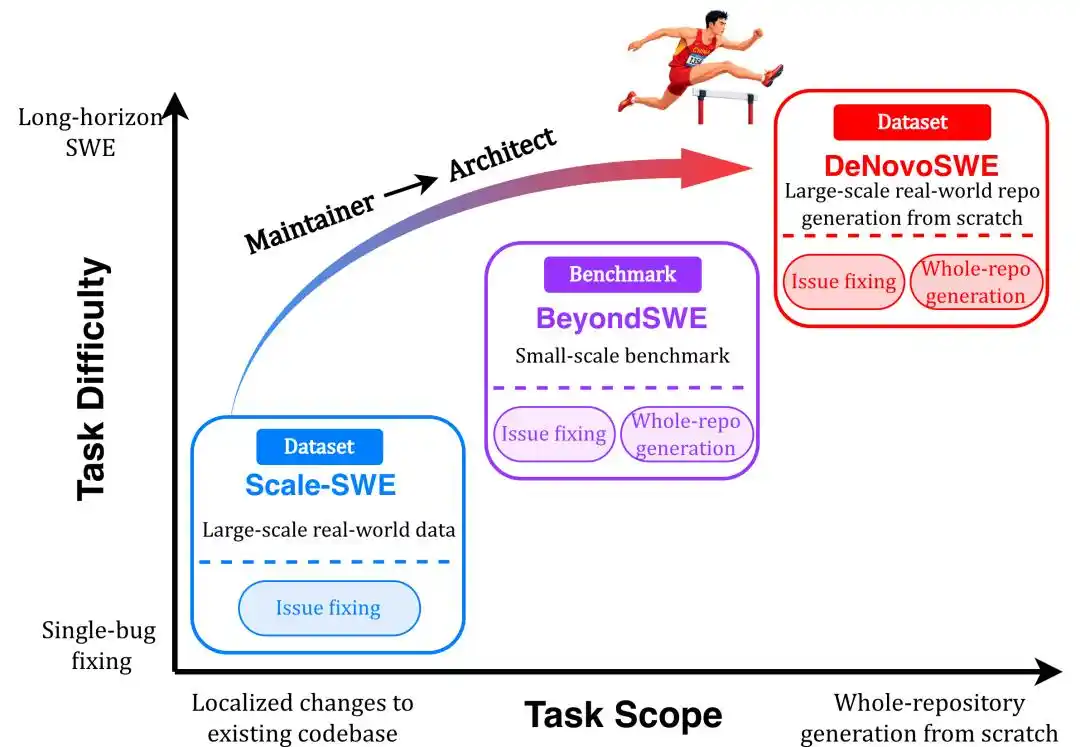
With the continuous improvement of LLM Code Agent capabilities, more and more researchers are realizing it's time to advance to the next stage of long-horizon tasks that are closer to real-world scenarios. Consequently, some benchmarks for evaluating long-horizon tasks have emerged, such as NL2RepoBench and BeyondSWE. The expected role of Code Agents is gradually shifting from repository maintainers to architects, capable of planning and completing long-horizon coding tasks for entire repositories.

Recently, the Gaoling School of Artificial Intelligence at Renmin University of China completed related research and officially released the DeNovoSWE dataset, focusing on long-horizon software engineering tasks, particularly repository-level code generation from scratch.
Paper link: https://arxiv.org/pdf/2606.10728

Repository link: https://github.com/AweAI-Team/DeNovoSWE

Data link: https://huggingface.co/collections/AweAI-Team/denovoswe

Through the mechanisms of Divide & Conquer and Critic & Repair, a high-quality dataset was constructed, successfully achieving scaling for long-horizon SWE tasks. This effort resulted in DeNovoSWE, an open-source, high-quality long-horizon SWE task dataset containing 4,818 real-world instances. This achievement provides large-scale data for training Code Agents' long-horizon capabilities, significantly enhancing their performance on such tasks.
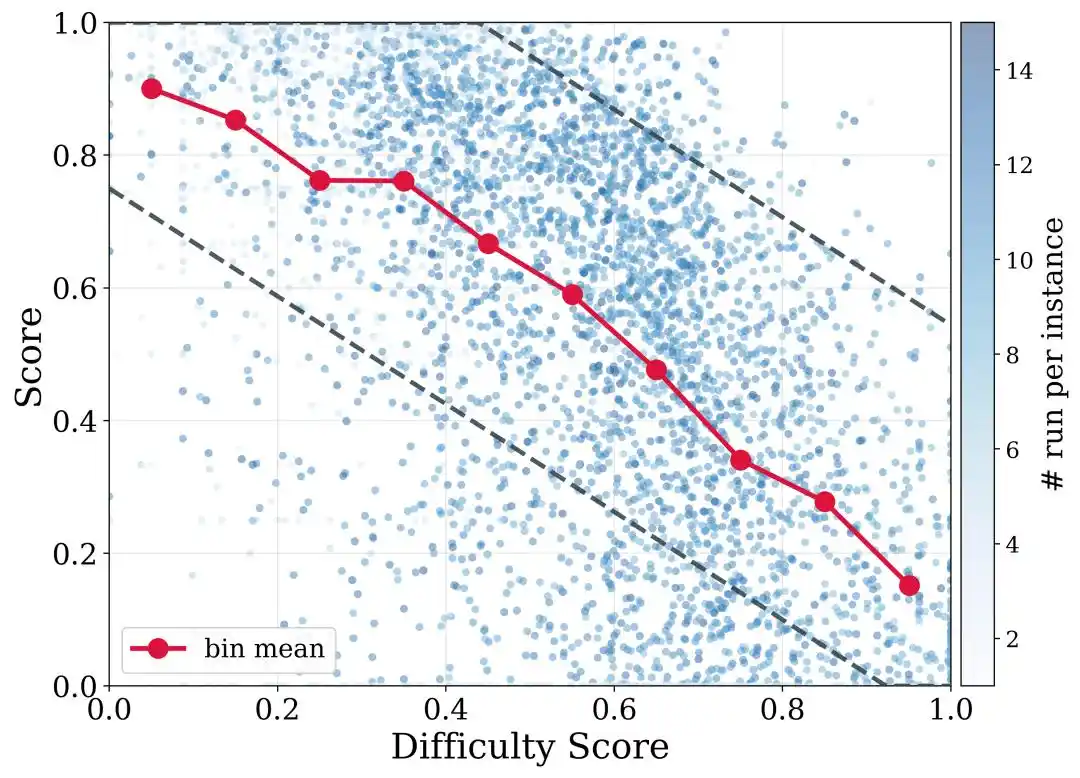
The paper also proposes methods based on difficulty score filtering, effectively alleviating the trade-off between the proportion of difficult problems and trajectory quality.
Experiments show that the Qwen3-30B-A3B-Instruct model trained on DeNovoSWE improved from 5.8% to 47.2% on BeyondSWE-Doc2Repo and from 4.3% to 23.0% on NL2RepoBench, demonstrating the significant boost in repository-level code generation capabilities brought by long-horizon data.

Rebuilding an Entire Repository from a Single Document

Over the past year, with the scaling of large-scale SWE data in works like Scale-SWE, code agents have rapidly progressed on real software engineering tasks like SWE-bench. But as models become increasingly adept at "fixing an issue" or "changing a few lines of buggy code," a more critical question arises: Do agents truly possess long-horizon software engineering capabilities? Judging from the performance of frontier models on BeyondSWE-Doc2Repo and NL2RepoBench, the results are not ideal.

Real-world software development often isn't about modifying a single function or adding a conditional statement. It involves understanding requirements, planning architecture, creating files, designing APIs, handling dependencies, connecting modules, and ultimately making the entire repository run successfully in tests.

In other words, the real challenge lies in long-horizon repository-level generation: starting from a task document and generating a complete, executable, and verifiable software repository. This is precisely the problem DeNovoSWE aims to solve.

High-Quality "Generate from Scratch" Task Documents

In document-to-repository generation, the document is not just a README, nor a simple API list. It is essentially the sole task entry point for the agent to rebuild the entire repository.

A high-quality task document needs to meet at least two core standards.

First, it must be well-organized.

Repository-level tasks are inherently complex, involving multiple modules, interfaces, configurations, data structures, and interaction flows. If the document merely piles up function descriptions, the agent can easily get lost in fragmented information. Therefore, the document should first provide a clear overview of the repository, then divide into chapters based on capabilities or workflows, ensuring each part corresponds to a clear functional boundary.

Second, it must be written from the perspective of reliable evaluation.

The document cannot be too sparse, otherwise the task becomes an underdefined problem, potentially requiring the model to guess aimlessly to pass evaluation. Nor can it be too detailed, as that would directly leak implementation details, making the task unchallenging.

A truly high-quality document should describe the key behaviors on which evaluation depends: including import paths, public APIs, inputs and outputs, default parameters, exception behaviors, configuration items, pattern strings, return fields, etc., while also outlining the general functionalities to be implemented. In other words, the document should be sufficient for the agent to reproduce testable behaviors, but it should not become a copy of the implementation code.

This is also the core idea of DeNovoSWE: making documents readable, implementable, and verifiable.

The DeNovoSWE Method

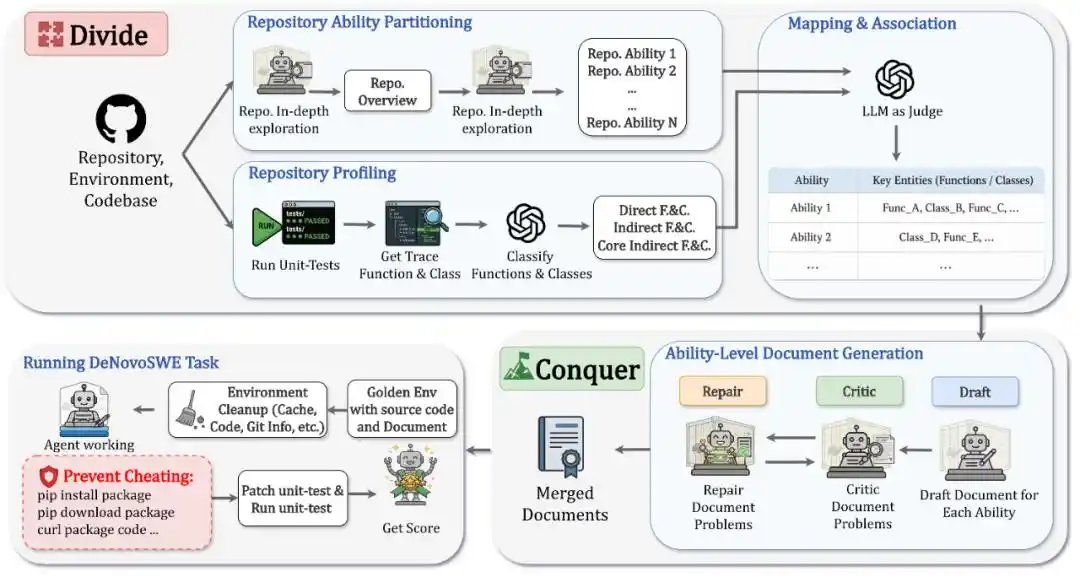
DeNovoSWE frames "generating a complete repository from a document" as a large-scale, verifiable long-horizon software engineering task. It does not rely on manually written documents but automatically constructs high-quality instances through a sandboxed multi-agent workflow. The entire method can be summarized in two steps: Divide and Conquer.

In the Divide stage, the system first analyzes the target repository, decomposing it into multiple repository capabilities.

Each capability corresponds to a core function or workflow within the repository, such as authentication and connection, data reading/writing, batch processing, export flows, etc. This way, the originally massive repository generation problem is split into several structurally clear document chapters.

Simultaneously, DeNovoSWE runs the original unit tests and collects execution traces to identify which functions, classes, and interfaces actually impact evaluation. This further distinguishes between direct components, core indirect components, and non-core indirect components: interfaces directly called by tests must be documented in detail; core indirect components that affect observable behaviors also need coverage; while non-core internal implementations can be left for the agent to handle freely.

In the Conquer stage, DeNovoSWE uses a Draft-Critic-Repair mechanism to generate documents for each capability one by one. The Draft agent writes an initial draft; the Critic agent checks for omissions of key APIs, behavioral contracts, or structural information; the Repair agent then fixes the document based on the feedback. This cycle iterates until each capability chapter is clear, complete, and aligned with evaluation.

Finally, the documents for different capabilities are merged into a single, comprehensive task document, serving as the sole basis for the agent to generate the repository from scratch.

Difficulty: Why is This a Long-Horizon Task?

The difficulty of DeNovoSWE tasks stems from a fundamental change: it's no longer issue-level fixing, but whole-repository generation.

In traditional SWE tasks, agents typically face an existing repository, needing only to locate a bug, modify local code, and pass tests.

In DeNovoSWE, the agent faces a cleaned environment: the original source code and tests are removed, git history is reset, and potential leakage channels like caches, site-packages residues, pip wheels, temporary compilation artifacts, etc., are also cleared. This means the agent must truly rely on the document to complete the entire repository rebuild. It needs to plan the project structure, create module files, define public interfaces, implement cross-file interactions, handle dependencies and configurations, and continuously fix errors across multiple rounds of editing and test feedback.

Any deviation in an API signature, return field, exception type, or default behavior can cause test failures. Errors can also accumulate over the long horizon: an early poorly designed module can affect multiple subsequent files and call chains.

To further address the difficulty variance across different repositories, DeNovoSWE also proposes difficulty-aware trajectory filtering. In simple terms, easy tasks should require a higher pass rate, while difficult tasks should not be entirely discarded just for failing to achieve a perfect score. DeNovoSWE sets different filtering thresholds for different difficulty intervals based on structural complexity and LLM difficulty assessment, thereby balancing quality and diversity.

This is particularly important for long-horizon tasks: the more complex the repository, the harder it is to pass all tests in one go. Yet, the trajectories from challenging repositories, even with low scores or partial success, still contain valuable long-horizon planning and implementation capabilities.
Experimental Results

DeNovoSWE ultimately constructed 4,818 high-quality document-to-repository task instances. It is an executable, evaluable, and trainable long-horizon software engineering environment.
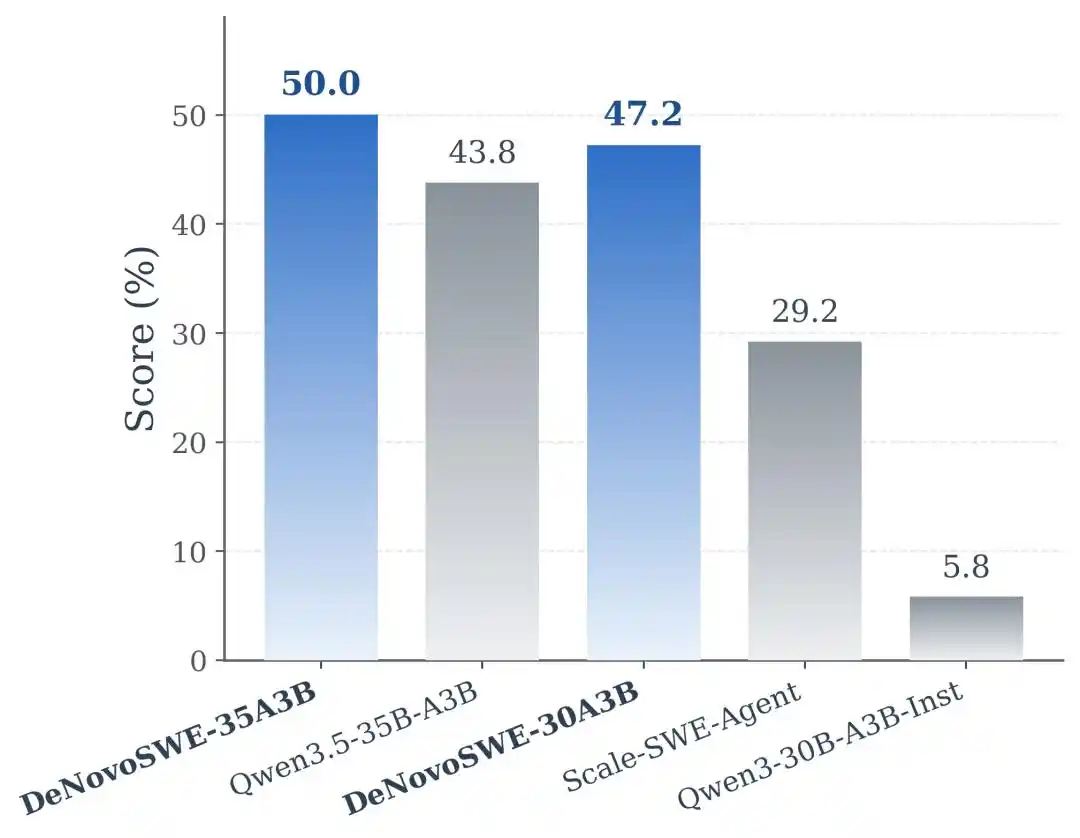
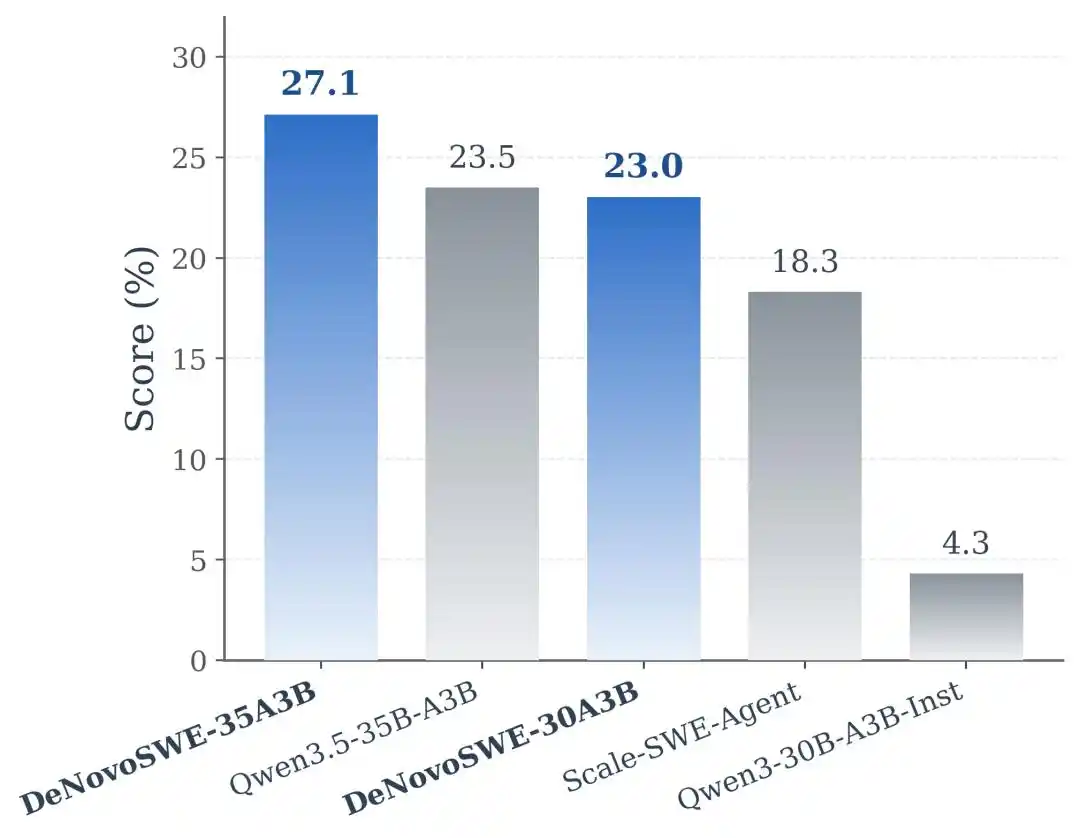
Experimental results show that DeNovoSWE brings significant improvements to models' long-horizon repository generation capabilities. For Qwen3-30B-A3B-Instruct, the original model scored only 5.8% on BeyondSWE-Doc2Repo and 4.3% on NL2RepoBench. Training with conventional issue-level SWE data like Scale-SWE-Agent improved these to 29.2% and 18.3%, indicating that general SWE data does have transfer effects. However, when the model was trained using DeNovoSWE, performance further increased to 47.2% and 23.0%.

This demonstrates that data oriented towards "fixing bugs" cannot fully replace data oriented towards "generating complete repositories" for long-horizon tasks. To truly teach agents repository-level engineering, specialized training environments built for long-horizon tasks are needed.

On the stronger Qwen3.5-35B-A3B backbone, DeNovoSWE similarly brought stable gains: BeyondSWE-Doc2Repo improved from 43.8% to 50.0%, and NL2RepoBench from 23.5% to 27.1%. This further indicates that the benefits of DeNovoSWE are not due to accidental adaptation to a specific model, but stem from the high-quality long-horizon data itself.

Conclusion

The next stage for code agents is not just about fixing individual issues faster, but about understanding documents, planning architecture, organizing modules, implementing interfaces, and ultimately generating a complete, runnable software repository.

DeNovoSWE systematically frames this goal into a trainable, verifiable, and scalable dataset. It answers a key question: What kind of data can truly train agents with long-horizon software engineering capabilities?

The answer is not more fragmented code, nor simpler problems, but high-quality, structured, evaluation-aligned, anti-leakage, full-repository generation tasks.

Starting from a single document, rebuild the entire repository. This is the threshold that long-horizon code agents need to cross.

Reference: https://arxiv.org/pdf/2606.10728

This article is from the WeChat public account "AI Era," edited by LRST.

Kripto yang Sedang Tren

Pertanyaan Terkait

QWhat is the main contribution of the research from Renmin University of China's Gaoling School of Artificial Intelligence?

AThe research introduces and releases the DeNovoSWE dataset, which is the first long-horizon Doc2Repo training set focused on repository-level code generation from scratch in software engineering tasks.

QHow does the DeNovoSWE dataset address the challenge of long-horizon software engineering tasks?

AIt uses a sandboxed multi-agent workflow based on 'Divide & Conquer' and 'Draft-Critic-Repair' mechanisms to automatically construct high-quality task documents, ensuring they are well-organized and evaluation-aligned for whole-repository generation.

QWhat were the performance improvements observed after training a model on the DeNovoSWE dataset?

AThe Qwen3-30B-A3B-Instruct model showed significant improvement, increasing its performance on BeyondSWE-Doc2Repo from 5.8% to 47.2% and on NL2RepoBench from 4.3% to 23.0%.

QWhat are the two core standards mentioned for a high-quality task document in document-to-repository generation?

AFirst, the document must be well-organized, providing a clear overview and structured chapters. Second, it must be evaluation-aligned, describing key behaviors for verification without leaking implementation details.

QWhat is the purpose of the difficulty-aware trajectory filtering mechanism in DeNovoSWE?

AIt sets different filtering thresholds for tasks of varying difficulty levels to balance quality and diversity, ensuring that valuable but partially successful trajectories from complex repositories are not discarded.

Bacaan Terkait

Setelah Tiga Kuartal Berturut-Turut Turun, Bisakah Pasar Kripto Menyambut Jendela Stabilitas di Kuartal Ketiga?

Pasar kripto mengalami kuartal terburuk sejak 2022, dengan kapitalisasi pasar turun 12.6% menjadi $2.1 triliun, didorong oleh keluarnya modal dan penurunan volume perdagangan. Bitcoin dan Ethereum masing-masing jatuh 14.2% dan 25.4% di kuartal kedua. Aliran keluar bersih dari ETF Bitcoin AS mencapai $4.67 miliar, menandakan tekanan jual yang berkelanjutan. Faktor utama meliputi terputusnya hubungan dengan saham AS, kebijakan moneter Federal Reserve yang ketat, dan pelepasan aset oleh perusahaan seperti Strategy. Proses legislasi UU CLARITY yang akan memberikan kejelasan regulasi terhambat, meningkatkan premi risiko di sektor ini. Namun, ada tanda-tanda potensi stabilisasi. Aliran keluar ETF yang besar secara historis sering terjadi di akhir fase penurunan, dan para pemegang Bitcoin jangka panjang mulai menambah kepemilikan lagi. Sementara sebagian besar sektor menyusut, pasar prediksi dan aset koleksi yang ditokenisasi mencatat pertumbuhan signifikan. Pandangan untuk kuartal ketiga sangat bergantung pada pertemuan Fed akhir Juli. Sinyal kebijakan yang lunak dapat mendukung pemulihan Bitcoin, sementara sikap yang hawkish dapat memicu konsolidasi lebih lanjut. Meskipun tantangan regulasi tetap ada, indikator teknis seperti harga Bitcoin yang mendekati rata-rata bergerak 200-mingguannya menunjukkan dasar jangka panjang belum rusak. Logika pasar telah bergeser dari mengandalkan narasi ke faktor fundamental seperti kebijakan dan ekspektasi suku bunga.

marsbit16j yang lalu

Setelah Tiga Kuartal Berturut-Turut Turun, Bisakah Pasar Kripto Menyambut Jendela Stabilitas di Kuartal Ketiga?

marsbit16j yang lalu

The SpaceX Trade, Terbuka: SPCXON Mulai Diperdagangkan di WEEX

SpaceX meluncurkan IPO terbesar dalam sejarah pada Juni 2026, namun akses bagi banyak pedagang terhambat oleh batasan regional dan prosedur broker. WEEX kini menghadirkan SPCXON/USDT di pasar spotnya, sebuah instrumen tokenisasi yang memungkinkan paparan terhadap pergerakan harga SpaceX melalui akun kripto yang diselesaikan dengan USDT, tanpa memerlukan broker AS atau pembiayaan bank. SPCXON adalah produk tokenisasi yang mencerminkan ekonomi kepemilikan SpaceX bagi pedagang yang memenuhi syarat di luar AS, dengan dividen diinvestasikan kembali. Aset ini diperdagangkan di WEEX sebagai pasangan spot dengan USDT, tersedia selama jam pasar, memberikan akses mudah bagi trader kripto. Kasus investasi untuk SpaceX didasarkan pada pertumbuhan pendapatan Starlink dan pencapaian Starship, meskipun valuasinya yang tinggi (sekitar 90-110 kali pendapatan) telah memperhitungkan eksekusi sempurna selama bertahun-tahun. Faktor seperti jumlah saham publik yang terbatas dan masa buka kunci (unlock) insider pertama menjadi pertimbangan penting. Penting untuk diingat bahwa SPCXON memberikan paparan, bukan kepemilikan langsung atas saham atau hak suara. Harganya dapat diperdagangkan pada premium atau diskon terhadap nilai aset bersih. WEEX menawarkan akses ke berbagai aset TradFi yang ditokenisasi seperti ini dalam satu akun terpadu, bersama dengan pasar futures dan kampanye perdagangan dengan pool hadiah.

TheNewsCrypto16j yang lalu

The SpaceX Trade, Terbuka: SPCXON Mulai Diperdagangkan di WEEX

TheNewsCrypto16j yang lalu

Momen Perdagangan BIT: BTC Masih Tertekan oleh EMA 200 Mingguan, Setelah Ditolak Mungkin Kembali Turun, Saham Penyimpanan dan Semikonduktor yang Melonjak Malam Kemudian Mulai Anjlok di Pasar Malam

**PASAR KRIPTO & SAHAM: BTC Hadapi Resistensi, Saham Semikonduktor Turun di Perdagangan Malam** Pasar kripto melanjutkan pemulihan, dengan harga Bitcoin bertahan di sekitar $66,000 setelah rebound lebih dari 15% dari titik terendah Juli. Namun, BTC menghadapi **tembok resistensi kuat di dekat $68,000**, yang bertepatan dengan biaya rata-rata investor selama lima bulan terakhir dan titik gagalnya rebound pertengahan Juni. Secara teknis, perhatian tertuju pada **200 EMA mingguan (~$68,328) sebagai level kunci**. Jika BTC ditolak di level ini, potensi penurunan menuju support $63,000 terbuka. Analis menyoroti volume rendah dan penurunan open interest futures di CME, menandakan rebound ini lebih dipicu likuiditas rendah musim panas daripada awal bull run penuh. Di pasar saham AS, **indeks futures utama turang** setelah sesi kemarin yang kuat. Sektor semikonduktor dan penyimpanan (storage), yang melonjak pada hari Selasa (contoh: Micron +12%), **mengalami koreksi di perdagangan malam (night trading)**. ETF semikonduktor turun 2,22% dan saham Micron turun 2,29%. Meski begitu, ada sorotan positif seperti **Super Micro Computer (SMCI)** yang naik lebih dari 15% setelah melaporkan pandangan pendapatan yang kuat dan pesanan baru yang sangat besar, mengonfirmasi permintaan server AI tetap solid. Kekhawatiran makro muncul dari **kenaikan harga minyak mentah (di atas $91)** akibat ketegangan geopolitik dan **lonjakan imbal hasil (yield) obligasi pemerintah AS**, dengan imbal hasil 10-tahun mencapai sekitar 4,64%. Faktor-faktor ini dapat menambah tekanan inflasi dan membatasi ruang gerak pasar saham. Saham terkait kripto seperti Coinbase dan Robinhood naik kuat didorong oleh perkembangan regulasi yang lebih jelas di AS. Di Asia, **Korea Selatan** dan **Jepang** menunjukkan kinerja beragam. Indeks KOSPI Korea naik didukung pemulihan saham semikonduktor, sementara pasar Jepang melemah dengan **Yen terus melemah ke level terendah sejak 1986**, meningkatkan kekhawatiran akan intervensi bank sentral. **Yang Perlu Diperhatikan Selanjutnya:** * **22 Juli:** Acara AI AMD, rilis laporan keuangan dari Google (Alphabet), Tesla, IBM. * **23 Juli:** Keputusan suku bunga Bank Sentral Eropa (ECB), data klaim pengangguran AS, laporan keuangan Intel. * Perkembangan lebih lanjut dari **harga minyak, imbal hasil obligasi, dan dinamika Yen Jepang** akan menjadi penentu sentimen pasar risiko secara keseluruhan.

marsbit16j yang lalu

Momen Perdagangan BIT: BTC Masih Tertekan oleh EMA 200 Mingguan, Setelah Ditolak Mungkin Kembali Turun, Saham Penyimpanan dan Semikonduktor yang Melonjak Malam Kemudian Mulai Anjlok di Pasar Malam

marsbit16j yang lalu

Mantan Ketua CFTC dan Presiden Circle, Tarbert: Satu Pihak Menasihati Anda untuk Berpikir Jangka Panjang, di Sisi Lain Menguangkan $30 Juta Sendiri

Penulis: Zen, PANews Heath Tarbert, mantan Ketua CFTC dan Presiden Circle, baru-baru ini menyerukan kepada investor untuk mengadopsi pandangan jangka panjang terhadap saham Circle, meskipun harganya telah turun 70% dari puncaknya. Namun, ia sendiri secara konsisten menjual saham CRCL sejak perusahaan go public, menguangkan sekitar $30 juta tanpa pernah membeli saham tambahan di pasar terbuka. Tarbert, yang bergabung dengan Circle pada Juli 2023 dan menjadi Presiden pada awal 2025, dikenal sebagai pendukung kuat narasi "jangka panjang" perusahaan. Namun, sehari sebelum IPO Circle, ia menetapkan rencana perdagangan 10b5-1 untuk menjual hingga 353.290 saham dalam setahun. Dalam 13 bulan setelah IPO, ia menjual lebih dari 360.000 saham, termasuk penjualan tunggal senilai $11,5 juta pada Maret 2026. Ia bahkan menetapkan rencana 10b5-1 kedua untuk menjual hingga 160.000 saham lagi pada akhir tahun 2026. Langkah Tarbert ini menuai kecaman karena dianggap tidak konsisten dengan pesan "jangka panjang" yang ia sampaikan kepada publik. Perjalanan kariernya sering dikaitkan dengan "revolving door" antara regulator dan dunia keuangan. Setelah mengundurkan diri sebagai Ketua CFTC pada Maret 2021, ia bergabung dengan Citadel Securities hanya 27 hari kemudian sebagai Kepala Penasihat Hukum, tepat saat perusahaan itu menghadapi pengawasan ketat terkait peristiwa GameStop. Di Citadel, ia juga mendukung undang-undang yang memperluas wewenang CFTC atas pasar crypto, sementara Citadel diketahui berencana berekspansi ke aset kripto. Tarbert kemudian pindah ke Circle pada 2023, membantu perusahaan mengatasi tantangan regulasi dan akhirnya go public melalui IPO langsung. Meskipun sangat berharga bagi perusahaan, tindakannya menjual saham dalam jumlah besar sambil mendorong investor untuk bertahan menimbulkan pertanyaan tentang komitmennya yang sebenarnya terhadap masa depan jangka panjang Circle.

marsbit17j yang lalu

Mantan Ketua CFTC dan Presiden Circle, Tarbert: Satu Pihak Menasihati Anda untuk Berpikir Jangka Panjang, di Sisi Lain Menguangkan $30 Juta Sendiri

marsbit17j yang lalu

Gate Research Institute: Produk Keuangan Kripto Menggulirkan Gelombang "Wall Street-ization", Kompetisi atau Integrasi?

**Ringkasan: Gelombang "Wall Street-ization" Produk Keuangan Kripto: Kompetisi atau Integrasi?** Artikel ini membahas fenomena konvergensi antara keuangan tradisional (TradFi) dan keuangan kripto (Crypto). Meskipun Bitcoin awalnya dirancang sebagai sistem peer-to-peer yang terdesentralisasi dan bebas dari perantara seperti bank, pasar kripto kini semakin diintegrasikan ke dalam infrastruktur keuangan tradisional. **Tren "Wall Street-ization":** Dimulai dengan disetujuinya ETF spot Bitcoin pada 2024, aset kripto kini dikemas menjadi produk seperti ETF (oleh BlackRock, Fidelity, dll.), futures, dan sekuritisasi aset riil (RWA) seperti obligasi pemerintah yang ditokenisasi. Ini memberikan akses yang mudah dan teregulasi bagi investor institusional, tetapi juga berarti kekuasaan atas penerbitan, penentuan harga, kustodian, dan distribusi aset kripto semakin bergeser ke lembaga keuangan besar. **Dua Jalur Konvergensi (1+1>2):** Artikel ini menyoroti dua arah integrasi: 1. **Dari CEX ke TradFi:** Dilambangkan oleh **Gate.io**, yang berkembang dari bursa kripto menjadi platform multi-aset. Gate kini menawarkan perdagangan saham nyata (AS, Hong Kong, Korea) menggunakan USDT, menyediakan akses tanpa batas waktu ke pasar tradisional. 2. **Dari TradFi ke Crypto:** Dilambangkan oleh **Robinhood**, platform broker tradisional yang memperluas layanannya ke aset kripto (termasuk melalui akuisisi Bitstamp) dan mengembangkan produk seperti token saham di blockchain. **Tujuan Bersama: Akun Keuangan "Super" Terpadu:** Kedua jalur ini bertujuan menciptakan **akun keuangan generasi berikutnya yang terpadu**. Pengguna di masa depan mungkin dapat memperdagangkan Bitcoin, saham Apple, ETF, emas, dan obligasi pemerintah yang ditokenisasi dalam satu antarmuka yang sama, menggunakan stablecoin sebagai lapisan dana. **RWA dan Obligasi Pemerintah di On-Chain sebagai Lapisan Tengah:** Tokenisasi aset dunia nyata, terutama obligasi pemerintah AS, menyediakan aset berpenghasilan rendah risiko di ekosistem on-chain. Pasar ini tumbuh pesat (naik 40% pada paruh pertama 2026) meskipun pasar kripto turun, menunjukkan permintaan nyata. **Kesimpulan:** "Wall Street-ization" bukanlah pengambilalihan sepihak, melainkan **transformasi timbal balik**. TradFi dan Crypto saling melengkapi: Crypto mendapatkan akses ke likuiditas, kepatuhan, dan jaringan distribusi yang luas, sementara TradFi mengadopsi efisiensi, kecepatan, dan pasar 24/7 dari Crypto. Hasil akhirnya adalah pembentukan **pasar modal terpadu yang lebih efisien dan global**, di mana batas antara aset tradisional dan kripto semakin kabur.

marsbit17j yang lalu

Gate Research Institute: Produk Keuangan Kripto Menggulirkan Gelombang "Wall Street-ization", Kompetisi atau Integrasi?

marsbit17j yang lalu

Trading

Spot

Artikel Populer

Cara Membeli RE

Selamat datang di HTX.com! Kami telah membuat pembelian Re (RE) menjadi mudah dan nyaman. Ikuti panduan langkah demi langkah kami untuk memulai perjalanan kripto Anda.Langkah 1: Buat Akun HTX AndaGunakan alamat email atau nomor ponsel Anda untuk mendaftar akun gratis di HTX. Rasakan perjalanan pendaftaran yang mudah dan buka semua fitur.Dapatkan Akun SayaLangkah 2: Buka Beli Kripto, lalu Pilih Metode Pembayaran AndaKartu Kredit/Debit: Gunakan Visa atau Mastercard Anda untuk membeli Re (RE) secara instan.Saldo: Gunakan dana dari saldo akun HTX Anda untuk melakukan trading dengan lancar.Pihak Ketiga: Kami telah menambahkan metode pembayaran populer seperti Google Pay dan Apple Pay untuk meningkatkan kenyamanan.P2P: Lakukan trading langsung dengan pengguna lain di HTX.Over-the-Counter (OTC): Kami menawarkan layanan yang dibuat khusus dan kurs yang kompetitif bagi para trader.Langkah 3: Simpan Re (RE) AndaSetelah melakukan pembelian, simpan Re (RE) di akun HTX Anda. Selain itu, Anda dapat mengirimkannya ke tempat lain melalui transfer blockchain atau menggunakannya untuk memperdagangkan mata uang kripto lainnya.Langkah 4: Lakukan trading Re (RE)Lakukan trading Re (RE) dengan mudah di pasar spot HTX. Cukup akses akun Anda, pilih pasangan perdagangan, jalankan trading, lalu pantau secara real-time. Kami menawarkan pengalaman yang ramah pengguna baik untuk pemula maupun trader berpengalaman.

211 Total TayanganDipublikasikan pada 2026.06.18Diperbarui pada 2026.06.29

Cara Membeli RE

Diskusi

Selamat datang di Komunitas HTX. Di sini, Anda bisa terus mendapatkan informasi terbaru tentang perkembangan platform terkini dan mendapatkan akses ke wawasan pasar profesional. Pendapat pengguna mengenai harga RE (RE) disajikan di bawah ini.

活动图片