Are the AI Giants' 'Token Subsidy Wars' Almost Over?

marsbitDipublikasikan tanggal 2026-06-22Terakhir diperbarui pada 2026-06-22

Abstrak

The article "Are AI Giants' 'Token Subsidy Wars' Nearing an End?" examines the ongoing price competition in AI token pricing, arguing that current subscription costs are heavily subsidized, with services like OpenAI and Anthropic reportedly subsidizing tokens at up to 70 times the subscription fee. Unlike past tech "subsidy wars" (e.g., ride-hailing, food delivery), AI tokens lack strong lock-in effects; users can easily switch providers if prices rise, making sustained subsidies risky. The piece highlights a structural asymmetry: giants like Google can fund subsidies with massive advertising revenue, while rivals like OpenAI and Anthropic rely on investor capital. Google Ventures founder Bill Maris suggests Google could slash token prices by 80%, putting immense pressure on competitors, especially as model capabilities converge. The article posits two potential endgames: a "winner-takes-all" monopoly scenario (like internet platforms) or a "utility" model where tokens become a low-margin, standardized commodity like electricity. Given the low switching costs, the latter seems more likely. This implies a prolonged, profitless competition where the primary goal for companies is to stay in the game, not to achieve dominance. For users, this may mean continued access to heavily subsidized AI services for the foreseeable future.

Author: Astronaut

Tokens are expensive, and burning through them is painful.

This isn't just the sentiment of those currently obsessed with Vibe Coding. Even the major Silicon Valley companies that were previously fervently preaching Tokenmaxxing have now started imposing token usage limits on their own employees.

But here's a counter-intuitive point: for those currently using AI subscriptions, the tokens you're consuming have already been subsidized by the major AI companies. The highest subsidy could be as much as 70 times the subscription fee itself!

What's more concerning is that both OpenAI and Anthropic, the two leading AI companies, are now entering their IPO sprint phases. After these companies go public, will they follow the post-subsidy-war playbook of the internet era, raising customer prices to bring token pricing back to a 'rational' level?

The good news is that this scenario might not happen. Recently, Google Ventures founder Bill Maris raised a question on the All-in podcast: What would happen if Google decided to slash token prices by another 80%? How would OpenAI and Anthropic respond?

Similarly, not long ago, the startup team Agnes AI explained the potential arrival of a 'Free Token Era' during a livestream with GeekPark.

So, will token prices rise or fall in the future? And what does this mean for those already addicted to AI?

01 The Token Subsidy War is Raging

Why is it said that current token prices aren't actually that expensive?

Because at least in the AI subscription model, the current prices offered by various AI companies are already 'rock-bottom' subsidized prices.

Recently, SemiAnalysis conducted a detailed evaluation comparing the actual token consumption value against the subscription fees under the subscription plans of OpenAI and Anthropic.

SemiAnalysis did something simple but effective: they practically used AI within the subscription plans of various AI platforms to complete different tasks, then reverse-calculated how much those tasks' tokens would cost using the API's public pricing. The results are as follows:
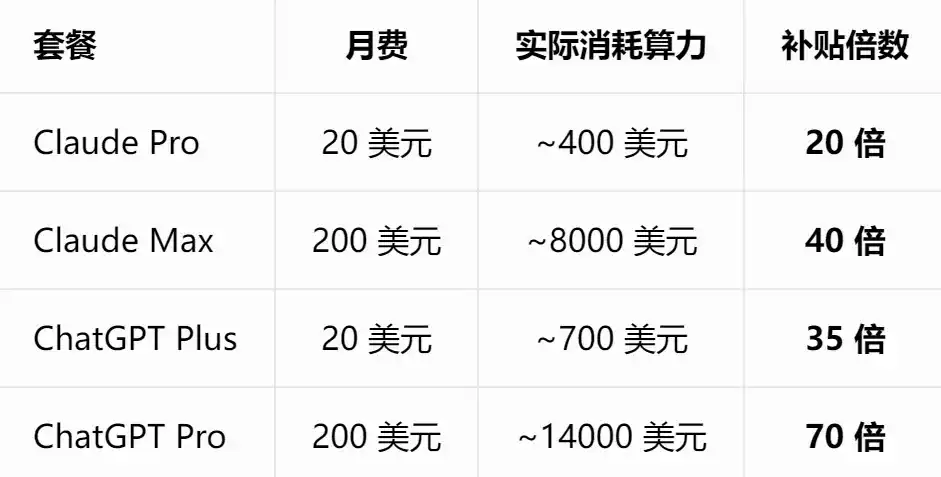
Notice a pattern: the more expensive the plan, the higher the subsidy multiple. This itself indicates these premium plans aren't meant for profit—they are a form of 'reverse pricing,' using the most aggressive losses to retain the most heavy-duty users. Because heavy users are developers, they are enterprise decision-makers. Once they are locked onto a platform, they can bring along entire teams and product lines.

Losing money to this extent, why still do it? The standard answer is: first burn money for scale, then raise prices to recoup once scale is achieved. That's how the mobile internet played out—Didi and Uber subsidized hundreds of billions in ride fares, and after subsidies ended, fares increased; Meituan subsidized countless meals, and after subsidies ended, delivery fees increased. This logic hinges on a key prerequisite: lock-in effect was established during the subsidy period.

Didi could raise prices because drivers couldn't leave the order flow on the platform, and passengers couldn't leave the drivers on the platform. Meituan could raise prices because merchants couldn't leave its traffic and delivery network. When subsidies ended, users were already 'locked' into the ecosystem, with extremely high switching costs.

But there's a fundamental difference between the AI war and the internet war—Tokens have almost no lock-in effect.

If Claude raises its prices, developers could migrate API calls to GPT or Gemini within a day—interfaces across providers are becoming increasingly standardized, and many development frameworks even have built-in multi-model switching capabilities. For regular users, it's even simpler: just switch to a different website. AI isn't like ride-hailing with a local driver network, nor like food delivery with a distribution system, nor like social media with a friend network. Tokens are just tokens; no matter who produces them, they are the same thing.

This means that once subsidies stop, users can vanish in an instant. Subsidies aren't 'building moats'; they are more like 'maintaining a heartbeat'—as long as someone offers a lower price, users run.

And this hasn't even accounted for a new variable that's making everyone's bills spin out of control: AI Agents.

When you chat with ChatGPT, a single conversation might consume a few thousand tokens. But when you task an AI Agent with a complex job—writing a piece of code and debugging it automatically, analyzing a dozens-page document and generating a report—a single round can consume 5 to 30 times more tokens than a regular conversation. Some developers have measured that on the $100 Claude Max plan, a single Agent programming session could burn through nearly $100 worth of tokens. Uber's CTO recently revealed the company burned through its entire 2026 AI budget in just four months.

The question is, can such a Token Subsidy War be sustained? Who might be the ones left standing when the chaotic fight is over?

Bill Maris believes the answer is clearly the traditional giants.

02 Token as a Weapon

To understand the true brutality of this subsidy war, one must first see a structural asymmetry—the ammunition sources for the various combatants are completely different.

Google's annual advertising revenue exceeds $300 billion. This isn't money from investors, nor is it money burned from fundraising; it's a money-printing machine running automatically every day. Billions of people worldwide open their search engine, watch YouTube, use Gmail, and advertising dollars automatically flow into its account. It doesn't need to do roadshows, doesn't need to please analysts, doesn't need to explain to anyone why it's spending this money.

Google using ad profits to subsidize AI tokens is like someone sitting on an oil well fighting a gas station price war—their oil comes bubbling up from their own land, while their opponents' oil is bought with bank loans.

OpenAI and Anthropic are precisely those buying oil with loans.

OpenAI has cumulatively raised over $180 billion, with the latest valuation exceeding $850 billion. Anthropic has raised over $130 billion. This money comes from venture capital and strategic investors—they aren't giving money out of charity; they expect these companies to go public, they expect hefty returns upon exit.

And after going public, the real trouble begins. An IPO means financial statements are public to the world. Every quarter, Wall Street analysts will scrutinize revenue, profit, customer acquisition cost, and marginal cost. When they calculate that you're actually losing $70 for every $1 of subscription fee received—no growth story, no matter how glorious, can support the stock price.

Bill Maris put this logic bluntly on the podcast. His exact words were: "If I were Google and decided to arbitrarily cut token prices by 80%, what would happen to OpenAI and Anthropic's business model?"

When the host asked how likely that was, Maris didn't hesitate: "100%. Capital as a weapon, tokens as a weapon."

This isn't speculation from an analyst. Bill Maris is the founder and CEO of Google Ventures, also a Google VP of Special Projects, having incubated Waymo and Google X. Everyone present understood: this wasn't a hypothetical; it was him having seen firsthand how Google fights wars.

The scenario he described is simple: Google announces an 80% price cut for the Gemini API. What would enterprise customers do? If the product quality is similar—and in many benchmark tests, Gemini is already comparable to Claude and GPT—but the price is four-fifths cheaper, would you continue using the expensive one?

Maris gave his own answer: "If you are a company and you can go to Google and Gemini and pay 80% less for basically the same product, why wouldn't you? And then the pressure on those companies becomes very severe."

And OpenAI and Anthropic have almost no symmetrical countermeasures. They can't match the price cut—they lack a money printer; every dollar is investor money. They also can't rely on a technology gap to maintain a premium—the gap between large models is closing rapidly. You might be ahead for three months today, but you'll be caught up in three months. It's not like the generational technological gap between the iPhone and Nokia. The moats between AI models are more like dykes built of sand, easily overrun when the tide rises.

In Bill's narrative, Google has a strong chance of winning. But in the AI world, can Google truly monopolize? Meta can open-source a free model at any time; China has DeepSeek and ByteDance; Amazon is pushing its own model. When you drive token prices down to dirt-cheap levels, competitors don't disappear—they are also lowering prices.

The AI war might have no winner.

03 The 'Infinite Game' of Tokens?

Even those unfamiliar with history can make the following judgments about the ultimate outcome of the current AI war:

The first is the 'Internet Service' script—the story of Didi, the story of Amazon: subsidize first, then monopolize, then raise prices to harvest. In this script, today's price war is just the prologue. Eventually, one or two winners will dominate most of the market and gain pricing power. If so, the massive losses today are a worthwhile investment—just like Amazon lost money for twenty years before ultimately becoming the dual champion of e-commerce and cloud computing.

The second is the 'Utility' script. Tokens become a standardized basic resource, like electricity, bandwidth, cloud storage. No one can maintain pricing power long-term because product differentiation is too small and switching costs are too low. Competition pushes prices infinitely towards the cost line, with profit margins approaching zero. Ultimately, governments might step in with regulation—just as they did with electricity and telecommunications a hundred years ago.

The difference between the two scripts hinges on one word:

Lock-in.

Didi could raise prices because passengers were locked into the driver network, and drivers were locked into the order flow. Amazon could raise prices because merchants were locked into its logistics and traffic ecosystem.

The lock-in effect is the cornerstone of the 'lose first, profit later' model.

But AI tokens—as argued repeatedly before—have almost no lock-in. APIs are standardized; switching costs are nearly zero. The core condition for the first script doesn't exist for the product of tokens.

If the second script, the 'utility' infrastructure endgame, is closer to reality, what we are witnessing is not a war that will eventually produce a victor, but a war of attrition with no end in sight.

Meituan founder Wang Xing once described this competitive state. His insight was: some competitions don't have a concept of 'winning.' The goal of the participants isn't to defeat opponents, but to ensure they remain at the table. Because as long as you are at the table, you can continue fundraising, hiring, and iterating. Leaving the table is the only way to lose.

Using this framework to re-examine today's AI landscape, many seemingly contradictory things suddenly become clear.

OpenAI's latest round valuation exceeds $800 billion, not because training models requires that much money. It needs that much money to continue the price war. Fundraising isn't to win; it's to 'qualify to keep fighting.'

Google preparing to cut token prices by 80% isn't to eliminate OpenAI and Anthropic. It's to ensure it remains a core player in the AI era—just as it once ensured it wasn't left off the mobile era table with free Android.

And Anthropic raising the API pricing for its latest flagship model Fable 5 to twice that of the previous generation—$10 per million tokens input, $50 per million output—seemingly 'raising prices,' is actually proactively filtering for enterprise customers willing to pay for high-end capabilities, because deep down it knows: it can't win the consumer-side subsidy war against Google.

Each round of price war expands the scale of AI usage. Expanded scale means more data, more scenarios, more developers flooding into the ecosystem. This in turn makes all participants' models stronger. Combatants use the war itself to attract resources to upgrade themselves—this isn't a zero-sum, life-or-death battle, but a process where everyone becomes stronger through competition, yet none are likely to reap massive profits.

Doesn't that sound exactly like how the electricity industry ultimately turned out?

140 years ago, both Edison and Westinghouse thought they were fighting for a winner-take-all market. They staked their entire fortunes, betting on 'whoever defines the standard for electricity, owns electricity.' But the fate of electricity tells us a simple truth:

When a technology becomes sufficiently important, sufficiently universal, sufficiently standardized, it no longer belongs to any single company. It becomes infrastructure.

The AI competition, on the surface, appears to be Google vs. OpenAI vs. Anthropic, a contest of model capabilities, a battle of fundraising scale. But zooming the lens out, the true function of this competition is: it is accelerating the push of AI toward a level of infrastructure that no company can monopolize.

When Bill Maris says "100% will happen," he may not just be predicting that Google will lower prices. He may be, perhaps unconsciously, predicting a larger trend—in the world of AI, tokens will ultimately not belong to anyone. Just as no one 'owns' electricity today.

For OpenAI and Anthropic, this means something unsettling: even with technological leads, even after raising astronomical funds, the future they are chasing—'making big money from AI'—might not have existed from the very beginning. They aren't facing a temporary price war, but a structural destiny—the thing they are striving to build might, in essence, be the next generation's water, electricity, and roads.

And for users, to some extent, this might be good news. As long as the Token Subsidy War continues, people can still enjoy the 'good deal' of $400 worth of compute power for a $20 cost.


Pertanyaan Terkait

QWhy is the current price of AI tokens considered 'not expensive', and what is the highest subsidy multiple mentioned in the article?

AThe current price of AI tokens is considered 'not expensive' because AI companies are heavily subsidizing their subscription plans. The article states that the highest subsidy multiple can be up to 70 times the subscription fee, meaning the actual token cost might be 70 times what the user pays.

QWhat fundamental difference does the article highlight between the AI token war and classic internet subsidy battles (like Uber or Meituan)?

AThe fundamental difference is the lack of 'lock-in effect'. In internet battles (e.g., Uber's driver network, Meituan's delivery system), subsidies built high switching costs, allowing companies to raise prices later. AI tokens are standardized and easily interchangeable between platforms (like swapping APIs), meaning users can leave instantly if prices rise, making sustained profits from subsidies much harder.

QAccording to the article, what is Bill Maris's argument about Google's potential strategy and its impact on competitors like OpenAI and Anthropic?

ABill Maris argues that Google, with its vast advertising revenue (over $300 billion annually), could weaponize capital by slashing token prices by 80%. This would put immense pressure on competitors like OpenAI and Anthropic, who rely on investor funding. If Google offers a similar product for 80% less, customers would switch, threatening the business models of the VC-backed companies, especially post-IPO when they face public scrutiny over profits.

QThe article presents two possible 'scripts' for the outcome of the AI token war. What are they, and which one does the author argue is more likely and why?

AThe two scripts are: 1) The 'Internet Service' script: A few winners emerge, gain monopoly power, and raise prices. 2) The 'Utilities' script (Water/Electricity): Tokens become a standardized commodity with near-zero profit margins, regulated like public infrastructure. The author argues the 'Utilities' script is more likely because AI tokens lack the lock-in effect essential for the first script. Their standardization and low switching costs push the market toward a commoditized, low-margin outcome.

QWhat does the article suggest is the real purpose of the ongoing price war and massive funding rounds for AI companies, according to the 'infinite game' perspective?

AFrom the 'infinite game' perspective, the real purpose is not to 'win' by eliminating competitors, but to 'stay at the table.' The price war expands the overall AI user base and ecosystem, which in turn improves all models. Massive funding (like OpenAI's high valuation) is less about training models and more about securing the capital needed to continue participating in this endless competitive game, ensuring the company remains a key player as AI evolves into a fundamental infrastructure.

Bacaan Terkait

Setelah Tiga Kuartal Berturut-Turut Turun, Bisakah Pasar Kripto Menyambut Jendela Stabilitas di Kuartal Ketiga?

Pasar kripto mengalami kuartal terburuk sejak 2022, dengan kapitalisasi pasar turun 12.6% menjadi $2.1 triliun, didorong oleh keluarnya modal dan penurunan volume perdagangan. Bitcoin dan Ethereum masing-masing jatuh 14.2% dan 25.4% di kuartal kedua. Aliran keluar bersih dari ETF Bitcoin AS mencapai $4.67 miliar, menandakan tekanan jual yang berkelanjutan. Faktor utama meliputi terputusnya hubungan dengan saham AS, kebijakan moneter Federal Reserve yang ketat, dan pelepasan aset oleh perusahaan seperti Strategy. Proses legislasi UU CLARITY yang akan memberikan kejelasan regulasi terhambat, meningkatkan premi risiko di sektor ini. Namun, ada tanda-tanda potensi stabilisasi. Aliran keluar ETF yang besar secara historis sering terjadi di akhir fase penurunan, dan para pemegang Bitcoin jangka panjang mulai menambah kepemilikan lagi. Sementara sebagian besar sektor menyusut, pasar prediksi dan aset koleksi yang ditokenisasi mencatat pertumbuhan signifikan. Pandangan untuk kuartal ketiga sangat bergantung pada pertemuan Fed akhir Juli. Sinyal kebijakan yang lunak dapat mendukung pemulihan Bitcoin, sementara sikap yang hawkish dapat memicu konsolidasi lebih lanjut. Meskipun tantangan regulasi tetap ada, indikator teknis seperti harga Bitcoin yang mendekati rata-rata bergerak 200-mingguannya menunjukkan dasar jangka panjang belum rusak. Logika pasar telah bergeser dari mengandalkan narasi ke faktor fundamental seperti kebijakan dan ekspektasi suku bunga.

marsbit23j yang lalu

Setelah Tiga Kuartal Berturut-Turut Turun, Bisakah Pasar Kripto Menyambut Jendela Stabilitas di Kuartal Ketiga?

marsbit23j yang lalu

The SpaceX Trade, Terbuka: SPCXON Mulai Diperdagangkan di WEEX

SpaceX meluncurkan IPO terbesar dalam sejarah pada Juni 2026, namun akses bagi banyak pedagang terhambat oleh batasan regional dan prosedur broker. WEEX kini menghadirkan SPCXON/USDT di pasar spotnya, sebuah instrumen tokenisasi yang memungkinkan paparan terhadap pergerakan harga SpaceX melalui akun kripto yang diselesaikan dengan USDT, tanpa memerlukan broker AS atau pembiayaan bank. SPCXON adalah produk tokenisasi yang mencerminkan ekonomi kepemilikan SpaceX bagi pedagang yang memenuhi syarat di luar AS, dengan dividen diinvestasikan kembali. Aset ini diperdagangkan di WEEX sebagai pasangan spot dengan USDT, tersedia selama jam pasar, memberikan akses mudah bagi trader kripto. Kasus investasi untuk SpaceX didasarkan pada pertumbuhan pendapatan Starlink dan pencapaian Starship, meskipun valuasinya yang tinggi (sekitar 90-110 kali pendapatan) telah memperhitungkan eksekusi sempurna selama bertahun-tahun. Faktor seperti jumlah saham publik yang terbatas dan masa buka kunci (unlock) insider pertama menjadi pertimbangan penting. Penting untuk diingat bahwa SPCXON memberikan paparan, bukan kepemilikan langsung atas saham atau hak suara. Harganya dapat diperdagangkan pada premium atau diskon terhadap nilai aset bersih. WEEX menawarkan akses ke berbagai aset TradFi yang ditokenisasi seperti ini dalam satu akun terpadu, bersama dengan pasar futures dan kampanye perdagangan dengan pool hadiah.

TheNewsCrypto23j yang lalu

The SpaceX Trade, Terbuka: SPCXON Mulai Diperdagangkan di WEEX

TheNewsCrypto23j yang lalu

Momen Perdagangan BIT: BTC Masih Tertekan oleh EMA 200 Mingguan, Setelah Ditolak Mungkin Kembali Turun, Saham Penyimpanan dan Semikonduktor yang Melonjak Malam Kemudian Mulai Anjlok di Pasar Malam

**PASAR KRIPTO & SAHAM: BTC Hadapi Resistensi, Saham Semikonduktor Turun di Perdagangan Malam** Pasar kripto melanjutkan pemulihan, dengan harga Bitcoin bertahan di sekitar $66,000 setelah rebound lebih dari 15% dari titik terendah Juli. Namun, BTC menghadapi **tembok resistensi kuat di dekat $68,000**, yang bertepatan dengan biaya rata-rata investor selama lima bulan terakhir dan titik gagalnya rebound pertengahan Juni. Secara teknis, perhatian tertuju pada **200 EMA mingguan (~$68,328) sebagai level kunci**. Jika BTC ditolak di level ini, potensi penurunan menuju support $63,000 terbuka. Analis menyoroti volume rendah dan penurunan open interest futures di CME, menandakan rebound ini lebih dipicu likuiditas rendah musim panas daripada awal bull run penuh. Di pasar saham AS, **indeks futures utama turang** setelah sesi kemarin yang kuat. Sektor semikonduktor dan penyimpanan (storage), yang melonjak pada hari Selasa (contoh: Micron +12%), **mengalami koreksi di perdagangan malam (night trading)**. ETF semikonduktor turun 2,22% dan saham Micron turun 2,29%. Meski begitu, ada sorotan positif seperti **Super Micro Computer (SMCI)** yang naik lebih dari 15% setelah melaporkan pandangan pendapatan yang kuat dan pesanan baru yang sangat besar, mengonfirmasi permintaan server AI tetap solid. Kekhawatiran makro muncul dari **kenaikan harga minyak mentah (di atas $91)** akibat ketegangan geopolitik dan **lonjakan imbal hasil (yield) obligasi pemerintah AS**, dengan imbal hasil 10-tahun mencapai sekitar 4,64%. Faktor-faktor ini dapat menambah tekanan inflasi dan membatasi ruang gerak pasar saham. Saham terkait kripto seperti Coinbase dan Robinhood naik kuat didorong oleh perkembangan regulasi yang lebih jelas di AS. Di Asia, **Korea Selatan** dan **Jepang** menunjukkan kinerja beragam. Indeks KOSPI Korea naik didukung pemulihan saham semikonduktor, sementara pasar Jepang melemah dengan **Yen terus melemah ke level terendah sejak 1986**, meningkatkan kekhawatiran akan intervensi bank sentral. **Yang Perlu Diperhatikan Selanjutnya:** * **22 Juli:** Acara AI AMD, rilis laporan keuangan dari Google (Alphabet), Tesla, IBM. * **23 Juli:** Keputusan suku bunga Bank Sentral Eropa (ECB), data klaim pengangguran AS, laporan keuangan Intel. * Perkembangan lebih lanjut dari **harga minyak, imbal hasil obligasi, dan dinamika Yen Jepang** akan menjadi penentu sentimen pasar risiko secara keseluruhan.

marsbit23j yang lalu

Momen Perdagangan BIT: BTC Masih Tertekan oleh EMA 200 Mingguan, Setelah Ditolak Mungkin Kembali Turun, Saham Penyimpanan dan Semikonduktor yang Melonjak Malam Kemudian Mulai Anjlok di Pasar Malam

marsbit23j yang lalu

Mantan Ketua CFTC dan Presiden Circle, Tarbert: Satu Pihak Menasihati Anda untuk Berpikir Jangka Panjang, di Sisi Lain Menguangkan $30 Juta Sendiri

Penulis: Zen, PANews Heath Tarbert, mantan Ketua CFTC dan Presiden Circle, baru-baru ini menyerukan kepada investor untuk mengadopsi pandangan jangka panjang terhadap saham Circle, meskipun harganya telah turun 70% dari puncaknya. Namun, ia sendiri secara konsisten menjual saham CRCL sejak perusahaan go public, menguangkan sekitar $30 juta tanpa pernah membeli saham tambahan di pasar terbuka. Tarbert, yang bergabung dengan Circle pada Juli 2023 dan menjadi Presiden pada awal 2025, dikenal sebagai pendukung kuat narasi "jangka panjang" perusahaan. Namun, sehari sebelum IPO Circle, ia menetapkan rencana perdagangan 10b5-1 untuk menjual hingga 353.290 saham dalam setahun. Dalam 13 bulan setelah IPO, ia menjual lebih dari 360.000 saham, termasuk penjualan tunggal senilai $11,5 juta pada Maret 2026. Ia bahkan menetapkan rencana 10b5-1 kedua untuk menjual hingga 160.000 saham lagi pada akhir tahun 2026. Langkah Tarbert ini menuai kecaman karena dianggap tidak konsisten dengan pesan "jangka panjang" yang ia sampaikan kepada publik. Perjalanan kariernya sering dikaitkan dengan "revolving door" antara regulator dan dunia keuangan. Setelah mengundurkan diri sebagai Ketua CFTC pada Maret 2021, ia bergabung dengan Citadel Securities hanya 27 hari kemudian sebagai Kepala Penasihat Hukum, tepat saat perusahaan itu menghadapi pengawasan ketat terkait peristiwa GameStop. Di Citadel, ia juga mendukung undang-undang yang memperluas wewenang CFTC atas pasar crypto, sementara Citadel diketahui berencana berekspansi ke aset kripto. Tarbert kemudian pindah ke Circle pada 2023, membantu perusahaan mengatasi tantangan regulasi dan akhirnya go public melalui IPO langsung. Meskipun sangat berharga bagi perusahaan, tindakannya menjual saham dalam jumlah besar sambil mendorong investor untuk bertahan menimbulkan pertanyaan tentang komitmennya yang sebenarnya terhadap masa depan jangka panjang Circle.

marsbitKemarin 08:09

Mantan Ketua CFTC dan Presiden Circle, Tarbert: Satu Pihak Menasihati Anda untuk Berpikir Jangka Panjang, di Sisi Lain Menguangkan $30 Juta Sendiri

marsbitKemarin 08:09

Gate Research Institute: Produk Keuangan Kripto Menggulirkan Gelombang "Wall Street-ization", Kompetisi atau Integrasi?

**Ringkasan: Gelombang "Wall Street-ization" Produk Keuangan Kripto: Kompetisi atau Integrasi?** Artikel ini membahas fenomena konvergensi antara keuangan tradisional (TradFi) dan keuangan kripto (Crypto). Meskipun Bitcoin awalnya dirancang sebagai sistem peer-to-peer yang terdesentralisasi dan bebas dari perantara seperti bank, pasar kripto kini semakin diintegrasikan ke dalam infrastruktur keuangan tradisional. **Tren "Wall Street-ization":** Dimulai dengan disetujuinya ETF spot Bitcoin pada 2024, aset kripto kini dikemas menjadi produk seperti ETF (oleh BlackRock, Fidelity, dll.), futures, dan sekuritisasi aset riil (RWA) seperti obligasi pemerintah yang ditokenisasi. Ini memberikan akses yang mudah dan teregulasi bagi investor institusional, tetapi juga berarti kekuasaan atas penerbitan, penentuan harga, kustodian, dan distribusi aset kripto semakin bergeser ke lembaga keuangan besar. **Dua Jalur Konvergensi (1+1>2):** Artikel ini menyoroti dua arah integrasi: 1. **Dari CEX ke TradFi:** Dilambangkan oleh **Gate.io**, yang berkembang dari bursa kripto menjadi platform multi-aset. Gate kini menawarkan perdagangan saham nyata (AS, Hong Kong, Korea) menggunakan USDT, menyediakan akses tanpa batas waktu ke pasar tradisional. 2. **Dari TradFi ke Crypto:** Dilambangkan oleh **Robinhood**, platform broker tradisional yang memperluas layanannya ke aset kripto (termasuk melalui akuisisi Bitstamp) dan mengembangkan produk seperti token saham di blockchain. **Tujuan Bersama: Akun Keuangan "Super" Terpadu:** Kedua jalur ini bertujuan menciptakan **akun keuangan generasi berikutnya yang terpadu**. Pengguna di masa depan mungkin dapat memperdagangkan Bitcoin, saham Apple, ETF, emas, dan obligasi pemerintah yang ditokenisasi dalam satu antarmuka yang sama, menggunakan stablecoin sebagai lapisan dana. **RWA dan Obligasi Pemerintah di On-Chain sebagai Lapisan Tengah:** Tokenisasi aset dunia nyata, terutama obligasi pemerintah AS, menyediakan aset berpenghasilan rendah risiko di ekosistem on-chain. Pasar ini tumbuh pesat (naik 40% pada paruh pertama 2026) meskipun pasar kripto turun, menunjukkan permintaan nyata. **Kesimpulan:** "Wall Street-ization" bukanlah pengambilalihan sepihak, melainkan **transformasi timbal balik**. TradFi dan Crypto saling melengkapi: Crypto mendapatkan akses ke likuiditas, kepatuhan, dan jaringan distribusi yang luas, sementara TradFi mengadopsi efisiensi, kecepatan, dan pasar 24/7 dari Crypto. Hasil akhirnya adalah pembentukan **pasar modal terpadu yang lebih efisien dan global**, di mana batas antara aset tradisional dan kripto semakin kabur.

marsbitKemarin 08:07

Gate Research Institute: Produk Keuangan Kripto Menggulirkan Gelombang "Wall Street-ization", Kompetisi atau Integrasi?

marsbitKemarin 08:07

Trading

Spot
活动图片




