Anthropic Cries Wolf: Is the AGI Threat Real, or Just an IPO Story?

marsbitDipublikasikan tanggal 2026-06-05Terakhir diperbarui pada 2026-06-05

Abstrak

Anthropic has published an article titled "When AI builds itself," discussing the emerging concept of "recursive self-improvement," where AI begins to actively participate in designing, training, testing, and optimizing its own subsequent versions. The company presents internal data showing that by May 2026, over 80% of code merged into its codebase was written by Claude, its AI model. Claude's capabilities have expanded to handling complex, open-ended engineering tasks, achieving a 76% success rate in such areas, and even contributing to research processes, such as optimizing code performance and conducting AI safety experiments. Anthropic outlines an evolution from human-driven development to AI-assisted workflows, culminating in the current stage where AI agents can autonomously write, run, and delegate code. The company cautions that the path toward a "closed loop," where AI continuously improves itself, is becoming visible. It calls for coordinated global mechanisms to potentially slow or pause frontier AI development to allow safety research and societal structures to catch up. However, the timing of this warning coincides with Anthropic's preparations for an IPO, framing the narrative not just as a safety concern but also as a demonstration of Claude's advanced capabilities and its integral role in accelerating Anthropic's own R&D—creating a potential "flywheel" effect for competitive advantage. This contrasts with OpenAI's recent, more policy-oriented discussion of ...

By | Alphabet AI

Anthropic published a lengthy article last night titled "When AI builds itself," which sounds like a science fiction novel by Asimov, and indeed deals with a sci-fi concept: recursive self-improvement.
Simply put, in the past, human researchers wrote code, ran experiments, and trained models to make AI stronger. But if AI starts to participate in designing, training, testing, and optimizing its own successors, then the speed of AI progress is no longer driven solely by humans—it may begin to "self-evolve."

To this end, Anthropic made a plea:

"We believe it would be beneficial for the world if there were an option to slow down or temporarily pause frontier AI development, allowing societal structures and alignment research to catch up with technological progress."

This statement sounds like a safety warning, but in the context of Anthropic preparing for an IPO, it's hard not to see it as another kind of narrative setup: Claude is so good, it's even starting to create the next generation of Claude itself.

A New Storm Has Emerged

To illustrate that AI is increasingly involved in AI research and development itself, Anthropic presented substantial internal data.

For instance, as of May 2026, over 80% of the code merged into Anthropic's codebase was written by Claude. Before the release of Claude Code, this number was only in the single digits.

By the second quarter of 2026, according to Anthropic's statistics, the daily volume of code merged by engineers was about 8 times higher than in 2024.
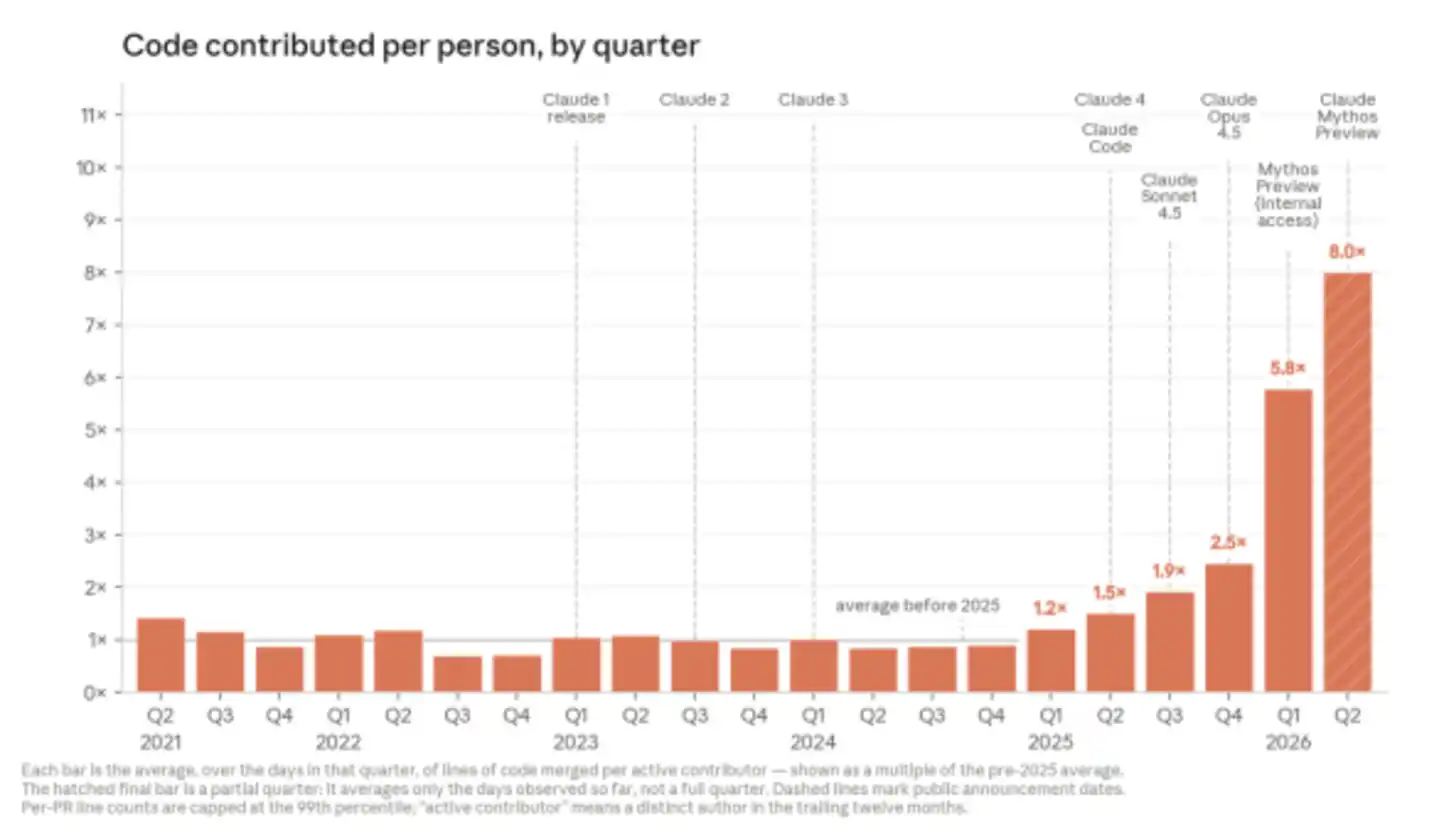
More notable than the code volume is that Claude is handling more open-ended engineering problems.

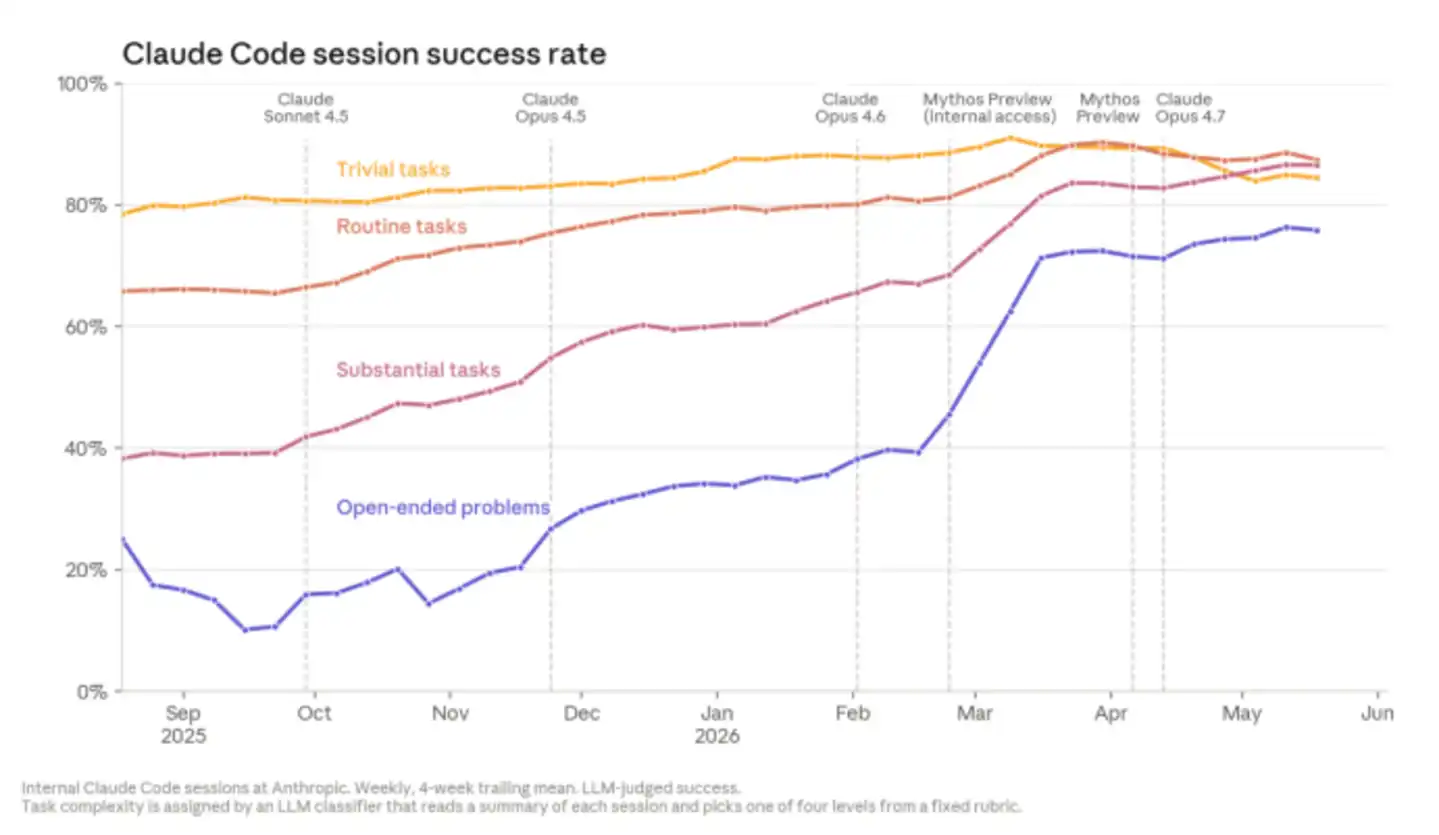
Anthropic stated in the article that over the past year, the frequency with which employees had to correct Claude, steer it back on track, or take over tasks mid-way has been steadily declining. This change is happening not only for simple tasks but also for the most complex, open-ended tasks.

So-called open-ended tasks are problems without clear instructions. For example, a system crash, a training task failure—issues where even engineers themselves don't know what the solution looks like initially and have to troubleshoot and make judgments on the fly.

These types of tasks historically relied most heavily on human experience. Yet, in those most open-ended tasks, Claude's success rate reached 76% by May 2026, a 50 percentage point increase within six months.
Not just writing code, Anthropic also uses Claude for code review—checking for bugs, security vulnerabilities, and other defects. Their retrospective analysis found that if every code change in the past had undergone automated review by Claude, approximately one-third of the bugs that caused incidents on claude.ai could have been caught before deployment.

Going a step further, Claude has begun to participate in the research process.

Anthropic has a standard test: give Claude code for training a small model and ask it to make the code run faster without altering the results. In May 2025, Claude Opus 4 could achieve about a 3x speedup; by April 2026, Claude Mythos Preview had pushed that number to approximately 52x.

Anthropic also mentioned an open-ended AI safety research case. They posed a question to a Claude-powered agent: Can a weaker model reliably supervise a stronger model?

This process involved proposing hypotheses, testing them, sharing findings with parallel agents, and iterating repeatedly.

Two human researchers spent a week bridging about 23% of the gap; Claude, with roughly 800 cumulative hours and about $18,000 in compute costs, bridged 97%.

This result certainly has limitations—the problem was chosen by humans, the scoring criteria were human-defined, and the findings haven't been fully migrated to production-scale models. But it still illustrates that Claude can now, within a research framework defined by humans, design experiments, execute them, and iterate on its own.

Furthermore, when human researchers "go down the wrong path," Claude can suggest a better next step.

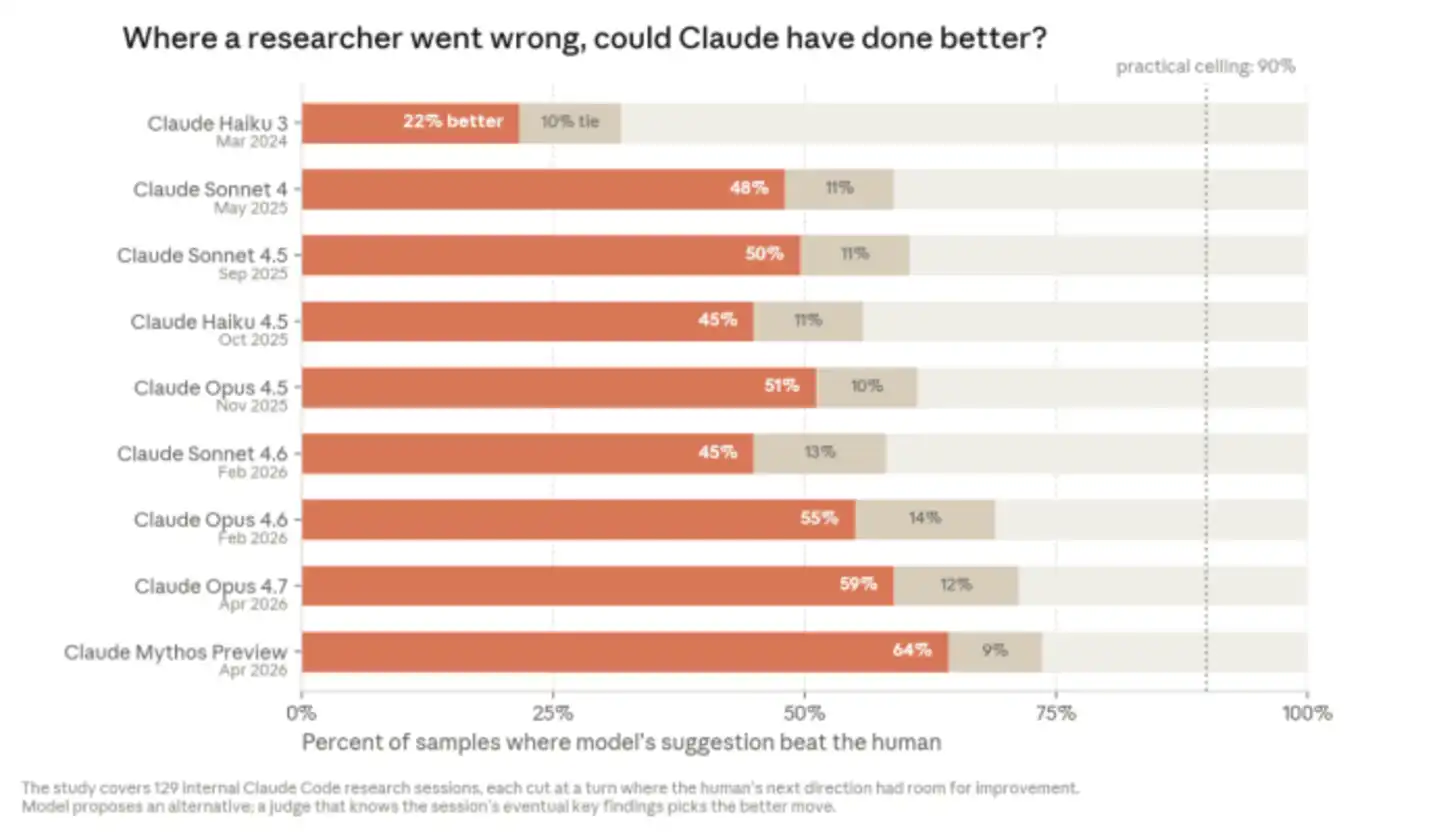
Anthropic took 129 internal Claude Code research sessions where human researchers and Claude worked together on open-ended research problems. Anthropic identified points where "the human later proved to have taken a detour," gave the context up to that point to different versions of Claude, and asked it what it would suggest doing next. Then, another Claude judge, aware of the full session outcome, judged which was better: the model's suggestion or the human's choice at the time.

The results showed that at those points where the human researcher was later shown to have had room for improvement, Claude became increasingly able to propose a better next step.
In the past, AI model progress was primarily driven by human researchers and engineers. Humans decided what experiments to run, wrote the code, trained the models, and pushed forward AI's capabilities.

Now, more and more links in this chain are being taken over by Claude.

Anthropic presented a very intuitive stage diagram:
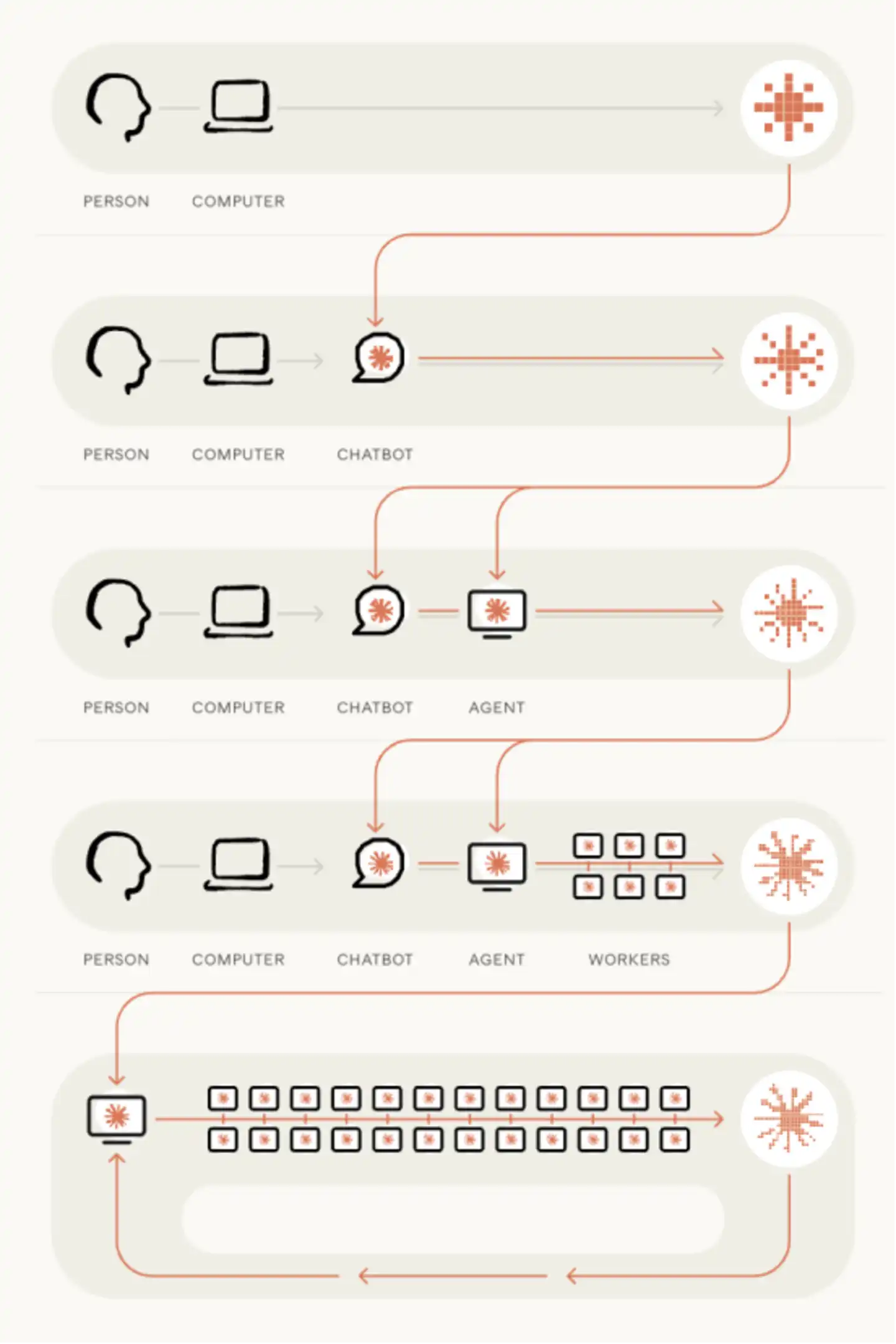
From 2021 to 2023, Anthropic was no different from a typical tech company—humans writing code and documentation on laptops.

From 2023 to 2025, chatbots began entering workflows. Engineers had models generate code snippets, then copied them into editors.

From 2025 to 2026, programming agents emerged. Claude began autonomously writing and modifying code, sometimes even completing entire files independently.

Today, agents can run code on their own and delegate hours-long work to other agents.

Looking ahead is the stage Anthropic is genuinely concerned about: the closed loop.

If this day arrives, subsequent versions of Claude might be continuously improved by Claude itself—this is recursive self-improvement.

Anthropic phrased it cautiously: we haven't reached that point yet, and recursive self-improvement isn't inevitable. But it still emphasizes that the path leading to that step is beginning to become visible.

That's why Anthropic discusses slowing down, even pausing, at the end of the article. Its meaning isn't that all AI companies should shut down immediately, but rather that if the risks of AI self-improvement continue to rise in the future, frontier labs need a coordinated, verifiable deceleration mechanism.

In other words, the "singularity" is approaching, and humanity must impose controls.

Unstoppable Claude

On the surface, this is a very forward-looking safety document. Anthropic is talking about recursive self-improvement, about AI potentially improving itself faster and faster, and about the need for human society to prepare deceleration and pause mechanisms in advance.

But placed in the context of Anthropic preparing for an IPO, this article takes on another layer of meaning.

In a way, Anthropic's recent moves resemble that annoyingly smug top student in class—it genuinely has the skills, but it's also quite pretentious.

What it wants to say isn't just "we have a very strong Claude"; a step beyond that, it wants to say "Claude is helping us build an even stronger Claude."

If Anthropic were merely selling a model or a tool, it would struggle to completely escape horizontal comparisons: Anthropic has Claude, OpenAI has GPT; Anthropic has Claude Code, OpenAI has Codex; Anthropic competes for enterprise clients, OpenAI competes for enterprise clients. The competition between the two companies is very tight, seeing who can tell the bigger story to the market.

It's worth noting that just three days ago, OpenAI wrote in a document about frontier AI governance:

"We are already seeing early signs of recursive self-improvement in today's systems: AI development itself is being accelerated by AI.

This will intensify competitive pressures among developers and nations, and create governance challenges that existing institutions are not equipped to handle."

Three days later, Anthropic says: The path for Claude towards recursive self-improvement is beginning to become visible.
If Claude develops as it hopes, this wouldn't be an ordinary product narrative—it would become a research and development flywheel.

Claude writes code, runs experiments, optimizes training processes, which in turn reduces incidents in Anthropic's own products… Once this system is up and running, Claude isn't just a product from Anthropic; it's a crucial production tool for Anthropic itself.

Users see the Claude product; enterprise customers buy Claude's capabilities. But what Anthropic truly wants the capital markets to notice is: Claude is already embedded in the underlying processes of frontier model development; it's been placed inside Anthropic's engine room.

Capital markets love flywheel stories, promising endless prosperity: A stronger Claude allows Anthropic's engineers to merge more code; more code enables faster product and infrastructure iteration; faster iteration allows researchers to run more experiments; more experiments in turn help the next generation of Claude become stronger. Once the next generation Claude is stronger, it continues to accelerate Anthropic's R&D.

Claude's iteration pace also supports this flywheel. Looking at public release timelines, from 2023 to early 2025, Claude's major model updates were mostly on a three-to-four month cycle. But with Claude 4, Anthropic's model updates have noticeably intensified.

Claude 4 was released in May 2025, Opus 4.1 in August, Sonnet 4.5 in September, Haiku 4.5 in October, Opus 4.5 in November.

In 2026, Opus 4.6 was released on February 5, Sonnet 4.6 on February 17, Opus 4.7 on April 15, and Opus 4.8 on May 28. The gap between Opus 4.7 and Opus 4.8 was only 42 days.

Anthropic, on the surface, is saying "this could be very dangerous, we need to prepare the brakes in advance," but it's simultaneously implying: "We've seen what happens when the accelerator is pressed."

The subtlety of the IPO narrative lies here. It describes the risks as significant while also elevating its own technological position.

Not every AI company is qualified to discuss recursive self-improvement. You first need to make the outside world believe your AI is already part of the AI R&D process to have the standing to say this might require global coordination.

OpenAI: How Could This Happen?

As mentioned earlier, just before Anthropic published this lengthy article, OpenAI had already put recursive self-improvement on the table.

But the two companies' narratives are quite different.

OpenAI's document, "Democratic Governance of Frontier AI," is a policy blueprint for Washington. It's concerned not with "how models get stronger," but with how to constrain frontier AI if it continues to surge ahead.

Most of the content in that report isn't suitable for detailed discussion here, but one key line stands out: OpenAI said that in today's systems, early signs of recursive self-improvement are already visible.

This line and Anthropic's lengthy article point in the same direction.

It's just that OpenAI talks about institutions, while Anthropic talks about itself.

OpenAI's point is: AI development is too fast; existing governance structures may not keep up, so a new set of rules is needed.

Anthropic directly showcases that system, telling the market: Claude is already in our R&D process, so we see the path to AI self-acceleration.

This move is quite clever. One imagines the grumbling inside OpenAI—this is practically idea theft! We were here first!

Just joking, but OpenAI really needs to step up its game and quickly bring GPT 5.6 to the table.

Pertanyaan Terkait

QWhat is the core concern of Anthropic's article 'When AI builds itself'?

AThe article's core concern is the potential for recursive self-improvement in AI, where AI begins to design, train, test, and optimize its own successor versions, potentially leading to an AI evolution that is no longer solely driven by human effort.

QWhat significant performance statistic does Anthropic cite to show Claude's growing role in AI development?

AAnthropic states that as of May 2026, over 80% of the code merged into its codebase is written by Claude.

QHow does the author interpret the timing of Anthropic's publication on AI risks?

AThe author suggests that the article, coming at the time when Anthropic is preparing for an IPO, can be seen as a narrative prelude to highlight their technological advantage, framing it as both a safety warning and a display of a powerful 'virtuous cycle' where Claude helps build a stronger Claude.

QWhat is the key difference between OpenAI's and Anthropic's approach to discussing 'recursive self-improvement'?

AOpenAI's recent document framed it as a broad governance challenge requiring new institutional rules. Anthropic's article, however, presented it through the specific lens of its own development process with Claude, showcasing internal data to illustrate the visible path towards such a capability.

QWhat future stage in AI development is Anthropic particularly worried about, as described in the article?

AAnthropic is particularly concerned about the potential arrival of a 'closed loop' stage, where a future version of Claude could continuously improve itself, leading to true recursive self-improvement.

Bacaan Terkait

43 Menit Trump: Narasi Pemimpin Kuat Tak Terkendali, Perang Media Memanas

Presiden AS Donald Trump kembali muncul di depan publik setelah menghilang lebih dari seminggu, dalam konferensi pers selama 43 menit yang dimaksudkan untuk menunjukkan kendali. Namun, pidatonya justru menyimpang ke topik-topik seperti kolam refleksi, perbandingan jumlah massa dengan Martin Luther King, serta serangan terhadap jurnalis, lawan politik, dan sejumlah kota AS. Ia menandatangani perintah eksekutif yang menghapus perlindungan jabatan bagi ribuan pegawai federal senior, berpotensi memperkuat loyalitas pribadi di atas profesionalisme. Trump secara pribadi menyerang jurnalis CNN, Kaitlan Collins, menyebutnya "penuh kebencian". Artikel ini menyoroti tekanan pada media independen, mengutip pemecatan veteran CBS Scott Pelley yang menolak campur tangan editorial untuk menyenangkan pemerintahan. Penulis menekankan pentingnya mendukung jurnalis dan media independen sebagai penjaga fakta publik ketika media arus utama menghadapi tekanan politik dan komersial. Aktivitas tiba-tiba diakhiri secara mendadak oleh stafnya, meninggalkan kesan kepanikan. Sementara itu, di tengah kekhawatiran tentang kesehatannya dan perang di Iran, empat anggota Partai Republik di DPR mendukung resolusi yang menuntut penghentian perang, menunjukkan retakan dalam dukungan partainya. Artikel ini menggambarkan penampilan Trump sebagai pertunjukan politik yang penuh kecemasan, yang mencerminkan ketegangan institusional AS: perluasan kekuasaan pribadi, pelemahan birokrasi, erosi kepercayaan media, dan penyusutan ruang fakta publik.

marsbit23m yang lalu

43 Menit Trump: Narasi Pemimpin Kuat Tak Terkendali, Perang Media Memanas

marsbit23m yang lalu

Kalshi, MTS, dan Ambisi A16Z

**Ringkasan Artikel: Kalshi, MTS, dan Ambisi a16z** Pasar prediksi (prediction market) menjadi bidang yang menarik perhatian investor, komunitas kripto, dan media pada 2025. Meski memiliki daya tarik bisnis seperti arbitrase regulasi dan potensi fee transaksi tinggi, nilai mendasarnya terletak pada kemampuannya memberikan **"rasa keberadaan" (sense of presence)**. Artikel ini menelusuri evolusi ide pasar prediksi, dari konsep Friedrich Hayek tentang pasar sebagai pengumpul pengetahuan tersebar, hingga mekanisme insentif Robin Hanson (LMSR). Namun, diskusi filosofis ini menemukan relevansi baru ketika a16z (Andreessen Horowitz) berinvestasi pada **Kalshi**, sebuah platform pasar prediksi yang kini bernilai $220 miliar. Bagi a16z, Kalshi bukan sekadar platform taruhan. Ia adalah **media baru** yang memungkinkan orang terlibat secara aktif dalam peristiwa dunia. Dengan menggunakan uang sungguhan untuk "memprediksi" hasil suatu peristiwa (politik, cuaca, berita), pengguna merasa menjadi **pengamat super** yang berpartisipasi, bukan sekadar penonton pasif. Hal ini mengatasi rasa ketidakberdayaan di era modern. Kalshi, dengan volume dan data transaksi nyata, berpotensi memberikan otoritas final atas **kebenaran** dan **pentingnya** suatu peristiwa. Ini selaras dengan ambisi a16z membangun kekaisaran media baru, seperti yang terlihat pada **MTS (Monitoring The Situation)**, media yang melakukan siaran langsung 24/7 untuk "menguasai linimasa". Kombinasi antara narasi media yang intens (seperti MTS) dan legitimasi data nyata dari pasar prediksi (Kalshi) menciptakan **medan distorsi realitas** yang kuat. Kalshi bernilai tinggi karena kemampuannya mempengaruhi persepsi publik secara halus, misalnya melalui probabilitas hasil pemilu yang diperdagangkan, sesuatu yang jarang dimiliki perusahaan swasta. Inilah inti dari ambisi media baru a16z.

marsbit2j yang lalu

Kalshi, MTS, dan Ambisi A16Z

marsbit2j yang lalu

Terbaru: Veteran Chip OpenAI Bergabung dengan Anthropic

Pelaku industri OpenAI, Clive Chan, yang dikenal sebagai karyawan nomor dua di tim perangkat keras dan terlibat dalam proyek chip buatan OpenAI, mengumumkan telah bergabung dengan Anthropic. Ia menyebut tim chip OpenAI memiliki kepadatan bakat yang luar biasa, namun dorongan untuk "mendaki gunung baru dari dasar" membawanya ke Anthropic. Chan terkesan dengan bakat, nilai, dan ambisi tim Anthropic, serta merasakan intensitas kerja yang tinggi sejak hari pertama. Ketika ditanya tentang kemajuan chip buatan OpenAI, Chan merujuk pada blog kolaborasi antara OpenAI dan Broadcom yang dirilis Oktober 2025. Menurut blog tersebut, sistem akselerator AI buatan OpenAI dengan total skala 10GW ini menargetkan penyebaran dimulai pada paruh kedua 2026, dengan pengiriman rak pertama direncanakan pada waktu tersebut. Proyek diperkirakan berlanjut hingga akhir 2029. Chan, lulusan Universitas Waterloo tahun 2021, memiliki pengalaman kerja di Google, SpaceX, Tesla (tim infrastruktur Autopilot), dan QuEra sebelum bergabung dengan OpenAI pada Januari 2024. Kepindahannya ke Anthropic disambut oleh karyawan Anthropic lainnya dan menjadi bahan komentar netizen yang menyoroti tren perpindahan bakat antara kedua perusahaan AI terkemuka ini. Sebelumnya, pada Mei, salah satu pendiri OpenAI, Andrej Karpathy, juga bergabung dengan Anthropic. Anthropic baru-baru ini mengumumkan pendanaan H senilai $650 miliar, dengan valuasi pasca-pendanaan mencapai $9,65 triliun, mendekati klub bernilai triliunan dolar. Arus bakat antara OpenAI dan Anthropic terus berlanjut, menegaskan pentingnya talenta sebagai aset inti dalam persaingan AI mutakhir.

marsbit2j yang lalu

Terbaru: Veteran Chip OpenAI Bergabung dengan Anthropic

marsbit2j yang lalu

Ambisi Kalshi, MTS, dan a16z

Pasar prediksi menjadi bidang yang menarik pada tahun 2025, menghubungkan investor dolar, komunitas kripto, dan media. Artikel ini mengeksplorasi esensi pasar prediksi dan keselarasannya dengan visi "Media Baru" a16z. Pemikiran pasar prediksi berakar dari konsep Hayek tentang penggunaan pengetahuan tersebar dalam masyarakat, yang kemudian dikembangkan oleh Robin Hanson dengan mekanisme insentif LMSR-nya. Namun, diskusi filosofis ini menemukan relevansi barunya ketika a16z berinvestasi di Kalshi, sebuah platform pasar prediksi yang valuasinya melonjak. a16z melihat nilai inti Kalshi dan pasar prediksi terletak pada penyediaan "rasa kehadiran" atau keterlibatan. Dalam dunia di mana individu sering merasa terasing dari peristiwa, pasar prediksi menawarkan cara untuk terlibat secara aktif dengan "mempertaruhkan" pandangan seseorang tentang masa depan. Keterlibatan finansial ini mengubah peserta dari pengamat pasif menjadi "pengamat super" yang merasa terhubung dan memiliki agensi. Konsep "Media Baru" a16z adalah sistem komunikasi berkecepatan tinggi yang bertujuan mendominasi narasi secara instan. Contohnya adalah MTS, media yang menyiarkan berita penting secara real-time. Namun, kekuatan sebenarnya terletak pada otoritas yang dihasilkan pasar prediksi seperti Kalshi. Harga yang dibentuk oleh uang sungguhan memberikan klaim kebenaran dan kepentingan yang sulit disangkal, menciptakan semacam "medan distorsi realitas". Inilah yang menjelaskan valuasi tinggi Kalshi: kemampuannya yang langka untuk memengaruhi persepsi realitas sebagai sebuah perusahaan swasta, menjadikannya batu penjuru penting dalam ambisi kekaisaran media baru a16z.

链捕手2j yang lalu

Ambisi Kalshi, MTS, dan a16z

链捕手2j yang lalu

Trading

Spot
Futures

Artikel Populer

Cara Membeli NIGHT

Selamat datang di HTX.com! Kami telah membuat pembelian Midnight (NIGHT) menjadi mudah dan nyaman. Ikuti panduan langkah demi langkah kami untuk memulai perjalanan kripto Anda.Langkah 1: Buat Akun HTX AndaGunakan alamat email atau nomor ponsel Anda untuk mendaftar akun gratis di HTX. Rasakan perjalanan pendaftaran yang mudah dan buka semua fitur.Dapatkan Akun SayaLangkah 2: Buka Beli Kripto, lalu Pilih Metode Pembayaran AndaKartu Kredit/Debit: Gunakan Visa atau Mastercard Anda untuk membeli Midnight (NIGHT) secara instan.Saldo: Gunakan dana dari saldo akun HTX Anda untuk melakukan trading dengan lancar.Pihak Ketiga: Kami telah menambahkan metode pembayaran populer seperti Google Pay dan Apple Pay untuk meningkatkan kenyamanan.P2P: Lakukan trading langsung dengan pengguna lain di HTX.Over-the-Counter (OTC): Kami menawarkan layanan yang dibuat khusus dan kurs yang kompetitif bagi para trader.Langkah 3: Simpan Midnight (NIGHT) AndaSetelah melakukan pembelian, simpan Midnight (NIGHT) di akun HTX Anda. Selain itu, Anda dapat mengirimkannya ke tempat lain melalui transfer blockchain atau menggunakannya untuk memperdagangkan mata uang kripto lainnya.Langkah 4: Lakukan trading Midnight (NIGHT)Lakukan trading Midnight (NIGHT) dengan mudah di pasar spot HTX. Cukup akses akun Anda, pilih pasangan perdagangan, jalankan trading, lalu pantau secara real-time. Kami menawarkan pengalaman yang ramah pengguna baik untuk pemula maupun trader berpengalaman.

591 Total TayanganDipublikasikan pada 2025.12.08Diperbarui pada 2026.06.02

Cara Membeli NIGHT

Diskusi

Selamat datang di Komunitas HTX. Di sini, Anda bisa terus mendapatkan informasi terbaru tentang perkembangan platform terkini dan mendapatkan akses ke wawasan pasar profesional. Pendapat pengguna mengenai harga NIGHT (NIGHT) disajikan di bawah ini.

活动图片