Claude Bill Skyrockets by 5 Billion, Surges 60-Fold Overnight—Can Your Token Budget Keep Up?

marsbitDipublikasikan tanggal 2026-06-01Terakhir diperbarui pada 2026-06-01

Abstrak

An enterprise reportedly ran up a staggering $500 million bill on Anthropic's Claude AI in just one month due to a simple oversight: failing to set usage limits for employee accounts. This incident highlights a growing trend of runaway AI costs. Other examples include a Google Cloud user hit with an unexpected $18,000 bill from API key abuse, and an OpenAI internal experiment that consumed 603 billion tokens, costing $1.3 million in 30 days. Major AI providers like OpenAI and GitHub are shifting from flat monthly fees to granular, usage-based pricing (per input/output/cached token), causing shock for some users whose costs skyrocketed by orders of magnitude. The root causes extend beyond pricing. The rise of autonomous AI agents executing long, complex tasks has drastically increased token consumption. Furthermore, misaligned incentives, like internal "leaderboards" ranking employees by AI usage, can encourage wasteful "tokenmaxxing"—using powerful models for trivial tasks just to inflate metrics. This has sparked a new industry focused on cost optimization. Solutions include providing AI with better context (reducing redundant searches) and intelligent model routing (matching tasks to the most cost-effective model). Research indicates token consumption for agentic tasks can vary wildly (up to 30x for the same job) without guaranteeing better results, and models often underestimate their own costs. As AI expenses begin to rival or even surpass human labor costs for some t...

A $500 Million Bill in Just 1 Month!

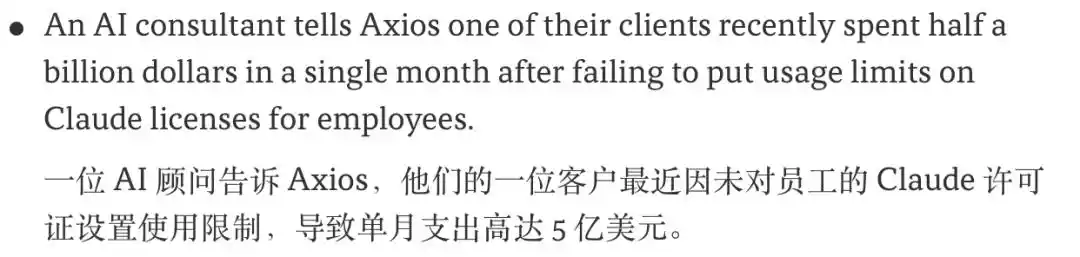
Recently, a shocking blunder erupted in the tech world. According to Axios, a company actually managed to rack up a $500 million bill on Claude in just one month!

The reason is laughable: management forgot to set usage limits when granting employees access to Claude accounts.
In fact, this isn't the only case of AI bills exploding.

In April, a Google Cloud user, whose publicly accessible API key was misused, received a bill for $18,000 overnight, despite having only a $7 budget set.

The unlucky user, Jesse Davies, is an Australian AI consultant and founder of Agentic Labs. He had set up two safeguards for his Google Cloud account: a A$10 (about $7) budget alert and a hard spending cap of $1,400.

As reported by Tom's Hardware, attackers discovered a Cloud Run service he had deployed months earlier from AI Studio, sending over 60,000 requests. Both safeguards failed: there was a delay in billing calculations, and by the time the system reacted, the amount had skyrocketed to $18,000.

In mid-May, Peter Steinberger, founder of the open-source project OpenClaw, posted a screenshot on X: a $1.3 million OpenAI API bill for 30 days.
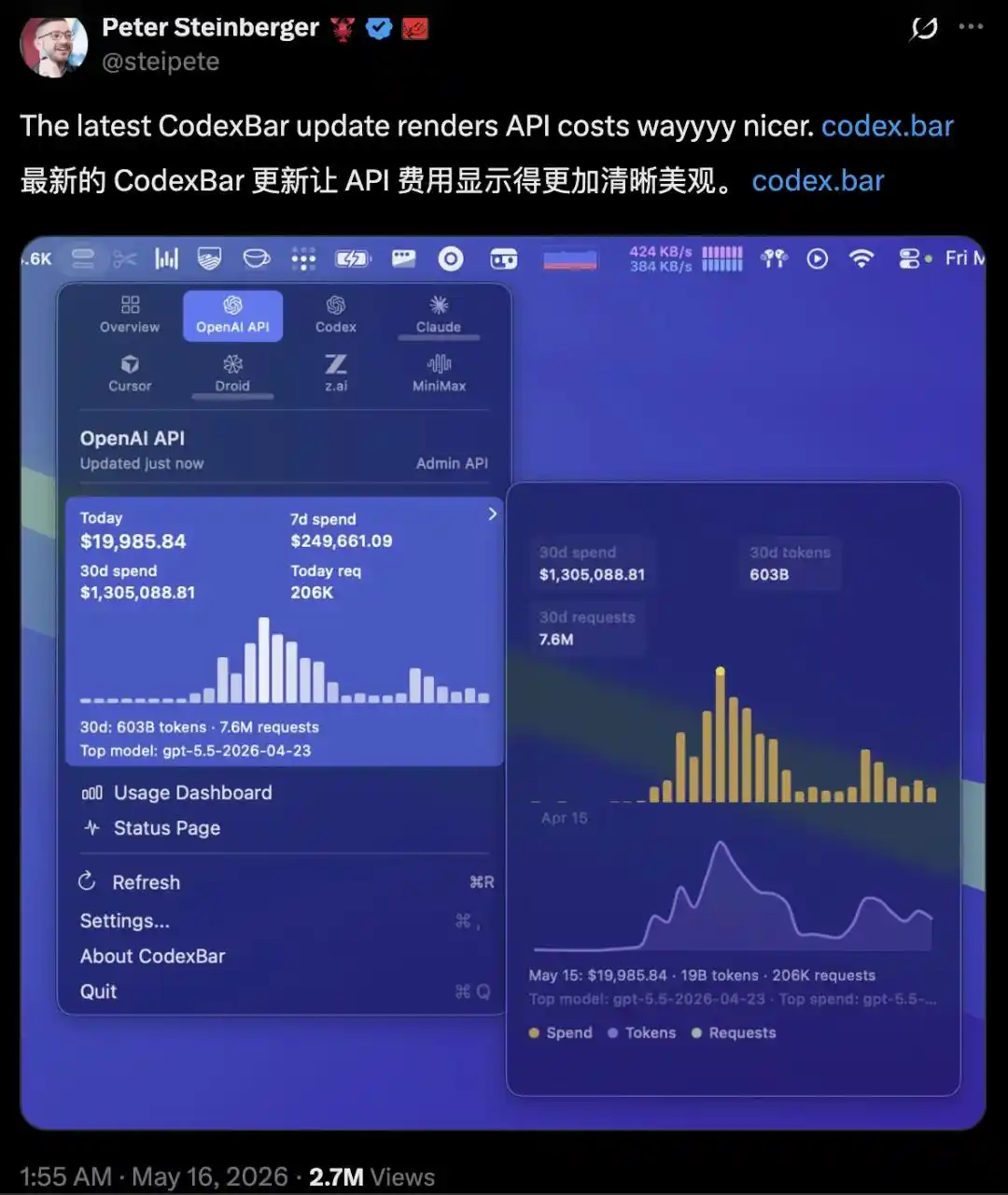
His team has only three people, but they orchestrated 100 Codex agents running in parallel: burning through 603 billion Tokens and making 7.6 million requests in 30 days. Fortunately, he didn't have to foot this $1.3 million bill himself.

Steinberger joined OpenAI this past February, and this $1.3 million was treated as an internal experiment:

to test the absolute limits of AI programming when token cost is not a consideration. He added that this was the result of Codex's "Fast Mode" (higher-tier billing); turning it off reduced the cost to about $300,000.

Even earlier, Uber's CTO Praveen Neppalli Naga had admitted to The Information that the company had exhausted its annual Claude Code budget by April, and their COO also publicly stated that AI costs were becoming increasingly "hard to justify."

$500 million, $1.3 million, $18,000—though these figures differ by orders of magnitude, they point to the same reality:

In the age of agents, any one of these—a compromised key, an army of agents running 24/7, or an account with forgotten limits—can blow up your token bill overnight.

Why Do AI Bills Explode?

The answer lies mainly in the shift in billing methods.

Starting April this year, OpenAI began transitioning from monthly flat fees to usage-based billing by Token.

On April 2, Codex billing shifted from per-message estimates to alignment with actual Token usage: Input, Cached Input, and Output Tokens are billed separately. On April 23, this rule was extended to all Enterprise, Edu, Health, and Gov plans: the invisible discount within the monthly fee was removed.

GitHub followed closely, just announcing: all Copilot plans will switch to usage-based billing effective June 1, 2026. The old premium request logic is scrapped, replaced with AI credits, settled based on actual consumption of Input, Output, and Cached Tokens against each model's API rate.
GitHub officially explained the reason for this change:

Currently, a quick chat question and a multi-hour autonomous coding task cost the user the same amount. GitHub has been subsidizing the heavy users, but this model is no longer sustainable.

Before the rise of AI agents, the costs of chat and completions were similar, and monthly fees could cover them.

After agents rose, a single task could run for hours and modify entire codebases, creating a cost difference of orders of magnitude between heavy and light users. The flat monthly fee model collapses in the face of such disparity.

The news sparked an uproar on Reddit and X.

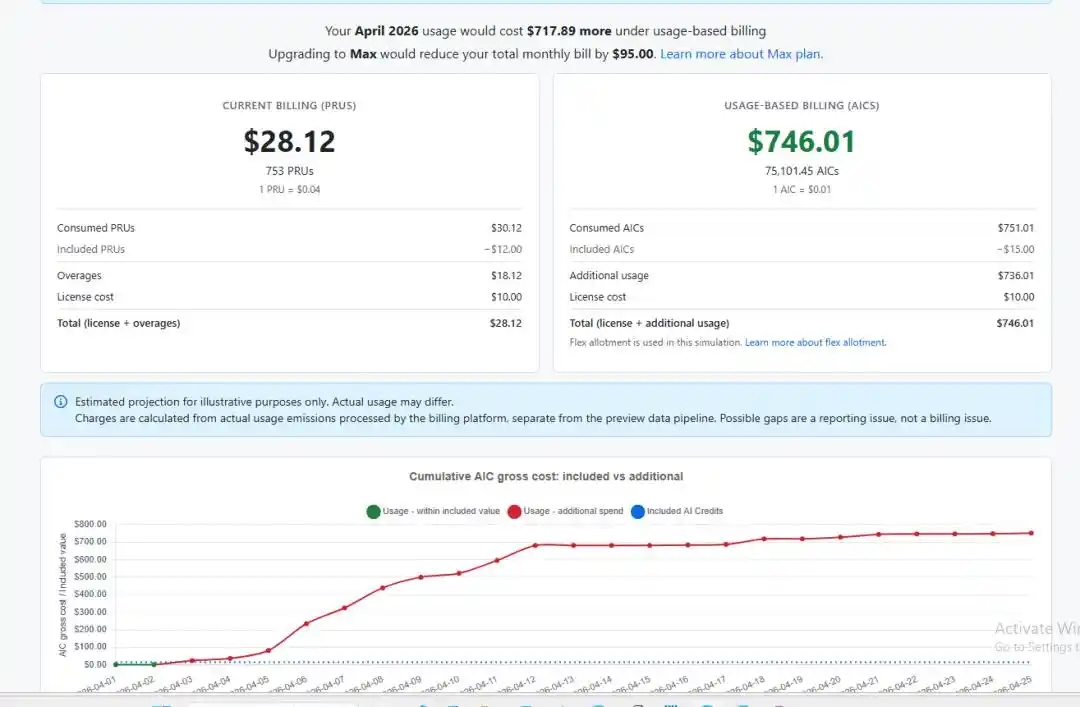
A developer with the ID JBusu shared a screenshot of their bill, bluntly calling the new pricing "a joke." Their previous monthly cost of $28.12 would become $746.01 under the new system. They've decided to cancel, "At this price, I could rent a cloud server myself and it would be cheaper."

Another user shared an even more extreme screenshot, showing costs soaring from $50 to $3,000. They said they never expected pricing to be this outrageous, "Is anyone still subscribing?"
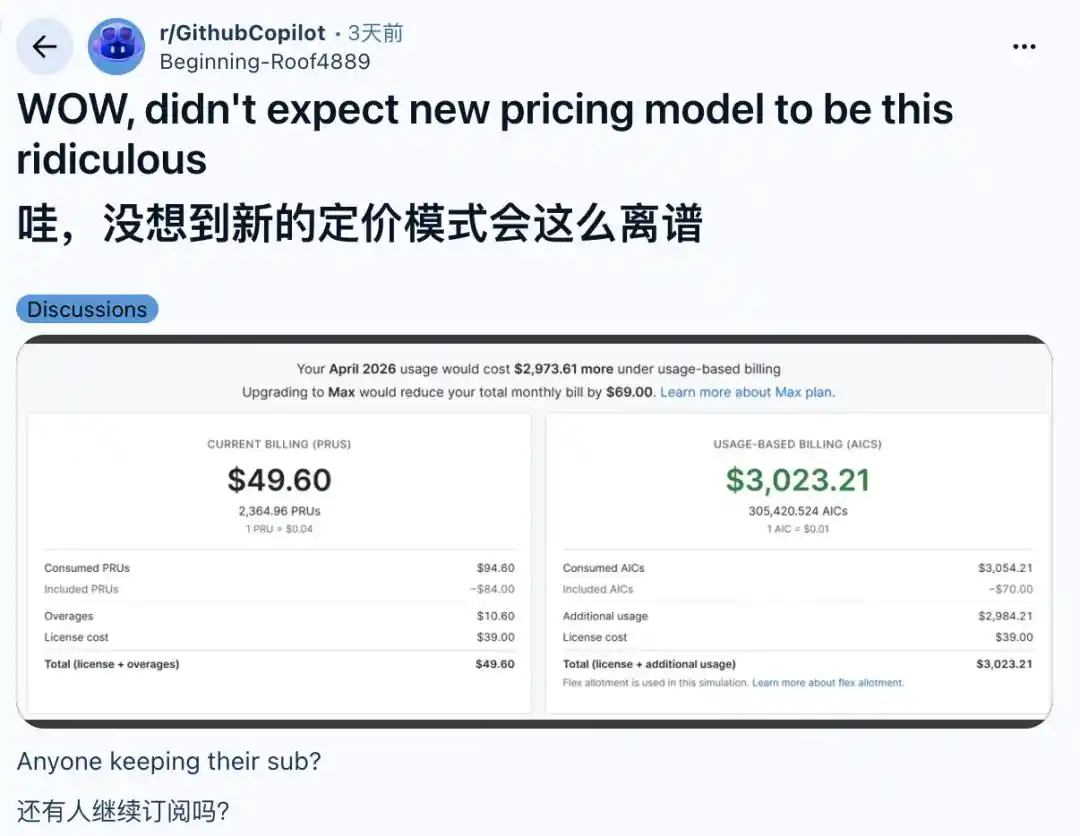
However, some veteran Copilot users countered: these extreme bills are likely burned by "vibe-coders" who aren't mindful of token usage and may not represent normal use.

One veteran user commented: "I use it all day long and rarely exceed limits by month-end. It's hard to believe this is due to differences in task complexity." Another was more direct: "It's people wanting fully automated YOLO-mode development, letting AI run wild. Culling this waste is actually good for everyone else."

One thing is clear: GitHub hasn't abolished monthly fees; the base subscription price remains unchanged. What has changed is that extra usage, agent tasks, and calls to more expensive models now fall under usage-based billing.

The hardest hit are those heavy agent users who rely on Copilot for long-chain tasks.

The Leaderboard Gamed by Its Own Users

The collapse of flat fees is partly due to platforms changing their billing rules, and partly because AI users themselves are burning through tokens.

In May, Business Insider reported that Amazon took down an internal AI usage leaderboard called KiroRank.

The report cited insiders saying the leaderboard quietly encouraged a strange work style: some employees, to climb the ranks, would burn tokens on tasks that didn't solve actual problems, purely for ranking.
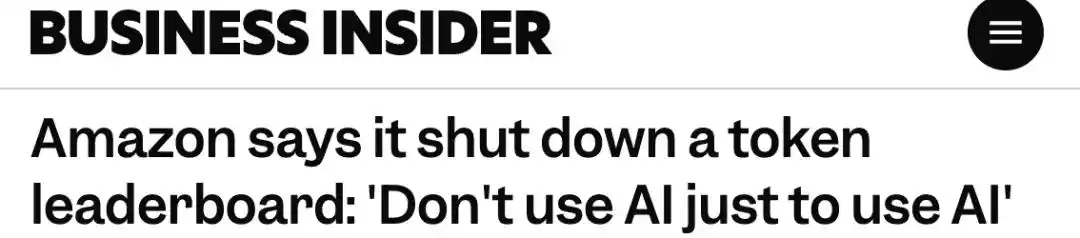
After the story broke, Amazon SVP Dave Treadwell directly addressed all employees: "Don't use AI for the sake of using AI. Use it to solve customer problems, business problems, to innovate."

Though absurd, this is hardly surprising. When "burning tokens" gets you on a leaderboard, employees will naturally burn tokens.

Silicon Valley has coined a term for this phenomenon: Tokenmaxxing—treating consumption volume as productivity.

Axios's report also mentioned CTOs discovering employees using cutting-edge AI models to check the weather or write routine emails—trivial tasks that, when run on the most expensive frontier models, can silently send bills soaring.

KiroRank wasn't part of Amazon's official evaluation system but an informal tool built by employees. Yet it clearly exposes a classic management principle: when KPIs are set wrong, people will use the cleverest ways to game the system.

Equating "how much was used" with "how well it was done"—this is the systemic root of this wave of AI waste.

Those Who Count Tokens Are Already Making Money

On the flip side of token bill anxiety, some are quietly turning it into a business.

First approach: Feed the AI with context.

Glean is actually Arvind Jain's own company. It builds an enterprise AI work assistant: unifying knowledge scattered across a company, giving employees' AI direct context so they don't have to dig around. The AI takes fewer detours, naturally burning fewer tokens.

This mechanism helped Glean's annual revenue triple in 15 months, crossing $300 million, with clients including Databricks, Reddit, and Samsung.

Second approach: Delegate tasks to the right model.

This is what model routing startup Factory AI does: automatically routing each task to the most suitable model, cheap ones for simple tasks, top-tier for complex ones. Arvind also noted: Do routing right, and you can save 10x.

Both paths lead to the same destination: Let AI work, but don't let it burn money indiscriminately.

Academic research is also laying the groundwork for this shift.
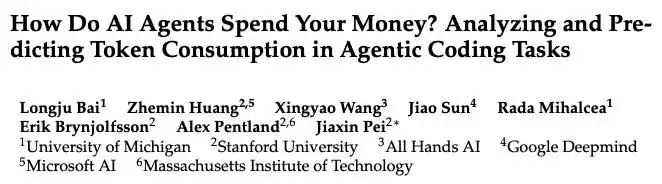
https://arxiv.org/pdf/2604.22750

An arXiv paper from April 2026 systematically broke down how agent coding tasks actually burn money for the first time.

Conclusion One: Token consumption for agent tasks can be thousands of times higher than ordinary code reasoning or code chat, with Input Tokens being the main cost driver.

Conclusion Two: Running the same task multiple times can result in a 30x difference in Token consumption.

Conclusion Three: Higher Token consumption does not necessarily lead to higher accuracy. Accuracy often peaks at medium cost—burning more beyond that spends money without yielding better results.

The paper also found that even frontier models can't reliably predict their own token consumption, generally underestimating the real cost.

You think spending more gets more done. In reality, money is spent, the work isn't necessarily better, and the budget is still unpredictable.

When AI Bills Start Rivaling Labor Costs

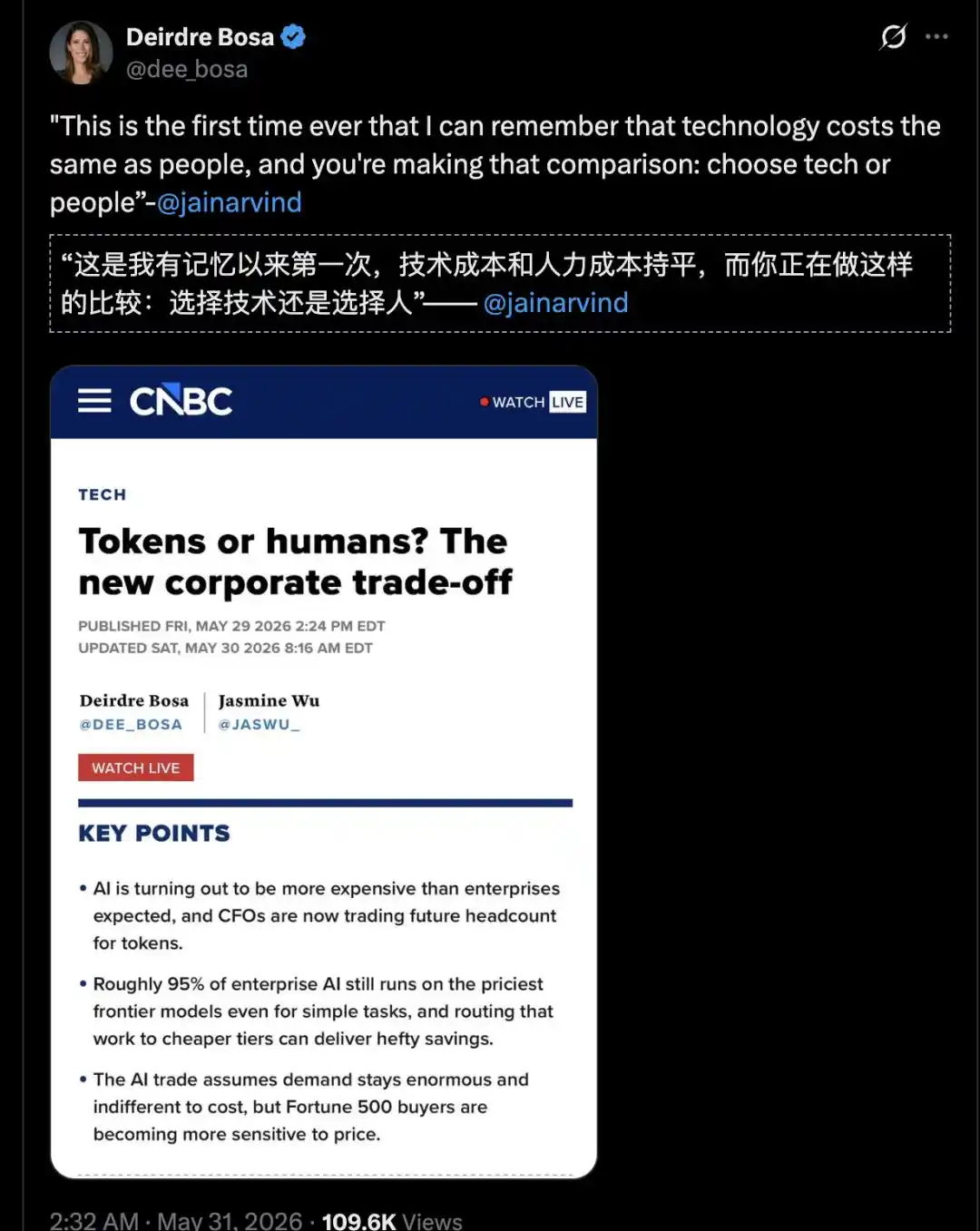
"This is the first time in my memory that technology costs are starting to be on par with human costs."

On May 29, Glean CEO Arvind Jain said this in an interview with CNBC's Deirdre Bosa.
Observations from Nvidia's Vice President of Applied Deep Learning, Bryan Catanzaro, corroborate this.

He mentioned in an Axios interview that for his team, compute costs far exceed employee salaries.

Similar trends are emerging across multiple companies: from enterprise AI player Glean, to AI compute seller Nvidia, to AI user Uber—all are re-evaluating this equation.

In Arvind's view, historically, technology was just a small slice of overall corporate costs. But now, AI costs are catching up to payrolls. Many companies' annual AI budgets are often burned through in just one or two months.

Over the past year, AI usage rate was a worshipped metric: more usage meant being advanced, burning tokens meant embracing the future. Now, many companies are reflecting on that simple question: What exactly did all those burned tokens buy?

The window of free or flat-rate unlimited usage is precisely closing at this moment.

Going forward, the question facing all developers is this: How to budget meticulously and maximize the value of every single Token.

Undoubtedly, the true winners of the future will be those who learn to count tokens first.

References:

https://x.com/dee_bosa/status/2060791500049613306%20

https://www.cnbc.com/2026/05/29/-tokens-or-humans-the-new-corporate-trade-off.html%20

https://www.axios.com/2026/05/28/ai-spending-roi-enterprise-costs%20

https://www.businessinsider.com/amazon-ai-leaderboard-tokenmaxxing-2026-5

This article is from the WeChat public account "AI Era Insights", author: ASI启示录

Pertanyaan Terkait

QWhat is the main reason behind the dramatic increase in AI usage costs as discussed in the article?

AThe primary reason is the shift from flat-rate monthly subscription models to consumption-based pricing (charging per Token used). This change, implemented by companies like OpenAI and GitHub, means that intensive AI agent tasks, which can consume orders of magnitude more tokens than simple chats or completions, now incur significantly higher costs.

QWhat incident involving a leaked API key led to a massive unexpected bill, and how much was it?

AAn Australian AI consultant named Jesse Davies had a Google Cloud API key exposed from a public service. Attackers used it to make over 60,000 requests, resulting in a bill of $18,000, despite him having set a budget alert and a hard spending limit.

QWhat does the term 'Token maxxing' refer to in the context of corporate AI use?

A'Token maxxing' refers to the practice of employees excessively consuming AI tokens, not to solve real problems, but to climb internal usage leaderboards (like Amazon's KiroRank) or meet misguided productivity KPIs that equate high token usage with good performance.

QWhat was the key finding of the April 2026 arXiv paper regarding AI agent coding tasks and cost?

AThe key finding was that AI agent tasks can consume up to a thousand times more tokens than standard code reasoning/dialogue, primarily due to input tokens. Crucially, higher token consumption does not necessarily lead to higher accuracy, with performance often plateauing at a medium cost level.

QAccording to the article, what are the two main business approaches emerging to help manage and reduce AI token costs?

A1. Providing context to AI: Companies like Glean build systems that give AI assistants direct access to relevant company knowledge, reducing the need for lengthy searches and context-building, thus saving tokens. 2. Model routing: Startups like Factory AI automatically route tasks to the most cost-appropriate AI model (e.g., simple tasks to cheaper models, complex ones to top-tier models), potentially saving up to 10x in costs.

Bacaan Terkait

Ambisi Kalshi, MTS, dan a16z

Pasar prediksi menjadi bidang yang menarik pada tahun 2025, menghubungkan investor dolar, komunitas kripto, dan media. Artikel ini mengeksplorasi esensi pasar prediksi dan keselarasannya dengan visi "Media Baru" a16z. Pemikiran pasar prediksi berakar dari konsep Hayek tentang penggunaan pengetahuan tersebar dalam masyarakat, yang kemudian dikembangkan oleh Robin Hanson dengan mekanisme insentif LMSR-nya. Namun, diskusi filosofis ini menemukan relevansi barunya ketika a16z berinvestasi di Kalshi, sebuah platform pasar prediksi yang valuasinya melonjak. a16z melihat nilai inti Kalshi dan pasar prediksi terletak pada penyediaan "rasa kehadiran" atau keterlibatan. Dalam dunia di mana individu sering merasa terasing dari peristiwa, pasar prediksi menawarkan cara untuk terlibat secara aktif dengan "mempertaruhkan" pandangan seseorang tentang masa depan. Keterlibatan finansial ini mengubah peserta dari pengamat pasif menjadi "pengamat super" yang merasa terhubung dan memiliki agensi. Konsep "Media Baru" a16z adalah sistem komunikasi berkecepatan tinggi yang bertujuan mendominasi narasi secara instan. Contohnya adalah MTS, media yang menyiarkan berita penting secara real-time. Namun, kekuatan sebenarnya terletak pada otoritas yang dihasilkan pasar prediksi seperti Kalshi. Harga yang dibentuk oleh uang sungguhan memberikan klaim kebenaran dan kepentingan yang sulit disangkal, menciptakan semacam "medan distorsi realitas". Inilah yang menjelaskan valuasi tinggi Kalshi: kemampuannya yang langka untuk memengaruhi persepsi realitas sebagai sebuah perusahaan swasta, menjadikannya batu penjuru penting dalam ambisi kekaisaran media baru a16z.

链捕手8m yang lalu

Ambisi Kalshi, MTS, dan a16z

链捕手8m yang lalu

Mengungkap Kebenaran tentang Bisnis, Pembayaran, dan Infrastruktur Agent

Setahun terakhir, penulis fokus membangun infrastruktur untuk ekonomi Agen, berbicara dengan banyak perusahaan besar dan startup. Kesimpulannya, permintaan riil untuk perdagangan berbasis Agen saat ini masih sangat terbatas, dengan banyak kendala struktural. Di sisi **Agen ke Merchant**, pengalaman belanja via chatbot masih kalah dari e-commerce tradisional untuk kebanyakan produk, kecuali untuk pembelian rutin seperti pesan makanan. Minat merchant saat ini lebih bersifat defensif (optimasi untuk Agen) daripada kebutuhan mendesak. Di sisi **Agen ke API**, kebutuhan pembayaran mikro untuk panggilan API sudah bisa ditangani dengan metode prabayar. Peluang baru ada di pasar ekor panjang di luar penyedia layanan developer utama, namun skalanya terbatas. **Agen ke Agen** masih merupakan visi jangka panjang tanpa volume transaksi nyata, meskipun berpotensi besar di masa depan dengan karakteristik transaksi yang unik. **Agen ke Finansial** adalah satu-satunya kategori dengan permintaan jelas dan pelanggan yang sudah ada, seperti di manajemen investasi dan DeFi, meskipun persaingannya ketat. Intinya, perusahaan besar membangun infrastruktur sebagai investasi jangka panjang. Namun untuk startup, tantangan sebenarnya bukan sekadar membangun lapisan pembayaran, tetapi menyelesaikan masalah koordinasi yang lebih besar antara Agen dan manusia. Solusi koordinasi inilah yang nantinya akan mendorong kebutuhan penyelesaian dan pembayaran.

marsbit10m yang lalu

Mengungkap Kebenaran tentang Bisnis, Pembayaran, dan Infrastruktur Agent

marsbit10m yang lalu

Pasar Saham AS Alami Jatuhnya Terberat Sejak 2025, Tiga Pemicu Meledakkan Penilaian Ulang Valuasi Saham Teknologi

Pasar saham AS mengalami keruntuhan terburuk sejak krisis tarif April 2025 pada 5 Juni. Indeks Nasdaq anjlok 4,18%, S&P 500 turun 2,64%, dan Dow Jones merosot 695 poin. Tiga pemicu utama diidentifikasi: 1. Laporan keuangan Broadcom mengisyaratkan kemungkinan perlambatan dalam pertumbuhan pendapatan chip AI kuartal depan, memicu kepanikan dan penjualan luas di seluruh sektor semikonduktor. Indeks Philadelphia Semiconductor terjun 10,26%. 2. Data tenaga kerja AS (NFP) bulan Mei jauh melampaui ekspektasi (172.000 vs 80.000), memperkuat kekhawatiran bahwa Federal Reserve mungkin tidak akan menurunkan suku bunga dan bahkan berpotensi menaikkannya. Ekspektasi kenaikan suku bunga melonjak di pasar. 3. Bayangan perang Iran dan harga minyak tinggi yang terus-menerus (WTI > $90) memperumit perang Fed melawan inflasi, menambah tekanan pada pasar. Ketiga faktor ini bersama-sama menggoyang narasi dasar pasar: pertumbuhan AI tanpa batas, likuiditas mudah dari Fed, dan inflasi yang telah terkendali. Keruntuhan dengan cepat menyebar ke pasar global di Asia dan Eropa. Apakah ini awal pecahnya gelembung AI? Analisis menunjukkan ini lebih sebagai penyesuaian penilaian ulang (valuasi) daripada keruntuhan narasi sepenuhnya. Permintaan chip AI tetap kuat (pertumbuhan 143% Broadcom), tetapi pasar menjadi lebih realistis mengenai kecepatan pertumbuhan dan harga yang bersedia dibayar. Arah pasar selanjutnya akan bergantung pada pertemuan FOMC Juni, panduan dari perusahaan AI lainnya seperti Nvidia, dan perkembangan situasi di Iran.

marsbit4j yang lalu

Pasar Saham AS Alami Jatuhnya Terberat Sejak 2025, Tiga Pemicu Meledakkan Penilaian Ulang Valuasi Saham Teknologi

marsbit4j yang lalu

Trading

Spot
Futures

Artikel Populer

Cara Membeli BILL

Selamat datang di HTX.com! Kami telah membuat pembelian Billions Network (BILL) menjadi mudah dan nyaman. Ikuti panduan langkah demi langkah kami untuk memulai perjalanan kripto Anda.Langkah 1: Buat Akun HTX AndaGunakan alamat email atau nomor ponsel Anda untuk mendaftar akun gratis di HTX. Rasakan perjalanan pendaftaran yang mudah dan buka semua fitur.Dapatkan Akun SayaLangkah 2: Buka Beli Kripto, lalu Pilih Metode Pembayaran AndaKartu Kredit/Debit: Gunakan Visa atau Mastercard Anda untuk membeli Billions Network (BILL) secara instan.Saldo: Gunakan dana dari saldo akun HTX Anda untuk melakukan trading dengan lancar.Pihak Ketiga: Kami telah menambahkan metode pembayaran populer seperti Google Pay dan Apple Pay untuk meningkatkan kenyamanan.P2P: Lakukan trading langsung dengan pengguna lain di HTX.Over-the-Counter (OTC): Kami menawarkan layanan yang dibuat khusus dan kurs yang kompetitif bagi para trader.Langkah 3: Simpan Billions Network (BILL) AndaSetelah melakukan pembelian, simpan Billions Network (BILL) di akun HTX Anda. Selain itu, Anda dapat mengirimkannya ke tempat lain melalui transfer blockchain atau menggunakannya untuk memperdagangkan mata uang kripto lainnya.Langkah 4: Lakukan trading Billions Network (BILL)Lakukan trading Billions Network (BILL) dengan mudah di pasar spot HTX. Cukup akses akun Anda, pilih pasangan perdagangan, jalankan trading, lalu pantau secara real-time. Kami menawarkan pengalaman yang ramah pengguna baik untuk pemula maupun trader berpengalaman.

197 Total TayanganDipublikasikan pada 2026.05.07Diperbarui pada 2026.06.02

Cara Membeli BILL

Diskusi

Selamat datang di Komunitas HTX. Di sini, Anda bisa terus mendapatkan informasi terbaru tentang perkembangan platform terkini dan mendapatkan akses ke wawasan pasar profesional. Pendapat pengguna mengenai harga BILL (BILL) disajikan di bawah ini.

活动图片