Hoskinson Warns Cardano Could Lose Its ‘Science Coin’ Edge

bitcoinistDipublikasikan tanggal 2026-05-21Terakhir diperbarui pada 2026-05-21

Abstrak

Charles Hoskinson warns that Cardano risks losing its identity as the "science coin" if DReps fail to approve a key research funding proposal. He explains the ecosystem is in "treasury season" with a tougher funding environment, requesting $52 million this year versus $98 million last year, leading to cuts and layoffs. Hoskinson argues Cardano's research program is its "spine and backbone," responsible for its differentiation through work on proof-of-stake, extended UTXO, Plutus, and academic collaborations. He rejects calls to selectively fund parts of the research group, warning that treating researchers as commodities could lead to an irreplaceable talent drain to better-funded rivals. Hoskinson ties research funding to Cardano's long-term investment case, stating that without it, the project would lose a core value proposition. He ends with a direct appeal to DReps to vote for the proposal, calling it a necessary foundation for Cardano's future.

Charles Hoskinson has urged Cardano DReps to back a research funding proposal, warning that a failure to do so could damage one of the network’s core value propositions: its identity as a research-led blockchain.

Speaking in a May 21 livestream from England, Hoskinson said Cardano is in “treasury season” and facing a tougher funding environment than last year. According to him, the ecosystem is asking for about $52 million in funding this year, down from roughly $98 million last year, after cuts that have already affected engineers and community teams.

“Many people have had to make profound sacrifices,” Hoskinson said. “Good people have had to go. Engineers have been let go. Community teams liquidating familiar faces and new faces alike.”

But the proposal that drew his strongest concern was research. Hoskinson said he had seen a “disturbing trend” of some DReps voting against funding Cardano’s research group, despite what he described as its foundational role in the network’s development.

Hoskinson Defends Cardano’s Research Core

Hoskinson framed the debate as larger than a budget dispute. In his view, Cardano’s long-running research program is the “spine and backbone” of the ecosystem and a key reason the project has differentiated itself from other major blockchains.

“The spine and backbone of what makes Cardano Cardano has always been and will always be the fact that we’re the science coin,” he said. “We’re the research coin. Over the last 10 years, hundreds of millions of dollars has been spent, and countless hundreds of researchers have been involved in the production of the largest research group in the world for cryptocurrencies.”

He pointed to Cardano’s work on proof-of-stake research, extended UTXO, Plutus, sidechains and Bitcoin-related DeFi research as examples of the group’s output. He also argued that the network’s academic ties, spanning institutions such as Stanford, the University of Edinburgh, the University of Wyoming and others, are not easily replaceable.

Hoskinson said critics of the proposal have argued that research funding should be broken apart, allowing the ecosystem to “pick and choose” which areas or people to keep. He rejected that framing, saying it would force the ecosystem into decisions it is not equipped to make without damaging the research operation as a whole.

“So then I asked the DReps, which scientists would you like me to fire?” he said, before naming several researchers associated with Cardano’s technical development. “And if not people, perhaps institutions. Which institutions would you like to shut down? And because you’re so qualified, which research agendas do you so feel are unnecessary?”

Warning Over Talent Flight

A major part of Hoskinson’s argument was that Cardano’s researchers could be recruited by better-funded rival ecosystems if the project signals that their work is no longer valued. He said other blockchains with large treasuries would likely be interested in the same cryptographers, programming language experts and distributed systems researchers.

“If you treat these people like commodities, they will leave,” Hoskinson said. “They’ll leave to other ecosystems that have a lot more money and are willing to pay a lot more with better stability and certainty.”

He warned that the loss would not be easily reversible. Academic and technical talent, he argued, depends on long-term stability, and once researchers move on to other ecosystems, Cardano may not be able to bring them back. “We can’t recover this. It’s a one-way door. If you lose your best and brightest, we won’t get them back. We don’t get to say we’re sorry.”

Hoskinson also tied the issue to market perception. He asked what Cardano’s investment case would look like over the next three to five years if the ecosystem signaled it was no longer willing to support research. Without that layer, he suggested, Cardano would have to lean more heavily on metrics such as monthly active users, TVL or transaction volume.

The livestream ended as a direct appeal to DReps who have not yet voted and to those who have voted against the proposal. Hoskinson asked them to reconsider, saying research funding is not a discretionary line item but part of Cardano’s long-term competitive position.

“You can’t walk without a spine,” he said. “Please vote for science. Please vote for the research proposal for IOG. It’s a necessary foundational proposal, and we can’t afford to lose it.”

At press time, ADA traded at $0.2499.
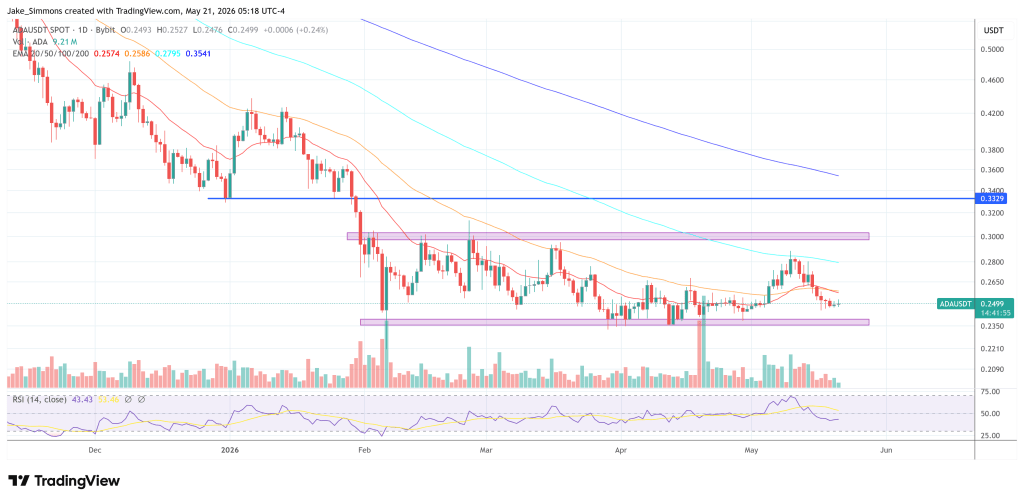
ADA remains in sideways trend, 1-day chart | Source: ADAUSDT on TradingView.com

Pertanyaan Terkait

QAccording to Hoskinson, what is the core identity of Cardano that is at risk?

AAccording to Hoskinson, Cardano's core identity at risk is being the 'science coin' or the research-led blockchain, which he describes as the 'spine and backbone' of the ecosystem.

QWhat is the potential consequence if Cardano's DReps vote against the research funding proposal, as warned by Hoskinson?

AHoskinson warns that voting against the research funding could lead to a talent flight, where Cardano's researchers would leave for better-funded rival ecosystems. This loss would be irreversible and would damage Cardano's long-term competitive position and investment case.

QHow much funding is the Cardano ecosystem asking for this year, and how does it compare to last year?

AThe Cardano ecosystem is asking for about $52 million in funding this year, which is down from roughly $98 million last year.

QWhat examples does Hoskinson give to demonstrate the output of Cardano's research group?

AHoskinson points to Cardano's work on proof-of-stake research, extended UTXO, Plutus, sidechains, and Bitcoin-related DeFi research as examples of the research group's output.

QWhat does Hoskinson say critics of the research funding proposal have argued, and how does he respond?

AHoskinson says critics argue that research funding should be broken apart, allowing the ecosystem to 'pick and choose' which areas or people to fund. He rejects this, stating it would force the ecosystem into decisions it is not equipped to make and would damage the research operation as a whole, challenging critics to name which specific scientists or institutions they would cut.

Bacaan Terkait

ViaBTC CEO Yang Haipo: Melihat Kembali Satu Dekade, Memahami Kembali Nilai Crypto

CEO ViaBTC Yang Haipo: Sepuluh Tahun Melihat Kembali, Memahami Ulang Nilai Crypto Dunia crypto telah berkembang pesat dalam dekade terakhir, dari komunitas kecil menjadi ekosistem yang mempengaruhi keuangan tradisional. Inti nilainya bukan hanya pada volatilitas harga, tetapi pada kemampuan untuk menulis ulang infrastruktur keuangan secara fundamental — seperti market-making, perdagangan, dan penyelesaian — menjadi terbuka dan dapat diakses oleh siapa saja. Spekulasi telah menjadi "bahan bakar" yang memungkinkan inovasi dan iterasi cepat, tetapi sering kali menutupi permintaan nyata. Sering kali, aktivitas yang tampak seperti adopsi massal ternyata hanya didorong oleh ekspektasi keuntungan jangka pendek. Di balik semua itu, nilai crypto harus diuji berdasarkan pengguna nyata, pendapatan protokol, dan arus kas yang sebenarnya. Membedakan antara teknologi, aplikasi, dan aset sangat penting. Blockchain adalah teknologi netral. Web3 adalah model aplikasi yang memerlukan kepemilikan pengguna. Sementara itu, aset crypto mendapat nilai dari dua hal: sebagai komoditas ruang blokir (misalnya, biaya gas) dan premium likuiditas berdaulat (seperti properti anti-sensor). Namun, hanya sedikit aset seperti BTC yang memiliki kedua dukungan ini. Kata kunci untuk dekade berikutnya bukan lagi "partisipasi terbuka," tetapi "partisipasi berkelanjutan." Nilai infrastruktur yang andal dan transparan, seperti yang disediakan oleh pool penambangan, terbukti paling kuat di saat-saat sulit, bukan hanya di puncak pasar. Di masa depan, crypto tidak perlu menggantikan segalanya. Alih-alih ekspansi tak terbatas, nilai akan terkonsentrasi pada beberapa jaringan dengan efek jaringan terkuat. DeFi kemungkinan akan melayani pengguna profesional dan aset digital native, bukan menggantikan rekening bank sehari-hari. Batas antara crypto dan keuangan tradisional akan semakin kabur, meskipun integrasi ini mungkin mengorbankan beberapa sifat keterbukaan. Selain itu, potensi nyata mungkin terletak pada melayani ekonomi mesin (M2M), di mana pembayaran lintas batas tanpa izin sangat dibutuhkan. Pada akhirnya, nilai crypto terletak pada jawaban atas pertanyaan sederhana: apakah ia mengurangi biaya kepercayaan, meningkatkan efisiensi pergerakan nilai, memberi pengguna lebih banyak pilihan, dan tetap dapat diandalkan melewati berbagai siklus pasar. Yang bernilai akan bertahan.

marsbit18m yang lalu

ViaBTC CEO Yang Haipo: Melihat Kembali Satu Dekade, Memahami Kembali Nilai Crypto

marsbit18m yang lalu

Jagoan Silicon Valley Berkumpul di Acara Realitas 'Permainan Mafia', Miliarder Memainkan Permainan Kekuasaan

Silikon Valley Elite Berkumpul dalam Acara Realitas "Mafia": Miliarder Bermain Game Kekuasaan Sejumlah tokoh terkuat di Silicon Valley, termasuk Sam Altman (OpenAI), Palmer Luckey (Anduril), Dylan Field (Figma), dan Moxie Marlinspike (Signal), baru-baru ini menghadiri pertemuan eksklusif yang tidak biasa. Alih-alih membahas AI atau bisnis, mereka justru bermain game "Mafia", versi AS dari "Werewolf" atau "Mafia Murderer". Acara ini direkam dan dirilis sebagai serial realitas berjudul "MAFIA" oleh Founders Fund, firma venture capital ternama di balik investasi di Facebook, SpaceX, dan OpenAI. Lokasi acara adalah Tosca Cafe, bar legendaris di San Francisco, yang menandai peralihan generasi kekuasaan di Silicon Valley. Menurut Mike Solana dari Founders Fund, permainan ini dirancang sebagai "eksperimen" untuk mengungkap kepribadian asli para peserta di bawah tekanan, di mana mereka harus membuat keputusan cepat dengan informasi terbatas. Selama permainan, dinamika kekuasaan terlihat jelas. Sam Altman menganalisis logika pembicaraan layaknya menganalisis model AI. Palmer Luckey yang terlalu bersemangat langsung menjadi target. Moxie Marlinspike berhasil mengubah kerangka berpikir semua orang hanya dengan satu kalimat. Sementara Dylan Field justru jadi korban eksekusi pertama. Altman sendiri akhirnya dieliminasi setelah dengan berani menuduh Moxie sebagai anggota Mafia. Acara ini dengan cepat viral di kalangan teknologi setelah dirilis di YouTube dan X, mencerminkan tren baru di mana elite Silicon Valley aktif menciptakan konten "infotainment". Dari a16z hingga OpenAI yang mengakuisisi podcast, kini Founders Fund terjun langsung ke hiburan. Logika di baliknya adalah bahwa dalam era digital, menguasai narasi, aliran informasi, dan performa publik telah menjadi modal bisnis yang sangat berharga. Keterampilan yang ditunjukkan dalam game—logika, persuasi, pengambilan keputusan dalam ketidakpastian—adalah gen yang sama yang mendorong kesuksesan bisnis mereka di dunia nyata.

marsbit1j yang lalu

Jagoan Silicon Valley Berkumpul di Acara Realitas 'Permainan Mafia', Miliarder Memainkan Permainan Kekuasaan

marsbit1j yang lalu

Trading

Spot
Futures

Artikel Populer

Cara Membeli EDGE

Selamat datang di HTX.com! Kami telah membuat pembelian edgeX (EDGE) menjadi mudah dan nyaman. Ikuti panduan langkah demi langkah kami untuk memulai perjalanan kripto Anda.Langkah 1: Buat Akun HTX AndaGunakan alamat email atau nomor ponsel Anda untuk mendaftar akun gratis di HTX. Rasakan perjalanan pendaftaran yang mudah dan buka semua fitur.Dapatkan Akun SayaLangkah 2: Buka Beli Kripto, lalu Pilih Metode Pembayaran AndaKartu Kredit/Debit: Gunakan Visa atau Mastercard Anda untuk membeli edgeX (EDGE) secara instan.Saldo: Gunakan dana dari saldo akun HTX Anda untuk melakukan trading dengan lancar.Pihak Ketiga: Kami telah menambahkan metode pembayaran populer seperti Google Pay dan Apple Pay untuk meningkatkan kenyamanan.P2P: Lakukan trading langsung dengan pengguna lain di HTX.Over-the-Counter (OTC): Kami menawarkan layanan yang dibuat khusus dan kurs yang kompetitif bagi para trader.Langkah 3: Simpan edgeX (EDGE) AndaSetelah melakukan pembelian, simpan edgeX (EDGE) di akun HTX Anda. Selain itu, Anda dapat mengirimkannya ke tempat lain melalui transfer blockchain atau menggunakannya untuk memperdagangkan mata uang kripto lainnya.Langkah 4: Lakukan trading edgeX (EDGE)Lakukan trading edgeX (EDGE) dengan mudah di pasar spot HTX. Cukup akses akun Anda, pilih pasangan perdagangan, jalankan trading, lalu pantau secara real-time. Kami menawarkan pengalaman yang ramah pengguna baik untuk pemula maupun trader berpengalaman.

329 Total TayanganDipublikasikan pada 2026.03.31Diperbarui pada 2026.06.02

Cara Membeli EDGE

Diskusi

Selamat datang di Komunitas HTX. Di sini, Anda bisa terus mendapatkan informasi terbaru tentang perkembangan platform terkini dan mendapatkan akses ke wawasan pasar profesional. Pendapat pengguna mengenai harga EDGE (EDGE) disajikan di bawah ini.

活动图片