Nvidia's Wednesday Earnings Night: The Battle That Decides the Fate of the AI Bull Market is Here

marsbitDipublikasikan tanggal 2026-05-18Terakhir diperbarui pada 2026-05-18

Abstrak

NVIDIA is set to report its quarterly earnings after the U.S. market closes on Wednesday, May 20. This event is widely seen as a crucial test for the current AI-driven bull market. The semiconductor sector is exhibiting severe technical overbought conditions, with the Philadelphia Semiconductor Index (SOX) trading approximately 60% above its 200-day moving average—the most extreme deviation since the dot-com bubble peak of 1999/2000. Market sentiment is highly concentrated on a few AI-related stocks, raising concerns about overall market breadth. Analysts highlight a key contradiction: while fundamentals for AI and semiconductors remain strong, significant technical pressures are building. Option market activity reflects this tension. Positions are heavily skewed towards bullish calls, yet there is also notable hedging activity through put options on broad indices and sector ETFs, signaling preparation for potential downside volatility. An unusual pattern of rising stock prices alongside rising implied volatility further underscores the market's expectation for a major move. For NVIDIA specifically, the market's primary focus will be on its forward guidance for the next quarter, which is deemed more critical than the immediate earnings results. Despite a recent seven-day rally adding roughly $1.7 trillion in market cap, historical data shows NVIDIA's stock has often declined the day after its past five earnings reports. The outcome of this report is expected to have a signi...

Original Author: Zhang Yaqi

Original Source: Wall Street Insights

Nvidia is set to release its quarterly report after the US market closes on Wednesday, May 20th (Eastern Time), serving as a crucial stress test for the current AI bull market cycle. The semiconductor sector's technically overbought condition, heavily bullish options positioning, and the rare signal of "stock price and implied volatility rising simultaneously" have significantly amplified the two-way risk around this earnings window compared to the past.

In a briefing titled "Yellow Light" issued on Monday, Peter Callahan, Goldman Sachs' TMT Chief Specialist, pointed out that the Nasdaq 100 Index (NDX) and the Philadelphia Semiconductor Index (SOX) recorded their first weekly decline of the quarter last week; the 10-year Treasury yield rose to around 4.60%, marking its largest weekly increase in over a year; oil prices rebounded to approximately $109 per barrel; and the VIX moved higher concurrently. He noted that the core contradiction currently facing the AI and semiconductor themes is: fundamentals remain robust, while technical pressure continues to accumulate.

Options analytics firm SpotGamma highlighted in a recent report that the market is exhibiting a rare parallel pattern of "rising stock prices alongside climbing volatility"—typically, these two should have an inverse relationship. This signal indicates that traders are chasing gains while simultaneously paying a premium for protection against significant volatility. The implied move around Nvidia's earnings is currently priced at +/-6%, with market attention highly focused on this event.
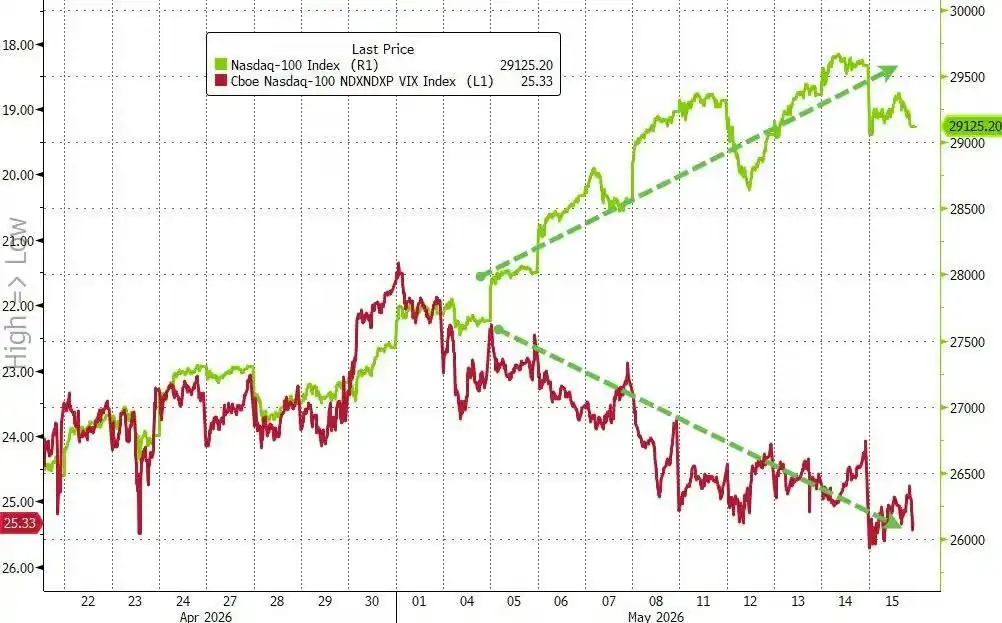
The earnings results and forward guidance will directly test the market's conviction in the AI computing super-cycle thesis. Given Nvidia's high correlation with the semiconductor sector and broader tech market, its earnings performance, whether positive or negative, is expected to trigger widespread ripple effects across the market.

Technical Indicators Flash Most Extreme Warning Since 1999/2000

The magnitude and speed of the recent semiconductor rally have pushed technical indicators to historically overbought extremes.

Goldman Sachs data shows the SOX index has surged approximately 70% from its late March low, adding over $5 trillion in market value along the way. Driving factors include a temporary easing of geopolitical tensions, better-than-expected corporate earnings—such as AMAT raising its full-year guidance more than anticipated and CSCO achieving 35% year-over-year growth in product orders—as well as investor confidence in AI computing demand; earnings expectations for the semiconductor industry have been revised upwards by over 25% year-to-date.

However, Peter Callahan specifically pointed out that the SOX index currently trades about 60% above its 200-day moving average, a deviation not seen since the peak of the 1999/2000 internet bubble. He also noted that Goldman Sachs' high momentum factor portfolio has experienced 12 trading days with daily moves of ±5% or more this year, accounting for nearly 15% of all trading days; the rapid expansion of leveraged ETFs and options products further amplifies this two-way volatility.
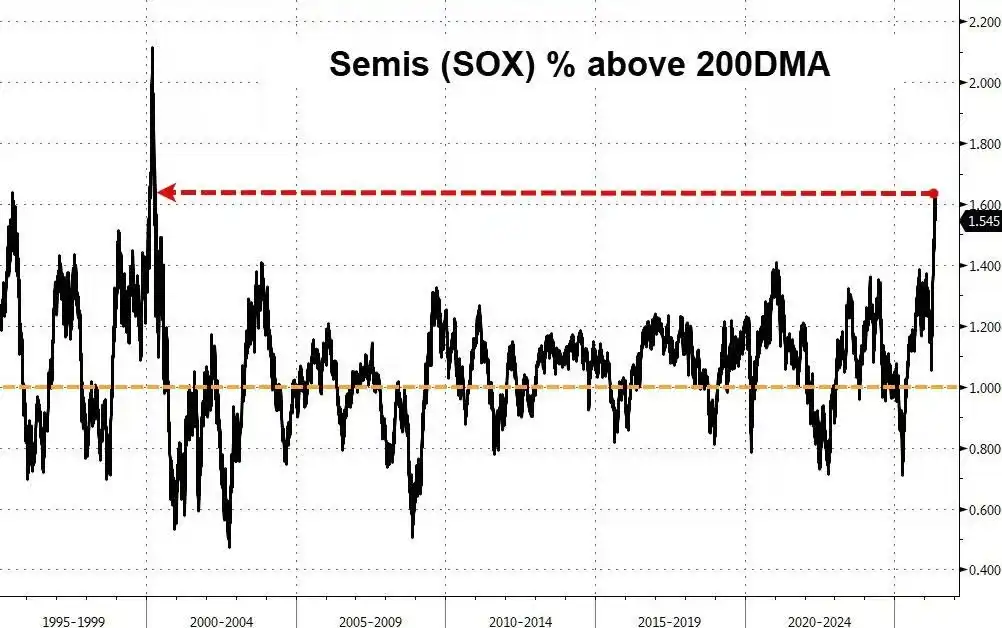
"It's worth keeping these tactical dynamics in mind ahead of the summer trading period, after this week's key earnings event (Nvidia on May 20) concludes," Callahan wrote. While Goldman's trading desk maintains a constructive medium-term view on the AI and semiconductor themes, it tactically advises investors to remain cautious regarding technical headwinds.

Nvidia Earnings: Forward Guidance May Be More Crucial Than Quarterly Results

Market optimism about Nvidia's fundamental prospects remains, but recent stock price movements have already priced in some of these expectations.

According to Goldman Sachs' Nvidia earnings preview, analysts generally expect the company's revenue for this quarter to exceed consensus estimates by approximately $2 billion—its typical historical beat margin has been around 2% to 3%. The market is more focused on forward guidance for the next quarter, with the current analyst consensus around $86 billion, implying a sequential increase of about 9%. Other key areas of focus include: potential for further upward revision to Nvidia's ~$1 trillion cumulative data center revenue target, and the narrative of accelerating Agentic AI inference demand—particularly its pure CPU rack product expected to begin shipments in the second half of 2026.

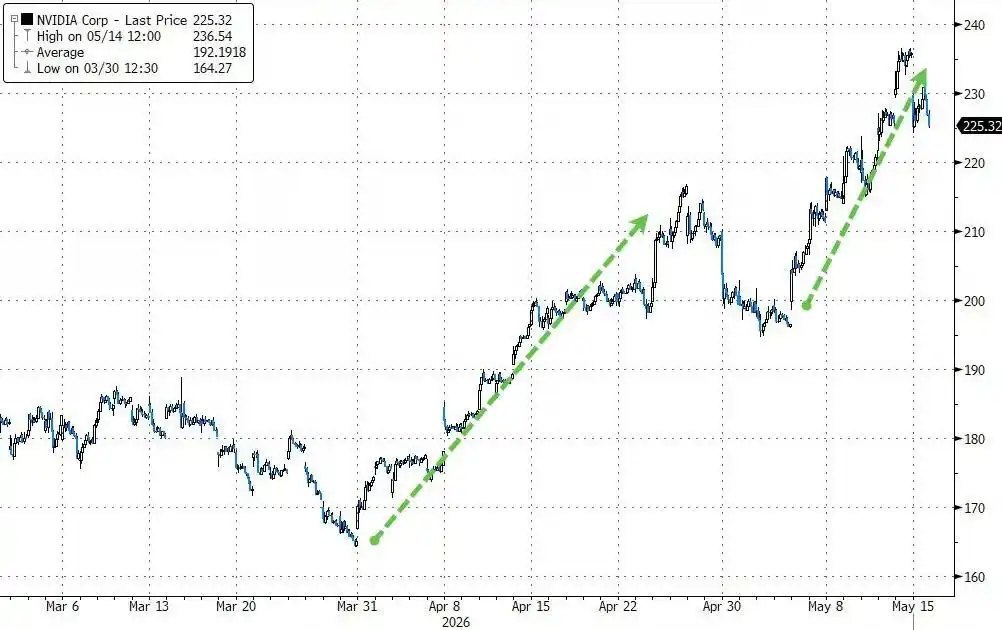
From a recent price action perspective, Nvidia has risen for seven consecutive trading days, gaining 20% during this stretch, marking its longest winning streak in nearly two years; it has added roughly $1.7 trillion in market capitalization since its late March low. However, Goldman data also shows that on the trading day following Nvidia's last five earnings reports (T+1), the stock declined four times. Since May 2022, a single-day surge triggered by earnings has not occurred.
Options Market: Extreme Bullish Bets and Tail Hedging Deployed Simultaneously

Options positioning reveals a set of inherently contradictory signals.

According to SpotGamma data, overall positioning remains heavily skewed towards bullish bets, with traders consistently rolling Nvidia call options to higher strike prices. The call skew remains at the high end of its 90-day historical range, while demand for downside protection is extremely limited. Data cited by 22V Research shows that nominal S&P 500 call option trading volume hit a record $2.6 trillion last Friday, with call volume accounting for 60% of total options activity; the RSI for the Philadelphia Semiconductor Index also rose to its highest level since March 2000.
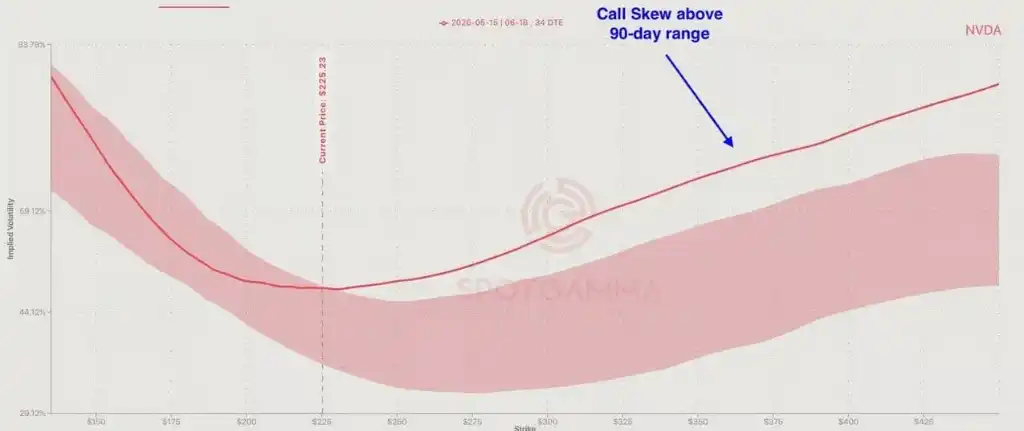
Meanwhile, hedging against downside risks is also quietly underway. SpotGamma points out that significant put option structures and buying activity have increased noticeably around the S&P 500 (SPY), semiconductor ETF (SMH), and DRAM-related assets, concentrated in deep out-of-the-money strike price ranges, indicating their function is more akin to tail risk hedging rather than pure directional bets. "Market participants are not bearish on Nvidia, but preparation for downside scenarios is non-trivial," SpotGamma wrote in its report, "Any directional shift is likely to quickly spill over into the broader market."

SpotGamma adds that Nvidia has rallied over 35% from its March low, and the size of current call option positions implies that disappointing earnings or a large-scale profit-taking event could potentially trigger a significant directional reversal.

Market Breadth Concerns: Rally Supported by a Handful of Stocks

Beneath the strong performance of semiconductor and large-cap tech stocks, the lack of broad market participation is forming a structural worry.

Peter Callahan noted in his report that although the S&P 500 is up about 8% year-to-date, only about 52% of its constituents are in positive territory. Sectors significantly lagging this year include residential real estate, medical devices, engineering & construction without government business exposure, federal IT services, software & services, independent power producers, restaurant chains, commercial real estate brokerage, and insurance brokerage, among others.

Callahan admits that when examining the charts of these sectors, it makes him question whether the current market performance reflects overall "health" or simply a "funding source" effect, where investors are forced to concentrate capital in a few large-cap AI stocks. Oppenheimer's equity derivatives team similarly pointed out that only about one-fifth of S&P 500 constituents have outperformed the index over the past month, with the dispersion index rising to its highest level in over a year, while implied correlation remains near year-to-date lows. Latest data from Goldman Sachs' Prime Brokerage (PB) desk also shows a clear "risk-off" move in the tech sector recently.

Pertanyaan Terkait

QWhy is Nvidia's upcoming earnings report on May 20th considered a critical stress test for the current AI bull market?

ANvidia's earnings report is considered a critical stress test because it directly tests the market's confidence in the AI compute super-cycle. The company is highly correlated with the semiconductor and broader tech sectors, meaning its results will likely trigger significant market-wide reactions regardless of whether they are positive or negative. The market is technically overextended, with extreme bullish positioning in options, making the event a key pressure point that could determine the near-term fate of the AI bull cycle.

QWhat is the core contradiction identified by Goldman Sachs' Peter Callahan regarding the AI and semiconductor theme?

AThe core contradiction is that the fundamentals remain strong (e.g., strong corporate earnings, upward revisions to profit expectations), while technical pressures are continuously accumulating. Key technical pressures include the SOX index trading at its most extreme deviation from its 200-day moving average since the 1999/2000 internet bubble peak and heightened market concentration in a few large-cap stocks.

QWhat is the unusual market signal that SpotGamma reports, and what does it indicate about trader behavior?

ASpotGamma reports the unusual signal of stock prices rising while implied volatility simultaneously climbs. Normally, these two have an inverse relationship. This pattern indicates that while traders are chasing the rally (buying stocks/calls), they are also paying a premium to hedge against significant volatility, preparing for a potential sharp move in either direction around high-stakes events like Nvidia's earnings.

QAccording to the article, what aspect of Nvidia's report might be more crucial than the quarterly results themselves?

AThe forward guidance for the next quarter is potentially more crucial than the immediate quarterly results. While analysts expect quarterly revenue to beat estimates by a significant margin, the market's primary focus is on the guidance for the upcoming quarter (estimated at around $86 billion) and whether there is further upside to Nvidia's cumulative data center revenue target of approximately $1 trillion.

QWhat does the data on market breadth and the 'funding source' effect suggest about the health of the current U.S. stock market rally?

AThe data on market breadth suggests underlying weakness and a lack of broad participation. While the S&P 500 is up year-to-date, only about 52% of its constituents have posted gains. The rally is being driven by a narrow concentration of capital in a few large-cap AI stocks like Nvidia, creating a 'funding source' effect. This raises questions about whether the market's performance reflects overall economic health or is simply a consequence of investors being forced to crowd into a shrinking pool of high-performing names.

Bacaan Terkait

43 Menit Trump: Narasi Pemimpin Kuat Tak Terkendali, Perang Media Memanas

Presiden AS Donald Trump kembali muncul di depan publik setelah menghilang lebih dari seminggu, dalam konferensi pers selama 43 menit yang dimaksudkan untuk menunjukkan kendali. Namun, pidatonya justru menyimpang ke topik-topik seperti kolam refleksi, perbandingan jumlah massa dengan Martin Luther King, serta serangan terhadap jurnalis, lawan politik, dan sejumlah kota AS. Ia menandatangani perintah eksekutif yang menghapus perlindungan jabatan bagi ribuan pegawai federal senior, berpotensi memperkuat loyalitas pribadi di atas profesionalisme. Trump secara pribadi menyerang jurnalis CNN, Kaitlan Collins, menyebutnya "penuh kebencian". Artikel ini menyoroti tekanan pada media independen, mengutip pemecatan veteran CBS Scott Pelley yang menolak campur tangan editorial untuk menyenangkan pemerintahan. Penulis menekankan pentingnya mendukung jurnalis dan media independen sebagai penjaga fakta publik ketika media arus utama menghadapi tekanan politik dan komersial. Aktivitas tiba-tiba diakhiri secara mendadak oleh stafnya, meninggalkan kesan kepanikan. Sementara itu, di tengah kekhawatiran tentang kesehatannya dan perang di Iran, empat anggota Partai Republik di DPR mendukung resolusi yang menuntut penghentian perang, menunjukkan retakan dalam dukungan partainya. Artikel ini menggambarkan penampilan Trump sebagai pertunjukan politik yang penuh kecemasan, yang mencerminkan ketegangan institusional AS: perluasan kekuasaan pribadi, pelemahan birokrasi, erosi kepercayaan media, dan penyusutan ruang fakta publik.

marsbit1j yang lalu

43 Menit Trump: Narasi Pemimpin Kuat Tak Terkendali, Perang Media Memanas

marsbit1j yang lalu

Kalshi, MTS, dan Ambisi A16Z

**Ringkasan Artikel: Kalshi, MTS, dan Ambisi a16z** Pasar prediksi (prediction market) menjadi bidang yang menarik perhatian investor, komunitas kripto, dan media pada 2025. Meski memiliki daya tarik bisnis seperti arbitrase regulasi dan potensi fee transaksi tinggi, nilai mendasarnya terletak pada kemampuannya memberikan **"rasa keberadaan" (sense of presence)**. Artikel ini menelusuri evolusi ide pasar prediksi, dari konsep Friedrich Hayek tentang pasar sebagai pengumpul pengetahuan tersebar, hingga mekanisme insentif Robin Hanson (LMSR). Namun, diskusi filosofis ini menemukan relevansi baru ketika a16z (Andreessen Horowitz) berinvestasi pada **Kalshi**, sebuah platform pasar prediksi yang kini bernilai $220 miliar. Bagi a16z, Kalshi bukan sekadar platform taruhan. Ia adalah **media baru** yang memungkinkan orang terlibat secara aktif dalam peristiwa dunia. Dengan menggunakan uang sungguhan untuk "memprediksi" hasil suatu peristiwa (politik, cuaca, berita), pengguna merasa menjadi **pengamat super** yang berpartisipasi, bukan sekadar penonton pasif. Hal ini mengatasi rasa ketidakberdayaan di era modern. Kalshi, dengan volume dan data transaksi nyata, berpotensi memberikan otoritas final atas **kebenaran** dan **pentingnya** suatu peristiwa. Ini selaras dengan ambisi a16z membangun kekaisaran media baru, seperti yang terlihat pada **MTS (Monitoring The Situation)**, media yang melakukan siaran langsung 24/7 untuk "menguasai linimasa". Kombinasi antara narasi media yang intens (seperti MTS) dan legitimasi data nyata dari pasar prediksi (Kalshi) menciptakan **medan distorsi realitas** yang kuat. Kalshi bernilai tinggi karena kemampuannya mempengaruhi persepsi publik secara halus, misalnya melalui probabilitas hasil pemilu yang diperdagangkan, sesuatu yang jarang dimiliki perusahaan swasta. Inilah inti dari ambisi media baru a16z.

marsbit3j yang lalu

Kalshi, MTS, dan Ambisi A16Z

marsbit3j yang lalu

Terbaru: Veteran Chip OpenAI Bergabung dengan Anthropic

Pelaku industri OpenAI, Clive Chan, yang dikenal sebagai karyawan nomor dua di tim perangkat keras dan terlibat dalam proyek chip buatan OpenAI, mengumumkan telah bergabung dengan Anthropic. Ia menyebut tim chip OpenAI memiliki kepadatan bakat yang luar biasa, namun dorongan untuk "mendaki gunung baru dari dasar" membawanya ke Anthropic. Chan terkesan dengan bakat, nilai, dan ambisi tim Anthropic, serta merasakan intensitas kerja yang tinggi sejak hari pertama. Ketika ditanya tentang kemajuan chip buatan OpenAI, Chan merujuk pada blog kolaborasi antara OpenAI dan Broadcom yang dirilis Oktober 2025. Menurut blog tersebut, sistem akselerator AI buatan OpenAI dengan total skala 10GW ini menargetkan penyebaran dimulai pada paruh kedua 2026, dengan pengiriman rak pertama direncanakan pada waktu tersebut. Proyek diperkirakan berlanjut hingga akhir 2029. Chan, lulusan Universitas Waterloo tahun 2021, memiliki pengalaman kerja di Google, SpaceX, Tesla (tim infrastruktur Autopilot), dan QuEra sebelum bergabung dengan OpenAI pada Januari 2024. Kepindahannya ke Anthropic disambut oleh karyawan Anthropic lainnya dan menjadi bahan komentar netizen yang menyoroti tren perpindahan bakat antara kedua perusahaan AI terkemuka ini. Sebelumnya, pada Mei, salah satu pendiri OpenAI, Andrej Karpathy, juga bergabung dengan Anthropic. Anthropic baru-baru ini mengumumkan pendanaan H senilai $650 miliar, dengan valuasi pasca-pendanaan mencapai $9,65 triliun, mendekati klub bernilai triliunan dolar. Arus bakat antara OpenAI dan Anthropic terus berlanjut, menegaskan pentingnya talenta sebagai aset inti dalam persaingan AI mutakhir.

marsbit3j yang lalu

Terbaru: Veteran Chip OpenAI Bergabung dengan Anthropic

marsbit3j yang lalu

Ambisi Kalshi, MTS, dan a16z

Pasar prediksi menjadi bidang yang menarik pada tahun 2025, menghubungkan investor dolar, komunitas kripto, dan media. Artikel ini mengeksplorasi esensi pasar prediksi dan keselarasannya dengan visi "Media Baru" a16z. Pemikiran pasar prediksi berakar dari konsep Hayek tentang penggunaan pengetahuan tersebar dalam masyarakat, yang kemudian dikembangkan oleh Robin Hanson dengan mekanisme insentif LMSR-nya. Namun, diskusi filosofis ini menemukan relevansi barunya ketika a16z berinvestasi di Kalshi, sebuah platform pasar prediksi yang valuasinya melonjak. a16z melihat nilai inti Kalshi dan pasar prediksi terletak pada penyediaan "rasa kehadiran" atau keterlibatan. Dalam dunia di mana individu sering merasa terasing dari peristiwa, pasar prediksi menawarkan cara untuk terlibat secara aktif dengan "mempertaruhkan" pandangan seseorang tentang masa depan. Keterlibatan finansial ini mengubah peserta dari pengamat pasif menjadi "pengamat super" yang merasa terhubung dan memiliki agensi. Konsep "Media Baru" a16z adalah sistem komunikasi berkecepatan tinggi yang bertujuan mendominasi narasi secara instan. Contohnya adalah MTS, media yang menyiarkan berita penting secara real-time. Namun, kekuatan sebenarnya terletak pada otoritas yang dihasilkan pasar prediksi seperti Kalshi. Harga yang dibentuk oleh uang sungguhan memberikan klaim kebenaran dan kepentingan yang sulit disangkal, menciptakan semacam "medan distorsi realitas". Inilah yang menjelaskan valuasi tinggi Kalshi: kemampuannya yang langka untuk memengaruhi persepsi realitas sebagai sebuah perusahaan swasta, menjadikannya batu penjuru penting dalam ambisi kekaisaran media baru a16z.

链捕手3j yang lalu

Ambisi Kalshi, MTS, dan a16z

链捕手3j yang lalu

Trading

Spot
Futures

Artikel Populer

Cara Membeli NIGHT

Selamat datang di HTX.com! Kami telah membuat pembelian Midnight (NIGHT) menjadi mudah dan nyaman. Ikuti panduan langkah demi langkah kami untuk memulai perjalanan kripto Anda.Langkah 1: Buat Akun HTX AndaGunakan alamat email atau nomor ponsel Anda untuk mendaftar akun gratis di HTX. Rasakan perjalanan pendaftaran yang mudah dan buka semua fitur.Dapatkan Akun SayaLangkah 2: Buka Beli Kripto, lalu Pilih Metode Pembayaran AndaKartu Kredit/Debit: Gunakan Visa atau Mastercard Anda untuk membeli Midnight (NIGHT) secara instan.Saldo: Gunakan dana dari saldo akun HTX Anda untuk melakukan trading dengan lancar.Pihak Ketiga: Kami telah menambahkan metode pembayaran populer seperti Google Pay dan Apple Pay untuk meningkatkan kenyamanan.P2P: Lakukan trading langsung dengan pengguna lain di HTX.Over-the-Counter (OTC): Kami menawarkan layanan yang dibuat khusus dan kurs yang kompetitif bagi para trader.Langkah 3: Simpan Midnight (NIGHT) AndaSetelah melakukan pembelian, simpan Midnight (NIGHT) di akun HTX Anda. Selain itu, Anda dapat mengirimkannya ke tempat lain melalui transfer blockchain atau menggunakannya untuk memperdagangkan mata uang kripto lainnya.Langkah 4: Lakukan trading Midnight (NIGHT)Lakukan trading Midnight (NIGHT) dengan mudah di pasar spot HTX. Cukup akses akun Anda, pilih pasangan perdagangan, jalankan trading, lalu pantau secara real-time. Kami menawarkan pengalaman yang ramah pengguna baik untuk pemula maupun trader berpengalaman.

591 Total TayanganDipublikasikan pada 2025.12.08Diperbarui pada 2026.06.02

Cara Membeli NIGHT

Diskusi

Selamat datang di Komunitas HTX. Di sini, Anda bisa terus mendapatkan informasi terbaru tentang perkembangan platform terkini dan mendapatkan akses ke wawasan pasar profesional. Pendapat pengguna mengenai harga NIGHT (NIGHT) disajikan di bawah ini.

活动图片