Jensen Huang is Satoshi Nakamoto

marsbitDipublikasikan tanggal 2026-03-19Terakhir diperbarui pada 2026-03-19

Abstrak

Summary: The article draws a compelling parallel between Jensen Huang, CEO of NVIDIA, and Satoshi Nakamoto, the pseudonymous creator of Bitcoin. It argues that both figures, though operating in different eras, fundamentally architected new "token economies" based on a core conversion rule: inputting computational power (electricity) to output a valuable token. Nakamoto's 2008 whitepaper defined a system where Proof-of-Work mining produces scarce cryptographic tokens, creating a decentralized "faith economy" based on speculative value. In 2026, Huang is portrayed as performing a structurally identical act at GTC. Instead of merely selling GPUs, he presented a complete "token economics" framework, segmenting the market into tiers (Free, Medium, High, Premium, Ultra) based on inference speed, model type, and price per million tokens. He defined valuable computation for the AI age. The key distinction lies in the tokens' purpose and resulting scarcity. Crypto tokens derive value from artificial, code-enforced scarcity (e.g., Bitcoin's 21 million cap) and are meant to be held. AI tokens derive value from their immediate consumption for productive tasks (coding, decision-making) and face a natural, physical scarcity governed by the laws of thermodynamics, land, and power grids, which Huang's hardware is designed to maximize. Ultimately, while Nakamoto created a speculative asset, Huang is building an indispensable utility. The AI token economy, powered by NVIDIA ecosystem, is ar...

Author: Luo Yihang

In January 2009, an anonymous individual invented something called a "token." You invest computing power, obtain tokens, and these tokens circulate, are priced, and traded within a consensus network. The entire crypto economy was born from this. Over a decade later, people are still debating whether this token has any value.

In March 2025, a man in a leather jacket redefined another thing called a "token." You invest computing power, produce tokens, and these tokens are instantly consumed in an AI inference (inference & reasoning) process: thinking, reasoning, writing code, making decisions. The entire AI economy is accelerating because of this. No one debates whether this token has value because you just used millions of them this morning.

Two types of tokens, the same name, the same underlying structure: computing power goes in, something valuable comes out.
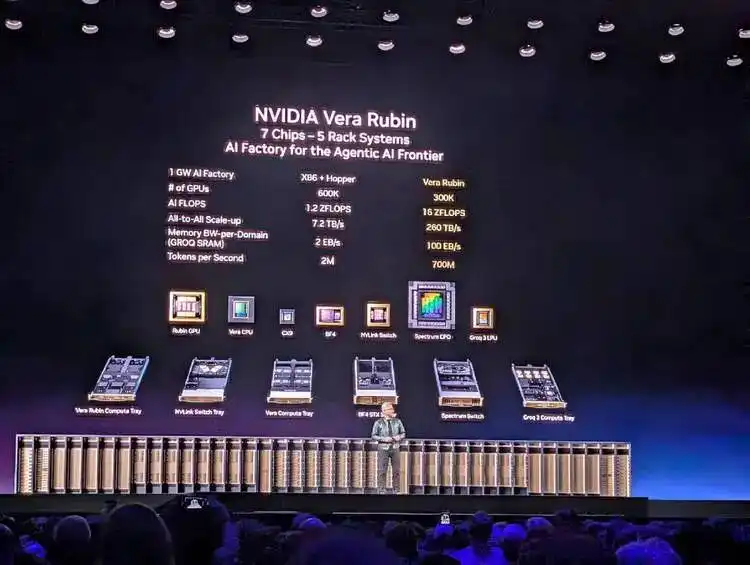
In March 2026, I sat in the NVIDIA GTC venue and listened to Jensen Huang deliver a keynote speech with almost no product promotion. Yes, he unveiled Vera Rubin, a product combining CPU and GPU. But this time, he didn't talk about chip specifications or manufacturing processes; he talked about a complete economics of token production, pricing, and consumption:

Which model corresponds to which token speed; which token speed corresponds to which price range; which price range requires what level of hardware to support.

He even prepared data center computing power allocation plans for the CEOs and decision-makers holding the corporate checkbooks in the audience: 25% for the free tier, 25% for mid-tier, 25% for high-end, 25% for the high-premium tier.

Yes, this time he wasn't specifically selling a particular GPU group, like he did with Blackwell two years ago. But this time, he was selling something bigger. After two hours, I felt the sentence he most wanted to say was: Welcome to consume tokens, and only Nvidia's factory could produce.

At that moment, I realized that this man was doing something structurally identical to what that anonymous person did 17 years ago when he mined the first token.

The Same Conversion Rules

The anonymous individual using the pseudonym "Satoshi Nakamoto" wrote a nine-page white paper in 2008, designing a set of rules: invest computing power, complete a mathematical proof (Proof of Work), and receive a crypto token as a reward.

The brilliance of this rule lies in the fact that it doesn't require anyone to trust anyone else—as long as you accept these rules, you automatically become a participant in this economy. The rule is correct; after all, it brought so many deceitful people together.

And Jensen Huang, on the stage at GTC 2026, did something structurally identical.

He showed a chart illustrating the relationship and tension between inference efficiency and token consumption: the Y-axis is throughput (tokens produced per megawatt of power), the X-axis is interactivity (token speed perceived per user). Then, he labeled five pricing tiers below the X-axis: Free uses Qwen 3, $0/million tokens; Medium uses Kimi K2.5, $3/million tokens; High uses GPT MoE, $6/million tokens; Premium uses GPT MoE 400K context, $45/million tokens; and Ultra, $150/million tokens.

This chart could almost serve as the cover of Jensen Huang's "token economics" white paper.
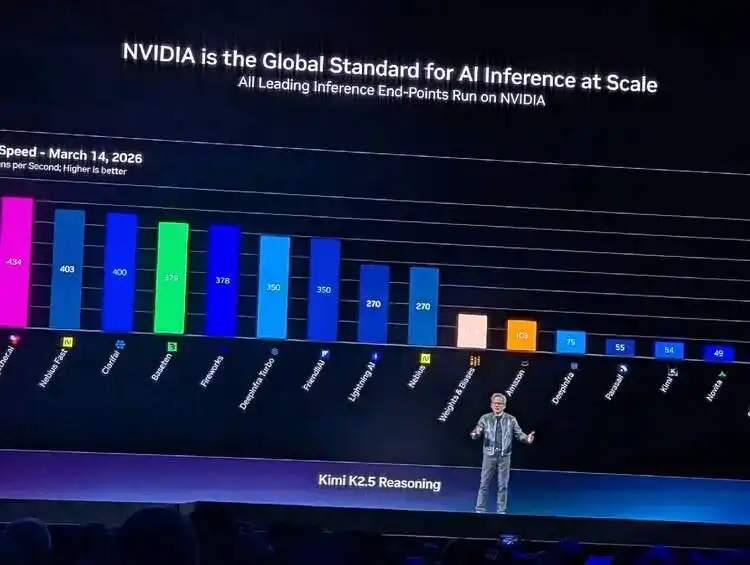
Satoshi defined "what constitutes valuable computation"—completing an SHA-256 hash collision was valuable. Jensen Huang defined "what constitutes valuable inference"—producing tokens for a specific scenario at a specific speed under given power constraints is valuable.

Neither Satoshi Nakamoto nor Jensen Huang directly produced tokens; they both defined the rules for token production and the pricing mechanism.

A sentence Huang said on stage could almost be written directly into the abstract of a token economics white paper—

Tokens are the new commodity, and like all commodities, once it reaches an inflection, once it becomes mature, it will segment into different parts.

Token is the new commodity. Commodities naturally stratify once they mature. He wasn't describing the status quo; he was predicting a market structure and then precisely laying out his hardware product line across every layer of this structure.

The production processes of the two types of tokens even have a semantic symmetry: mining is called mining, inference is called inference.

The essence of both mining and inference is turning electricity into money. Miners spend electricity costs to mine crypto tokens and then sell them. Inference models and AI Agents spend electricity costs to generate AI tokens and then sell them to developers priced per million. The middle steps are different, but the two ends are the same: on the left is the electricity meter, on the right is revenue.

Two Ways to Write Scarcity

The most important design decision Satoshi Nakamoto made was not Proof of Work, but the 21 million Bitcoin supply cap. He used code to create artificial scarcity—no matter how many mining rigs flood in, the total number of Bitcoins will never exceed 21 million. This scarcity is the value anchor of the entire crypto economy.

And Jensen Huang created natural scarcity using physical laws. He said:

"You still have to build a gigawatt data center. You still have to build a gigawatt factory, and that one gigawatt factory for 15 years amortized... is about $40 billion even when you put nothing on it. It's $40 billion. You better make for darn sure you put the best computer system on that thing so that you can have the best token cost."

A 1GW data center will never become 2GW. This isn't a code limitation; it's a law of physics.

Land, electricity, cooling—each has a physical limit. How many tokens this factory you built for $40 billion can produce over its 15-year lifecycle depends entirely on what computing architecture you put inside it.
Satoshi's scarcity can be forked. If you don't like the 21 million cap, fork a new chain, change it to 200 million, call it Ether or whatever, and issue a white paper. And people did just that, with great relish.

But the scarcity Huang creates cannot be forked. After all, you can't fork the second law of thermodynamics, you can't fork a city's power grid capacity, you can't fork the physical area of a piece of land.

But whether it's Satoshi Nakamoto or Jensen Huang, the scarcity they created led to the same result: a hardware arms race.

The history of mining is: CPU→GPU→FPGA→ASIC. Each generation of specialized hardware rendered the previous generation obsolete. And the history of AI training and inference is replaying: Hopper→Blackwell→Vera Rubin→Groq LPU. Start with general-purpose hardware, settle with specialized hardware. The Groq LPU showcased by Huang at this year's GTC, the deterministic dataflow processor released after acquiring Groq. Static compilation, compiler scheduling, no dynamic scheduling, 500MB on-chip SRAM—its architectural philosophy is the ASIC of the inference field. Do one thing, but do it to the extreme.

Interestingly, GPUs played a key role in both waves.

Around 2013, miners found that GPUs were more suitable for mining crypto tokens than CPUs, and NVIDIA graphics cards were sold out. 10 years later, researchers found that GPUs are the best tool for training and inferring AI models, and NVIDIA data center cards were sold out again. GPU, as a processor category, has successively served two generations of token economies.

The difference is, the first time NVIDIA benefited passively, and that was it. The second time, as the main battlefield of AI computing consumption shifted from pre-training to inference, NVIDIA quickly seized the opportunity to actively design the entire game, becoming the writer of the AI rules of the game.

The World's Most Profitable Shovel Seller

In the gold rush, the most profitable weren't the gold miners, but the shovel seller Levi Strauss. In the mining boom, the most profitable weren't the miners, but the mining machine seller Bitmain and Jihan Wu. In the AI pre-training and inference wave, the most profitable aren't the foundation models and Agents, but the GPU seller NVIDIA.

But honestly, the roles of Bitmain and NVIDIA in their respective industries are no longer comparable.

Bitmain only sold mining machines; NVIDIA was even a supplier to Bitmain. You bought a mining machine, what coin to mine, which mining pool to join, at what price to sell, all had nothing to do with Bitmain. It was a pure hardware supplier, earning one-time equipment profits.

NVIDIA is different. He doesn't just sell hardware; now, especially since the explosion of inference-side AI in 2025, he deeply defines what should be mined with this GPU, how to price tokens, who to sell tokens to, how data center computing power should be allocated... All of this is in Huang's presentation PPT: he divides the market into five tiers, each tier corresponding to which model, context length, interaction speed, and price... NVIDIA has standardized and formatted the future market driven by AI inference.

Around 2018, global computing power was concentrated in a few large mining pools—F2Pool, Antpool, BTC.com—they competed for computing power share, but the source of mining machines was highly concentrated in Bitmain.

Just like NVIDIA today, 60% of revenue comes from competing "hyperscalers" like AWS, Azure, GCP, Oracle, CoreWeave, while 40% comes from dispersed AI Natives, sovereign AI projects, and enterprise customers. Large "mining pools" contribute the main revenue, small "miners" provide resilience and diversification.

The structure of the two ecosystems is exactly the same. But Bitmain later encountered competitors—MicroBT, Innosilicon, Canaan—all eating into its share. Mining machines are relatively simple ASIC designs, so followers had a chance. But shaking NVIDIA seems increasingly difficult: 20 years of CUDA ecosystem, hundreds of millions of GPU install base, six generations of NVLink interconnect technology, the decoupled inference architecture after the Groq integration—NVIDIA's technical complexity and ecosystem barriers have rendered most competitive tools ineffective.

This might last for 20 years.

The Fundamental Fork of Two Tokens

What makes cryptocurrency and AI training/inference tokens fundamentally different is the motivation and psychology of their users.

The demand side for Crypto tokens is speculation. No one "needs" Bitcoin to get work done. All white papers claiming blockchain tokens can solve your problems were written by scammers. You hold crypto because you believe someone will buy it from you at a higher price in the future. Bitcoin's value comes from a self-fulfilling prophecy: if enough people believe it has value, it has value. This is the faith economy.

The demand side for AI tokens is productivity. Nestlé needs tokens to make supply chain decisions—its supply chain data refresh rate went from every 15 minutes to every 3 minutes, costs reduced by 83%; this value can be directly mapped to the P&L. 100% of NVIDIA engineers already need tokens to write code instead of hand-coding; research teams need tokens for scientific research. You don't need to believe tokens have value; you just need to use them, and the value proves itself in use.

This is the most essential difference between the two tokens. Crypto tokens are produced to be held and traded—their value lies in not being used. AI tokens are produced to be consumed immediately—their value lies in the moment they are used.

One is digital gold, more valuable the more you hoard it; the other is digital electricity, produced to be burned.

This difference determines that: the AI token economy will not become as bubble-prone as the crypto token economy. Bitcoin rises and falls sharply because the price of a speculative item is driven by sentiment. But the price of [AI] tokens is driven by usage volume and production cost. As long as AI remains useful—as long as people are still using Claude Code to write code, using ChatGPT to write reports, using Agents to run business processes—the demand for tokens won't collapse. It doesn't rely on faith; it relies on being indispensable.

In 2008, the Bitcoin white paper needed to repeatedly argue why a decentralized electronic cash system was valuable. 17 years later, people are still arguing.

In 2026, token economics did not引发 any debate; it didn't even need论证 and became consensus. When Huang stood on the GTC stage and said "tokens are the new commodity," no one questioned it. Because everyone sitting in the audience had used Claude Code or ChatGPT to consume millions of tokens this morning. They didn't need to be convinced that tokens have value—their credit card bills had already proven it.

In this sense, Huang really is a副本 of Satoshi Nakamoto, the副本 that stayed behind to monopolize mining machine production, defined the usage scenarios and norms for tokens, and holds an annual show at the San Jose SAP Center telling people how powerful the next generation of "mining machines" supporting AI training and inference will be.

Satoshi Nakamoto had a charm of cautious desire; he designed the rules, handed them over to the code, and then disappeared. This is cypherpunk romance. And Huang is more of a businessman than any scientist; he designed the rules, maintains them personally, constantly adds bricks and tiles, and solidifies his moat.

The token you used to see because you believed, now you can see without believing. It is the next one after Watt, Ampere, Bit.


Pertanyaan Terkait

QWhat is the core similarity between Satoshi Nakamoto's crypto token and Jensen Huang's AI token as described in the article?

ABoth involve a fundamental structure where computational power (electricity and hardware) is converted into valuable tokens. In crypto, proof-of-work mining produces tokens for a decentralized financial network, while in AI, inference computation produces tokens for immediate consumption in tasks like reasoning and decision-making.

QHow does Jensen Huang's 'token economics' define the value of AI tokens, according to the article?

AHuang defines the value of AI tokens based on the efficiency of their production—how many tokens can be generated per megawatt of power at specific speeds (latency) for different pricing tiers (e.g., free, medium, high, premium, ultra), correlating directly with the computational hardware and model used.

QWhat is the key difference in how scarcity is created between Bitcoin tokens and AI tokens, as per the article?

ABitcoin's scarcity is artificial and code-enforced, with a fixed supply limit of 21 million coins, which can be forked and altered. AI token scarcity is natural and physics-bound, limited by real-world constraints like land, electricity, cooling, and the fixed capacity of data centers (e.g., a 1GW facility's output is capped by its hardware efficiency).

QWhy does the article claim that AI token economics is less prone to bubbles compared to crypto token economics?

ACrypto tokens derive value from speculation and belief, with prices driven by sentiment and trading, leading to volatility. AI tokens derive value from immediate productivity and utility (e.g., coding, decision-making), with demand anchored in real-world use cases and cost of production, making them more stable and less bubble-prone.

QHow has Nvidia's role evolved from the crypto mining era to the AI era, as highlighted in the article?

ADuring the crypto era, Nvidia was a passive beneficiary as GPUs were used for mining, but it did not define the ecosystem. In the AI era, Nvidia actively shapes the market by designing the rules—hardware, token pricing tiers, data center allocation, and inference architectures—becoming the central rule-maker and infrastructure provider for AI token production.

Bacaan Terkait

Setelah Tiga Kuartal Berturut-Turut Turun, Bisakah Pasar Kripto Menyambut Jendela Stabilitas di Kuartal Ketiga?

Pasar kripto mengalami kuartal terburuk sejak 2022, dengan kapitalisasi pasar turun 12.6% menjadi $2.1 triliun, didorong oleh keluarnya modal dan penurunan volume perdagangan. Bitcoin dan Ethereum masing-masing jatuh 14.2% dan 25.4% di kuartal kedua. Aliran keluar bersih dari ETF Bitcoin AS mencapai $4.67 miliar, menandakan tekanan jual yang berkelanjutan. Faktor utama meliputi terputusnya hubungan dengan saham AS, kebijakan moneter Federal Reserve yang ketat, dan pelepasan aset oleh perusahaan seperti Strategy. Proses legislasi UU CLARITY yang akan memberikan kejelasan regulasi terhambat, meningkatkan premi risiko di sektor ini. Namun, ada tanda-tanda potensi stabilisasi. Aliran keluar ETF yang besar secara historis sering terjadi di akhir fase penurunan, dan para pemegang Bitcoin jangka panjang mulai menambah kepemilikan lagi. Sementara sebagian besar sektor menyusut, pasar prediksi dan aset koleksi yang ditokenisasi mencatat pertumbuhan signifikan. Pandangan untuk kuartal ketiga sangat bergantung pada pertemuan Fed akhir Juli. Sinyal kebijakan yang lunak dapat mendukung pemulihan Bitcoin, sementara sikap yang hawkish dapat memicu konsolidasi lebih lanjut. Meskipun tantangan regulasi tetap ada, indikator teknis seperti harga Bitcoin yang mendekati rata-rata bergerak 200-mingguannya menunjukkan dasar jangka panjang belum rusak. Logika pasar telah bergeser dari mengandalkan narasi ke faktor fundamental seperti kebijakan dan ekspektasi suku bunga.

marsbit17j yang lalu

Setelah Tiga Kuartal Berturut-Turut Turun, Bisakah Pasar Kripto Menyambut Jendela Stabilitas di Kuartal Ketiga?

marsbit17j yang lalu

The SpaceX Trade, Terbuka: SPCXON Mulai Diperdagangkan di WEEX

SpaceX meluncurkan IPO terbesar dalam sejarah pada Juni 2026, namun akses bagi banyak pedagang terhambat oleh batasan regional dan prosedur broker. WEEX kini menghadirkan SPCXON/USDT di pasar spotnya, sebuah instrumen tokenisasi yang memungkinkan paparan terhadap pergerakan harga SpaceX melalui akun kripto yang diselesaikan dengan USDT, tanpa memerlukan broker AS atau pembiayaan bank. SPCXON adalah produk tokenisasi yang mencerminkan ekonomi kepemilikan SpaceX bagi pedagang yang memenuhi syarat di luar AS, dengan dividen diinvestasikan kembali. Aset ini diperdagangkan di WEEX sebagai pasangan spot dengan USDT, tersedia selama jam pasar, memberikan akses mudah bagi trader kripto. Kasus investasi untuk SpaceX didasarkan pada pertumbuhan pendapatan Starlink dan pencapaian Starship, meskipun valuasinya yang tinggi (sekitar 90-110 kali pendapatan) telah memperhitungkan eksekusi sempurna selama bertahun-tahun. Faktor seperti jumlah saham publik yang terbatas dan masa buka kunci (unlock) insider pertama menjadi pertimbangan penting. Penting untuk diingat bahwa SPCXON memberikan paparan, bukan kepemilikan langsung atas saham atau hak suara. Harganya dapat diperdagangkan pada premium atau diskon terhadap nilai aset bersih. WEEX menawarkan akses ke berbagai aset TradFi yang ditokenisasi seperti ini dalam satu akun terpadu, bersama dengan pasar futures dan kampanye perdagangan dengan pool hadiah.

TheNewsCrypto17j yang lalu

The SpaceX Trade, Terbuka: SPCXON Mulai Diperdagangkan di WEEX

TheNewsCrypto17j yang lalu

Momen Perdagangan BIT: BTC Masih Tertekan oleh EMA 200 Mingguan, Setelah Ditolak Mungkin Kembali Turun, Saham Penyimpanan dan Semikonduktor yang Melonjak Malam Kemudian Mulai Anjlok di Pasar Malam

**PASAR KRIPTO & SAHAM: BTC Hadapi Resistensi, Saham Semikonduktor Turun di Perdagangan Malam** Pasar kripto melanjutkan pemulihan, dengan harga Bitcoin bertahan di sekitar $66,000 setelah rebound lebih dari 15% dari titik terendah Juli. Namun, BTC menghadapi **tembok resistensi kuat di dekat $68,000**, yang bertepatan dengan biaya rata-rata investor selama lima bulan terakhir dan titik gagalnya rebound pertengahan Juni. Secara teknis, perhatian tertuju pada **200 EMA mingguan (~$68,328) sebagai level kunci**. Jika BTC ditolak di level ini, potensi penurunan menuju support $63,000 terbuka. Analis menyoroti volume rendah dan penurunan open interest futures di CME, menandakan rebound ini lebih dipicu likuiditas rendah musim panas daripada awal bull run penuh. Di pasar saham AS, **indeks futures utama turang** setelah sesi kemarin yang kuat. Sektor semikonduktor dan penyimpanan (storage), yang melonjak pada hari Selasa (contoh: Micron +12%), **mengalami koreksi di perdagangan malam (night trading)**. ETF semikonduktor turun 2,22% dan saham Micron turun 2,29%. Meski begitu, ada sorotan positif seperti **Super Micro Computer (SMCI)** yang naik lebih dari 15% setelah melaporkan pandangan pendapatan yang kuat dan pesanan baru yang sangat besar, mengonfirmasi permintaan server AI tetap solid. Kekhawatiran makro muncul dari **kenaikan harga minyak mentah (di atas $91)** akibat ketegangan geopolitik dan **lonjakan imbal hasil (yield) obligasi pemerintah AS**, dengan imbal hasil 10-tahun mencapai sekitar 4,64%. Faktor-faktor ini dapat menambah tekanan inflasi dan membatasi ruang gerak pasar saham. Saham terkait kripto seperti Coinbase dan Robinhood naik kuat didorong oleh perkembangan regulasi yang lebih jelas di AS. Di Asia, **Korea Selatan** dan **Jepang** menunjukkan kinerja beragam. Indeks KOSPI Korea naik didukung pemulihan saham semikonduktor, sementara pasar Jepang melemah dengan **Yen terus melemah ke level terendah sejak 1986**, meningkatkan kekhawatiran akan intervensi bank sentral. **Yang Perlu Diperhatikan Selanjutnya:** * **22 Juli:** Acara AI AMD, rilis laporan keuangan dari Google (Alphabet), Tesla, IBM. * **23 Juli:** Keputusan suku bunga Bank Sentral Eropa (ECB), data klaim pengangguran AS, laporan keuangan Intel. * Perkembangan lebih lanjut dari **harga minyak, imbal hasil obligasi, dan dinamika Yen Jepang** akan menjadi penentu sentimen pasar risiko secara keseluruhan.

marsbit17j yang lalu

Momen Perdagangan BIT: BTC Masih Tertekan oleh EMA 200 Mingguan, Setelah Ditolak Mungkin Kembali Turun, Saham Penyimpanan dan Semikonduktor yang Melonjak Malam Kemudian Mulai Anjlok di Pasar Malam

marsbit17j yang lalu

Mantan Ketua CFTC dan Presiden Circle, Tarbert: Satu Pihak Menasihati Anda untuk Berpikir Jangka Panjang, di Sisi Lain Menguangkan $30 Juta Sendiri

Penulis: Zen, PANews Heath Tarbert, mantan Ketua CFTC dan Presiden Circle, baru-baru ini menyerukan kepada investor untuk mengadopsi pandangan jangka panjang terhadap saham Circle, meskipun harganya telah turun 70% dari puncaknya. Namun, ia sendiri secara konsisten menjual saham CRCL sejak perusahaan go public, menguangkan sekitar $30 juta tanpa pernah membeli saham tambahan di pasar terbuka. Tarbert, yang bergabung dengan Circle pada Juli 2023 dan menjadi Presiden pada awal 2025, dikenal sebagai pendukung kuat narasi "jangka panjang" perusahaan. Namun, sehari sebelum IPO Circle, ia menetapkan rencana perdagangan 10b5-1 untuk menjual hingga 353.290 saham dalam setahun. Dalam 13 bulan setelah IPO, ia menjual lebih dari 360.000 saham, termasuk penjualan tunggal senilai $11,5 juta pada Maret 2026. Ia bahkan menetapkan rencana 10b5-1 kedua untuk menjual hingga 160.000 saham lagi pada akhir tahun 2026. Langkah Tarbert ini menuai kecaman karena dianggap tidak konsisten dengan pesan "jangka panjang" yang ia sampaikan kepada publik. Perjalanan kariernya sering dikaitkan dengan "revolving door" antara regulator dan dunia keuangan. Setelah mengundurkan diri sebagai Ketua CFTC pada Maret 2021, ia bergabung dengan Citadel Securities hanya 27 hari kemudian sebagai Kepala Penasihat Hukum, tepat saat perusahaan itu menghadapi pengawasan ketat terkait peristiwa GameStop. Di Citadel, ia juga mendukung undang-undang yang memperluas wewenang CFTC atas pasar crypto, sementara Citadel diketahui berencana berekspansi ke aset kripto. Tarbert kemudian pindah ke Circle pada 2023, membantu perusahaan mengatasi tantangan regulasi dan akhirnya go public melalui IPO langsung. Meskipun sangat berharga bagi perusahaan, tindakannya menjual saham dalam jumlah besar sambil mendorong investor untuk bertahan menimbulkan pertanyaan tentang komitmennya yang sebenarnya terhadap masa depan jangka panjang Circle.

marsbit18j yang lalu

Mantan Ketua CFTC dan Presiden Circle, Tarbert: Satu Pihak Menasihati Anda untuk Berpikir Jangka Panjang, di Sisi Lain Menguangkan $30 Juta Sendiri

marsbit18j yang lalu

Gate Research Institute: Produk Keuangan Kripto Menggulirkan Gelombang "Wall Street-ization", Kompetisi atau Integrasi?

**Ringkasan: Gelombang "Wall Street-ization" Produk Keuangan Kripto: Kompetisi atau Integrasi?** Artikel ini membahas fenomena konvergensi antara keuangan tradisional (TradFi) dan keuangan kripto (Crypto). Meskipun Bitcoin awalnya dirancang sebagai sistem peer-to-peer yang terdesentralisasi dan bebas dari perantara seperti bank, pasar kripto kini semakin diintegrasikan ke dalam infrastruktur keuangan tradisional. **Tren "Wall Street-ization":** Dimulai dengan disetujuinya ETF spot Bitcoin pada 2024, aset kripto kini dikemas menjadi produk seperti ETF (oleh BlackRock, Fidelity, dll.), futures, dan sekuritisasi aset riil (RWA) seperti obligasi pemerintah yang ditokenisasi. Ini memberikan akses yang mudah dan teregulasi bagi investor institusional, tetapi juga berarti kekuasaan atas penerbitan, penentuan harga, kustodian, dan distribusi aset kripto semakin bergeser ke lembaga keuangan besar. **Dua Jalur Konvergensi (1+1>2):** Artikel ini menyoroti dua arah integrasi: 1. **Dari CEX ke TradFi:** Dilambangkan oleh **Gate.io**, yang berkembang dari bursa kripto menjadi platform multi-aset. Gate kini menawarkan perdagangan saham nyata (AS, Hong Kong, Korea) menggunakan USDT, menyediakan akses tanpa batas waktu ke pasar tradisional. 2. **Dari TradFi ke Crypto:** Dilambangkan oleh **Robinhood**, platform broker tradisional yang memperluas layanannya ke aset kripto (termasuk melalui akuisisi Bitstamp) dan mengembangkan produk seperti token saham di blockchain. **Tujuan Bersama: Akun Keuangan "Super" Terpadu:** Kedua jalur ini bertujuan menciptakan **akun keuangan generasi berikutnya yang terpadu**. Pengguna di masa depan mungkin dapat memperdagangkan Bitcoin, saham Apple, ETF, emas, dan obligasi pemerintah yang ditokenisasi dalam satu antarmuka yang sama, menggunakan stablecoin sebagai lapisan dana. **RWA dan Obligasi Pemerintah di On-Chain sebagai Lapisan Tengah:** Tokenisasi aset dunia nyata, terutama obligasi pemerintah AS, menyediakan aset berpenghasilan rendah risiko di ekosistem on-chain. Pasar ini tumbuh pesat (naik 40% pada paruh pertama 2026) meskipun pasar kripto turun, menunjukkan permintaan nyata. **Kesimpulan:** "Wall Street-ization" bukanlah pengambilalihan sepihak, melainkan **transformasi timbal balik**. TradFi dan Crypto saling melengkapi: Crypto mendapatkan akses ke likuiditas, kepatuhan, dan jaringan distribusi yang luas, sementara TradFi mengadopsi efisiensi, kecepatan, dan pasar 24/7 dari Crypto. Hasil akhirnya adalah pembentukan **pasar modal terpadu yang lebih efisien dan global**, di mana batas antara aset tradisional dan kripto semakin kabur.

marsbit18j yang lalu

Gate Research Institute: Produk Keuangan Kripto Menggulirkan Gelombang "Wall Street-ization", Kompetisi atau Integrasi?

marsbit18j yang lalu

Trading

Spot
活动图片




