Accumulation addresses = a bull run?

cryptoslateDipublikasikan tanggal 2022-08-05Terakhir diperbarui pada 2022-08-05

Abstrak

A valuable metric that can be used to predict bull runs with a significant degree of accuracy is accumulation addresses. Defined as Bitcoin wallets held by investors that haven’t withdrawn or spent any of the BTC stored in them, accumulation addresses are often used to calculate the bullish sentiment in the market.

While active Bitcoin (BTC) addresses are seen as a good indicator of the overall health of the crypto market, they’re less helpful in predicting market cycles.

A valuable metric that can be used to predict bull runs with a significant degree of accuracy is accumulation addresses. Defined as Bitcoin wallets held by investors that haven’t withdrawn or spent any of the BTC stored in them, accumulation addresses are often used to calculate the bullish sentiment in the market.

Determining the number of accumulation addresses requires applying strict limitations to the data. Any amount of Bitcoin withdrawn or spent from this particular type of address immediately removes it from the cohort. When calculating the total number of accumulation addresses, Glassnode considered both cold and hot wallets.
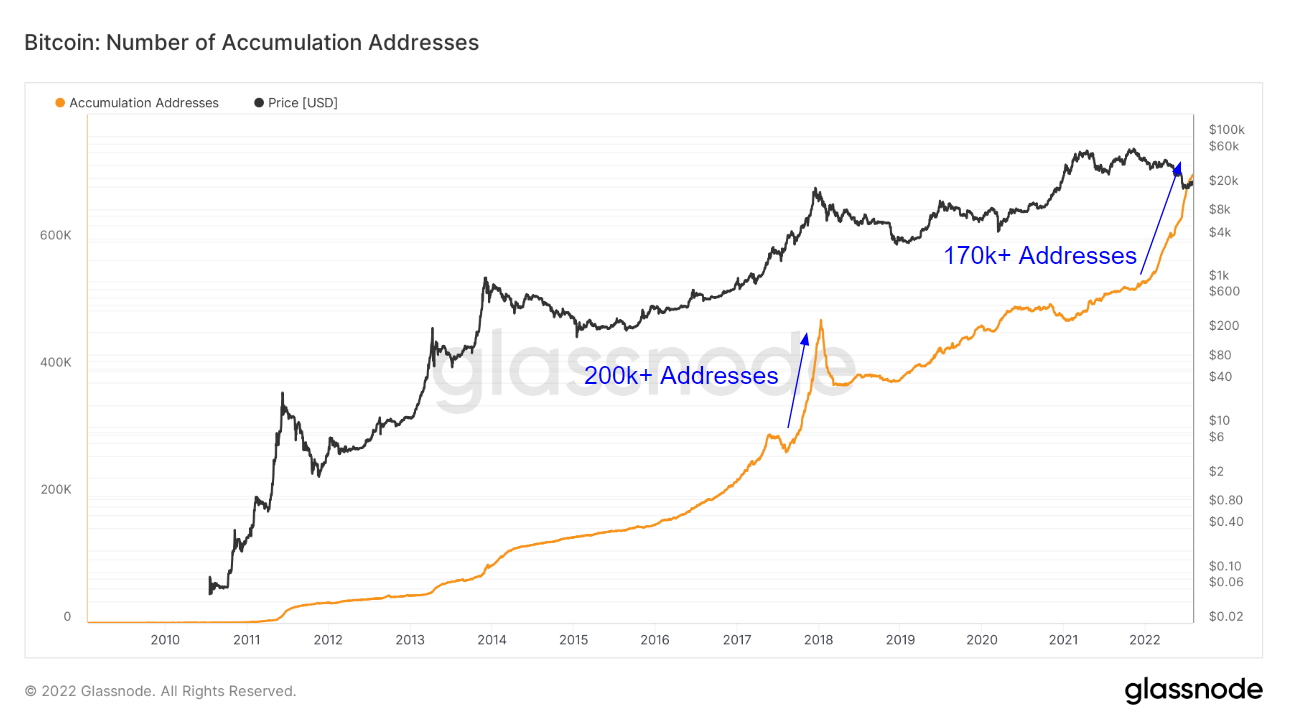
Zooming out to 2010 reveals an interesting trend — every time the number of these addresses increased, a bull run ensued.

The bull run of 2018 was preceded by the addition of 200,000 new accumulation addresses. Its peaks in 2014, 2013, and 2011 also correlated with a significant spike in the number of accumulation addresses. 

According to Glassnode’s data, accumulation addresses have grown by 18% since Jan. 1, 2022, reaching an all-time high of 700,000 addresses. 

The addition of 170,000 new accumulation addresses is typically a bullish indicator, as it shows an increasing amount of Bitcoin’s supply being taken out of the network. A drastically reduced supply of Bitcoins on exchanges then triggers an increase in buying pressure, pushing the price up. 

Bacaan Terkait

Pembongkaran Strategi Trading Bitcoin: Prediksi Selebritas dan Model Klasik Semua Tidak Akurat, Hanya Empat Indikator Ini yang Tersisa

Penulis, yang bukan trader profesional, mengembangkan strategi trading Bitcoin dengan mengevaluasi berbagai metode prediksi dari 2017 hingga 2025. Ia menyimpulkan bahwa prediksi dari selebritas dan model klasik seperti Stock-to-Flow tidak akurat, sementara indikator on-chain dan data institusional lebih andal. Empat indikator inti yang dipilih: 1. **MVRV Z-Score**: Mengukur deviasi harga dari biaya rata-rata pemegang, efektif untuk identifikasi bottom (daerah hijau), tetapi tidak akurat untuk puncak sejak 2024. 2. **SOPR 28-hari**: Menunjukkan penjualan rugi saat di bawah 1.0, sinyal bottom yang historis stabil. 3. **Aliran Dana ETF**: Indikator institusional kunci sejak 2024, dengan aliran masuk/keluar yang signifikan menunjukkan akumulasi/penjualan. 4. **Likuiditas Makro (Fed dan M2)**: Menentukan arah umum pasar, bukan timing. Fear & Greed Index digunakan hanya sebagai konfirmasi tambahan. Strategi ini mengandalkan resonansi tiga atau lebih sinyal untuk mengambil keputusan. Sistem otomatis memantau data, mengirim notifikasi hanya saat sinyal kuat terdeteksi. Pada 15 April 2026, sistem menunjukkan tiga sinyal bottom: Fear & Greed = 12 (panik ekstrem), MVRV di zona hijau, dan SOPR < 1.0, mirip dengan kondisi bottom historis seperti 2018, 2020, dan 2022. Namun, aliran ETF masih lemah, menunggu konfirmasi institusional. Penekanan pada kerangka kerja yang dapat diuji, bukan prediksi subjektif.

marsbit41m yang lalu

Pembongkaran Strategi Trading Bitcoin: Prediksi Selebritas dan Model Klasik Semua Tidak Akurat, Hanya Empat Indikator Ini yang Tersisa

marsbit41m yang lalu

Trading

Spot
Futures
活动图片