Crypto VCs Pivot to AI: A 'Coming of Age' Ceremony Beginning with a Collapse of Belief

比推Dipublikasikan tanggal 2026-02-05Terakhir diperbarui pada 2026-02-05

Abstrak

In a personal reflection, the author expresses sadness over Kyle Samani, a partner at crypto VC firm Multicoin Capital, publicly announcing his departure from the crypto industry to focus on AI, longevity tech, and robotics. Kyle was known for his thesis-driven, opinionated, and often controversial investment style—publicly criticizing Ethereum’s scaling roadmap, backing Solana early, and supporting DePIN projects like Helium. Despite mistakes (EOS, FTX exposure), he was transparent about losses and decisions. His exit feels symbolic: an honest, sharp voice leaving crypto. Before deleting the tweet, Kyle stated that crypto is primarily an asset ledger with limited use beyond finance, marking a shift from evangelist to realist—a “loss of faith” rather than just market loss. The author contrasts crypto’s current state—filled with memecoins, gambling, and technical debates—with AI’s rapid, tangible progress. Yet, they choose to stay, seeing crypto as a permissionless, open field for upward mobility and financial infrastructure innovation (e.g., stablecoins, DeFi, RWA), while remaining open to future possibilities.

Author: Dora B Dream, Deep Tide TechFlow

Original Title: Kyle Left the Crypto Industry, and I'm a Bit Sad


*This article expresses personal opinions.

On the morning of February 5th, a day that began with a market crash, I was scrolling through Twitter as usual when a departure announcement from Kyle Samani, a partner at the well-known crypto VC firm Multicoin, suddenly appeared in my feed. My finger paused on the screen for a few seconds. My heart sank. Why him?

I know Kyle, or more accurately, I know *of* him.

Back in 2020, during my junior year of college, I read Multicoin's "pitch" paper for the first time. It was eye-opening. The concept of being "Thesis-Driven" was imprinted in my mind.

I realized VCs could write like this—not using vague, PPT-style phrases like "we see long-term value in the XX sector," but thinking like traders, directly providing clear bullish and bearish logic, avoiding ambiguity, and presenting sharp, distinct viewpoints.

Kyle's persona on Twitter has always been distinct: aggressive, mean, offending countless people.

He dared to publicly criticize Ethereum's scaling roadmap when everyone was bullish on it. He dared to place firm bets on Solana when others dismissed it. He dared to promptly, transparently disclose losses and复盘 decision-making after the FTX collapse, where Multicoin suffered significant losses.

Many in the Western crypto circle dislike him, finding him *too arrogant*. But I've always felt the industry needs people like him.

Now he's gone. Pivoting to AI, longevity technology, robotics. I suddenly felt a pang of sadness: If even Kyle doesn't want to play anymore, what's wrong with this industry?

When Kyle Left

What makes me sad isn't just another VC pivoting to AI—who isn't talking about AI these days?

What makes me sad is that it's specifically Multicoin's Kyle, someone I viewed as very resolute.

What is the investment logic of most Crypto VCs? Spray and pray, bet on sectors, say nice things but never make a definitive judgment, or just follow others' leads.

Open the investment reports of those famous firms; it's always "we believe in a decentralized future," "we are optimistic about innovation in the XX field," but you never see a firm statement like "we think Project A will outperform Project B."

This isn't prudence; it's worldliness. No matter who wins, they can always say, "See, we were positioned early."

Kyle, or rather Multicoin, wasn't like that. He dared to make "life-or-death judgments."

He publicly declared Ethereum's sharding roadmap a dead end as early as 2017. He once bet on EOS and failed. In 2018, he placed his bets on Solana. In 2020, he strongly supported Helium, believing DePIN was the only viable non-financial use case for Crypto.

Yes, he missed many opportunities and made big mistakes—EOS and FTX are bloody lessons. But he never hid them, disclosing losses transparently and owning up to every error he should.

He wasn't the smartest VC, nor the gentlest evangelist, but he was one of the most "real" ones. His departure symbolizes a certain kind of "honesty and sharpness" fading from this industry.

That Instantly Deleted Tweet

What struck me even more was the tweet he sent just before leaving, though he deleted it instantly.

He said: "Crypto is not fundamentally as interesting as many crypto enthusiasts want it to be. I used to believe in the Web3 vision, I used to believe in dApps. I no longer do. Blockchains are primarily asset ledgers. They can reshape finance, but their potential in other areas is limited."
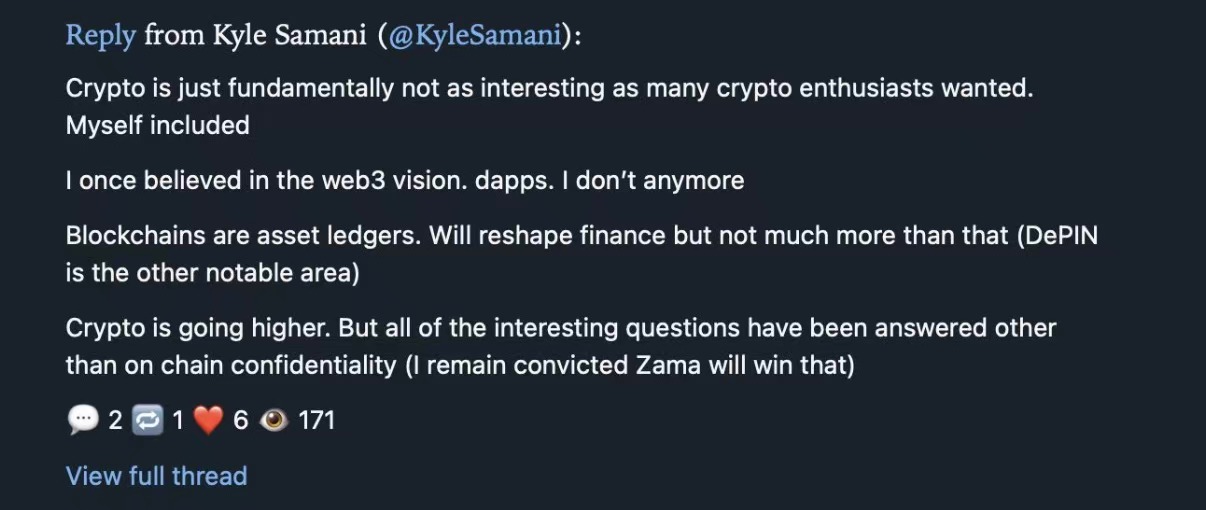
Why delete it instantly? Because saying it out loud makes you a "heretic."

Why couldn't he resist posting it? It's the conclusion reached by someone trapped between faith and reality, after spending 8 years and investing hundreds of millions of dollars.

I understand this feeling all too well because it mirrors my own journey this past year.

What did we believe in when we entered in 2021? That decentralized social would颠覆 Twitter. That on-chain identity (DID) would let users control their data. That GameFi would let players truly "own their assets." Back then, everyone on Twitter timelines was discussing "how Web3 will change the world." Every new project felt like a gateway to the future.

What is the reality in 2025? Friend.tech died. Lens Protocol has no users. ENS has become a tool for speculation; no one actually uses DID beyond wallet addresses. The collapses of Axie and StepN proved "X to Earn" is just a Ponzi scheme in disguise.

But Kyle didn't否定 everything. He still sees value in stablecoins, DeFi, RWA (these financial applications), and projects like Helium (DePIN). He's still betting on technologies like Zama's fully homomorphic encryption.

The question is: Do these things still require "faith"? Or just rational calculation?

Some see Kyle's departure as a betrayal. In my eyes, it's a process of "disenchantment"—transitioning from a Crypto Evangelist to a Crypto Realist. This transformation might be the necessary coming-of-age ceremony the entire industry must undergo.

Last Time We Lost Money, This Time We're Losing Confidence

When FTX imploded in 2022, the entire industry hit rock bottom. Luna went to zero, Three Arrows Capital破产, the market was halved and halved again. But back then, everyone still held onto a belief: The market crashed, but we weren't wrong. If we persevere, the bull market will prove us right.

Back then, we still believed in Ethereum's "endgame narrative"—from PoW to PoS, from a single chain to modularity—thinking it was the necessary path to the "world computer."

We still believed in Solana's "performance revolution," thinking that high-performance chains would surely win if they could just survive the bear market.

We still believed in Web3's "paradigm shift," believing the next chapter of the internet必然 was decentralization.

What about now, in 2025?

Objectively, the data is much better than the last trough. BTC briefly surpassed $100,000, ETFs were approved, and Crypto's ties with Wall Street grew stronger.

But the subjective feeling is completely opposite. Prices are higher, but confidence is lower.

The "culprit," or perhaps the "revealing mirror," is AI.

When ChatGPT launched in 2023, everyone was discussing "how AI will change the world." What was Crypto discussing at the same time? "Should L2 sequencers be decentralized?" One was talking about a productivity revolution; the other was arguing over technical details.

The subsequent two years saw AI progress at a dizzying pace: Gemini, Claude, ChatGPT—a three-way battle, with new developments daily. Lately, everyone is obsessed with OpenClaw.

And Crypto? There are more and more L2s and chains, but no one can clearly explain "why we need 100 L2s." Even Vitalik has reflected on past roadmap mistakes. NFT, GameFi, SocialFi have all had their moments, but they were all flashes in the pan.

By now, the biggest innovation of this cycle has turned out to be Meme Coins and "reinventing gambling."

I often ask myself late at night: AI is redefining productivity with technology. Crypto is redistributing wealth with financial games. The former creates; the latter transfers. What are we actually building?

Kyle's departure is, at its core, a "value choice."

He chose to chase AI, longevity tech, robotics—fields that are truly "expanding human frontiers." Crypto, at least for now,更像 is a high-stakes casino.

But I'm Not Ready to Leave Yet

After saying all this, you might think I'm about to announce my exit too.

But no, I still want to "gamble" one more time.

Kyle can leave because he is already financially free and can pursue grander dreams. But for young people like me, Crypto still represents: a relatively fair channel for "upward mobility," a "permissionless" testing ground that doesn't require diplomas, background, or connections—just cognition and courage. It's an emerging industry not yet completely monopolized by the elite class.

More importantly, perhaps the grand Web3 narrative has failed, but that doesn't mean Crypto is worthless.

The revolution in financial infrastructure has already happened. The daily settlement volume of stablecoins has surpassed Visa. DeFi allows people worldwide to use financial services and RWA 24/7.

Most crucially: I haven't figured out my own answer yet.

Kyle spent 8 years concluding "Crypto is just an asset ledger."

But I'm still just a rookie; what right do I have to make that judgment now?

Maybe in a few years, I'll leave like he did. But for now, I want to stay at the table to see if this industry still holds some unseen possibilities.

Years from now, Crypto might no longer be the "disrupt-everything" revolution but rather the value settlement layer for the AI era.

When that time comes, I'll order a coffee and chat about the scenery I saw along the way.


Twitter:https://twitter.com/BitpushNewsCN

Bitpush TG Discussion Group:https://t.me/BitPushCommunity

Bitpush TG Subscription: https://t.me/bitpush

Original article link:https://www.bitpush.news/articles/7609106

Pertanyaan Terkait

QWhy did Kyle Samani's departure from the crypto industry resonate so deeply with the author?

ABecause Kyle represented a rare combination of honesty, sharpness, and a willingness to make bold, public judgments in an industry often filled with vague, non-committal statements. His departure felt like the loss of a 'real' and aggressive voice that the author believed the industry needed.

QWhat was the core belief that Kyle Samani expressed in his since-deleted tweet?

AHe expressed that cryptocurrency is not as revolutionary as many enthusiasts hope. He no longer believes in the Web3 vision or dApps, concluding that blockchain is primarily a ledger for assets with significant potential mainly in finance, but limited potential in other fields.

QHow does the author contrast the current state of the AI and Crypto industries?

AThe author contrasts them by stating that AI is focused on a 'productivity revolution,' creating new things and pushing the boundaries of human capability with rapid, tangible progress. In contrast, much of Crypto's recent innovation has been in 'Meme Coin and reinventing gambling,' which is more about wealth transfer than creation, leading to a crisis of confidence despite higher prices.

QDespite the author's sense of disillusionment, what reasons do they give for staying in the crypto industry?

AThe author cites that crypto still offers a relatively fair path for social mobility ('class leap'), a permissionless testing ground that doesn't require traditional credentials, and that the financial infrastructure revolution (e.g., stablecoins, DeFi) is already real. They feel it's too early in their own journey to make a final judgment and want to see if there are still unseen possibilities.

QWhat does the author mean by calling Kyle's departure a '祛魅' (disenchantment) and the industry's 'adult ceremony'?

AIt means that Kyle's shift from a 'Crypto Evangelist' to a 'Crypto Realist' represents a loss of naive faith and a transition to a more mature, sober, and pragmatic understanding of the technology's actual capabilities and limitations, which the author believes is a necessary growing-up phase for the entire industry.

Bacaan Terkait

Setelah Tiga Kuartal Berturut-Turut Turun, Bisakah Pasar Kripto Menyambut Jendela Stabilitas di Kuartal Ketiga?

Pasar kripto mengalami kuartal terburuk sejak 2022, dengan kapitalisasi pasar turun 12.6% menjadi $2.1 triliun, didorong oleh keluarnya modal dan penurunan volume perdagangan. Bitcoin dan Ethereum masing-masing jatuh 14.2% dan 25.4% di kuartal kedua. Aliran keluar bersih dari ETF Bitcoin AS mencapai $4.67 miliar, menandakan tekanan jual yang berkelanjutan. Faktor utama meliputi terputusnya hubungan dengan saham AS, kebijakan moneter Federal Reserve yang ketat, dan pelepasan aset oleh perusahaan seperti Strategy. Proses legislasi UU CLARITY yang akan memberikan kejelasan regulasi terhambat, meningkatkan premi risiko di sektor ini. Namun, ada tanda-tanda potensi stabilisasi. Aliran keluar ETF yang besar secara historis sering terjadi di akhir fase penurunan, dan para pemegang Bitcoin jangka panjang mulai menambah kepemilikan lagi. Sementara sebagian besar sektor menyusut, pasar prediksi dan aset koleksi yang ditokenisasi mencatat pertumbuhan signifikan. Pandangan untuk kuartal ketiga sangat bergantung pada pertemuan Fed akhir Juli. Sinyal kebijakan yang lunak dapat mendukung pemulihan Bitcoin, sementara sikap yang hawkish dapat memicu konsolidasi lebih lanjut. Meskipun tantangan regulasi tetap ada, indikator teknis seperti harga Bitcoin yang mendekati rata-rata bergerak 200-mingguannya menunjukkan dasar jangka panjang belum rusak. Logika pasar telah bergeser dari mengandalkan narasi ke faktor fundamental seperti kebijakan dan ekspektasi suku bunga.

marsbitKemarin 08:40

Setelah Tiga Kuartal Berturut-Turut Turun, Bisakah Pasar Kripto Menyambut Jendela Stabilitas di Kuartal Ketiga?

marsbitKemarin 08:40

The SpaceX Trade, Terbuka: SPCXON Mulai Diperdagangkan di WEEX

SpaceX meluncurkan IPO terbesar dalam sejarah pada Juni 2026, namun akses bagi banyak pedagang terhambat oleh batasan regional dan prosedur broker. WEEX kini menghadirkan SPCXON/USDT di pasar spotnya, sebuah instrumen tokenisasi yang memungkinkan paparan terhadap pergerakan harga SpaceX melalui akun kripto yang diselesaikan dengan USDT, tanpa memerlukan broker AS atau pembiayaan bank. SPCXON adalah produk tokenisasi yang mencerminkan ekonomi kepemilikan SpaceX bagi pedagang yang memenuhi syarat di luar AS, dengan dividen diinvestasikan kembali. Aset ini diperdagangkan di WEEX sebagai pasangan spot dengan USDT, tersedia selama jam pasar, memberikan akses mudah bagi trader kripto. Kasus investasi untuk SpaceX didasarkan pada pertumbuhan pendapatan Starlink dan pencapaian Starship, meskipun valuasinya yang tinggi (sekitar 90-110 kali pendapatan) telah memperhitungkan eksekusi sempurna selama bertahun-tahun. Faktor seperti jumlah saham publik yang terbatas dan masa buka kunci (unlock) insider pertama menjadi pertimbangan penting. Penting untuk diingat bahwa SPCXON memberikan paparan, bukan kepemilikan langsung atas saham atau hak suara. Harganya dapat diperdagangkan pada premium atau diskon terhadap nilai aset bersih. WEEX menawarkan akses ke berbagai aset TradFi yang ditokenisasi seperti ini dalam satu akun terpadu, bersama dengan pasar futures dan kampanye perdagangan dengan pool hadiah.

TheNewsCryptoKemarin 08:33

The SpaceX Trade, Terbuka: SPCXON Mulai Diperdagangkan di WEEX

TheNewsCryptoKemarin 08:33

Momen Perdagangan BIT: BTC Masih Tertekan oleh EMA 200 Mingguan, Setelah Ditolak Mungkin Kembali Turun, Saham Penyimpanan dan Semikonduktor yang Melonjak Malam Kemudian Mulai Anjlok di Pasar Malam

**PASAR KRIPTO & SAHAM: BTC Hadapi Resistensi, Saham Semikonduktor Turun di Perdagangan Malam** Pasar kripto melanjutkan pemulihan, dengan harga Bitcoin bertahan di sekitar $66,000 setelah rebound lebih dari 15% dari titik terendah Juli. Namun, BTC menghadapi **tembok resistensi kuat di dekat $68,000**, yang bertepatan dengan biaya rata-rata investor selama lima bulan terakhir dan titik gagalnya rebound pertengahan Juni. Secara teknis, perhatian tertuju pada **200 EMA mingguan (~$68,328) sebagai level kunci**. Jika BTC ditolak di level ini, potensi penurunan menuju support $63,000 terbuka. Analis menyoroti volume rendah dan penurunan open interest futures di CME, menandakan rebound ini lebih dipicu likuiditas rendah musim panas daripada awal bull run penuh. Di pasar saham AS, **indeks futures utama turang** setelah sesi kemarin yang kuat. Sektor semikonduktor dan penyimpanan (storage), yang melonjak pada hari Selasa (contoh: Micron +12%), **mengalami koreksi di perdagangan malam (night trading)**. ETF semikonduktor turun 2,22% dan saham Micron turun 2,29%. Meski begitu, ada sorotan positif seperti **Super Micro Computer (SMCI)** yang naik lebih dari 15% setelah melaporkan pandangan pendapatan yang kuat dan pesanan baru yang sangat besar, mengonfirmasi permintaan server AI tetap solid. Kekhawatiran makro muncul dari **kenaikan harga minyak mentah (di atas $91)** akibat ketegangan geopolitik dan **lonjakan imbal hasil (yield) obligasi pemerintah AS**, dengan imbal hasil 10-tahun mencapai sekitar 4,64%. Faktor-faktor ini dapat menambah tekanan inflasi dan membatasi ruang gerak pasar saham. Saham terkait kripto seperti Coinbase dan Robinhood naik kuat didorong oleh perkembangan regulasi yang lebih jelas di AS. Di Asia, **Korea Selatan** dan **Jepang** menunjukkan kinerja beragam. Indeks KOSPI Korea naik didukung pemulihan saham semikonduktor, sementara pasar Jepang melemah dengan **Yen terus melemah ke level terendah sejak 1986**, meningkatkan kekhawatiran akan intervensi bank sentral. **Yang Perlu Diperhatikan Selanjutnya:** * **22 Juli:** Acara AI AMD, rilis laporan keuangan dari Google (Alphabet), Tesla, IBM. * **23 Juli:** Keputusan suku bunga Bank Sentral Eropa (ECB), data klaim pengangguran AS, laporan keuangan Intel. * Perkembangan lebih lanjut dari **harga minyak, imbal hasil obligasi, dan dinamika Yen Jepang** akan menjadi penentu sentimen pasar risiko secara keseluruhan.

marsbitKemarin 08:32

Momen Perdagangan BIT: BTC Masih Tertekan oleh EMA 200 Mingguan, Setelah Ditolak Mungkin Kembali Turun, Saham Penyimpanan dan Semikonduktor yang Melonjak Malam Kemudian Mulai Anjlok di Pasar Malam

marsbitKemarin 08:32

Mantan Ketua CFTC dan Presiden Circle, Tarbert: Satu Pihak Menasihati Anda untuk Berpikir Jangka Panjang, di Sisi Lain Menguangkan $30 Juta Sendiri

Penulis: Zen, PANews Heath Tarbert, mantan Ketua CFTC dan Presiden Circle, baru-baru ini menyerukan kepada investor untuk mengadopsi pandangan jangka panjang terhadap saham Circle, meskipun harganya telah turun 70% dari puncaknya. Namun, ia sendiri secara konsisten menjual saham CRCL sejak perusahaan go public, menguangkan sekitar $30 juta tanpa pernah membeli saham tambahan di pasar terbuka. Tarbert, yang bergabung dengan Circle pada Juli 2023 dan menjadi Presiden pada awal 2025, dikenal sebagai pendukung kuat narasi "jangka panjang" perusahaan. Namun, sehari sebelum IPO Circle, ia menetapkan rencana perdagangan 10b5-1 untuk menjual hingga 353.290 saham dalam setahun. Dalam 13 bulan setelah IPO, ia menjual lebih dari 360.000 saham, termasuk penjualan tunggal senilai $11,5 juta pada Maret 2026. Ia bahkan menetapkan rencana 10b5-1 kedua untuk menjual hingga 160.000 saham lagi pada akhir tahun 2026. Langkah Tarbert ini menuai kecaman karena dianggap tidak konsisten dengan pesan "jangka panjang" yang ia sampaikan kepada publik. Perjalanan kariernya sering dikaitkan dengan "revolving door" antara regulator dan dunia keuangan. Setelah mengundurkan diri sebagai Ketua CFTC pada Maret 2021, ia bergabung dengan Citadel Securities hanya 27 hari kemudian sebagai Kepala Penasihat Hukum, tepat saat perusahaan itu menghadapi pengawasan ketat terkait peristiwa GameStop. Di Citadel, ia juga mendukung undang-undang yang memperluas wewenang CFTC atas pasar crypto, sementara Citadel diketahui berencana berekspansi ke aset kripto. Tarbert kemudian pindah ke Circle pada 2023, membantu perusahaan mengatasi tantangan regulasi dan akhirnya go public melalui IPO langsung. Meskipun sangat berharga bagi perusahaan, tindakannya menjual saham dalam jumlah besar sambil mendorong investor untuk bertahan menimbulkan pertanyaan tentang komitmennya yang sebenarnya terhadap masa depan jangka panjang Circle.

marsbitKemarin 08:09

Mantan Ketua CFTC dan Presiden Circle, Tarbert: Satu Pihak Menasihati Anda untuk Berpikir Jangka Panjang, di Sisi Lain Menguangkan $30 Juta Sendiri

marsbitKemarin 08:09

Gate Research Institute: Produk Keuangan Kripto Menggulirkan Gelombang "Wall Street-ization", Kompetisi atau Integrasi?

**Ringkasan: Gelombang "Wall Street-ization" Produk Keuangan Kripto: Kompetisi atau Integrasi?** Artikel ini membahas fenomena konvergensi antara keuangan tradisional (TradFi) dan keuangan kripto (Crypto). Meskipun Bitcoin awalnya dirancang sebagai sistem peer-to-peer yang terdesentralisasi dan bebas dari perantara seperti bank, pasar kripto kini semakin diintegrasikan ke dalam infrastruktur keuangan tradisional. **Tren "Wall Street-ization":** Dimulai dengan disetujuinya ETF spot Bitcoin pada 2024, aset kripto kini dikemas menjadi produk seperti ETF (oleh BlackRock, Fidelity, dll.), futures, dan sekuritisasi aset riil (RWA) seperti obligasi pemerintah yang ditokenisasi. Ini memberikan akses yang mudah dan teregulasi bagi investor institusional, tetapi juga berarti kekuasaan atas penerbitan, penentuan harga, kustodian, dan distribusi aset kripto semakin bergeser ke lembaga keuangan besar. **Dua Jalur Konvergensi (1+1>2):** Artikel ini menyoroti dua arah integrasi: 1. **Dari CEX ke TradFi:** Dilambangkan oleh **Gate.io**, yang berkembang dari bursa kripto menjadi platform multi-aset. Gate kini menawarkan perdagangan saham nyata (AS, Hong Kong, Korea) menggunakan USDT, menyediakan akses tanpa batas waktu ke pasar tradisional. 2. **Dari TradFi ke Crypto:** Dilambangkan oleh **Robinhood**, platform broker tradisional yang memperluas layanannya ke aset kripto (termasuk melalui akuisisi Bitstamp) dan mengembangkan produk seperti token saham di blockchain. **Tujuan Bersama: Akun Keuangan "Super" Terpadu:** Kedua jalur ini bertujuan menciptakan **akun keuangan generasi berikutnya yang terpadu**. Pengguna di masa depan mungkin dapat memperdagangkan Bitcoin, saham Apple, ETF, emas, dan obligasi pemerintah yang ditokenisasi dalam satu antarmuka yang sama, menggunakan stablecoin sebagai lapisan dana. **RWA dan Obligasi Pemerintah di On-Chain sebagai Lapisan Tengah:** Tokenisasi aset dunia nyata, terutama obligasi pemerintah AS, menyediakan aset berpenghasilan rendah risiko di ekosistem on-chain. Pasar ini tumbuh pesat (naik 40% pada paruh pertama 2026) meskipun pasar kripto turun, menunjukkan permintaan nyata. **Kesimpulan:** "Wall Street-ization" bukanlah pengambilalihan sepihak, melainkan **transformasi timbal balik**. TradFi dan Crypto saling melengkapi: Crypto mendapatkan akses ke likuiditas, kepatuhan, dan jaringan distribusi yang luas, sementara TradFi mengadopsi efisiensi, kecepatan, dan pasar 24/7 dari Crypto. Hasil akhirnya adalah pembentukan **pasar modal terpadu yang lebih efisien dan global**, di mana batas antara aset tradisional dan kripto semakin kabur.

marsbitKemarin 08:07

Gate Research Institute: Produk Keuangan Kripto Menggulirkan Gelombang "Wall Street-ization", Kompetisi atau Integrasi?

marsbitKemarin 08:07

Trading

Spot
活动图片





