Survey Finds 54% of Firms Plan Stablecoin Adoption by 2026; Best Wallet Token Presale Nears $16M

bitcoinistDipublikasikan tanggal 2025-09-17Terakhir diperbarui pada 2025-09-17

Abstrak

Per an EY-Parthenon survey, 54% of business leaders who have yet to touch stablecoins plan to do so by 2026....

Trusted Editorial content, reviewed by leading industry experts and seasoned editors. Ad Disclosure

Per an EY-Parthenon survey, 54% of business leaders who have yet to touch stablecoins plan to do so by 2026.

Why the change of heart? Lower transaction costs and faster cross-border payments are the main reasons organizations are turning to stablecoins.

Since crypto wallets play a key role in enabling stablecoin transactions, choosing the right one matters. One option we like is Best Wallet, thanks to its ease of use and security.

Its native token, $BEST, also deserves a shout-out. It’s close to raising nearly $16M on presale, as it supports the wallet’s developments and grants holders low gas fees.

Only 13% of Firms Use Stablecoins, But 41% Report Big Savings

The report found that, right now, only around 13% of financial institutions and  international corporations use stablecoins. One of the main reasons for them not doing so boils down to regulatory uncertainty.
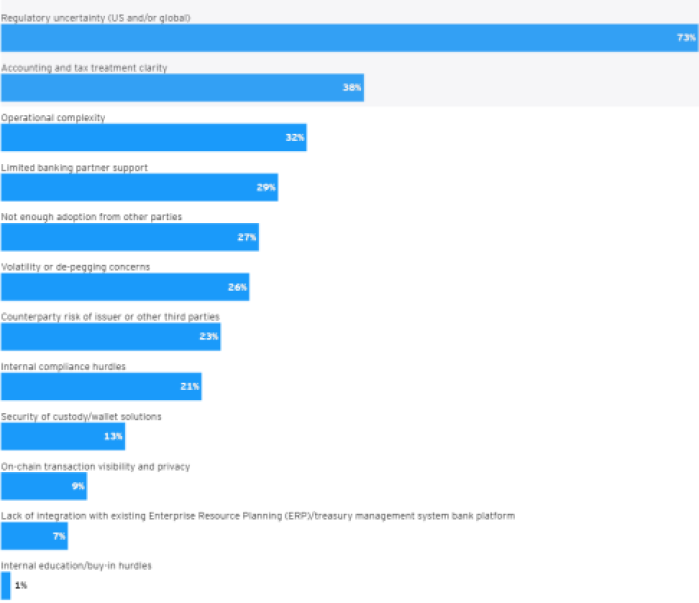
Graph showing reasons behind low stablecoin adoption.
Source: EY-Parthenon

Yet, this percentage is on the rise following the passage of the GENIUS Act on July 18. It gives institutions greater regulatory clarity and, thus, confidence to move forward with adopting these digital assets.

And it’s no wonder stablecoins are attracting attention. Among current users, 41% said they’ve saved over 10% in costs compared to traditional payment methods.

The top use case for stablecoins is cross-border supplier payments, which account for 62% of implementations.

The reason is that they’re 1:1 backed by reserve assets (often the US dollar) for stability. Yet, they have faster settlement times compared to traditional international transfers.

Out of the stablecoins available, US-dollar-pegged ones are the go-to choice. $USDC is the clear frontrunner with 77%, followed by $USDT at 59%.

If these stablecoins are top of your radar, Best Wallet is a great way to manage, buy, and sell them.

Store Top Stablecoins & Cryptos on Best Wallet

Available on Google Play and iOS, the Best Wallet app is a great way to manage, buy, sell, and swap various types of cryptos while out and about.

The mobile app already supports over 1K+ assets across top chains like Ethereum, BNB Chain, and Polygon. This includes top stablecoins like $USDC and $USDT, plus leading cryptos like $BTC, $ETH, and $BNB.

It takes pride in making crypto activities simple. Check out its built-in launchpad, for instance. It gives you access to the best crypto presales. And that’s not to mention its swap engine, which scans 330+ DEXs and 30 bridges to find you the best rates.
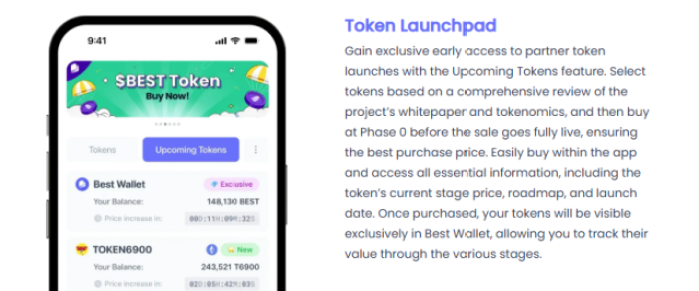
Best Wallet has its own crypto launchpad.
Source: Best Wallet

And all is achieved with security intact. Because Best Wallet’s non-custodial, it ensures that you, and only you, have access to your private keys.

Also helping prevent unauthorized access are extra layers of protection like 2FA, biometrics, and local encryption.

Even if you lose account access, you can rest easy knowing that you can restore your assets through encrypted cloud backups.

The app also has lots to look forward to in the pipeline, including an NFT gallery, intel market analytics, and a rewards hub.

$BEST will make this possible, as a quarter of its total token supply is set aside for product development.
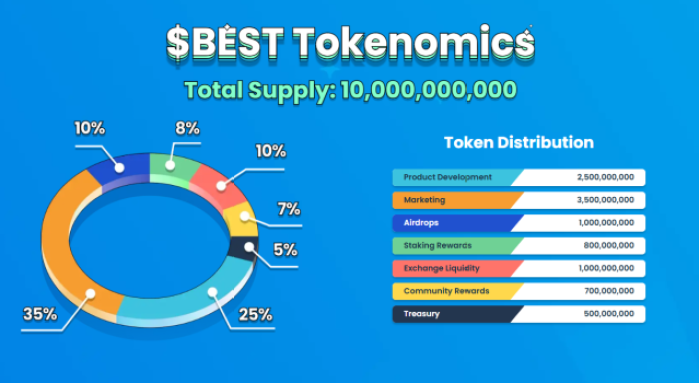
Best Wallet tokenomics.
Source: Best Wallet Token

Holding $BEST also grants governance rights, reduces gas fees, and offers staking rewards at an 83% APY.

So far, $BEST has raised over $15.9M on presale, backed by three major investors ($70.2K, $91.1K, and $59K).

You can buy $BBEST for as little as $0.025655. Following the upcoming app developments, the cost could increase to $0.072 this year, making now a great time to join before it possibly spikes by over 180%.

Want to learn more? Check out our Best Wallet guide.

Authored by Leah Waters, Bitcoinist – https://bitcoinist.com/stablecoin-adoption-rises-best-wallet-nears-16m

Editorial Process for bitcoinist is centered on delivering thoroughly researched, accurate, and unbiased content. We uphold strict sourcing standards, and each page undergoes diligent review by our team of top technology experts and seasoned editors. This process ensures the integrity, relevance, and value of our content for our readers.

Leah is a British journalist with a BA in Journalism, Media, and Communications and nearly a decade of content writing experience. Over the last four years, her focus has primarily been on Web3 technologies, driven by her genuine enthusiasm for decentralization and the latest technological advancements. She has contributed to leading crypto and NFT publications – Cointelegraph, Coinbound, Crypto News, NFT Plazas, Bitcolumnist, Techreport, and NFT Lately – which has elevated her to a senior role in crypto journalism. Whether crafting breaking news or in-depth reviews, she strives to engage her readers with the latest insights and information. Her articles often span the hottest cryptos, exchanges, and evolving regulations. As part of her ploy to attract crypto newbies into Web3, she explains even the most complex topics in an easily understandable and engaging way. Further underscoring her dynamic journalism background, she has written for various sectors, including software testing (TEST Magazine), travel (Travel Off Path), and music (Mixmag). When she's not deep into a crypto rabbit hole, she's probably island-hopping (with the Galapagos and Hainan being her go-to's). Or perhaps sketching chalk pencil drawings while listening to the Pixies, her all-time favorite band.

Bacaan Terkait

Huang Renxun: Prompt Sudah Usang, Loop adalah Paradigma Baru

**Ringkasan:** **Prompt Sudah Ketinggalan Zaman, Loop adalah Paradigma Baru.** Menurut Huang Renxun (Jensen Huang), pendiri NVIDIA, tugas utama di era AI sekarang bukan lagi menulis perintah (prompt), tetapi **menulis dan mengelola loop (siklus).** **Apa itu Loop?** Loop adalah sistem di mana Anda mendefinisikan suatu tujuan, dan AI menjalankannya secara mandiri—memeriksa hasil, memperbaiki kesalahan, dan mengulangi proses tersebut hingga tugas selesai atau mencapai batas tertentu. Manusia beralih peran dari "pemberi perintah" menjadi **"perancang aturan" atau "arsitek sistem."** **Loop vs. Agent:** Agent adalah "pekerja" yang menjalankan tugas. Loop adalah **mekanisme pengelolaan** yang memungkinkan Agent bekerja terus-menerus tanpa pengawasan manusia. Agent dengan loop menjadi sistem yang dapat berjalan otomatis. **Contoh Penerapan:** Produk seperti Claude Code (dengan fitur /loop, /goal, /schedule) dan OpenAI Codex telah menerapkan konsep ini. Mereka membagi tugas kompleks ke beberapa Agent yang berjalan paralel di lingkungan terisolasi, dengan model terpisah untuk menulis kode dan memvalidasi hasil, memastikan objektivitas. **Bagaimana Memulai Loop?** 1. **Uji Kelayakan:** Pastikan tugas berulang, dapat divalidasi otomatis, dan anggaran token mencukupi. 2. **Mulai dari Loop Minimal:** Bangun sistem dengan pemicu otomatis, keterampilan (skill), file status (STATE.md), dan "gerbang" validasi (seperti pengujian). 3. **Pisahkan Pemeriksa dan Pelaksana:** Gunakan model atau Agent berbeda untuk menulis kode dan memeriksa/mengujinya. Ini kunci untuk kualitas. 4. **Hindari Jebakan Umum:** Tetapkan batas pengulangan dan token, simpan status, hindari tugas yang membutuhkan pertimbangan manusia, dan tetap tinjau perubahan kode (diff). 5. **Ukur Efektivitas:** Metrik utama adalah **biaya rata-rata per perubahan yang diterima.** **Evolusi Paradigma:** Perkembangan AI menunjukkan pergeseran berkelanjutan: 1. **Prompt Engineering** (2023-2024): Fokus pada cara menulis perintah. 2. **Context Engineering** (2024-2025): Fokus pada informasi dan latar belakang yang diberikan ke AI. 3. **Harness Engineering** (2025-2026): Fokus pada lingkungan eksekusi dimana AI dapat menggunakan alat dan sumber daya. 4. **Loop Engineering** (sekarang): Fokus pada merancang sistem siklus otomatis yang berjalan mandiri. Konsep loop memiliki akar akademis, seperti dalam framework **ReAct** (Reasoning + Acting) yang dikembangkan oleh Yao Shunyu dkk., yang menggabungkan penalaran dan tindakan dalam sebuah siklus. **Catatan Penting:** Meskipun menjanjikan, teknologi ini masih awal. Perlu kehati-hatian terhadap biaya token dan kompleksitas. Seperti dikutip Andrej Karpathy, **"Anda dapat mengalihdayakan pemikiran Anda, tetapi Anda tidak dapat mengalihdayakan pemahaman Anda."** Pemahaman mendalam tentang masalah tetap berada di tangan manusia.

marsbit1j yang lalu

Huang Renxun: Prompt Sudah Usang, Loop adalah Paradigma Baru

marsbit1j yang lalu

GPT Merancang GPT

OpenAI akhirnya merilis chip pertamanya, Jalapeño. Meski banyak yang menganggapnya sebagai tantangan bagi Nvidia, inti dari langkah ini justru adalah pengakuan terbuka OpenAI bahwa mereka tidak puas hanya menjadi perusahaan model AI. Mereka ingin mengontrol seluruh proses produksi kecerdasan, dari model, chip, hingga pusat data dan energi. Perbedaan kemampuan model semakin menyempit, namun kesenjangan dalam komputasi justru melebar. Dalam era AI, satuan biaya terpenting bukan lagi harga server atau GPU, melainkan biaya produksi setiap Token. Sebagai penyedia layanan seperti ChatGPT dan API, OpenAI menghadapi kenyataan bahwa semakin sukses produk mereka, semakin besar "pajak inferensi" yang harus dibayarkan ke penyedia hardware eksternal. Jalapeño adalah upaya membangun "pabrik Token" sendiri untuk mengurangi ketergantungan ini. Yang menarik, siklus pengembangan chip Jalapeño hanya sembilan bulan, jauh lebih cepat dari standar industri. Kunci percepatan ini adalah pengetahuan OpenAI tentang beban kerja model nyata. Mereka bahkan menggunakan model AI mereka sendiri untuk mempercepat bagian proses desain dan optimasi chip. Ini menciptakan siklus umpan balik: model yang lebih baik membantu mendesain chip yang lebih baik, yang kemudian menurunkan biaya menjalankan model generasi berikutnya. Jalapeño difokuskan untuk inferensi, bukan pelatihan. Inferensi adalah pengeluaran tunai harian yang masif, terutama dengan berkembangnya Agent dan tugas-tugas rantai panjang. Dengan mengurangi "pajak inferensi" ini, OpenAI dapat meningkatkan margin keuntungan layanannya. Strategi OpenAI semakin mirip dengan Apple: membangun ekosistem tertutup yang terintegrasi, dari model (perangkat lunak intelijen), antarmuka seperti ChatGPT, hingga chip dan infrastruktur fisik. Mereka tidak ingin menjual "sekop" (seperti Nvidia), tetapi memiliki "tambang" dan menjual "kecerdasan" yang dihasilkannya. Pada akhirnya, artikel ini menyimpulkan bahwa aset terpenting di era AI sedang bergeser. Model akan terus berubah seperti "aliran traffic," tetapi infrastruktur produksi—chip, jaringan, pusat data, energi—akan menjadi "tanah" yang dikuasai oleh sedikit pemain. Dengan Jalapeño, OpenAI menyatakan ambisinya: tidak hanya menjadi perusahaan paling cerdas, tetapi mengontrol produksi kecerdasan itu sendiri.

marsbit1j yang lalu

GPT Merancang GPT

marsbit1j yang lalu

Trading

Spot
Futures
活动图片