Dogecoin Price Retests 100 SMA Again – Here’s What It Means For Price

bitcoinistDipublikasikan tanggal 2025-06-23Terakhir diperbarui pada 2025-06-23

Abstrak

After a turbulent price action over the weekend that saw Dogecoin briefly dip below $0.15, the meme-inspired cryptocurrency is now...

Trusted Editorial content, reviewed by leading industry experts and seasoned editors. Ad Disclosure

After a turbulent price action over the weekend that saw Dogecoin briefly dip below $0.15, the meme-inspired cryptocurrency is now back again to testing an important technical level. Particularly, DOGE is now revisiting the 100-week Simple Moving Average (SMA), which has served as a strong support line for more than a year on the weekly candlestick timeframe, raising questions about what might unfold next for its price movement.

Dogecoin Revisits Familiar Support Line

Dogecoin’s recent extended price decline saw it break below $0.15 very briefly in the past 24 hours. Notably, Dogecoin slipped below $0.16 on Saturday for the first time since April, extending a downtrend that’s seen its price fall about 36% in the past 30 days. Over the weekend, DOGE’s price dropped to around $0.143 before rebounding to approximately $0.153 behind heavy trading volume of over five times the recent daily average. 

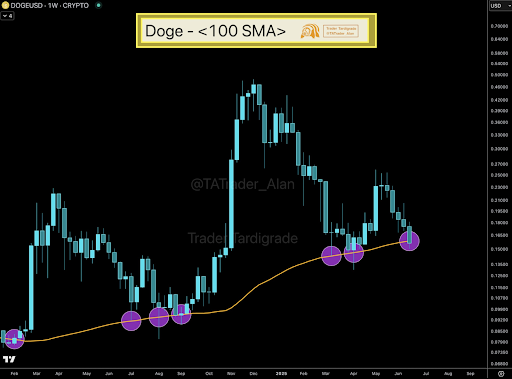
Interestingly, this downward price action has seen DOGE now retesting a technical indicator that has had an important hand in its price action over the past year. This phenomenon was first noted on the social media platform X by crypto analyst Trader Tardigrade.
Dogecoin
Source: Trader Tardigrade on X

The chart shared by the crypto analyst on X captures an important pattern. DOGE’s weekly candles have repeatedly bounced off the 100 SMA over the past year, which has made it a vital technical floor for the meme coin. Each time Dogecoin’s price approached or dipped slightly below this moving average, it quickly recovered and went on uptrends.

Dogecoin’s brief plunge to around $0.143, its lowest point since early April, before rebounding above $0.15, has now placed interest with the 100 SMA, which could serve as a launchpad once again if bullish sentiment seeps in.

DOGE Price Zones To Watch

Right now, the important thing is whether Dogecoin can maintain its footing above the $0.145 to $0.151 support zone. The quick rebound following the weekend’s drop below $0.15 shows that buyers are still stepping in at this level. However, any signs of weakness could invalidate the bullish outlook of a bounce off the 100 SMA.

On the upside, reclaiming the $0.153 to $0.16 resistance range with volume confirmation would lend credibility to the idea that Dogecoin is ready for another rally from the 100 SMA. If that happens, price history shows Dogecoin could mirror previous reactions off this moving average and set up a rebound to a resistance level between $0.19 and $0.21. If the current retest leads to another successful bounce, a projection of the most recent bounce shows a move to at least $0.3 could be next.

At the time of writing, Dogecoin is trading at $0.1547, down by 2% in the past 24 hours.

Dogecoin
DOGE trading at $0.15 on the 1D chart | Source: DOGEUSDT on Tradingview.com
Featured image from Getty Images, chart from Tradingview.com
Editorial Process for bitcoinist is centered on delivering thoroughly researched, accurate, and unbiased content. We uphold strict sourcing standards, and each page undergoes diligent review by our team of top technology experts and seasoned editors. This process ensures the integrity, relevance, and value of our content for our readers.

Scott Matherson is a leading crypto writer at Bitcoinist, who possesses a sharp analytical mind and a deep understanding of the digital currency landscape. Scott has earned a reputation for delivering thought-provoking and well-researched articles that resonate with both newcomers and seasoned crypto enthusiasts. Outside of his writing, Scott is passionate about promoting crypto literacy and often works to educate the public on the potential of blockchain.

Bacaan Terkait

AI Pembuatan Gambar Tanpa Pelatihan Dipercepat 1000%, Caranya: 'Pipa Tiga Tahap' Paling Sederhana

Kemampuan gambar AI semakin kuat, namun pengguna masih merasakannya lambat. Metode akselerasi model difusi tradisional seperti kuantisasi atau distilasi langkah sering kali bergantung pada perangkat keras atau fine-tuning yang mahal. Tim peneliti dari Beihang University, NTU, dan ETH memperkenalkan **MrFlow (Multi-Resolution Flow Matching)**, sebuah pipeline tiga tahap sederhana dan bebas pelatihan untuk mempercepat pembuatan gambar secara signifikan: 1. **Pembuatan Kerangka Beresolusi Rendah:** Model asli menghasilkan gambar struktur global (subjek, tata letak, semantik) di ruang latens beresolusi rendah. Token gambar jauh lebih sedikit, sehingga setiap langkah lebih murah dan konvergensinya lebih cepat. 2. **Super-Resolution di Ruang Pixel:** Hasil beresolusi rendah didekode ke gambar, lalu ditingkatkan resolusinya di ruang pixel menggunakan model super-resolution yang telah dilatih sebelumnya (seperti Real-ESRGAN). Pendekatan ini mempertahankan struktur dengan lebih baik daripada upsampling di ruang latens. 3. **Pemurnian Satu Langkah Beresolusi Tinggi:** Gambar super-resolution dienkode ulang ke ruang latens, ditambahkan sedikit noise intensitas rendah (~0.12), lalu dimurnikan oleh model flow-matching asli hanya dalam **satu langkah** inferensi resolusi tinggi. Noise rendah memungkinkan titik awal dekat dengan gambar bersih. Dengan konfigurasi default "12+1" (12 langkah rendah-res, 1 langkah tinggi-res), MrFlow mencapai **percepatan 10.35x** (dari 49.32s menjadi 4.77s) pada model seperti Qwen-Image, dengan penurunan kualitas minimal (~1%). Metode ini unggul dalam kurva trade-off kecepatan-kualitas dibanding metode akselerasi bebas pelatihan lainnya, dapat digabungkan dengan model distilasi untuk akselerasi lebih lanjut, dan sudah tersedia sebagai kode open-source beserta plugin ComfyUI.

marsbit8m yang lalu

AI Pembuatan Gambar Tanpa Pelatihan Dipercepat 1000%, Caranya: 'Pipa Tiga Tahap' Paling Sederhana

marsbit8m yang lalu

Dolar Kolateral: Bagaimana 'Lapisan Kedua Dolar' di Atas Stablecoin Terbentuk?

Kebanyakan orang berpikir stablecoin menggantikan fungsi Eurodolar, namun sebenarnya mereka hanya mengganti beberapa fungsi dalam sistem yang ada, terutama saldo dolar untuk operasional dan penyelesaian sehari-hari. Pertanyaan utama adalah: apa yang terjadi ketika perantara keuangan menciptakan klaim dolar baru di atas stablecoin? Artikel ini menjelaskan bagaimana saluran pembiayaan agunan baru ini bekerja. Stablecoin memperkenalkan klaim dolar pribadi yang ditokenisasi. Pengendalian agunan yang dapat diberlakukan membuka saluran kredit terjamin, tetapi tidak menciptakan klaim moneter. Peristiwa moneter sejati hanya terjadi ketika neraca lain membiayai, memperpanjang, atau menerima kewajiban atas token yang dikendalikan tersebut mendekati nilai nominal. "Agunan Dolar" bukanlah stablecoin itu sendiri. Ini adalah lapisan kewajiban kedua yang diciptakan oleh neraca lain terhadap saldo token yang dikendalikan, yang dibiayai dan dipertahankan mendekati nilai nominal. Elastisitas berasal dari neraca yang menerbitkan kewajiban atas token dan kesediaan pihak ketiga memperlakukan kewajiban itu sebagai aset bernilai dekat nominal, bahkan di bawah tekanan. Stablecoin terutama menggantikan fungsi deposit operasional lepas pantai. Namun, mereka tidak menggantikan kebutuhan akan "kapasitas neraca dolar" — kemampuan untuk mendapatkan pembiayaan, margin, lindung nilai, atau transformasi jatuh tempo. Saluran agunan menjadi penting secara sistemik hanya ketika klaim yang diciptakan di atas stablecoin memperoleh pembiayaan atau diterima mendekati nilai nominal oleh pihak lain. Tekanan dalam saluran agunan stablecoin bekerja secara berbeda. Yang gagal pertama adalah klaim lapisan kedua (janji penyedia likuiditas), bahkan jika token dasar (janji penerbit) masih solven. Penyesuaian margin, penjualan terpaksa, atau kehilangan pendanaan dapat memicu spiral di mana penurunan harga token dan peningkatan diskon saling memperkuat.

marsbit49m yang lalu

Dolar Kolateral: Bagaimana 'Lapisan Kedua Dolar' di Atas Stablecoin Terbentuk?

marsbit49m yang lalu

Trading

Spot
活动图片