In a significant development for the industry, the US Securities and Exchange Commission’s (SEC) Division of Corporation Finance shared its view on crypto staking after the recent call for clear guidance on the sector. The SEC branch seeks to “provide greater clarity on the application of the federal securities laws to crypto assets.”
SEC Offers Clarity On Crypto Staking
On Thursday, the SEC’s Division of Corporation Finance issued new guidance on Protocol Staking, affirming that most of these activities are not subject to US securities laws and “don’t need to register with the Commission transactions under the Securities Act.”
In its statement, the regulatory agency said that certain staking activities on Proof-of-Stake (PoS) networks are not considered securities transactions under federal regulations. The SEC explained that the new guidance addresses the staking of cryptocurrencies “intrinsically linked to the programmatic functioning of a public, permissionless network.”
Therefore, these activities, including self-staking, self-custodial staking with direct third-party validators, and custodial staking where platforms stake assets on behalf of customers, don’t meet the criteria for an investment contract under the Howey Test and don’t involve the offer and sale of securities.
Journalist Eleanor Terret highlighted that the SEC’s statement “is a big deal for ETF providers who want to offer staking,” as it clarifies that “staking in this format is generally not thought of as a securities transaction by the Division of Corporation Finance.”
However, the guidance noted that it doesn’t address all staking practices: “This statement addresses Protocol Staking generally rather than all of its variations. Further, this statement does not address all forms of ‘staking,’ such as so-called ‘liquid staking,’ ‘restaking’ or ‘liquid restaking.’”
‘Stake It Till You Make It’?
Following the news, SEC Commissioner Hester Peirce stated that the new guidance “provides welcome clarity for stakers” as uncertainty surrounding regulatory views discouraged Americans from engaging in staking activities for fear of violating securities laws.
“Providing Security is not a ‘Security,’” she affirmed, adding that the unclear rules “artificially constrained participation in network consensus and undermined the decentralization, censorship resistance, and credible neutrality of proof-of-stake blockchains.”
The new guidance follows the industry’s call for clear staking rules, where a coalition of nearly 30 industry players and advocacy groups urged the SEC to offer clarity. As reported by Bitcoinist, the Crypto Council for Innovation’s (CCI) Proof of Stake Alliance (POSA) sent a letter signed by 29 industry giants to the SEC’s Crypto Task Force on April 30.
Acknowledging the SEC’s regulatory shift under the Trump administration, the letter argued that the existing securities disclosure regime was ill-suited for staking services, which are fundamentally technical instead of financial.
The crypto coalition asked for clear, principles-based guidance for staking and staking services, citing the SEC’s March statement on Proof-of-Work (PoW) mining, to protect users while enabling the growth of the staking industry.
However, not all SEC Commissioners agreed with the new guidance. Commissioner Caroline Crenshaw expressed her discontent in a Thursday statement, claiming that “staff ignores how its conclusions conflict with that applicable law.”
Crenshaw considers that the Division of Corporation Finance’s analysis “may reflect what some wish the law to be, but it does not square with the court decisions on staking and the longstanding Howey precedent on which they are based,” affirming that “This is yet another example of the SEC’s ongoing ‘fake it ‘till we make it’ approach to crypto – taking action based on anticipation of future changes while ignoring existing law.”
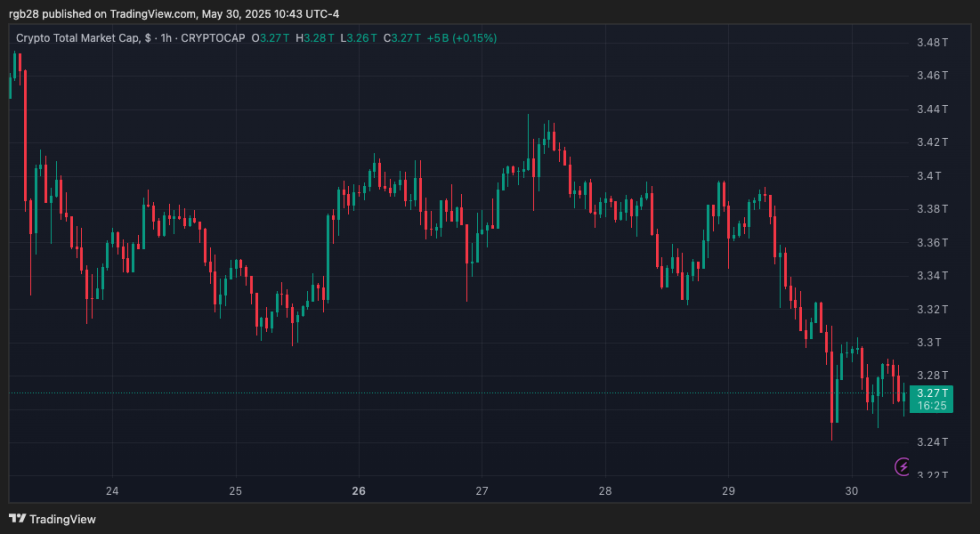
Total crypto market capitalization is at $3.27 trillion in the one-week chart. Source: TOTAL on TradingView

Related Posts