A cryptocurrency project touted as helping to democratize the Ethereum blockchain is coming under criticism for potentially taking too much control of the network as it undergoes a closely-watched software upgrade.
The DeFi, or decentralized finance, platform Lido Finance has become the largest provider of staking services for Ethereum, a practice that allows owners of the Ether cryptocurrency to earn passive income without having to sell their tokens. The staked coins are used to help validate transactions and secure the network in exchange for rewards, based in part on the amount of new tokens minted and fees collected.
With more than 4 million Ether deposited through Lido, or 32% of the total amount of the token being staked, the concentration is raising red flags. One entity holding a huge amount of Ether could raise security risks for the network, critics say. Ethereum is moving to what’s billed as a less-energy intensive process known as proof-of-stake from its current proof-of-work mechanism. Under the system upgrade known as the Merge, so-called solo-staking requires setting up dedicated hardware and holding a minimum amount of 32 Ether, valued at about $54,000, based on current prices. Staking services like Lido don’t have those requirements and make staking easier for small investors.
Lido’s dominance in staking could lead to a centralized attack of the network, when it switches to proof-of-stake consensus because the majority of staking power would be too concentrated, Danny Ryan, a researcher at the Ethereum Foundation that supports the network, warned in an recent article.
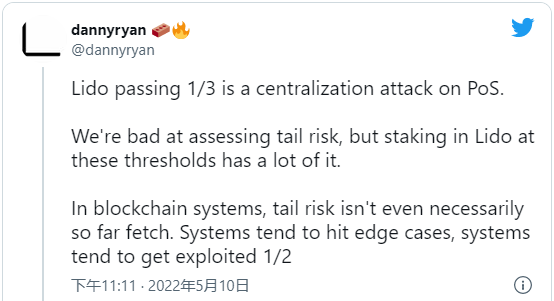
Ryan suggested Lido and similar projects should set limits on their level of Ether staking, and warned investors that they should reduce their exposure to the protocol because of the “inherent” risks from too much concentration. If one entity gains majority control of the distributed ledger, it could interrupt the recording of new blocks.
Lido developer Vasiliy Shapovalov said he disagrees with the self-limit solution. One of the reasons Lido was built was to decentralize Ether staking and prevent centralized exchanges from dominating the market, he said in an interview.
Lido also provides more transparency on validators who are responsible for the staking: there are 21 validators responsible for Ether staking, according to Lido’s website.
If Lido limits itself on Ether staking, it will not necessarily lead to growth for other staking projects, according to Will Harborne, founder of the decentralized exchange DeversiFi. The second largest project similar to Lido is Rocket Pool, which has about 182,192 Ether staked, according to Dune Analytics.
“I think it’s too soon to impose self-limitation, if ever,” said Alex Svanevik, chief executive officer at the blockchain analytics platform Nansen and a member of the DAO, or decentralized autonomous organization, that runs Lido. “You could easily imagine a more centralized or more malicious entity with no self-limitation racing past Lido.”
Kraken, the second-largest entity for Ether staking, declined to disclose information regarding validators. The exchange pointed out that it has a market share of less than 10%.