[dragon and tiger list] BTC investors account for 76% of profits. How can investors who lose 80% of their profits in one year get back

Huobi ResearchDipublikasikan tanggal 2022-05-06Terakhir diperbarui pada 2022-05-07

Abstrak

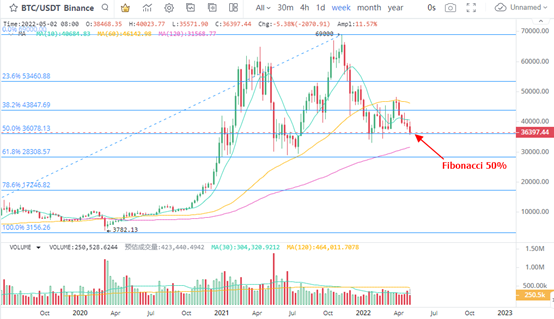
On the weekly K-line level, the decline of BTC has reached the key point of $36078 corresponding to 50% of Fibonacci.

1. Market trend: low rebound, creating trading opportunities

On the weekly K-line level, the decline of BTC has reached the key point of $36078 corresponding to 50% of Fibonacci. On May 5, BTC hit a minimum of US $35500 and once fell below 50% of Fibonacci in the short term, with clear signs of adjustment. Meanwhile, in terms of decline within one year, since the decline of US $57446 on May 5, 2021, the cumulative decline of BTC has expanded to 38%.

In terms of support worthy of attention, 61.8% of Fibonacci's support is more effective. It was recognized as a typical support line in mid-2021, and the corresponding price is US $28308. At present, the support corresponding to 50% is weak, and the risk of BTC falling near us $36078 increases.

Defensive investors can refer to US $28308 suggested by 61.8% Fibonacci as an important low suction point, and pay attention to the buying opportunities from this split line to US $36078 upward and US $17246 downward.
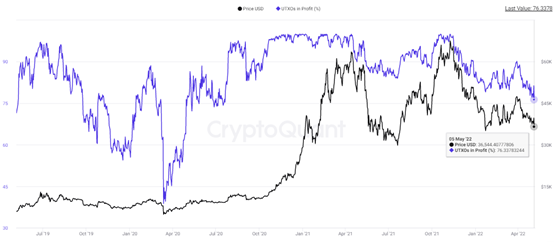
In terms of indicators, measuring the overall profit proportion of BTC investors is very important to confirm trading opportunities. The decrease in the ratio of BTC's profitable utxo to the total utxo will reduce the selling pressure brought by profitable investors and increase the probability of BTC's bottom building success accordingly.

The latest data show that the utxo of BTC was 76.34% on May 22, indicating that most investors in transfer transactions still made profits. Historically, investors can effectively verify the bottom signal after their profitability has fallen to the range of 40% to 60%. Before that, investors who buy BTC at a low price can build positions in batches, so as to effectively avoid risks.

Considering that BTC has been adjusted for more than one year since 2021, the chip concentration of more than $30000 has increased. Therefore, in the phase of BTC's continued retreat, the reduction of investor profitability may appear in the near future.
2. Rise and fall performance of top 100 currencies in market value within one year

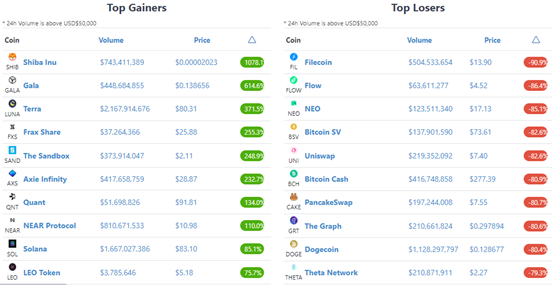
Over the past year, among the top 100 currencies with market value, Shib has the highest increase, reaching 1078%. Secondly, gamefi concept currency Gala, algorithm stability currency Luna, FXS and meta universe concept sand all increased by more than 200%.

On the decline list, fil, flow and Neo fell by 90.9%, 86.4% and 85% respectively. In the bear market, when the decline reaches 80%, the maximum cash holding loss can also reach 80%. In this way, the increase required for breakeven can reach up to 500%. Therefore, in the face of the bear market, it is important to reduce positions and buy at a low price, so as to reduce losses and seize the opportunity to buy at a low price.
3. Rise and fall performance of top 300 currencies in market value within one year

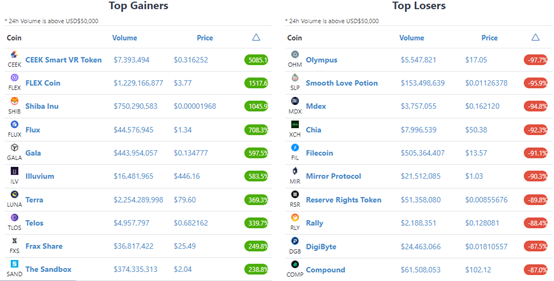
Among the top 300 currencies by market value, the volatility intensity in the past year is higher. On the list of increase, the largest increase of the top 300 market value currencies was ceek, with 5085%, and the second highest flex increased by 1517%.

In terms of the decline list, among the top 10 currencies with the largest decline, comp has the smallest decline of 87%, and there are as many as 6 currencies with a decline of more than 90%. Only from the decline list, among the investors who have held money for a year, they have lost the most money on fil, XCH and comp. In terms of circulation market value, the circulation market value of fil, XCH and comp can reach US $2.732 billion, US $177 million and US $697 million. The larger the market value, the corresponding loss of circulation market value can reach US $24 billion, US $1.59 billion and US $6.2 billion respectively.

Bacaan Terkait

Jepang Naikkan Suku Bunga, Mengapa Seluruh Dunia Merasa Cemas?

Bank sentral Jepang menaikkan suku bunga kebijakan menjadi 1% pada Juni 2026, tingkat pertama kali dalam 1% sejak 1995. Meski angka ini masih rendah dibandingkan AS dan Eropa, kenaikan ini sangat diperhatikan pasar global karena menandai perubahan mendasar dari kebijakan suku bunga ultra-rendah yang berlangsung selama tiga dekade. Inti kekhawatiran global terletak pada peran Jepang sebagai "pusat pendanaan berbiaya terendah global." Selama lebih dari 20 tahun, investor internasional meminjam yen dengan biaya hampir nol untuk berinvestasi di aset berimbal hasil tinggi di seluruh dunia (saham AS, obligasi emerging market, dll.), menciptakan "carry trade" yen. Praktik ini menjadi sumber likuiditas murah penting yang mendorong kenaikan harga aset global. Kini, kenaikan suku bunga Jepang mengancam logika fundamental ini. Biaya pinjaman yen yang meningkat memaksa investor global mengevaluasi ulang dan berpotensi mengurangi posisi leverage mereka, yang dapat memicu kontraksi likuiditas dan volatilitas di pasar keuangan global. Pasar tidak terlalu khawatir dengan level bunga 1%, tetapi lebih pada perubahan tren dan runtuhnya konsensus bahwa "Jepang akan selamanya menyediakan uang murah." Faktor pendorong kenaikan suku bunga antara lain: inflasi yang bertahan di atas target 2%, kenaikan upah berkelanjutan ("siklus positif upah-inflasi"), dan tekanan pada yen yang melemah. Namun, arah akhir aliran modal global tetap akan sangat dipengaruhi oleh kebijakan The Fed AS. Jika AS mulai menurunkan suku bunga sementara Jepang menaikkan, penyempitan selisih suku bunga AS-Jepang dapat berdampak lebih besar pada pasar.

marsbit43m yang lalu

Jepang Naikkan Suku Bunga, Mengapa Seluruh Dunia Merasa Cemas?

marsbit43m yang lalu

Sebuah Negara yang Menambang Bitcoin Selama 8 Tahun, Mendirikan Bank Kripto Khusus Miliknya Sendiri

Sejak 2018, kerajaan kecil Bhutan di Pegunungan Himalaya telah menambang Bitcoin, memanfaatkan sumber daya hidro yang melimpah. Kini, negara ini melangkah lebih jauh dengan mendirikan DK Bank, bank berlisensi khusus untuk aset kripto, yang berlokasi di zona administratif khusus Gedu Mindfulness City (GMC). DK Bank, di bawah pengawasan bersama Otoritas Moneter Kerajaan Bhutan, bertujuan mengisi celah layanan perbankan bagi bisnis kripto yang sering ditolak bank tradisional karena kesulitan manajemen risiko. Bank ini menawarkan akun terpadu yang mendukung 9 mata uang fiat dan stablecoin seperti USDT/USDC dalam satu tempat, layanan kustodi aset kripto, serta jalur on/off-ramp. GMC, yang mengadopsi sistem "satu negara, dua sistem", membangun kerangka regulasi dengan merujuk hukum umum Singapura dan aturan pasar keuangan Abu Dhabi Global Market (ADGM). Perusahaan berlisensi dari yurisdiksi tersebut dapat mempercepat proses izin operasi di sini. Para pemimpin proyek menekankan fokus pada infrastruktur keuangan institusional seperti penambangan, kustodian, dan tokenisasi aset riil, bukan produk spekulatif untuk ritel. Mereka juga menyoroti diversifikasi portofolio di berbagai sektor blockchain untuk memitigasi risiko volatilitas Bitcoin. Dengan bandara internasional yang direncanakan selesai pada 2029 dan visa digital nomad yang sedang diuji, Bhutan bercita-cita menjadikan GMC sebagai pusat layanan keuangan untuk Asia Selatan, menawarkan stabilitas dan pendekatan yang tertib dalam lanskap keuangan global yang semakin kompleks.

Foresight News2j yang lalu

Sebuah Negara yang Menambang Bitcoin Selama 8 Tahun, Mendirikan Bank Kripto Khusus Miliknya Sendiri

Foresight News2j yang lalu

Trading

Spot
Futures
活动图片